The Mountain Flip Flop

Despite otherwise having little in common save for lots of mountains, Switzerland and Afghanistan have a shared reputation in popular culture as being impregnable, untameable countries. Which led me to go: What if circumstances flip-flopped their history and outcomes?

In Central Asia, a Dari-speaking nation arises in the mountains of what we’d call northern and central Afghanistan. Close to many major trade routes, it takes advantage of its geographic security and reputation for studious neutrality to develop a thriving financial sector. This and the wealth generated by it enable this to develop a reputation for exporting luxury, advanced artisanal goods as well. Meanwhile in Europe, an artificial clump of different ethnicities in the Alps becomes a weak, tumultuous, war-torn “western Yugoslavia”.

Yes, it’s a very soft alternate history. But it’s the kind of thing that alternate history was made for, and it’d work great as a story’s setting.

The Super-Mansion

The conclusion of The Sure Bet King took place at a Los Angeles super-mansion. My current WIP is also focused around a super-mansion. The super-mansion is one of those setting places that I just love. They’re (impractically) big, they can have a lot of stuff, and they can have very different themes.

The closest thing to an official definition of a “mansion” is “a luxury home at least 5,000 square feet in size”. Super-mansions are even more nebulous, with their only real distinguishing feature being their bulk. My own definition is “it’s a super-mansion if any one room in it is bigger than an entire normal mansion”.

Airfield Construction

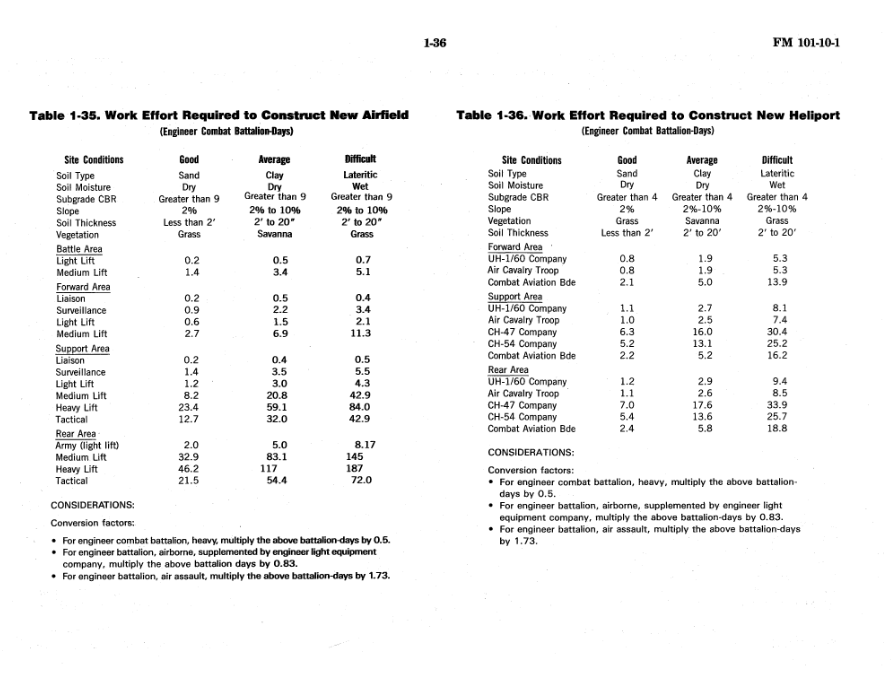
Notional airfield construction times from the 1987 Staff Officer’s Handbook

Although obviously outside the scope of this simple spherical cow chart, I do wonder when the point would come when more engineer battalions would pass the point of diminishing returns. Nine women can’t make a baby in a month, after all.

A Heavy OPFOR army/corps has an organic engineer brigade with heavy equipment that would presumably halve the time required. Fronts will also include at least one engineer brigade. The construction of airfields and other base areas is a stated mission of those high-level assets. (If only the Russians had spent 2021 building and refurbishing better depots right on the borders instead of just piling up the rusty AFVs…)

Weird Wargaming: The Jeep Compass Army

Using variants of civilian vehicles from Model Ts and Rolls Royces in World War I to the omnipresent Land Cruisers and Hiluxes of today is nothing new. But I saw a proposal from an Indian armoring firm (which also advertised the boxiest armored vehicles ever) for uparmored Jeep Compasses, and my brain sparked. After all, compact crossovers like it are so common now, so why not send them to war? This isn’t like the classic jeep, even in its latest form.

Well, there’s obvious reasons against it. It can barely fit five normal-sized people without wargear. Five big soldier men with all their equipment would probably be a nonstarter. You could use it as a pure weapons carrier-but the disadvantages of that would be obvious as well. There are plenty of off the shelf SUVs far more suitable… but I don’t care.

The Compasses would be used by recon/raiding teams, being too small (regardless of how many people you can stuff inside) to be a line carrier. The least bad option, of gun vehicles, involves a crew of three with extra munitions in the (gulp) trunk/back. Even then, the Compass has a max payload of only around 1,100 pounds/500 kilograms. Which would probably have been eaten up by the armoring, but I’ll let it slide for now.

So, here it goes:

  • Command vehicle: Unit commander, driver, comms equipment, aide, maybe lighter machine gun RWS.
  • Personnel Carrier: Driver, 2-4 additional troops, lighter machine gun RWS.
  • Weapons Carrier: Driver, Gunner, Commander, either light missile or heavy machine gun.

The number of vehicles of each type depends on the exact mission. And the Jeep Compass could be replaced by any light SUV. And I do not recommend actually trying these small light SUVs unless you have no other choice.

Even Cheapies Are Expensive

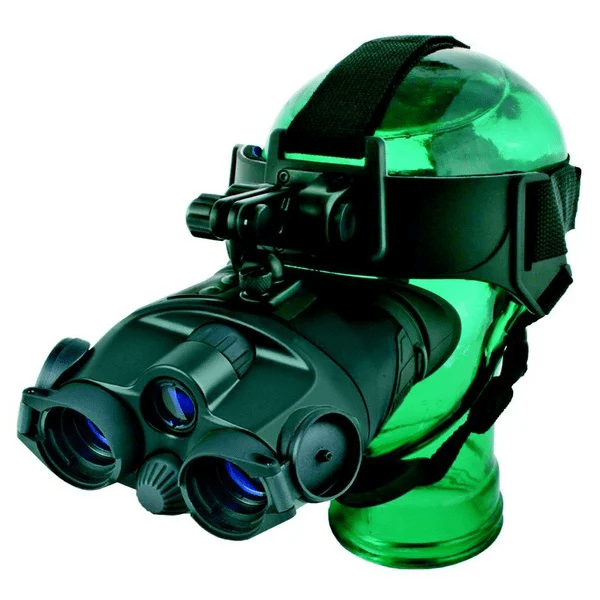
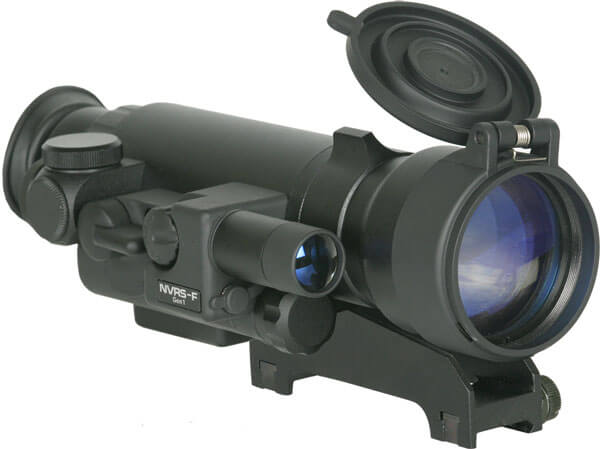
So take these cheapie eastern night vision division devices: Good for a range of 150-200 meters depending on context, around $700 a pop. Both goggles/binoculars and rifle scopes for different contexts.

Yukon Tracker
Yukon NVRS Scope

To equip the line personnel (defined here as those in the actual fighting regiments/brigades) of one small division in the absolute most oversimplified fashion would be around $7-10 million, depending on the exact size. Getting around 5,000 sets, but then there comes the hard part: Maintaining 5,000 sets, keeping track of 5,000 sets, making sure that those 5,000 sets aren’t lost (via honest or dishonest means…), and so on.

Now apply this to almost any even slightly expensive piece of military equipment and you can see why, for instance, Egypt still issues its draftees equipment left over from the Yom Kippur War. That’s an extreme example, but you can see how even the individually “cheap” stuff can be expensive, particularly for less funded armies. And you can see both the political and military advantage of reserving such a thing for “elite” units if one has no choice but to only acquire a limited number of said items.

And you need a lot of stuff, to the point where it’s almost an “I, Pencil” situation. Boots, uniforms, load bearing equipment, helmets, packs, shelters, it all adds up. The bottlenecks can appear where you wouldn’t think they would. For instance, many people know of WWII Germany’s fuel shortages, and historians know of their special alloy shortages, but what a lot of either don’t know is of their cotton shortage resulting in less effective leather load bearing equipment.

The Airlifters

Airlifters are very interesting to me, especially mega-lifters. But “exotics” are also fun, like tilt-ducted fans, compound helicopters, convertiplanes, flying wings, and much more. I think there’s several reasons why I’ve taken a liking to them, besides some very good sources that I’m eager to review.

  1. They represent an army marching on its stomach, or in this case, flying on its stomach. They’re the behind-the-scenes things that no one can do without.
  2. They’re military but not inherently destructive (unless converted to bombers, of course). Thus they can serve humanitarian and civilian support efforts very well.
  3. Finally, the numbers analyst in me likes seeing, especially for inherently risky airborne drops/landings, what you can accomplish with X number of airlifters with a capacity of Y per unit. Operations researchers with far more resources and far better command of math than me have been studying this since the parachute was invented.
  4. Plus I live fairly close to an airlifter base and see the big grey Globemasters and Galaxies flying overhead fairly frequently.
  5. Paradropping can be used as a way to add drama to the characters in a story, regardless of the overall force balance.
  6. It’s hard not to be impressed by something weird and/or big.

What I’m most interested in at the moment is: “To what extend does having big lifters that can reach the LZ safely remove bottlenecks?”

The Atomic Trojan Horses

Basically every piece of nuclear technology is advertised as being “proliferation resistant”, for obvious reasons. And in many cases that’s legitimately true (albeit that as an armchair non-physicist, I wouldn’t be the best at explaining exactly why ). But I’ve had a few hunches and read my share of case studies. And there are undoubtedly a few wooden horses with hoplites lurking inside (at least according to the Roman version of the story).

One is chemical enrichment, which has never been commercialized but has been demonstrated and proposed for decades. There’s actually a real case study of its role in a nuclear weapons program. For Iraq’s pre-1991 nuclear infrastructure, it sought a chemical enrichment plant. To directly make weapons-grade uranium via the chemical method would be hideously impractical according to its proponents (argued as taking over a decade ), but to make LEU that would in turn be easier to further enrich (or use in reactors indirectly) is another story.

Another is small modular reactors. The suspicion I have is that unlike the eggs-in-one-basket normal sized ones, it’d be easier to have some units be used for normal power and others “throttled” (for lack of a better word) in ways that are far less efficient for electricity-but more so for weaponizable plutonium.

Of course, I know very little about the technical side of things so I could be totally off-base, especially for the modular reactors. But it’s still something I’ve thought about.

Review: Building The Tatmadaw

Building The Tatmadaw

Likely because it’s lacked the direct confrontation with a major western power that North Korea or Middle Eastern states have had, Myanmar is one of the more forgotten and undercovered of the militarized pariah states. That military dictatorships are not exactly known for their openness and transparency doesn’t help things. Thankfully, Maung Auyng Myoe has risen to the challenge with Building The Tatmadaw.

The often murky and convoluted history of the military, as well as the brutal but often underreported internal wars, is shown in depth. As is the Tatmadaw’s force structure and conventional paper doctrine. For the former, it follows (at least as of the writing of the book) a common in Southeast Asia pattern of having “regional forces” tied to a certain area and mobile reaction forces (known here as “light infantry divisions”) that can travel where needed. Regarding the latter, Myoe’s description comes across as basically a Light OPFOR right out of Central Casting. The picture is that of an infantry-heavy force where advanced and heavy equipment is present but not dominant, and where the strategy against an external opponent consists of fortifications and irregular tactics to counter the material disadvantage.

Published in 2009, this is bound to be outdated, especially given the massive tumult that has happened since then (the “thaw”, the anti-Rohingya campaign, and the military re-takeover). But as always, that’s not the author’s fault. I did notice a few slip-ups and a bit of clunkiness when talking about specific military issues, but none of those are very big or bad. If you want to learn about the Tatmadaw, this book is an excellent resource.

Weird Wargaming: The Soviet-Romanian War

If you want to use small-unit wargames in my never-was draft percolating of a futuristic USSR deciding to finish off a surviving Ceausescu, some basic guidelines. Obviously, it’ll depend on the exact ruleset, but here’s the basics:

Union of Soviet Sovereign Republics

The USSR, under a Sovereign Union that in real life got scuttled by the August Coup, follows the 1990s GENFORCE “Mobile Forces” concept. Which is to say a multi-tier force. The “Basic Forces” divisions resemble slightly better late Cold War ones. The Mobile Forces ones have more futuristic equipment, better body armor/night vision, and substantially better training.

Mobile Forces battalions are organically combined arms mixed. APCs/IFVs are three to a platoon with each squad having a magazine LMG and rocket launcher. Company weapons platoons have lighter ATGMs and belt/tripod GPMGs. All Mobile Forces mechanized battalions have a large number of organic 2S31s (or Nonas for less-equipped formations).

Given the terrain, mountain formations have been plucked and sent in. GENFORCE mountain brigades are a four-infantry-one-tank battalion setup with supporting equipment suited for high altitudes (ie, lighter and higher-angle artillery). They also have a separate APC battalion that can be used to motorize if the terrain is appropriate. The one historical Soviet mountain brigade was inherited by Kyrgyzstan and consisted of two BMP and two soft-skin battalions with some attached cavalry and pack animal units.

Soviet Allies

The main contributors to the Soviet effort are Bulgaria and the stabilized Afghanistan. The former mobilizes to its full ability, which means it runs the gauntlet from “1980s NSWP” to “T-34s and World War I heavy artillery” (hey, if it can shoot and make a big explosion, it’s still worth something). The latter contribute a fairly standard BTR-equipped motor rifle division and numerous commando units.

Romania

Romania has a regular army with a degree of military modernization that it lacked. While select units have SRBMs based on foreign civilian sounding rockets, bespoke grenade launchers, and more (comparably) advanced tanks like the bizarrely shaped TAA, others are bottom of the barrel. All units should be mostly low quality, but some (particularly Securitat irregulars) will have better morale than others if applicable.

Organizationally, most should resemble lower-tier eastern forces.