Star Wars and Warhammer 40,000 combine science fiction with mystical fantasy, albeit the latter to a much larger degree. So it came as little surprise that one self proclaimed “fan with too much time” made an elaborate crossover audio drama of Era Indomitus 40k and prequel-era Star Wars. A large fleet from the Imperium of Man gets blown into the Star Wars galaxy at the height of the Clone Wars. Stuff then ensues.
An open-ended fanfic is always hard to review exactly, so I’m sticking with the first season in this review. And it’s excellent. First, the audio drama has some great written and voiced scenes, like describing what it’s like to be on the receiving end of an Astartes/Space Marine attack (hint: not very pleasant). Second, it manages to balance the factions well. The clash of Astartes vs. Jedi is balanced in an apples vs. oranges way, as they’re not symmetric superhumans the way that say, Astartes and SPARTANs from Halo would be. Finally the culture clash (as in, what happens when a sane universe meets a crazed one) is handled great as well.
This reminded me of Worldwar, with the Imperium as the lizard-race. It’s been a very fun way to pass the time.
Officially, this was the second movie in the Ator series of Conan the Barbarian knock offs. But it’s as “Cave Dwellers” that it leapt into my heart as the greatest Mystery Science Theater 3000 episode I have watched. The small and sus company known as Film Ventures International took a questionable strategy of getting the rights to show clips from movies, changing the titles and credits, then calling the rest of the movie a “clip” for legal reasons. It only worked because they were small.
Anyway, the film started with an extremely blurry clip from a 1960s Italian Tarzan knockoff in its bootleg credits, and then only got crazier from there, following up with an action-packed climax featuring a hang glider and concluding with nuclear bomb footage(!). Joel and the robots excelled, especially because this is the kind of mock where the movie itself has enough great material to build on (for instance, it’s hard to do that much with a stilted, no-budget 50s movie).
Yeah. This is my favorite Mystery Science Theater episode of all time. It’s amazing, and the movie it’s mocking is amazingly bad.
It’s no secret that all kinds of fictional works change from their beginning to their final product. And a minor character in a classic video game embodies this very well. In the Kanto Pokemon games, Erika is the grass-type specialist leader of the Celadon City gym. Wearing traditional Japanese clothing, her characterization is that of a graceful flower lady (who has a tendency to fall asleep).
But apparently she wasn’t always that way. And some of the changes made to her were after her Gen I artwork had already been drawn.
Development and concepts assets that have emerged have shown a picture of the original Erika. She would have been placed in what would have been Lavender Town (which in the final version didn’t have a gym at all). And, unsurprisingly, she would have specialized in ghost types. The sole ghost specialist who actually emerged in Gen I was Agatha, portrayed as a normal person who just happened to use ghost types.
At least judging from her art design, Erika would, uh, not have been. Her eyes were closed and the Poke Ball in her sprite was in midair, which could be justified as her juggling it but which was likely meant to have her hovering it with supernatural powers. Finally, her clothes were folded in a way that was only used for the dead in her initial sprite. (A pretty big implication of this is that her design was changed in Yellow and all later appearances to be folded the correct way).
In other words, she was heavily implied just from the visual assets alone to be some kind of undead. Since no final text dialogue was made, there’s no 100% confirmation, but it’s pretty clear. Would this design carrying over really change much?
Probably not. Unlike a few other Gen I leaders, Erika did not become a superstar in her own right. At the time, not much would really change. Except for her prominence. See, spooky Lavender Town became a centerpiece of internet creepypasta campfire stories immediately. And having someone who was an outright zombie? Oh yeah, she’s definitely getting featured in them. So even if official media stays out, Erika the Zombie would become a star of the internet.
Since a multiverse canonically exists in Pokemon, Zombie Erika probably lives in some variant universe. Much as how creepy supernatural anime Sabrina exists alongside normal actress game Sabrina. Who knows, maybe this Erika starts conventional Fuldapocalypses as a hobby. Has the zombie sorceress been found?!?
Starting The Last Roman: Exile, I was struck by the extreme similarity of the gimmick to the Casca series. Namely, a Roman gets splattered during the Crucifixion, becomes healed and unaging as a result. I’ll let it slide because they’re both based on the Longinus legend that long precedes them both. Yet that’s not the biggest difference between them. Marcus, the protagonist here, and Sadler’s titular hero could not be more apart.
Basically, the Casca series after the second book used the circumstances of its main character as just an excuse for the pop-historical setting of the week. That he was connected to Christianity meant nothing, his background meant nothing, and each story was just a 51% effort (at most) historical thriller. This book is still a cheap thriller through and through, but everything in it is done so much better.
There’s a lot of flashbacks and jumping between eras, but it’s done very smoothly and effectively. The contemporary cheap thriller setting features a MacGuffin and plan that would do Jon Land proud. There’s an energy to it that Casca completely lacks, and I’m always glad to see a premise with potential done right.
Rick Wilder and Alan Smale’s The Wandering Warriors is a very goofy novel. In it, a 1940s baseball team finds itself isekaied to Ancient Rome. Hijinks ensue. Lots of hijinks. Ok, lots and lots of hijinks.
This silly book has a silly premise and a silly conclusion. But it’s a lot of fun. Don’t read it expecting any kind of historical accuracy, serious study or culture clash. Read it for the ridiculous fun of a baseball team teaching Romans to play baseball in the Colosseum.
If you like out-there time travel fantasy, this is the book for you.
When I saw the title of the 1966 film Billy The Kid vs. Dracula, I knew I had to watch it. With a name like that, you know you’re in for something special. And this indeed was something very special. A vampire Western that hits every single cliche of both genres, the story is that Billy The Kid has reformed (!) and aims for a new peaceful life, but his fiancee is threated by Dracula.
Actually, there’s one point in which the movie is surprisingly progressive for its time: The inevitable Native American attack on the stagecoach is explicit as only happening because Dracula killed one of the previously stated as friendly ones and blamed it on the other passengers. Apart from that, it differs in how stupid and clueless everyone, including female lead Melinda Plowman, is. I was rooting for the vampire, especially because John Carradine (David’s father) delivers one of the few good performances as the monster.
This is very much a B-movie with B-movie problems, but its pure weirdness means it’s worth a watch.
The 1981 David Cronenberg film Scanners, about people with psychic powers, is a perfect movie to review in October. It’s also an underappreciated movie. See, it has Cronenberg’s trademark twisted body horror done in a way that’s suspenseful and not overexaggerated. It also manages to be excellently paced and creepy.
However, most people only know Scanners for the scene where a man’s head explodes. While that is well-done, there’s so much more to the movie than that. It’s well worth a watch.
Horror legend Richard Laymon’s Funland is a tale of terror at an amusement park. Or at least it supposedly is. What it actually is is a story of a war between crazed hobos known as “trolls” and a gang of teenage delinquents fighting them. Oh, and love triangles.
The only real “horror action” occurs very late in the book. Other than that, it’s just a conflict between groups of totally unsympathetic people. That the small spurts of action are indeed good is what makes this a slightly better horror novel than the last one I reviewed. But only slightly.
Would it really hurt to have people who you can actually support? Even conventional horror story victims would be better than the waves of creeps and vigilantes that we got.
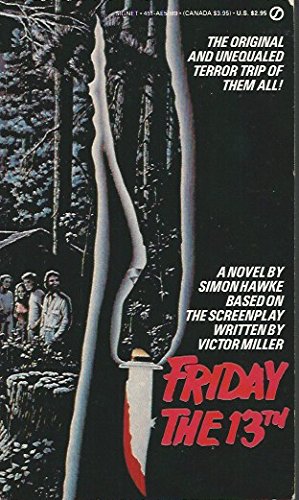
Film tie-in novelizations do not have a good reputation. The tie-in for the first Friday The 13th movie is no exception. Granted, it has a shallow film as a base (the movie is a stilted, aged terribly movie that doesn’t even have most of the sleaze/exploitation elements of its sequels). But author Simon Hawke didn’t even try very hard.
There is one exception. That would be the doomed lovebirds Jack and Marcie, whose shallow sleazy character in the actual movie gets stretched out to a long piece of angsty exposition. But that amusing bit of padding can’t make up for the rest of the book. Especially because, having been released several years (!) after the movie, you can’t even use the justification of being rushed!
It’s one of those things that’s basically just sort of… there.

 Fuldapocalypse Fiction