Review: The Mission

The Mission

The 57th Kirov book, The Mission is a delightful change of pace. For a start, the absolute basics are changed. It’s less of a long, big, every-tank-and-every-missile wargame lets play like the past two seasons. This alone makes it preferable to the formula that was wearing out its welcome after sixteen previous installments.

The setting is also different. And by different, I mean “a lot more awesome”. There’s not only a change of scenery back to the Russian Civil War and airship fights, but the ridiculous goofy time manipulation and mystical elements come back with a vengeance. It reminds me of the later Payday 2 metaplot, and I say this as a total compliment.

This book was a lot of fun, the most I’ve had with Kirov in a while.

Review: I Refuse To Be Your Enemy Volume 1

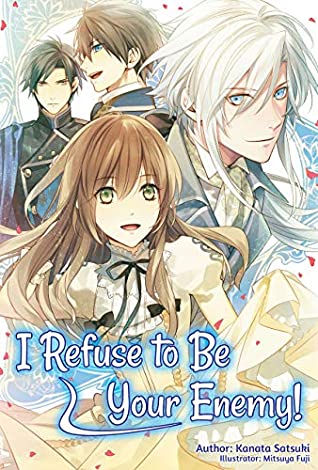
I Refuse To Be Your Enemy! Volume 1

It’s time to review another light novel with an overlong title, this one being Kanata Satsuki’s I Refuse To Be Your Enemy! Now, a bit of explanation is in order. Much as how Mack Bolan spawned a glut of mobster-slaying vigilantes, thus the success of Hamefura led to a ton of “reincarnated as a previously doomed video game character” tales that continue to this day. And this is no exception, with game villainess Kiara Credias realizing her predicament and trying to change things.

The problem with this compared to My Next Life As A Villainess is that the latter didn’t go the easy route of just munchkining through with foreknowledge. Instead, Katarina tried to munchkin her way through with foreknowledge and it didn’t work (except it did in that she survived happily). In this case, the “win through foreknowledge” is played much straighter. This is both less amusing in its own right and clashes with the still-present goofy antics.

While this isn’t technically bad , it’s still little more than a 51% book.

Review: My Next Life As A Villainess Volume 3

My Next Life As A Villainess Volume 3

The third volume of My Next Life As A Villainess takes place after the original planned ending of the story. In-universe, it takes place after Katarina has “beaten the game”. There’s two reasons why this declines in quality. The first is that the second volume was such a good stopping point that it feels a little wrong (even if understandable) to go past it. The second is that the setup just really isn’t that deep, so it’s especially vulnerable to getting worse as it gets bigger.

The structural fundamentals present in the past two books are still there, for better and worse. But it’s definitely lost something. Going from “someone tries to munchkin a setting through foreknowledge and successfully ‘fails’ because she thinks it’s still railroaded when it’s not” to just “light fantasy antics” is a big step down. There’s a reason why, despite enjoying the first two installments, the third is the last I’ve read, with little motivation to keep going further.

Review: Forgotten Ruin

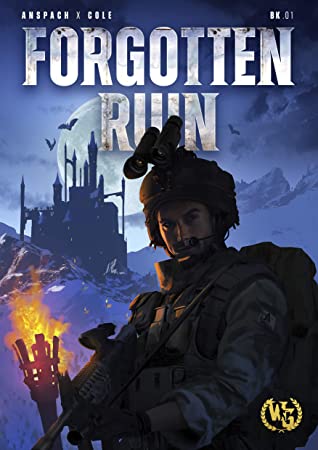
Forgotten Ruin

A lot of books are what I call “median 51%”, middle of the road stuff that’s perfectly fine to read but which can be hard to actually review well. Then there’s Jason Anspach and Nick Cole’s Forgotten Ruin. I can hardly think of a better example of a “Mean 51%” book. The means a work of fiction that does some things very well and others-not so much. This kind of book can both be disappointing and engaging, and perfect to critique.

Since its magic-vs-technology, fantasy-vs-firepower conflict is music to my ears, I knew I had to check it out. So how was it?

From the start, it’s written in first-person, which I consider suboptimal for thrillers. But this isn’t a deal-breaker. A lot of the characters are one-note stereotypes and the main narrator comes across as a macho ass. But that’s not a deal-breaker either.

The bigger dichotomy comes from the worldbuilding and action. To be frank, the worldbuilding doesn’t live up its potential. It puts its modern military heroes in a fantasy world, but then does nothing but stuff it full of generic fantasy creatures. And the contrivances needed to set it up range from “oh, this political reference is really hamfisted and likely will age quickly” to “OH COME ON!”. (What a coincidence the main character is a linguist who just happens to be able to speak all the right languages, which are variations of existing human ones!)

Then there’s the fighting, which is of course the centerpiece of this kind of book. I’m also of two minds on this. On one hand, at times it reminded me of artificial Payday 2 assault waves where masses of enemies just keep charging forward into superior firepower, which is not a good thing. But on the other, there were instances of cleverness and, more importantly, the setup was evenhanded. As I’ve seen way too much fiction where the “primitives” are just tomato cans for the “awesome modern armies”, this was a welcome change.

While I had mixed feelings about this, its premise is good enough and well executed enough to make me want to continue. And it’s the kind of book I really enjoyed thinking about and writing about. And that alone makes it worthwhile to me.

Review: The Hungry Dead of Yu-Ching And Other Stories

The Hungry Dead of Yu-Ching And Other Stories

From Sea Lion Press author Paul Leone comes The Hungry Dead of Yu-Ching And Other Stories, a series of horror-fantasy-thriller tales spanning history. From the ancient past to the Cold War and beyond, he brings to life one supernatural confrontation after another. Each story is short but sharp and never wears out its welcome.

I might be biased given the preferred subject matter of Fuldapocalypse, but I liked the “Red Dawn [no relation to the movie], Operation ___” stories the best. It’s very hard to go wrong with Soviet commandos facing extranormal enemies, and I grinned at every word of those tales. Not that the others were bad by any means, but these were my favorite.

In short, this is a very fun collection. I enjoyed it a lot and highly recommend it.

Review: Whirlwind

Whirlwind

The 56th book in the Kirov series and the conclusion of its third World War III arc is Whirlwind. By this point, the same issues present in any other installment are there. The prose is what it is, and the “time travel soap opera mixed with wargame AARs” is familiar as well. A large chunk of this book doesn’t even pretend to be a conventional narrative and just recaps the war in detail.

While this (supposedly) second-to-last arc in the series doesn’t just nuke everything and overwrite the timeline like its predecessor, it leaves an uncomfortable feeling. The talk about how weapons and doctrine in-universe evolved gave me the impression that Schettler would pull the football yet again and have yet another four-books-too-long wargame sim. Especially because the main ship plot does have a lot of genuine promise.

The concept of the titular ship’s crew going back in time to stop delightful supervillain Ivan Volkov from destroying the timeline is a great one, and I know very well that you could merge such a plot with wargame scenarios. But even my patience is wearing down with the formula. The circle could be squared if the ship and its crew got a good final conclusion while allowing the toy box lets plays to continue, but I’m not really confident in that happening.

Review: My Next Life as a Villainess Vol 2

My Next Life as a Villainess: Volume 2

The second volume of My Next Life as a Villainess deals with Katarina now going to the actual academy setting of the game and demonstrating her biggest character trait of absolute obliviousness towards romantic attraction (the fandom joke is that black holes are less dense than her). One of the biggest and best buildups in the first volume was foreshadowing the game’s protagonist, Maria Campbell. The second doesn’t disappoint when she actually appears. Katarina is clueless to the fact that her being actually nice has already butterflied almost all of the original game’s plot away, and equally clueless to how Maria is now attracted to her.

The plot is worse when it tries to go for more genuine danger and drama, simply because it conflicts with the tone of the rest of the story. But even that’s not too bad. While I can understand why that would be included, it’d probably have been more preferable to just focus entirely on its heroine worrying about nonexistent “death flags”.

It also has a good conclusion as Katarina survives the “game” and hears Maria’s confession, which she of course doesn’t get. When I read that this was the original planned ending, it didn’t surprise me at all. Of course, it was successful enough to continue, but just as how The Sum of All Fears serves as a good stopping point for Jack Ryan, so does this for the series (boy, never thought I’d be directly comparing those two).

The structural issues I mentioned in the past volume are still there. But after seeing so much of setting munchkinism, and coming from an online community where this kind of thing is a stereotype, I love the concept of someone who tries to munchkin the setting and it doesn’t work out (well, in this case it does, but not in the way Katarina thought or intended). While I probably won’t read too far beyond the original end, I still enjoyed this series as a break from tanks exploding.

Review: My Next Life As A Villainess Vol 1

My Next Life As a Villainess: Volume 1

I felt it was time to check out of one of those “anime antics” settings that Spacebattles has a bizarre fascination with. In this case, it was Saturo Yamaguchi’s light novel series, My Next Life As A Villainess: All Routes Lead To Doom (these are notorious for their extremely long titles). Frequently abbreviated as Hamefura, this is the story of someone who is reincarnated as a video game character.

More specifically, it’s the story of a schoolgirl who stayed up too late playing her dating sims, which led to her death in a bicycle/car accident as she tried to hurry to compensate the next day. This led to her being reborn as Katarina Claes, the antagonist/rival girl in one of them set in a fantasy academy setting. Upon recovering her memories of her past life, and knowing that Katarina is fated to have a bad end in the game, the heroine tries to get a better fate.

This initial installment isn’t bad. I can see the “it’s a good concept even if the execution is ‘iffy’ ” that made appealing to fanfic writers. The prose is pretty well, matter of fact. I don’t know how much of that is due to translation issues and how much is due to the novel being intended to be smooth and easy to read (you could say it was meant as light literature). But it’s not a deal breaker, and neither are the “anime antics” surrounding Katarina and the inevitable boys. I had fun with it and it’s a nice change of pace from the usual fare here.

A Thousand Words: High Seas Havoc

High Seas Havoc

Data East’s High Seas Havoc is one of the many 1990s mascot platformers. In fact, it was so generic at first glance that when I saw footage of it and wanted to look further, it took some effort to do so. Still, looking at it closely shows some interesting things and some that are very well-done.

The title character, a sailor seal (no, not that kind) has to save the damsel in distress and Macguffin Gem from an evil pirate lord. The opening part is a sort of semi-soft attempt to sort of, maybe a little, come close to Sonic. There’s slopes but not really any mechanics to take advantage of them. The base mechanics are a lot different too-most notably, you have a refillable health bar instead of anything like rings. Then the game gives up on that and goes back to being a completely traditional platformer. It also becomes a lot harder.

Though janky (the main character really needed to be able to use the sword he was shown as having in the box art instead of relying on an iffy flying kick) and having all the issues of a “B-list” game, this is never outright bad. Certainly it’s not a rushed absolute low-effort game like too many other trend-following platformers of this time. And this especially shows in the music. Emi Shimizu’s soundtrack is one of the most underappreciated ever, with my favorite track being “Cold Paradise“.

The level that song plays on, Frozen Palace, is also something to behold. It’s a variant on the typical “mechanical works” level, albeit with freezers and water instead of the usual molten metal. Combined with hovering meditating dogs (yes, really) as some of the enemies, it’s definitely the most unique stage in this game. The rest is more generic, but the graphics are still well done for the time.

There is some undeniable “inspiration” from Sonic and the game is in the same basic field, but it’s different enough thematically and gameplay-wise to not be considered a mere lazy ripoff. Probably the biggest issue besides “cartoon animals” is the gem Macguffin, and that’s small. And did I mention the soundtrack is amazing?

Weird Wargaming: Artificial Humans

Ok, this is one of the weirdest Weird Wargamings yet, and it depends entirely on what ruleset is being used. Basically, one of my loves is “artificial humans“. The boring thing to do would be to treat them as either normal humans or robots. But there was one attempt at going beyond that.

Now in Fire Emblem: The Blazing Blade, the morphs are treated just like normal units with one exception-all of them, even the strongest, have zero luck. Zero luck means that they have lower hit and dodge rates mixed with massive opponent critical rates. That can definitely be incorporated into various tabletop rules.

Of course, it can make some sense to give them higher stats in other categories to compensate for that. It all depends on what the theme of these artificial humans are. They can be everything from super to expendable, as the Fire Emblem morphs are.