The A Button Challenge

Mario was originally known as “Jumpman” in the first releases of Donkey Kong. Super Mario Bros. defined the platformer. What I’m trying to say is that Mario jumps. Until now.

For 20+ years, an array of gamers dug deep into the code of Super Mario 64 to see in how few A presses (jumping) they could beat the game. Last year, a successful run with zero presses was finally accomplished.

Numerous stars and even entire levels had to be skipped entirely as they required jumping. The centerpiece that enabled the final “A”-less run to be performed involved playing on Wii Virtual Console and using an emulator/porting glitch that had platforms in the Bowser in the Fire Sea stage moving sloooooowly upwards over time. The game had to be run for three real-time days to let them get into place.

Yet in the greatest human accomplishment since the moon landing, the A Button Challenge was finally completed.

Review: Speedrunning

Speedrunning: Interviews With The Quickest Gamers

David Snyder in Speedrunning tackles the titular way of playing video games. It looks good on paper, interviewing numerous champion speedrunners and explaining how the basics work. The problem is its format and layout. It’s like trying to play Dark Souls on a drum set, and he doesn’t quite manage it.

So this first consists of explanations of speedrunning, which are a little cookie-cutter but still essentially accurate for an absolute beginning. Then Snyder gets to interviewing speedrunners, which isn’t really the best way to go about it. I might be a little stereotypical, but speedrunners are a group not generally known for their wit or sociability. More importantly and specifically, the interview subjects go straight into huge technical details which contrast with the basics given elsewhere in the book. I don’t blame them, but I blame Snyder for not integrating it better.

A bigger problem is that it’s using text to describe a visual medium. There’s no shortage of speedrun history/explanation videos , and almost all of the record speedruns themselves can be easily seen. Reading a book about it simply can’t compare, even if Snyder was a lot better. So that’s why I can’t recommend this.

A Thousand Words: NARC

NARC

The 1988 Williams arcade game NARC is probably the most 1980s piece of interactive media developed. Playing as super-cops in biker helmets Max Force and Hit Man, you blast your way through a drug empire of hobos, dealers, weed-growing Rambos, prostitute-kidnapping clowns, henchmen who couldn’t decide if they wanted to dress like mobsters or construction workers, and attack dogs, ruled by a giant biomechanical head-worm. None of that is exaggerated or false.

There is nothing subtle or easy about this game. It’s meant to have you win solely by pushing in quarters. (Who’s the addiction inducing dealer now?) But it is fun and is well, incredibly 1980s.

Console Pokemon Returns

With the release and controversy of Pokemon Legends ZA, it’s time to once again return to the Console Pokemon fantasy that was popped for good in Sword/Shield.

What is “Console Pokemon”? It’s something us 90s/00s kids had in our minds as we moved pocket monsters around our pocket gameboys. Basically, without severe hardware limitations, a Pokemon that would burst out into a paradigm shifting masterpiece.

Was this naive gamer fantasy? Probably. But it was something that had indeed happened with Mario 64 and Ocarina of Time (or GTA III, or Halo, or Final Fantasy VII…) We kept getting hints-a Snap here, a Stadium or Colosseum there. And then the 3DS (probably the first real big “Console Game”) and finally the Switch gave us… unoptimized 3d games with similar mechanics that looked worse than ones twenty years prior.

Of course, now I know that rather than being made by a mega-publisher as its flagship title, it’s actually developed by small Game Freak, whose lack of programming chops was evident in some ways from the get-go. Now I know that the business model is basically that of a yearly sports game, being critic proof in that regard. Now I know that with the franchise so lucrative, the games themselves matter as much as Half Life currently does to Valve.

So yeah, Console Pokemon isn’t coming.

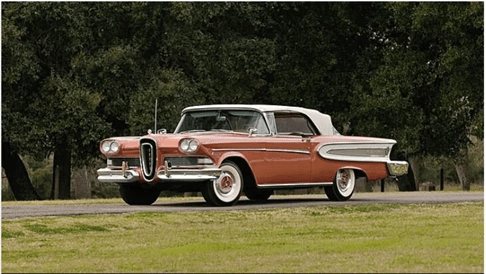
Gaming’s Ford Edsel

Looking at retrospectives for the infamously legendary recent video game bust Concord , I thought a lot of “wow, this really is the Ford Edsel of video games.” And I mean that specifically.

This video is as good as any for explaining in short terms what Concord was. That said:

  • It wasn’t actually that bad mechanically
    The Edsel was no worse in performance or safety than any other car of its era. Whatever issues it did have could be understood as it being brand new and not ‘broken in’. Likewise, Concord wasn’t a Memetic Bethesda Launch glitchfest with a lot of its immediate issues being… brand new and not ‘broken in’.
  • The timing was terrible
    The Edsel launched in a recession where the cars in its market segment were the hardest hit. Concord launched when hero shooters had gone from “hot” to “disco in 1982.”
  • The visual design was bad
    I don’t think I really have to elaborate here.
  • Expectations were far too high
    Concord was supposed to be a big merchandising and spinoff paradise as well as a tentpole franchise. The Edsel was supposed to be an entire division like Lincoln, the slightly above average in the brand ladder.

    Amazing how history can rhyme.

A Thousand Words: Heading Out

Heading Out

I saw “road trip” themed games and got Heading Out on a lark. I want to say that it was a worthwhile playthrough simply because of the feelings it generated and how at the very least it was interesting. But to be honest, this is a game where the messaging actually felt insulting to me.

So the gameplay itself is moderate roguelike resource management between driving set-pieces that control like a second-rate arcade racer from the mid 90s. I think it says something about its interest that I turned the difficulty down at the first chance. Beyond that, the best strategy is to frequently cut off road, which doesn’t feel right. Which unfortunately meant I had to experience the plot. Oh boy, the plot.

You’re a faceless figure on a trip of reckless driving in the 1970s USA. Through a series of not-exactly difficult deductions, it’s revealed the player is stuck in a Groundhog Day loop after being tricked into a deal with the devil. Is it real or metaphorical? I know it’s pretentious. As they go west to face the “world’s greatest driver” (an instant obvious hallucination), they develop a reputation as the “Interstate Jackalope” and various people comment on them (and other things) over the radio. This is the worst part of the game. The music itself ranges from serviceable to very good, with a lot of guitars and early 1970s electronics (think electric organs).

The “talk radio” is not. It is what happened if someone took the anti-American axe-grindiness of Grand Theft Auto at its worst but with none of the goofiness, and (even?) worse quality all around. It’s honestly one of the most mean-spirited pieces of fiction I’ve seen. Like the overwhelming theme is of some bitter underemployed elitist screeching at everything and everyone. You have the screaming right-wing host who is designed both to be completely wrong about everything while also being sanded down to the point where he can’t be as vile as a real George Wallace-era figure of that time and place would be. There’s a ripoff of the movie Network desperate host broadcasting and two liberal women who are supposed to be better than Mr. Right Wrong but who you’re also supposed to sneer at (see what I meant?), and the literal (drug?) devil who’s providing social commentary that is still supposed to be profound but ends up being the ramblings of someone who just read A Peoples History of the United States while listening to turn of the millennium whine-rock.

Also the story scenes/adventure book style choices you encounter are variations of: “I don’t really care because this is all a time loop/crazy drug-induced hallucination anyway” – “the same bitter nihilistic things you had to listen to now you have to read and watch” and, in my least favorite scene, treating immigrants who are sincerely in awe of America’s wealth with barely concealed subtext of them being naive fools and not, you know, people who actually have firsthand knowledge of what real poverty and oppression is like.

Anyway, I spited the game by ramming into as many things on the road as I could while giving my character the least sympathetic backstory in the choices allowed. (He was an adulterer who was driven to despair and rampages out of boredom).

…Whoa, never thought the plot of a rougelike would invoke this much reaction in me.

A Thousand Words: Gone Home

Gone Home

A 2013 game about a young woman exploring her now-deserted family home, Gone Home has been pretty controversial back in the day, being one of the first video games classified as the dreaded “Walking Simulators.” Now that I’ve played it, it’s weirdly better in terms of actual gameplay but worse in terms of central plot than I’d expected it to be.

So the game is not just “hold forward to win while listening to some pretentious narration” like too many of its successors were. It’s really atmospheric, you have to do some exploring even if it ultimately boils down to “go everywhere and interact with everything”, and it’s no worse in terms of kinetic gameplay or lack thereof than say, the classic PC adventure Myst. That’s the good part. It’s still just a short fun experience but there’s substance to it.

The not so good part is that the “secret” hidden is a melodramatic teen drama where I saw every twist and development coming despite not really knowing the game before I played it. The first world problems of upper-middle class America here just aren’t that intriguing.

That said, I have to give this a positive overall score. It is better than the firebreathers have made it out to be.

A Thousand Words: Knuckle Bash

Knuckle Bash

One of the weirdest Final Fight descendants, Knuckle Bash is a very strange game. Yes I know I repeated myself. But it is. That it was made by the same people who made Zero “All Your Base Are Belong To Us” Wing explains some of it, including the plot which involves pro wrestlers fighting a group called the “Bulls” (well, Michael Jordan was at the height of his power when the game came out…)

The game is janky and poorly translated (to put it mildly) but the best/worst part is the enemies. For instance, the first stage is outside a hotel. The enemies there include hotel doormen. Then a later level as sunglasses wearing tourists alongside the typical thugs.

This isn’t good by any means, but it is memorable. And that’s more than can be said for a lot of video games.

A Thousand Words: Tough Turf

In 1989, Final Fight revolutionized the arcade brawler. In that same year, a game called Tough Turf showed just how much Final Fight revolutionized the genre. The game has… no story. Just a well dressed person beating up a bunch of less well dressed people.

Do you like stupid arbitrary game-over restrictions even by arcade standards? Controls terrible even at the time? Platforming that Final Fight mercifully stopped? Then Tough Turf is the game for you. About the only good thing is the jumpy upbeat music. That and the weird conclusion where the would-be damsel in distress is actually the final boss and the ending is just a picture of her slumped body.

Just play Final Fight instead.

A Thousand Words: The Simpsons Wrestling

The Simpsons Wrestling

Simpsons games have a reputation for a few hits (Hit and Run, the original arcade game) and a lot of misses. One of those is The Simpsons Wrestling, one of the last Playstation 1 games released. By this point, a lot of wrestling games had been made. A lot of 3d and 2d fighting games for it had been made. A lot of Simpsons games were just low-quality knockoffs of the big popular genres, from skateboarding to platforming.

This is at least interestingly bad. It’s a 3d fighting game whose only actual “wrestling” is a pin incorporated in the final knockout. The characters are laughably imbalanced, and the action is unhinged (and not in a good way). Simpsons characters with crude early 3D models pinball around the wrestling ring. Yet the worst thing is the moveset. You have only three attacks, something that Street Fighter 1 had more than twice of.

But if “it’s interestingly bad” is the best one can say about this, then… it’s bad.