A Thousand Words: Battle Circuit

Battle Circuit

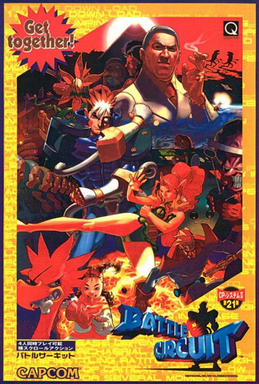
One of the last arcade beat em ups that Capcom released in the wake of Final Fight, 1997’s Battle Circuit was obscure for many years until its availability in the Capcom Arcade Stadium collection. This is a shame, because of all the successors to that masterpiece, Battle Circuit is the best I’ve played.

The plot is simple: In a sci fi future, control one of five bounty hunters as they pursue a bunch of colorful villains. The quirkiness and silliness of the genre shows in both the heroes and villains. You can choose between Cyber Blue, a pretty normal anime hero, Captain Silver, a Plastic Man/Mr. Fantastic style stretch-armer, and three goofballs: Catgirl Yellow Iris, walking Venus Flytrap Alien Green, and the weirdest yet: Pink Ostrich, the titular bird with a girl riding on its back (it’s unclear who’s the brains). Similarly, the bosses are just as ridiculous. They start with a disco Elvis impersonator and go through such things as a woman and her giant mandril, an all-female biker gang, and a robot samurai riding some giant beast. The final boss can only be described as looking like an evil Santa Claus.

But what makes the game amazing beyond these characters and their beautiful sprites/animations is how it’s both easy and deep. Sure, it can be played like Final Fight. You can jump around, throw, and do sweep attacks that cost you health. But each character has a lot of moves, and they can be upgraded between levels if you’ve earned enough coins-which you get by landing lots of hits on enemies. Mastering each of these moves makes things a lot more fun. Especially as the characters have their styles, with Alien Green being the slow grappler a la Haggar and Yellow Iris being the rapid “Guy”. All can jump and power up with a special gauge, the effects of which range from gaining more power to recovering health to becoming very durable for a brief time.

There are a few snags. The first is that the characters are not exactly balanced compared to each other. Cyber Blue is the cheap easy mode character. Not only is he intuitive and strong, but his upgraded sweep attack damages everything on the screen. Bosses can be cheesed by just powering up (which increases his strength) and then spamming that move. Meanwhile, Pink Ostrich is very weak normally, only has a flight power of dubious use, and is hard to control. The others fall between those extremes. The worse one, I’d say, is that the segments between the bosses are kind of minimal and forgettable. There’s only a few enemy types and no real engaging set pieces. It’s not really bad, but it doesn’t have the spark the rest of the game does.

Also the third boss is a blander giant robot with very wonky hit detection that’s just frustrating and not fun. But hey, five out of six aren’t bad.

If you like any kind of beat em up, you deserve to check out Battle Circuit. It’s an amazing underappreciated game.

A Thousand Words: Captain Commando

Captain Commando

Capcom, fresh off the success of Final Fight, made another arcade brawler called Captain Commando in 1991. I’m sure the title was just a coincidence. You can control the titular vanilla superhero, a ninja, an alien mummy named “Mack The Knife”, and, most bizarrely, a baby prodigy that controls a mech-that can ride other mechs. It’s like the walking robot version of a nesting doll.

Anyway, to call it a superhero version of Final Fight would be unfair. It’s more like a souped up superhero Final Fight. For instance, the second boss of Captain Commando is almost exactly like the final boss in that game (someone who jumps around with a crossbow). Only he’s much faster. As for the real final boss, it’s one of the cheapest in all arcade brawlers, and exists primarily to devour quarters.

For all this enhanced goofiness, it doesn’t seem as graceful or punchy as Final Fight was. The new move additions consist of the previously mentioned mechs (which are few and far between, and clunky enough to generally be more trouble than they’re worth) and dash moves that are both hard to do and rarely of that much use.

It gets the basics right, but if you have to choose, I’d say either Final Fight itself or one of the better successors. This is not one of the better successors.

A bizarre archetype

I’ve been playing a lot of beat ’em up video games (ie Final Fight), and I’ve noticed (and have not been the only one who’s noticed) a recurring enemy theme. Yes, you get the normal goons, the musclemen, the femme fatales, and the final boss who has the only ranged weapon in the entire game. And the people with very few hit points who run in, attack once, and leave. And big fat enemies.

But among the last, there’s one strange consistent theme. These portly foes breathe fire. Ok. I don’t know why, but somehow game designers thought “All right, let’s keep doing this.”

A Thousand Words: Final Fight

Final Fight

Capcom’s 1989 Final Fight was not the first “beat em up” video game. It wasn’t the first popular game of that type, with Double Dragon taking that two years earlier. But it was an instance where the genre was-dare I say-mastered. With an excuse plot of “save the mayor’s daughter”, ninja Guy, tough thug Cody, and the former wrestling star and mayor himself, Mike Haggar, go off to wallop street goons in a thinly veiled New York City.

An action sports star in political office of that nature has come true twice , with former pro wrestler Jesse Ventura becoming governor of Minnesota and, more recently and relevantly, heavyweight boxing champion Vitali Klitschko becoming mayor of war-torn Kyiv. But I digress. Final Fight either introduced or popularized a lot of beat em up elements, the first being playable characters on a speed-power spectrum from Haggar (slow, strong) to Guy (fast, weaker). The second was the moveset, combining normal attacks, throws, and an all-round attack that costs the player health.

It’s amazing how A: This feels natural and effective, and B: All of this was accomplished with only one attack button. The fighting is fluid and forgiving in ways that a lot of similar games-even those made by Capcom itself-are not. Everything from combinations to attacking enemies by throwing other enemies at them just clicks. The one sour move is the grab attack (where you just hold and beat an enemy), which is both hard to do and of limited use given how many enemies are on screen at once. But everything else fits into its niche near-perfectly.

The graphics are amazing for the time and still look good by pixel art standards over thirty years later. The music a mixed bag, but it has some catchy tunes and it’s a rare instance of an arcade game from that period with actually good sound mixing. Others will often have the music drowned out by the action, which is not the case here.

Final Fight is a classic video game. And it’s a classic for good reason.

A Thousand Words: Carrier Air Wing

Carrier Air Wing

Capcom’s 1990 Carrier Air Wing is a fairly standard side scrolling plane shooter. Except for one thing that elevated it massively in my eyes. That’s the surprisingly detailed and (in a visual sense) accurate depiction of military hardware. You can control either a Hornet, a Tomcat, or an Intruder (which is marked as an A-6F. Wonder if they knew of the never-was upgrade or if it was a happy coincidence because they chose the next letter after E.)

When I saw Tu-22 Blinders as enemies in the first level, I was in love. When I saw Yak-38s in a later stage, I was even more in love. This is quite possibly the most Fuldapocalyptic shmup there is, and I loved playing every second of it. Yes, there’s the sci-fi superweapons (such as a final boss that includes a Buran shuttle) but it’s otherwise very grounded-looking compared to other games of its time and nature.

This is basically a video game adaptation of a Mack Maloney novel. What’s not to like?

A Thousand Words: Progear

Progear

What do you get when you push an inherently limited genre as far as it can go? Probably something like Progear, a 2001 Capcom arcade “shmup”, the classic Gradius-type arcade game where you control a little spaceship moving around on a scrolling field. Only this “spaceship” is a World War I-type fighter plane, and the game has a very dieselpunk theme that I like. The graphics are very good, being (or at least looking like) beautiful sprites in an age of polygons.

The story is utter nonsense, and I have to wonder how much of it is due to iffy translations and how much is due to just limited information. Basically a group of young pilots have to fight off a conspiracy of posh Victorians led by a lion-man, and I’m not making that up. It feels like you only got ten seconds of a thirty-minute show and had to piece everything together from there. But this is a classic video game where such stuff was par for the course.

The gameplay is nothing to write home about, as it’s the same “fire away, use limited power ups, and try and dodge at least some of the impossibly large number of projectiles heading your way” formula. But that’s a fun formula for a reason. And whether by accident or design, one boss seemed to mock the formula. In a game where your ship faces right and only right, the boss tries to counter by…. moving to the left of the screen. Too bad you have homing missiles.

This is not a deep game, even by the standards of arcade classics. It’s not the most polished or fair game. But it is quite the fun game, and a sign of how far “handmade” graphics could go.

A Thousand Words: Mega Man

Mega Man

Mega Man and Street Fighter are two of Capcom’s legendary franchises. Perhaps fittingly, they followed the same pattern: Breaking out with a rightfully praised and successful second installment after a less-than-ideal first one. And in both cases, the way they were clunky were the same: The very basics of what would make them so great were there, but they were incredibly rough around the edges.

Mega Man 1 thus has everything the later games have: Platforming, shooting, and defeating bosses to use their weapons. And in 1987, there wasn’t that much of a comparison. The problem is the second game two years later utterly obliterated it in terms of usability, difficulty, ease of play-everything, basically.

So in Mega Man 1, you have only six Robot Masters compared to the eight of pretty much every later game. But the game is overloaded with the kind of “cheap difficulty” even by the standards of the time. Spikes explain this very good. In later Mega Man games, falling into spikes kills you instantly-but if you were knocked onto them by an enemy and still had your brief recovery frames, then you had a small chance to escape if you jumped right away. Not so here-if you come into contact with spikes, goodbye.

There’s also no real good starting boss/level, and in true 1980s game fashion, the game is unwinnable unless you get a “secret” item in one stage. You could do worse for other vintage platformers, but you could also do a lot better. Like, say, one of the nine direct sequels.

Nuclear War Simulator is Out

Nuclear War Simulator, a detailed simulation of nuclear war (obviously 😀 ) on any scale from “one missile” to “one destroyed world”, of any type from “meticulously placed real units and real locations” to “hypothetical custom clashes between two countries that never historically developed nukes at all” is now out.

It can be gotten here.

A Thousand Words: Armoured Commander II

Armoured Commander II

Surrounded by all kinds of danger, a threat can come out of nowhere and kill you. This describes war, but it also describes roguelikes, the kind of deliberately unfair randomized video games that have occupied a niche for decades. Naturally, someone had the great idea to combine them. The result was the Armoured Commander series, with the second installment being the subject of this review.

You are a tank in World War II. You can command just about any kind of tank in any campaign at any point during the war. Try and survive in a world of ASCII graphics and constant threats. The deliberately ultra-retro UI gives the game a bit of a learning curve, but I didn’t consider it too hard. A more intentional “issue” is that you get what you want. I learned the hard way that a Renault FT means you’re slow, you’re weak, you’re inaccurate, and the commander has to do a ridiculous amount of multitasking.

This is an excellent game for anyone who likes roguelikes and/or tanks.