My first Steam guide is now up. It’s about creating custom units in Nuclear War Simulator. This is, like all internet guides, a work that could very well be updated and/or changed. But I still hope even in its beginning form, it helps players use one of the simulation’s greatest strengths.
Nuclear War Simulator, a detailed simulation of nuclear war (obviously 😀 ) on any scale from “one missile” to “one destroyed world”, of any type from “meticulously placed real units and real locations” to “hypothetical custom clashes between two countries that never historically developed nukes at all” is now out.
Surrounded by all kinds of danger, a threat can come out of nowhere and kill you. This describes war, but it also describes roguelikes, the kind of deliberately unfair randomized video games that have occupied a niche for decades. Naturally, someone had the great idea to combine them. The result was the Armoured Commander series, with the second installment being the subject of this review.
You are a tank in World War II. You can command just about any kind of tank in any campaign at any point during the war. Try and survive in a world of ASCII graphics and constant threats. The deliberately ultra-retro UI gives the game a bit of a learning curve, but I didn’t consider it too hard. A more intentional “issue” is that you get what you want. I learned the hard way that a Renault FT means you’re slow, you’re weak, you’re inaccurate, and the commander has to do a ridiculous amount of multitasking.
This is an excellent game for anyone who likes roguelikes and/or tanks.
It’s no secret that all kinds of fictional works change from their beginning to their final product. And a minor character in a classic video game embodies this very well. In the Kanto Pokemon games, Erika is the grass-type specialist leader of the Celadon City gym. Wearing traditional Japanese clothing, her characterization is that of a graceful flower lady (who has a tendency to fall asleep).
But apparently she wasn’t always that way. And some of the changes made to her were after her Gen I artwork had already been drawn.
Development and concepts assets that have emerged have shown a picture of the original Erika. She would have been placed in what would have been Lavender Town (which in the final version didn’t have a gym at all). And, unsurprisingly, she would have specialized in ghost types. The sole ghost specialist who actually emerged in Gen I was Agatha, portrayed as a normal person who just happened to use ghost types.
At least judging from her art design, Erika would, uh, not have been. Her eyes were closed and the Poke Ball in her sprite was in midair, which could be justified as her juggling it but which was likely meant to have her hovering it with supernatural powers. Finally, her clothes were folded in a way that was only used for the dead in her initial sprite. (A pretty big implication of this is that her design was changed in Yellow and all later appearances to be folded the correct way).
In other words, she was heavily implied just from the visual assets alone to be some kind of undead. Since no final text dialogue was made, there’s no 100% confirmation, but it’s pretty clear. Would this design carrying over really change much?
Probably not. Unlike a few other Gen I leaders, Erika did not become a superstar in her own right. At the time, not much would really change. Except for her prominence. See, spooky Lavender Town became a centerpiece of internet creepypasta campfire stories immediately. And having someone who was an outright zombie? Oh yeah, she’s definitely getting featured in them. So even if official media stays out, Erika the Zombie would become a star of the internet.
Since a multiverse canonically exists in Pokemon, Zombie Erika probably lives in some variant universe. Much as how creepy supernatural anime Sabrina exists alongside normal actress game Sabrina. Who knows, maybe this Erika starts conventional Fuldapocalypses as a hobby. Has the zombie sorceress been found?!?
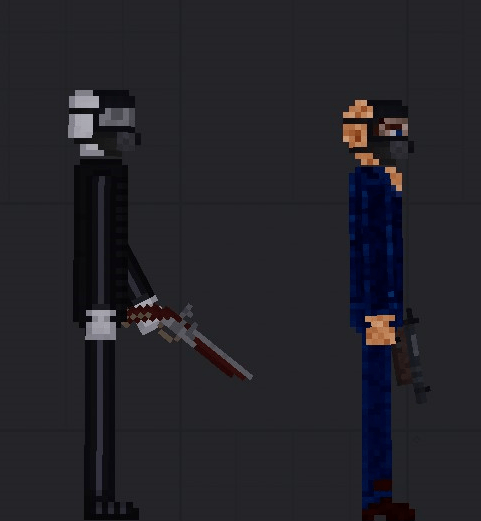
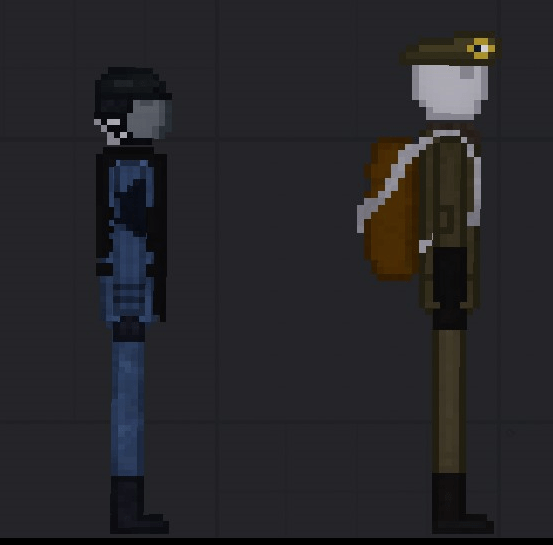
My current People Playground mod-enabled obsession is the “Facility Escape”. The background for this RP is simple: A character from another setting is trapped in the mysterious mad science super-facility and has to try and escape, fighting their way past an army of workers, security contractors, androids, and who knows what else.
Characters from settings as distinct as Undertale and Hotline Miami have been placed in the playground. The (intentional) clumsiness of the human figures just, if anything adds to the fun. There’s nothing like jury-rigging an “epic” sword vs. chainsaw battle.
Characters who have “earned the privilege” of escaping have the final exit simulated by a black hole being created with them sucked in. This symbolizes a portal to their home setting (or somewhere else?) being activated.
A roguelike platformer based on Finnish mythology, Noita (Finnish for “mage” ) is a brilliant game of losing. You control a vague purple-robed wand-wielding adventurer and delve into one randomly generated cave after another, facing all sorts of threats and almost always getting killed.
The big gimmick of Noita, besides its huge array of customizations, is that every single part of the game world is destructible. So yes, with the right tools you can blast a tunnel down and avoid the monsters-in theory. In practice you’ll probably just break open the entrance to a lava pit or something. This is not a fair game.
But it is a fun one, and it handles well. The player character has a limited levitation “jump” that handles a lot like the jetpack in the classic platformer Cave Story (that’s unlikely to be a coincidence). It’s very smooth and precise, and thus works beautifully. Obviously not everyone will play as story-light, unfair a game as Noita, but for what it is, it’s incredible.
My favorite go-to relaxing game now, especially after I’ve discovered the massive and excellent mod scene, is People Playground. I of course act out a lot of scenarios-ok, a few types of scenarios, involving the mysterious mad science facility. And here are the “roles”.
Subjects
Represented usually by the default “humans”, subjects are the test subjects who are either being killed in terrible ways (don’t feel too bad for them, they struggle to walk several steps) or rebelling in some form (and usually ending up getting killed in terrible ways).
Technicians
Dressed in work-esque outfits, technicians usually sport some kind of chemical mask. They’re often placed by pieces of machinery, where they operate them and oversee experiments (very, very frequently becoming collateral damage). Unlike troopers, technicians mostly use a min-max arsenal-either finicky destructive contraptions or simple/improvised-type weapons that they built themselves.
Troopers
Troopers are the enforcement arm of the facility, being dressed in various kinds of military uniform and carrying a large variety of conventional weapons. Don’t worry, they always get killed in quantity too.
Commanders
Clad in various types of ornate and/or formal clothing, commanders wield sidearms and direct the “experiments”. However, a field commander is just as vulnerable as anyone else on the playground.
One of many indie platformers, Camera Obscura is the story of a photographer-woman trying to climb to the top of an ancient clockwork tower. The big gameplay gimmick is that you can take photos, and the “afterimages” will move for a bit before freezing. This creates temporary platforms.
A (mostly) slow-paced puzzle game, this is not an easy finish. The excellent (I’d recommend the game for the soundtrack alone) original music kind of fits with each area. The story, which is a combination of exposition about the tower builders and a really pretentious, almost stereotypical love story plot involving the photographer, doesn’t really do so. But it’s a small part.
As far as indie games go, you could do a lot worse. Did I mention the music is amazing?
Judged on its own without any other context, Mighty No. 9 would resemble a mediocre Mega Man-style game. There have been dozens of those, including more than a few in the official series itself. To study it there would not be the most interesting. About the only things I can say for the game itself are that it copied the cheapest difficulty elements (why?) and in everything from plot to aesthetics simply tried to be “as close to classic Mega Man as possible without lawsuits”.
But what is interesting is the ridiculous amount of hype that came around its crowdfunding. Occuring in the “irrational exuberance” phase of Kickstarter and spearheaded by ex-Mega Man head Keiji Inafune, this was one of those “the gaming king came down to make a dream” experiences. This prompted emotion that successful MM-esques like Azure Striker Gunvolt (made conventionally by a firm that had experience on the official games) and 20XX (crowdfunded yet made by an unknown) couldn’t bring.
The result was a ton of stretch goals “met”, feature creep, the project getting out of hand, the mood turning from hopeful to laughable, and then the game itself sinking like a stone when it was finally released. Whether it could have been better or if the expectations were just too great is an open question. What is not is that this was one of the biggest crowdfunding embarrassments.