What’s In A Space Warship Name

(That I’m interested in this topic just as I’ve gotten into Starmada is just a coincidence, I swear.)

Atomic Rockets is a great site for semi-realistic spacecraft design. However, one of their contributors was adamant about not transplanting ship names wholesale from maritime ones, as has happened many times before. Is this a sensible avoidance of tropes or just hipsterism for the sake of being different?

I feel it depends on the setting and tone. IE Warhammer 40k and its broadside space cathedrals and obvious Age of Sail symbolism can adopt naval terminology just fine. But there are understandable reasons to avoid the ‘superdreadnought’.

Names I think could make the cut:

  • Battleship. Pretty self-explanatory.
  • Carrier for anything carrying smaller craft. Also pretty self-explanatory.
  • Gunship/gunboat. I think this has already passed one test in that plenty of real aircraft are called gunships, and an added bonus of being a good literal description for many designs. (IE, big weapon on a spinal mount the rest of the ship is built around).

Cruiser, Destroyer, and Frigate are already a mess and have been for decades if not longer. These smaller ships are probably the best to make up your own terminology for (ie “Dragonship”).

Fictional and Alternate Historical Airlines

Airplane manufacturing is a very tough process. Barring some strange point of divergence, it’s hard to avoid large airplane builders sorting out into a few giants. Yet airlines are another story altogether. It’s interesting how in the “Goldilocks businesses”, airplane builders and airlines fall on opposite disadvantageous ends.

For the manufacturers, it’s the “too many barriers to entry, thus you end up with a oligopoly” issue. For the airlines, where existing planes and even crews are just a few lease deals away, it’s the “too few barriers to entry, which leads to too many participants chasing too small a market”. In many cases both of these are unavoidable. (Novels, sadly, were the latter even before the rise of internet self-publishing).

What this means is that it’s incredibly easy to change the fates of the airlines, and even easier with a point of divergence after the large and successful deregulation of the late 1970s.

Asialink

Here is a logo for Asialink, a fictional airline I’ve made headquartered in Singapore and focused on linking all of one continent (guess which ).

The yin-yang (Asia) and circular chain (link) were made seperately in Stable Diffusion XL and edited together externally. The text was manually added and uses the Shojumaru font.

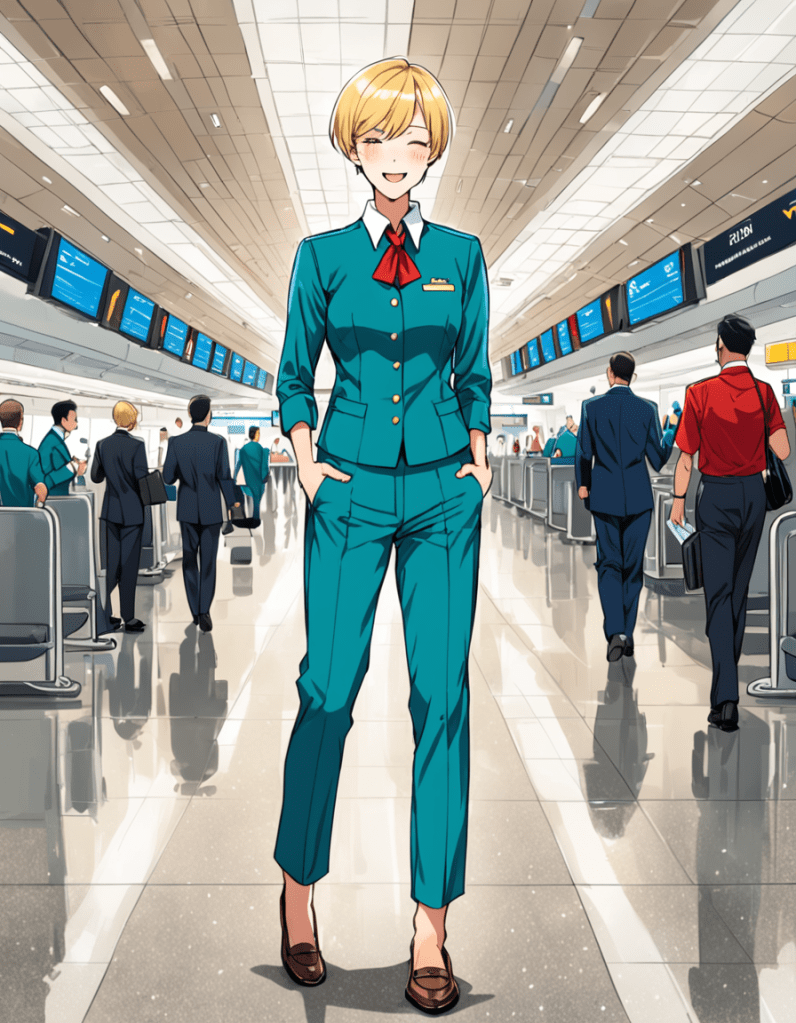
Asialink flight attendant uniforms are the same combination of teal and/or light green with red neckwear.

How To Nuke

How much nuke-metal can you get out of Reactor X? As it turned out, nuclear proliferation scholar David Albright came up with an oversimplified rough formula, which he wrote in a briefing.

You need:

  1. The thermal energy created by the reactor. Note that thermal megawatts are different and greater than electrical megawatts.
  2. The capacity factor. As I’m not any kind of scientist, I would say just go with Albright’s recommendations or make it even lower than 0.5 if you’re using a press-ganged power reactor to simulate the extra work needed.
  3. The conversion factor. This is obvious in the slide for purpose-built production reactors, but for adapted ones, you need to look a little deeper. Fortunately, the same presentation has a comparative slide.

(Again, do not quote me on this. The very presentation says “this is for production not adapted reactors”, but oh well.)

So:

200mw production reactor: 200×0.6x365x.85=37kg of weapons grade plutonium in a year.

Adapted LWR power reactor: 1,400 mwth, wastage: 1400×0.35x365x.51= 91.2 kg of weapons grade plutonium in a year.

A Fat Man-level warhead is estimated to need anything from 6.5 kg (very low technology, used in said bomb itself) to 3kg. See here and here.

Cuban T-72s

I’ve used the term “Cuban T-72s” to refer to a very interesting phenomenon in fiction, especially contemporary fiction. Which is to say, something that’s technically inaccurate but makes an incredible amount of intuitive sense. And it’s technically achievable as well. What is a Cuban T-72?

Well, despite being one of the premier Soviet clients, Cuba has never operated T-72 tanks. T-72s are, of course, a common Soviet export tank. So even though Cuba historically never moved beyond the T-62 despite being actively engaged in Angola, if a thriller novel or alternate timeline had them operating that autoloaded tank, I would let it slide.

So if the rest of the work is pretty good, I can let things like wrong calibers off the hook. Especially if there’s an understandable reason why the author would think that way. Note that this only applies to small things like that-someone like Ian Slater who constantly gets the easiest-to-check facts wrong is not a “Cuban T-72.”

Mobile Corps Order Of Battle

So my book project now has a name: All Union. To celebrate this milestone and excellent progress on it, I figured I should share the rivet-counting infodump of very little actual relevance to the plot (or is it…) but which is fun to do: An Order of Battle chart of the Mobile Corps (of GENFORCE-Mobile inspiration) of the Union of Soviet Sovereign Republics, most famous for their actions in the invasion of Romania.

The methodology is simple: For the number of corps and locations, I went with this analysis, which predicted eight total by the turn of the millennium and theorized their number by district. In actual history, only one was created, the 5th Guards Army Corps stationed in Belarus. For their numbering, I went with the invaluable ww2.dk and looked for defunct/easily disbandable corps HQs in the general area (HQ cities here NOT always correspond to historical bases). So on with the fun exercise/sneak preview-oops, did I say too much??

General Notes

Mobile Corps have adopted a degree of heraldry beyond previous divisions. All save one have a geographic semi-nickname, and all have a “mascot” creature displayed prominently on all unit patches and symbols. The “Sovereign Guards” honorific was made to reward units for the Romanian war without worrying about legacy “guards” titles from long ago.

Western TVD

5th Guards Mobile Combined Arms Corps “Neman” (bison): First (and in actual history only) mobile corps created. Peacetime garrison Minsk, Belarusian SSR, served in Romanian invasion under Dniester Front.

7th Sovereign Guards Mobile Combined Arms “Vena” (elk): Peacetime garrison Vitebsk, Belarusian SSR. Served in Romanian invasion under Dniester Front, given sovereign guards status postwar.

28th Mobile Combined Arms Corps “Buh” (medieval lion): Peacetime garrison Lviv, Ukrainian SSR. Served in Romanian invasion under Dniester Front. Considered one of the primary frontline units against independent, hostile Poland.

Northwestern TVD

26th Mobile Combined Arms Corps “Lagoda” (Karelian Bear Dog): Peacetime garrison Petrozavodsk, Russian SSR. Did not participate in Romanian invasion but was on high alert and was earmarked for a proposed second large offensive operation that never had to be conducted.

Southern TVD

17th Sovereign Guards Mobile Combined Arms Corps “Fergana” (Huma bird): Peacetime garrison Tashkent, Uzbek SSR. Participated in Romanian invasion under Dniester Front. Given sovereign guards status postwar. Its base in the otherwise remote area makes it the closest thing to a strategic reserve mobile corps, and it is poised to always go either west, east, or south. One of the main characters in All Union, Cholpon Murad-Kyzy, served in the 17th Corps during the war in a forward medical station.

Southwestern TVD

64th Sovereign Guards Mobile Combined Arms Corps “Donets” (nightingale): Peacetime garrison Luhansk, Ukrainian SSR. Participated in Romanian invasion under Dniester Front. Given sovereign guards status postwar. Its base in the birthplace of All-Union president and legendary leader Anton Yatchenko is widely believed to not exactly be the most coincidential, as is it receiving sovereign guards status and massive accolades.

32nd Mobile Combined Arms Corps “Roman-Kosh” (mythical hippocampus mermaid-horse): Peacetime garrison Sevastopol, Russian SSR [not a typo]. Participated in Romanian invasion under Danube Front, the only mobile corps to do so. Is believed to be the mobile corps with the most focus on amphibious invasions and operations in extreme terrain. There are even rumors that detachments from it are earmarked for the seizure of Iceland should it come to that.

Far Eastern TVD

57th Mobile Combined Arms Corps “Kisilyakh” (lynx): Peacetime garrison Ulan-Ude, Russian SSR. Did not participate in the Romanian invasion but was earmarked and prepared as part of the ultimately unnecessary second offensive operation.

43rd Mobile Combined Arms Corps “Amur” (mosquito): Peacetime garrison Khabarovsk, Russian SSR. High-priority unit for potential war with China. Because of this and its distance did not participate in the Romanian invasion and was never considered for doing so, even as part of the hypothetical second wave.

VNG/Efir Group

“VNG Elite Corps”/”Efir Group Corps”/”Phantom Corps” (ghost): Peacetime garrison Gorky, Russian SSR. Formed after the Romanian invasion, exact strength still unclear. Under the control of KGB successor VNG (based on an acronym that can translate to “All Union Monitoring Group”). Part of the mysterious and nominally private “Efir [Aether] Group, which officially is nothing but a small real estate firm registered in Pune, India. It is said that the corps is haunted and anyone who gazes at its facilities without approval is immediately flung out of a tall window by poltergeists.


My OPFOR Countries

Screenwriter Stephen E. de Souza has a catch-all Latin American country called “Val Verde” he uses whenever a politically neutral country in that part of the world is required for one of his movies. (In Arnold’s Commando, John Matrix wiped out the entire military of Val Verde by himself.) I have made several Val Verdes in my brain that I’m in the process of putting down in writing, and which may become more than just an order of battle chart.

They are:

Cardona

Cardona is the conventionally weakest OPFOR country and the closest to de Souza’s Val Verde in terms of theme. It draws from both South American and Southeast Asian influences (if I wanted to be really shameless, I could have it have large conveniently Spanish-speaking regions and equally large parts with native Asian languages.)

Cardona’s military is large in numerical terms but lightly equipped and is focused on internal control rather than external invasion. It also has no shortage of irregular groups of all shapes and sizes.

Seleucia

Named for the Seleucid Empire, Seleucia is a catch-all Middle Eastern OPFOR country. Like its namesake, it features terrain from the Mediterranean to the Altais. A diverse and fractious nation, it is at times (ie, when the scenario calls for it) a strong state and at times a weak one. But even at its conventionally weakest, it’s still more powerful in material terms than Cardona is.

Seleucia can be the opponent in everything from irregular warfare to Gulf War level major battles. It also can have nuclear weapons in some cases.

Teutonia

Named after a form of Germany, Teutonia is the developed western European country. The most technologically advanced of these states for the time period, it was once a world power and remains a continental one.

In addition, Teutonian exports are found all over the world, including in the other two mentioned countries. Teutonia is a nuclear power if the tech level of the scenario allows it.

All three will be elaborated on, possibly in prose form… (winks)

The Mountain Flip Flop

Despite otherwise having little in common save for lots of mountains, Switzerland and Afghanistan have a shared reputation in popular culture as being impregnable, untameable countries. Which led me to go: What if circumstances flip-flopped their history and outcomes?

In Central Asia, a Dari-speaking nation arises in the mountains of what we’d call northern and central Afghanistan. Close to many major trade routes, it takes advantage of its geographic security and reputation for studious neutrality to develop a thriving financial sector. This and the wealth generated by it enable this to develop a reputation for exporting luxury, advanced artisanal goods as well. Meanwhile in Europe, an artificial clump of different ethnicities in the Alps becomes a weak, tumultuous, war-torn “western Yugoslavia”.

Yes, it’s a very soft alternate history. But it’s the kind of thing that alternate history was made for, and it’d work great as a story’s setting.

The Making Of A Division

Just as eggs, butter and flour mix don’t equal a pancake on their own, having three hundred tanks and two hundred APCs does not equal an armored division. By American standards, even in World War II, it took a year and a half to turn a scratch-built division from “exists on paper” to “ready to deploy”. Postwar, two years was an optimistic hope.

The central core of the division is a “cadre”. The officers (how many are commissioned vs. non depends on the circumstances) comprise the cadre of the division, which in a normal sized division is around one to two thousand people. Reserve forces deliberately keep their cadre at higher strength and readiness so they can be quickly built around during mobilization.

There’s also external powers not just supplying the equipment, training, and resources for their client/colonial army, but also supplying the central officer cadre as well. (This is why one snapshot analysis of Iranian casualties in the Syrian Civil War found no confirmed dead below the rank of sergeant.)

I also want to say that the cadre forces are the hardest to obtain (from just my amateur gut reaction) compared to either a large number of shorter-trained recruits or a few high-level commanders. The bottleneck for your revved-up 25 division army, especially an effective one, feels like the roughly 25,000 people in the cadre, compared to the 25 commanding generals or the 250,000 enlisted. And this is before political difficulties arise. Although I should note that this was less an issue for continental powers in the World Wars because of both having plenty of survivors from destroyed units as cadres and, to be frank, lower standards.

Cadres can come from:

  • Scratch-trained officers “jumping rank”.
  • The small existing military being streched out to become a cadre force (this happened in World War II-in 1939 Ike was a lieutenant colonel).
  • Retired personnel being brought back.
  • Existing irregulars being formalized. (This led to “Zouave” regiments in the American Civil War being formed around Napoleonic reenactors because they were the only ones with skill at musket drills).
  • External personnel being sent in to fill the cadre role.
  • Survivors from reduced/destroyed units.

The Question of Motivation and Interior Forces

For one alternate half-fantastical daydream war scenario I’d created (that I may or may not be simming further), I had one fictional country’s interior ministry forces fight harder and better than their regular army did. This despite them not being really designed for conventional war at all and having nothing heavier than box-APCs and crew-served weapons. Part of it was good mountainous terrain that played to the strengths of lighter forces (like them, particularly their commando units) while weakening heavier ones (like the attackers). But then it got me thinking to other parts.

  • Being all-volunteer (even if only for pay) compared to the mostly draftee military.
  • Being a sort of counterbalance to the regular army that put them on alert. (This is why they’d have antitank weapons and training, for instance…)
  • Finally and more crucially, being tied to the regime rather than the country. This meant they had more to lose in the event of a defeat.