Review: Foundation

Foundation

foundationcover

Now I can add Isaac Asimov to the list of famous authors reviewed on Fuldapocalypse, and what better book than his masterpiece, Foundation?

I’m somewhat leery of reviewing massively successful books by famous authors. A part of me has this guarded “it can’t possibly be as good as they say” feeling, and I like giving more obscure stories a platform. But I felt I had to.

The story of the decaying empire and genuis Hari Seldon’s plan is very Shakespearean. By which I mean it’s a well-done story that nonetheless has gotten retroactively treated as something a lot more highbrow than it was upon first release. This isn’t a mere spacesuit commando book, but it’s still much closer to Ken Bulmer than it is to Stephen Baxter.

And while this isn’t Asimov’s fault, a lot of this is dated. There’s the obvious, like treating “nuclear power” as some kind of super-technology. There’s the historical conceits, like taking Edward Gibbon’s view of ancient Rome too closely. Then there’s the central premise of a triumphant technocratic process, the sort of thing embodied most by… Robert McNamara.

Yet I don’t want to come across as too negative. This is very readable, and it’s been so influential for science fiction that seeing where a lot of the tropes became popularized is also fun. This is a “classic” I do recommend.

The Iceland Scale And The Origins of Fuldapocalypse

Back in the day when I was convinced that everywhere was being overrun by bad World War III stories, I made the Iceland Scale as part of my backlash. Now with a sense that I got too angry about it, I figure I should post both the scale itself and commentary on how it did and didn’t hold up.

This is probably going to be the longest post yet on Fuldapocalypse, and it’s been a long time in coming. This is something that I wanted to look back on. Now, with a lot of time on my hands and the last review of a “World War III” book being months old, I think it’s as good a time as any.

I’ve been worrying about how to say what I want to. Regardless, I still think this should be told, for it influenced the formation of this blog.

Here’s the scale itself:

BACKGROUND

-If the Soviets start the war: 1 Iceland
-If the Soviets do so in a way that, to the average reader, makes little sense: 3 Icelands.
-If there’s at least one chapter of “intrigue” leading to the shocking result that yes, in a WW3 book, WW3 starts: 5 Icelands per chapter/update.
-If NATO starts the war: -10000 Icelands

-If the third-person narrator delivers an infodump about forces deployed: 50 Icelands per infodump.
-If there’s a scene where a bunch of generals and leaders stand in a conference room and deliver a joint infodump about forces deployed: 600 Icelands per infodump.
-If the central and obvious protagonist is introduced prior to the fighting started: -20 Icelands

-If the war takes place in the 1970s or earlier: -100 Icelands
-If the war takes place in the 1980s: 1 Iceland
-If the war takes place in the 1990s or beyond, with a surviving/restored USSR: -5 Icelands

CONDUCT OF THE WAR

-If NATO wins: 1 Iceland
-If the USSR wins: -500 Icelands
-If the war ends in a nuclear apocalypse: -200 Icelands

-If the war remains conventional throughout: 1 Iceland
-If nuclear weapons are occasionally used in anger, but the war stays largely conventional: 150 Icelands

-If the Soviets invade Iceland: 1000 Icelands
-If the Soviets invade any part of the United States proper: 15000 Icelands

-If the battles focus around tanks or aircraft: 1 Iceland per battle
-If the battles focus around ships or submarines: 1 Iceland per battle
-if the battles involve gritty, close infantry firefights: -10 Icelands per battle

-If any part of the story takes place in Germany: 100 Icelands
-If any part of the story takes place in the Atlantic Ocean: 200 Icelands
-If any part of the story takes place in a theater other than the two mentioned above: -50 Icelands

CHARACTERIZATION

-If there is one central, total viewpoint character: -25 Icelands.
-Likewise, if the number of viewpoint characters numbers:
-2-5: 10 Icelands
-5-10: 50 Icelands
->10: 1000 Icelands
-If there are no “characters” in a traditional literary sense at all: 500 Icelands.

-If a character’s physical appearance is described: -10 Icelands
-If a character is given an infodump to serve as their sole form of development: 100 Icelands

-If a weapons system is described in more detail than the basic terms (ie, M1A1, T-80BV rather than M1/Abrams or T-80): 15 Icelands
-If a weapons system is given more description or development than a character: 100 Icelands

-If any characters are in a position of utter powerlessness-(civilians, routed soldiers): -25 Icelands
-If any Soviet characters exist as mustache-twirling puppy kickers: 10 Icelands
-If any NATO characters exist as mustache-twirling puppy kickers: -100 Icelands

_ _ _ _ _ _ _ _ _ _

So how did this come into being?

At the time I had read far fewer “cheap thrillers” in general and my exposure came in three places:

  • Wargames, where World War IIIs are over-represented compared to other types of fiction. (A study of scenario locations in Steel Panthers MBT had about 27% of them being “World War III” in some form, a ratio that is definitely not true of fiction in general).
  • Red Storm Rising itself and a few of the knockoffs, particularly Harvey Black and Brad Smith.
  • A boomlet of conventional World War III TLs/stories on alternatehistory.com.

In hindsight, the knockoff triple-xeroxed fanfiction of Hackett (or Clancy/Bond, or Coyle, or Peters, or Red Dawn) that appeared on AH really wasn’t that good, bad, or representative. It’s like trying to see what crime fiction is like by reading the entries in the Law and Order section of fanfiction.net.

But it’s what I was reading at the time.

What holds up?

I’d say the supervillain Soviets and longer weapons descriptions. That’s pretty much it for just cheap thrillers in general. For technothrillers, the conference room scenes are probably the biggest.

And there are “Icelandic” stories out there. There just aren’t that many. Instead of looking at overbearing cliches, I was accidentally focusing on a very small, very niche type of writing. I was the blind man touching one part of the elephant.

And what doesn’t?

A lot. First, the invasion of Iceland itself isn’t a staple even in World War III stories. It appeared in wargaming and Red Storm Rising. And really not that much else, even in that narrow niche.

A few instances had stories that were “Icelandic” but not necessarily bad. Team Yankee checks most of the Iceland boxes on paper, but is a smoothly flowing story that’s the exact opposite of the cumbersome “boom boom goes the tank” I’d seen on the internet.

But most of it was simply not “Icelandic” at all. And this includes almost all of the cheap thrillers that were actually written. Nukes aren’t handwaved away, they’re incorporated into the story in some fashion. As a look at the number of “Action Hero” and “Special Forces” tags on this blog shows, shooter fiction with an unambiguous main character leaves “big war thrillers” in its dust. By a gigantic margin.

Why is the “They invade the US” score so high?

This is probably the most personally biased score of them all. It’s not overly representative or even prominent in a few specific pieces the way Iceland was (the exception being Red Dawn). Rather, seeing rote rivet-counting descriptions of Soviet invasions of the continental US flared up one of my frustrations with internet alternate history.

I should note that this is one of the least connected to actual commercial fiction. It could not be further from the special forces raid in Northern Fury (a more workable scenario) or the invasion in the early Survivalist (something that didn’t involve rivet counting).

So why this? Well, internet alternate history has, as it’s grown, sort of shifted in a questionable way. The idea behind simply writing in ways that aren’t conventional narratives was so that writers, unencumbered by the need for plots/characterizations, could fill in a lot of details.

As the community diluted, this became a way to avoid detail, done by people who cared less about “plausibility”. The analogy I’d use is, of all things, car racing. A race car is not a practical car for everyday driving, and the people involved know it. But then people start building race cars. They have one seat and no amenities, but the focus is on that one seat and the shape and not how fast they can go. But at the same time there’s just enough residual race car focus to dull the edges. The cars aren’t in goofy novelty shapes, they’re just race cars that look like race cars but with engines that a stock 1992 Camry could outpace.

As AH’s own wiki states about fictional election results lists, “No offense, but very few people are impressed by your ability to make up fake percentages. For extra cliché points, present them through Wikiboxes. “

Likewise, seeing lists and lists of orders of battle and recitations for something I knew was both implausible and unsuitable for its genre prompted an overreaction in me. I say overreaction because it’s like treating fanfiction that ignores the genre of its base work in favor of sleaze and/or sloppiness as something unique or distinctly bad. Once you know the context, it’s unsurprising and arguably uninteresting.

I guess another analogy is like vs. debates tiering, where it’s something nominally “crunchy”, a field that can bring often unjustified aggravation quickly, and where studying the context of how something that should be technical became lowbrow is a lot more interesting than seeing the end result of questionable infodumps.

Does the Iceland Scale have any retroactive value?

It’s basically one of those fanfic “litmus tests” you see floating around on the internet. After all, the place that motivated it was essentially a fanfiction board, only with “history” as the setting .

And well, especially after writing creative fiction, and especially after seeing much more, I don’t really think so. I’ve been a litmus test skeptic because this kind of fiction tends to have the execution be important. It’s entirely possible to have what should be a rote “shoot the terrorist” premise but succeed with good execution. Likewise, take a “Clive Cussler’s” book that has on paper a goofy premise but is just dull.

Team Yankee has a lot of “Icelandic” elements on paper but is well-done. Even Red Army has a parade of viewpoint characters-and it’s also done well. Northern Fury H-Hour would probably rank very high given that it’s an explicit homage, and its execution was also done effectively.

I mean, this has been a little unpleasant for me to think about, which is why I’ve been holding off on writing this post or something like it for a long time. I got too caught up in board drama (which is a staple of AH.com), and it’s kind of a sign of how narrow-minded I was. As I’ve repeatedly said, the diversification of Fuldapocalypse was something genuinely good in a lot of ways.

Some time ago, I made this silly graphic to show how much my horizons were broadened. It’s true.
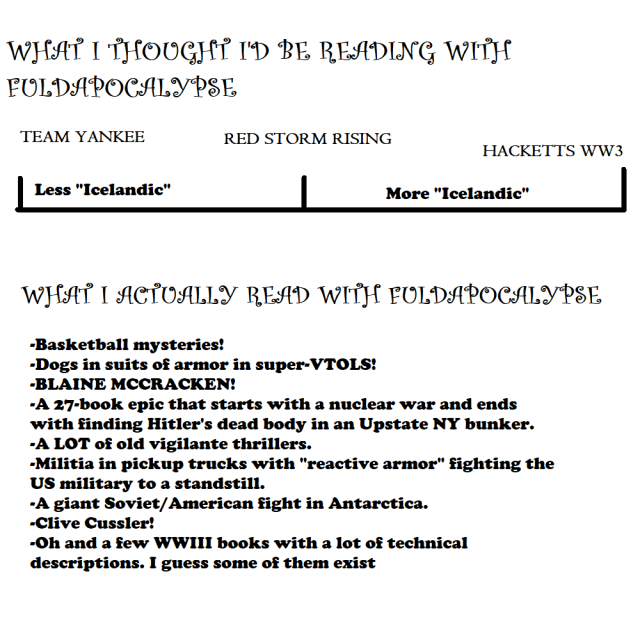
fuldapocalypseexpectation

What lessons do you think there are from the Iceland Scale?

These are kind of truisms, but…

  • Don’t get too caught up in any one fandom. While I think alternate history has some unique hangups, fandom drama is definitely not unique to it.
  • Don’t get caught up in something with small sample size, and always look for more perspective.
  • Broaden your literary horizons, even in the same basic genre.

When I wrote the Iceland Scale, I was convinced there were too many conventional WW3 stories out there. Now I feel there arguably aren’t enough. There’s certainly very few. A single very long series can outnumber the “conventional WWIII” genre, and a single prolific author can easily outpace the entire “big war thriller” type of book.  So upon seeing an “Icelandic” story, my thought is now less “Argh, another WWIII” and more “oh, it’s a niche story that probably isn’t for me”. So this horizon-broadening has been very positive. Not just for enjoyment, but for understanding.

How did this help lead to Fuldapocalypse?

Here’s how. Part of the reason for starting Fuldapocalypse was because I didn’t want to crowd out the Creative Corner. Of course, this ended up doing just that as my interests shifted, but that’s another story.

But another part of starting Fuldapocalypse came from me wanting to give these stories a more fair and critical shake. And I’ll say this flat out-I at first went about it the wrong way. My initial goal was “move past the board drama, look at ‘real’ published World War III books, and use a rigorous scale to see how they differed and what cliches they did and didn’t follow, so that your own emotion and opinions can mostly stay out of it”. It was trying to move towards a narrower slice of fiction, towards a more robotic litmus test.

Thankfully, it worked out. I soon grew tired with my self-imposed limitations and began, slowly at first, reading and reviewing stuff that wasn’t “Icelandic” at all. While it took a little while for me to throw off the shackles entirely, I did. And this is the reason why I made the post-instead of constantly obsessing over something, whatever its (lack of) quality, shouldn’t be obsessed over, this post can stand between whatever non-Icelandic works of fiction strike my fancy.

Review: The Return of the Dog Team

The Return of the Dog Team

It’s time for Fuldapocalypse to dive into the world of “William W. Johnstone’s” novels. Johnstone himself wrote (and apparently considered his proudest work) the original Last of the Dog Team in 1981. By 2005 he was dead, though he lived on as a “Tom Clancy’s”-esque brand name, with its sequel being written “with” “Fred Austin” (who I’m convinced is just a house name).

To be honest, this isn’t really that bad-or that good. Yes, the heroes are ridiculous unstoppable Mary Sues, but this is far from the only book to have that issue. Yes, the military details are frequently inaccurate, often to excess (behold the “A-130” gunship helicopter), but that’s also common. Yes, there’s axe-grinding politics and horrible stereotypes, but-you get the idea.

In a strange way, William W. Johnstone stood out. This doesn’t. It’s just “shoot the terrorist” mush that hundreds of writers have done better without the baggage attached to the name. It’s a little better technically than Johnstone himself, but still. People remember the 1899 Cleveland Spiders. They don’t remember the 2002 Kansas City Royals.

Review: Agile Retrieval

Agile Retrieval

agileretrievalcover

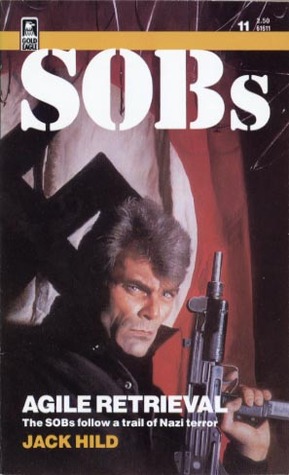
The SOBs series (officially Soldiers of Barabbas, but like Doom’s Bio-Force-Gun, the real implication is obvious) was a Gold Eagle men’s adventure series of the 1980s. Peter Nealen has cited it as one of the biggest inspirations for Brannigan’s Blackhearts. Agile Retrieval is the eleventh book in the series but the first that I read. Though series house name “Jack Hild” is on the cover, the real author was Robin Hardy.

Having read the successors first, I was on guard for the “having seen those, the original doesn’t seem so original”. This didn’t manifest in a negative way. In part this was because a lot of the elements that were copied were positive ones. For instance, giving the main characters lives outside of the action (we see the wedding and family troubles of the protagonists in the entire first part) makes them more sympathetic and human, unlike the mobster/terrorist killing robots that make up a lot of action-adventure. And in part because this entry, a chase for Nazi Macguffins in Cold War Germany, is a little unconventional.

It’s not really unconventional in a good way, though. The flaws (in particular, the stock villains) are still there, while being a little less action-y and a little more cloak and dagger takes away from the strengths of the formula. The “big, vulnerable team” subgenre of action adventure is, in my opinion, the style that offers the most, and to pull back from it is giving up a lot and not really gaining anything in return. While the structure of the series has many strong points, the structure of this particular book does not. After the opening, it doesn’t manage a good climax and remains slapdash throughout. The pool of cheap thrillers of past and present is so big and vast that I cannot recommend this except for completionists.


A Thousand Words: The Hunt For Red October

A Thousand Words: The Hunt For Red October

Probably my first exposure to technothrillers came on the screen, when I watched The Hunt For Red October long ago. The movie is both a classic and, in my controversial opinion, better than the book.

Yes, I said it. The movie distills the essence of the book into one brief tour de force. The main plot is simple enough to distill into screen form without most of the clunkiness that Clancy had even back at the beginning. Yes, there’s more “Hollywood-ism”, but there’s also less of Clancy’s bias.

Technothrillers in general are hard to adapt to the screen because they require a big budget to be effective. In this case, the filmmakers got the budget, got the actors (Sean Connery’s accent notwithstanding), and knew how to separate the wheat from the chaff. The result is one of the best film adaptations of all time.

Review: Covert Action

Covert Action

Chet Cunningham’s Covert Action was one of his last books released, out on a small independent press. While I didn’t think too much of it upon my initial readthrough, now I think it clarifies something that’s been bothering me.

Having read some of Cunningham’s SEAL Team Seven novels, the book itself is basically one of those. The names are obviously changed, but the plot structure of hyperactive zipping around the world and constant action remains unmistakable to someone who’s read the “Keith Douglass” books helmed by him. The problem is that thanks to even iffier fundamentals and considerably worse proofreading, it goes from “ok” to “bad.” The book itself I’d just leave and not really recommend.

But what was the “a-ha” moment for me was how this affected reviewing. This is an example of how some cheap thrillers can feel interchangeable-because in some cases they are. There’s this. There’s the same author doing most of the work on both the MIA Hunter and Cody’s Army series. And finally, in one of the most extreme examples, the “Sharpshooter” and “Marksman” series of ‘shoot the mobster’ novels in the 1970s shared so much and were so rushed that manuscripts from the latter were used for the former, to the point where the main character’s name didn’t stay consistent.

There’s going to be a lot of overlap in a genre that’s formulaic by nature. And not all, or even most of the books I read reach this extreme. But there’s an undeniably sour feeling I’ve been getting as I reach for the keyboard.

The kind of “51% book” that Marine Force One still stands as the best example of can still be perfectly fun to read. But I’m finding, much like I’ve found with books in the same series, that repeated examples of those are getting harder and harder to actually review.

Review: Destiny In The Ashes

Destiny In The Ashes

ashesdestinycover

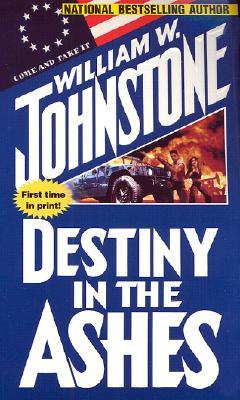
William W. Johnstone’s Destiny in the Ashes is the 32nd (!) book in the series. Released near the end of Johnstone’s life, there are legitimate questions as to whether it’s the work of Johnstone the person or “Johnstone”, the pen name used by his niece and an army of ghostwriters behind ironclad NDAs since his death. I will only say that it reads like the real Johnstone and certainly isn’t any better than anything unambiguously written by the real Johnstone.

It took over ten books for Jerry Ahern’s Survivalist to stop being truly post-apocalyptic. It took Johnstone less than one. Instead it was focused entirely on societal commentary, if the commentary came from a pretentious, incoherent redneck.

The “plot” of this book is a Middle Eastern terrorist is striking the “US” run by the EVIL LIBERAL GUN GRABBERS, and they are forced to call upon Raines in the Great People’s SUSA Utopia for help. Raines steps up, in part with lectures about the inferiority of helicopters for troop insertion compared to HALO jumps. Naturally, the Americans go in with helicopters and get killed, while the Rebels HALO drop with ease.

The “military action” in this book (and the whole series, I must add) is legitimately strange and not just poorly written. It would be one thing if, by accident or design, it involved unrealistic and overly cinematic action. There’s some of that, but there’s also hunched strategy sessions that just make no sense and end in Mary Sue stomps.

The conclusion of this book involves an effortless jaunt out to Iraq in a passage that reads like a far worse version of a Chet Cunningham SEAL Team Seven novel. This continues the trend made far earlier in the series when Johnstone ran out of domestic “punks” for Raines to kill and had to send him abroad to get more.

The writing is terrible, the pacing is only somewhat bad, the plotting is terrible, and the characterization is extra-terrible. Yet, if it makes sense, the Ashes series is genuinely and distinctly terrible. A horrendous writer got a conventional publisher to produce and distribute literally dozens of his picture-book war stories and become successful enough that he endured as a “Tom Clancy’s” -esque brand name. That’s what makes it stand out.

Front Defensive Operations

frontdefense

From the Heavy OPFOR Operational, here is a picture of a front-sized defensive operation. My first thought upon seeing it and counting the divisions, besides any political concerns, is – “Does NATO even have enough forces to break through it without a huge amount of technological superiority”?

This particular diagram is something of an idealized best case, as the front has both a second-echelon tank army to counterattack and several independent divisions as “combined arms reserves”. But still. I’d have to ask…

  • How much of a force multiplier are the initial belts (which were expected to be overrun?)
  • How much of the artillery and missile forces can survive and fire effectively on the attackers as they approach?
  • Most importantly, what’s the overall context?


Review: The Delian Cycle

The Delian Cycle

The quality of Kenneth Bulmer’s “Delian Cycle” of Dray Prescot novels (I got the omnibus edition) can be described in this anecdote. I dove straight through all 27 Survivalists with ease. To get through the five individually shorter Prescots took me considerably more effort. The question is…. why? I know I’ve explained my frustrations in my review of the second installment, but they deserve elaboration. After all, it’s not like I’ve had objections to reading similarly shallow cheap thrillers before.

The biggest reason is the prose, which is incredibly overwrought. It’s very hard to get through and takes away from whatever feelings the action might generate. Bulmer is seemingly never satisfied to use one paragraph to describe something when he can use three, and throw in another made-up word or ten while he’s at it. Still, if I can read Mike Lunnon-Wood, I can read him.

Then there’s the action, which labors under the horrendous prose and is just so constant that it becomes mundane. This is another reason, and it’d be a perfectly good reason. After all, cheap thrillers need to be good with action. But the action still isn’t the worst.

Another issue is the setting. The worldbuilding consists of nothing but throwing out so many names that the omnibus needs a giant glossary at the end, yet all it accomplishes is the creation of a sword and planet theme park, with the “exotic” names and airships and places being pushed so hard they lose any appeal. But it’s not like a bad setting is an absolute turn-off in a genre that depends on execution.

No, I think the biggest problem is the artificial nature of it. The books always involve Prescot getting teleported in and out by the MacGuffin People Star Lords. To use so blatant a setup would be bad, but what makes it worse is that they’re written in a kayfabe “Prescot has narrated this on cassette tapes to Alan Burt Akers [Bulmer’s pen name]” style. What turns this from a gimmick into a flaw is that the tapes are used as get-out-of-trouble cards where-not infrequently during a dramatic moment-Bulmer will just say “and then the tapes are missing, but Prescot clearly got out of it”.

I maintain a weird curiosity for the series, but it’s not very good.

An Old Story Draft Of Mine

So, a long time ago I had this idea in my mind. Now, granted, I didn’t know how to proceed from there, but it was this idea I had in my mind. Maybe it could still work as a very short story by itself.

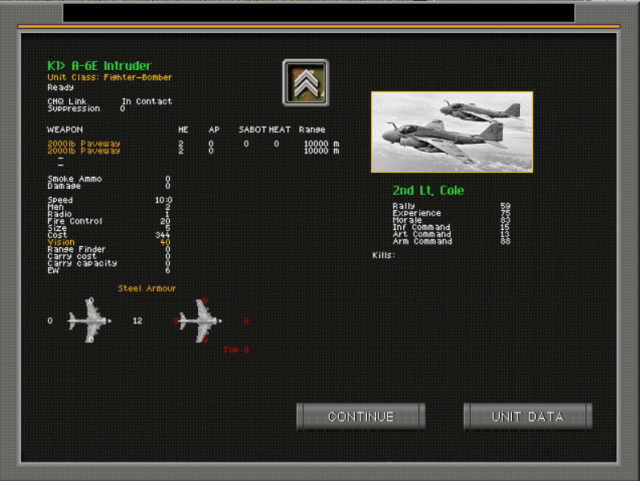
I’ve talked before about “Steel Panthers Characterization”, derived from this:

spexample

Basically, in Steel Panthers, a unit has a nationally appropriate name and rank applied to it. Being otherwise interchangeable, this means nothing else in terms of characterization.

I came up with the term “Steel Panthers Characterization” to describe situations when characters were not just underdeveloped, but seemed to exist solely to put a certain piece of military equipment into action.

Fortunately, just as there were many, many fewer “Big-War Thrillers” than I’d thought, there are equally as few Steel Panthers Characters. Yet as a formative experience, this introduction stuck in my mind.

Basically, there would be a pilot in a two-seat, side-by-side aircraft, like an A-6 (as in the illustration) or an F-111 or an Su-24. It would dive in, release its weapons, and fly away on a routine mission.

Suddenly, the pilot would realize something wasn’t right. He looks at the other crewman, clad in his flight suit. Lifting up the visor, the pilot sees absolutely nothing underneath it. Same thing with the gloves and sleeves. Unnerved, the pilot simply ejects. His fate would be left ambiguous in a short story, but in a longer one he would become one of the characters.

What’s soured me on the concept is that I’ve felt it’s not only too harsh a critique, but also too inaccurate of one, given how few works really sink to that level. And the ones that do either make up for it in some way or are just unfairly easy targets. But still, the draft of the pilot’s story is something I feel I should share.