Review: Unflown Wings

Unflown Wings

I was somewhat critical of Yefim Gordon’s book on the MiG-29. Yet for his Unflown Wings, showing nearly a century of never-built Soviet/Russian aircraft, I’m far less so. This is an amazing book about amazing aircraft. It’s rightfully massive, covering every major design bureau.

People looking at the weird “Luft 46” German aircraft often overlook that every country had its similar oddball paper planes. And so it is with this book. With many illustrations, one can see everything from the redundant to the too expensive to the too out-there. It’s a lot to make you wonder what could have been, from the cancelled jet-powered maritime patroller to giant seaplanes to my personal favorite, the overambitious “Backfiretomcat” Tu-148 multi-role fighter.

The very nature of this book means that the issues I had with the Fulcrum one are far less so. Because the aircraft here never actually entered service in any event, it means there’s less need for total rigor and one doesn’t have to be “deep”. Breadth is required for this overview, and it’s very, very broad indeed.

This is a very fun, very thick book, and I recommend it to any aviation fan in spite of its size and expense.

A Thousand Words: Pokemon Black/White

Pokemon Black and White Versions

It was recently the 11th anniversary of Pokemon Black and White’s release. Now in terms of actual gameplay, it’s the same monster-catching as always. But in terms of opinion, it’s one of the games where, with full hindsight and difference, my views on it have shifted the most.

At the time, I viewed the story’s very slight challenge of its premise as something hamfisted and dumb. For the gameplay, while it wasn’t bad, it still felt like business as usual. Now with three more generations and a decade of thought, I can actually appreciate it more.

The first thing is realizing that Unova, the region of the game, is (loosely) based off my local area, the New York City metropolitan area. That’s neat, at least. The second is seeing that Game Freak played it so safe with the next three games that their mild, necessarily child-friendly critique comes across as the best they could do. Instead of slamming them for not doing it the best, I can praise them for trying. The third is the graphics. This was the last Pokemon game to feature classic sprites, which reach their apex here. After that, it’s ugly, basic, horribly optimized 3D models.

So what I wasn’t the fondest of at the time has turned into a nostalgic memory.

Review: Mikoyan MiG-29 and MiG-35

Mikoyan MiG-29 and MiG-35: Famous Russian Aircraft

The MiG-29 was the last hurrah of the legendary Cold War bureau. Aviation authors Yefim Gordon and Dimitry Komissarov write about it in the extensive Famous Russian Aircraft: MiG-29 book. The book is both a wonderful treat and a bitter “what could have been”. First, the obvious needs to be stated. This is a book for aviation enthusiasts and not a general audience. If you don’t know much about the MiG-29 or military aircraft already, it’s not a good first choice.

But even as a niche in-detail work, it’s uneven. Gordon has a reputation online for not being the most reliable source, but I wouldn’t know enough to comment in that regard. Whatever the veracity, the book is extremely broad, covering each and every prototype, variant, and proposal of the Fulcrum complete with excellent pictures and once-rare photographs. You want to know the exact radar designations? This is for you. You want to know the slight visual differences? This is also for you.

Yet while it’s broad, this book also feels shallower than it could have been. This manifests most visibly in the section on the actual service of the MiG-29. There, it’s a combination of more lists and stuff that I’d already heard about. It was disappointing and could have used a little more doctrinal meat.

Finally, the book feels a little, well, inefficient. It’s a very long impressive paperweight of a hardcover, but its layout and formatting doesn’t look very space-effective. The pictures are good, but their organization isn’t. That being said, take this book for what it is-something meant for serious aviation fans. It’s what you’re getting, for better or worse.

A Thousand Words: Stealth

Stealth

2005’s box office flop Stealth has become a cult classic for all the wrong reasons. This military thriller feels like what would would happen if you took someone who once read a Dale Brown novel and watched a few old war movies as his sole references, gave him a $100,000,000 budget, and turned him loose. It has “stealth” aircraft behaving in the least stealthy way possible, a haywire robot plane, and a bunch of jumbled plotlines that end with the characters just walking casually across the Korean DMZ.

I’ve long felt that the movie would be better if it was either smarter or dumber. If it was smarter, it could be prescient look at drone warfare. If it was dumber, it would be a much more focused Iron Eagle-style funfest. Instead it’s just a bizarre mess with the occasional attempt at a serious point mixed with advanced jets fighting like it’s 1916 and product placement music.

Still, I can’t bring myself to truly dislike this movie. The sheer excess of it in all directions means that it’s at least interestingly bad. And it does have explosions in it.

The Similarities Of Two Seemingly Different Activities

What I like about my favorite simulation games is that you can set up a situation and see how it plays out. Sometimes it’s an obvious situation, and sometimes you legitimately don’t know. Sometimes it’s legitimately relevant to contemporary issues, and sometimes it’s a total gonzo fantasy. I did think that writing fiction was different-until I actually wrote multiple books.

In the spectrum of “write completely as you go along” to “meticulous plotting”, I’m somewhere in between. I do make outlines and character lists, as much as so that I don’t forget them as for any other reason. But my final products have frequently either diverged from the outline or incorporated something not in them. Reminiscing on that has made think “a-ha, so it really isn’t that different from a sim.”

It involves me setting up a situation (which is to say the basic plot and main characters). Then it involves me seeing how that situation plays out over the course of me writing and editing it. It is fascinating to look back on my completed books and see how their development unfolded.

Review: Give Us This Day

Give Us This Day

I bought Tom Avitabile’s Give Us This Day in a grocery store. It should have been a bad sign. Sometimes “grocery store books” are good. This one was not. Even by cheap thriller standards. No, make that especially by cheap thriller standards. The action scenes have the exact same (flat) tone as the rest of the book, for starters.

Anyway, we get secret agent Brooke Burrell as she shoots…. terrorists. Yep, it’s a “shoot the terrorist” novel, and the execution is nowhere near good enough to make up for the bland premise. The writing is done in rambling, really blocky paragraphs and constant jumps in iffy formatting. No one is particularly interesting.

This is the kind of book the mainstream technothriller devolved into in the 2000s. It combines “technology” and viewpoint hopping with watered down action and no sense of a big picture. There are just so many better cheap thrillers out there.

Review: Silent Night

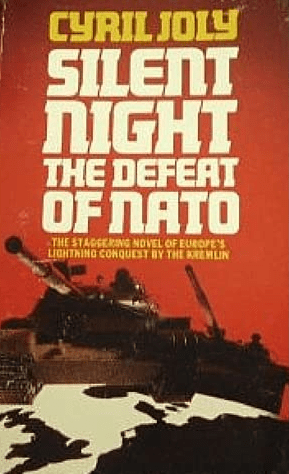
Silent Night: The Defeat of NATO

I thought that the well of classic Fuldapocalypses had run too low. Then I found out about and read Silent Night, a 1980 story about a Soviet invasion of Western Europe. Written by WWII tank veteran Cyril Joly, it, as the title suggests, tells the story of NATO’s loss. There’s a reason why this book is not mentioned alongside Red Army in the list of “bad guys win” novels. Or talked about much at all.

That’s because it’s a terrible book. First the prose is clunky and none of the characters sound natural. Then there’s a ton of conference rooms, hopping viewpoints around everywhere and a tone of forced “solemn darkness”. It honestly reminded me of the online TLs/fanfics I’d read and gotten too angry about-but this was published in 1980. Of course, one thing about it is incredibly different and that is the nature of the war’s conduct.

Basically, 99.9999% of the work is done by infiltrated-in irregular forces, ranging from external operators to local collaborators. They smash bases, kill or capture commanders, and generally break NATO completely. By the time the Soviet conventional forces cross the Inter-German border, they’re facing only a tiny amount of scattered, light resistance. I’d compare it to the Iraqis in 2003 or the final stages of World War II in the west-but that would be an insult to the Fedayeen Saddam and Volkssturm.

After the cakewalk conquest, the later portion of the book involves a clear author rant where he suggests that NATO dramatically reduce its conventional forces in favor of fortifications with “micronuclear” launchers. Then it ends with an OOB dump to add “character.”

There’s a thing called survivorship bias, where you get nostalgia because you remember the good and not the bad. People remember Red Storm Rising, Team Yankee, Red Army, Chieftains, and Hackett for good reasons. They do not remember this, and it’s also for good reason.

Review: Hitler’s Last Levy

Hitler’s Last Levy

Hans Kissell was chief of operations for the German “Volkssturm” (lit. “People’s Storm”), the infamous last-ditch militia created at the end of World War II. In Hitler’s Last Levy, published in German in the 1960s and translated decades later, he told their story. It’s an interesting look at a horrific footnote.

The Volkssturm was both a desperation formation and Martin Bormann’s attempt at making his own pet army (like the SS was for Himmler or the Luftwaffe ground formations were for Goering). Kissell goes into detail and includes a massive amount of direct primary sources. While this is a work by a German WWII commander, its subject matter makes it at least a little better than the usual “we fought in our unstoppable kitty-tanks until we ran out of ammunition and fought totally cleanly” memoirs. It’s impossible to portray the ragged old men as some kind of super-army, and they had far less opportunity to commit war crimes simply because by that point they were losing. And Kissell doesn’t hesitate to point to their (many) weaknesses.

Because of this, and because of the wealth of primary sources and details (for instance, describing how on paper, some Volkstturm battalions had an organic battery of captured anti-tank guns), I recommend this for anyone wanting to know about them or similar emergency territorial formations. Yes, it’s dated and slanted. But it’s not nearly as bad in those regards as you might think.

On Sports Betting Media

The legalization of sports betting in the United States has brought about a wave of media devoted to it. And even in the offshore era, there were no shortage of websites talking about gambling. After looking at sports betting media, it didn’t take me long to sour on it. Even with less direct knowledge, it came across as being extremely shallow at best and, more often, something sinister seeming. It felt like trying to goad people who knew basic sports trivia into playing a stacked against them game (even back then, I knew the fundamentals of how gambling worked).

And after finding out more, studying more, and getting the spark that would lead to The Sure Bet King, I feel weirdly proud to say that well, I was completely on point. The conflicts of interest are there. Sportsbooks themselves and their loss share affiliates (people who get others to sign up to the books in exchange for a share of the house winnings) obviously have no direct incentive to help punters win and much motivation to help them lose. There’s a reason why sportsbooks hype up the people who hit a monster parlay/accumulator (where multiple outcomes all have to win), because those are where the house has the biggest edge. The idea is to get Joe Sportsball Fan to be convinced that if he follows his gut and knowledge of trivia, like how Aaron Rodgers doesn’t have that clutch spirit, then the jackpot will be his.

Even more innocently, I think (no pun intended) that even without this conflict, a lot of sports betting shows are just basic sports opinion pieces given a gilded gambling coating. The indispensable “Sports Truth with William Leiss” channel (who I actually thanked in the dedication to my book, and with good reason), has two videos showing this, which is dubbed the “think tank.” There isn’t any actual statistical analysis (not that most sports hosts could really do it beyond “Oh, he’s hitting .230”), just stuff like “I think that the Giants offense isn’t ready yet so I think the Colts will cover.”

Then there are the few sharp bettors who are (of course) magnified on social media. To be honest, after seeing what it entails, I would chose one of my old jobs that involved hauling carts back to a rickety old, cramped supermarket, often in bad weather, for six days a week, in an instant over being a professional sports bettor. It just feels almost wasteful, like a strange form of slumming from people who have the drive and/or intelligence to succeed at other careers that are far less zero-sum and far more relaxing. Learning that a lot of the “sharps” win not by being better handicappers but by a combination of manipulating the lines and doing the equivalent of coupon-clipping and bargain hunting, further drove my opinion down.

In fact, despite me maintaining every bit of negative feelings for the sleazy tactics of the bookmakers, I actually began to take their side to an extent regarding the banning/limiting of winners (one of the most vocal complaints from the sharps). And it wasn’t just “oh, they have to make money.” It was more like “oh, they have every right to keep munchkins from plundering them. Good for them.”

And then there are the touts, or tipsters. These pick-sellers are nearly all scam artists, and when I saw how they worked, I knew that one would be the perfect topic for a novel. Touts got amplified because for the longest time they were the only sports betting figures who could operate semi-openly (see the infamous infomercials), and they took advantage of it post-legalization.

Finally, there are the various governments who treat sports betting as a tax-producing cash cow. New York is particularly ham-fisted in this regard, which is even more counterproductive because there’s the far more lenient New Jersey right next door. So yeah, there’s that too.

So I came away from my research with even less regard for the sports betting industry than I had before-and more of a feeling that it would be great subject matter. So I wrote my first full-length novel about that very topic. And I had lots of fun doing so.