Review: Serial Vigilantes of Paperback Fiction

Serial Vigilantes of Paperback Fiction

Bradley Mengel’s Serial Vigilantes of Paperback Fiction takes on the task of trying to catalogue many, many cheap thrillers. Mengel uses the term “serial vigilante” to describe what many call “men’s adventure”, and what would in many circumstances be labeled “action hero” on this blog. It’s an impressive feat.

Most of the book is lists and descriptions of various series’ in this subgenre. It’s a self-proclaimed encyclopedia, so its descriptions are broad and not deep. Interestingly, it provides page counts. Though a little dated thanks to to its 2009 publication date, this book has nonetheless been an invaluable resource for finding obscure series.

A Thousand Words: Time Gal

Time Gal

The 1983 video game Dragon’s Lair pioneered a feature to get around the then-primitive graphics of the time. Animated scenes would play via laserdisc while the player engaged in what are now called quick-time events. One of the more memorable versions of this is 1985’s Time Gal.

First, it has legitimately good-quality animation, no doubt due to the presence of the big-time Toei Animation doing the work there. Second is its premise. Basically, someone stole a time machine and Reika, the game’s heroine, must pursue him throughout many times, from the far past to the far future. Goofy anime antics and quick-time events galore ensue. There’s a tiny bit more depth in that from time to time, the game will briefly stop and allow the player choices, only one of which will succeed.

One of the more bizarre coincidences of the game is the one that ties it to Fuldapocalypse. The “AD 1990” stage features Reika avoiding M1 Abrams tanks and an AH-1 Cobra helicopter on a battlefield. The closeness of the then-future date to the actual Gulf War is uncanny, especially given how pop-culture to outright wrong everything else is.

This is a goofy spectacle that was meant to be a goofy spectacle. For the voice acting to be technically “better” or the animation to be more recent and even smoother would ruin the experience. And while many “interactive movie” games were cheap bandwagon-hoppers, this is not.

Review: Ripple Effect

Ripple Effect

I’ll be honest. The sole reason I was attracted to Ripple Effect was the name of its main character, “Bear” Logan. Given how I like thrillers with ridiculous character names, I figured I had to check this one out. So I did. And this time the “the more ridiculous the name, the better” explanation didn’t really work out.

It’s not bad, but it’s only merely adequate at best in a genre filled with adequate books. The only standout feature, besides the name, is how it jumps between first and third person perspective in its writing-something that I don’t think really adds anything. The action is adequate. The pacing is adequate. The characters are adequate for this kind of book. You get the idea.

Tank Fiction

The comparative lack of “tank fiction”, especially non-historical tank fiction, compared to other types of thrillers isn’t really that surprising to me, but it is a little bit disappointing. I can see why that’s the case, because tanks have less (literal and figurative) flexibility than dismounted people, and because they can appear in books without being the absolute center of everything.

Still, when it does appear, I tend to like tank fiction. Tin Soldiers, a tank novel extraordinaire, is arguably my favorite post-1991 technothriller. Although this raises the question of how prominent a tank or other AFV needs to be in a book for it to be considered true “tank fiction”, especially once one gets past the easy cases.

Review: Roadside Picnic

Roadside Picnic

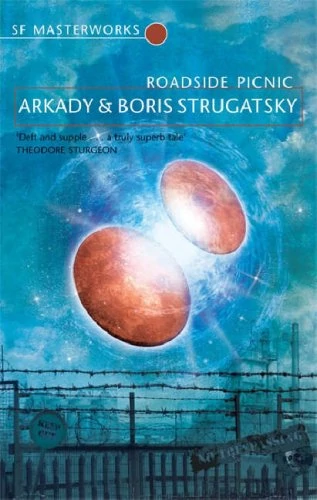
It’s time to review another classic of science fiction, the Strugatsky brothers’ Roadside Picnic. It’s famous for leading to the “Stalker” movie and video game series, as well as gaining extra prominence after the Chernobyl disaster. But how does the book itself hold up?

Sadly, my thought after reading it is “not the best”. Maybe this is just the translation, but I felt constantly felt like the concepts were far better than the execution. The execution felt like it was either dull or pretentious with nothing in between, while the concepts of both “ultra-advanced aliens nonchalantly passing by” and “weird zone full of weirdness” are more interesting.

Perhaps this kind of higher-brow science fiction just isn’t my genre. But I could see why the book was both influential (because adaptations could take advantage of the really, really good concepts) and at least in some places less prominent by itself (because the actual novel doesn’t work as well).

Review: Philippine Hardpunch

Philippine Hardpunch

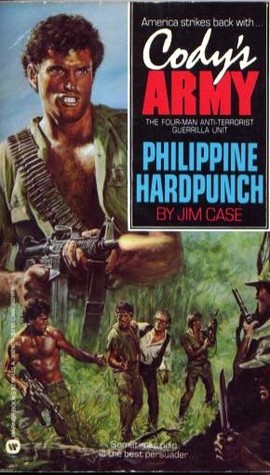
Of all the books in the Cody’s Army series, Philippine Hardpunch may be the most middling. Given the nature of 1980s “men’s adventure” fiction, that’s very forgivable. It could easily have been something worse than “middling”, and can still succeed as a time-passer. John Cody and his “army” of three other people still fight, and the result is still a competent cheap thriller.

That being said, in hindsight it falls particularly short. The later Hellfire in Haiti takes its basic premise (associate of a recently ousted, headline-grabbing dictator tries to retake the country, the “army” opposes him) and has a spectacularly better execution. Thus, this becomes one of those books that I’d put in the “only for genre ultra-enthusiasts” category. Not because it’s bad, but because it’s in a genre where there’s just so much available that it has to be really good to stand out. And sadly, this isn’t.

Review: The Ultimate Solution

The Ultimate Solution

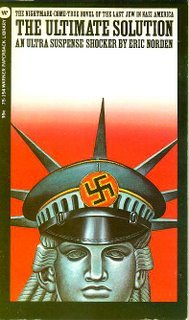
Eric Norden’s The Ultimate Solution is a fairly early alternate history novel. A short book told in the style of a classic detective novella, it tells the story of an NYPD officer who, after the German victory in World War II and occupation of America, must track down a reappeared Jew, long after they were thought exterminated. Or at least that’s what the nominal plot is about.

The real meaning of this book is a trend in alternate history that this book was a pioneer in-use an Axis victory world as a way to express social commentary about contemporary society. This is the kind of thing that sometimes can be an insightful “mirror darkly” presentation, but often degenerates into massive axe-grinding.

Here it’s the latter, with a vengeance. Norden has the subtlety of Tsar Bombas preceding a parade of NASA Crawlers blaring Korn out of sonic blasters. Everyone is a (literal) puppy kicking monster. It’s so over-the-top it actually takes away from the message. Instead of “this is how good people can believe and do bad things”, it’s the far less profound or interesting “people here are bad”. And since most of the small book is devoted to this horrible horribleness of horrors, there isn’t really much else. This is the kind of book that’s interesting for its place in the chronology of its genre (in this case, alternate history) but has little else to recommend it.

A Thousand Words: Undertale

Undertale

It’s the 5th anniversary of Undertale , the cult classic indie RPG/homage to Earthbound. It’s hard to really explain, because in some ways it’s a victim of its own success. There was a yo-yo of crazed fandom and understandable backlash. People know the plot twists now.

When I first played, I didn’t, and I could appreciate what it delivered, and what’s been lost. So yeah, I know it’s a five year old game now and has been successful, but I’m going to be spoilering it all.

You control a deliberately androgynous-looking child (I thought the sprite looked more feminine) as they fall, Alice-in-Wonderland style, into a sealed-off world of goofy monsters. The battle system is an action-RPG hybrid where you can move around on a screen to avoid attacks.

What works is how it works with the expectation of it being a normal RPG. Basically, I thought “You don’t have to destroy anything” was just a sardonic comment like Postal 2’s “only as violent as you are”. Flowey, the psychotic flower-beast, is basically a “lolmeta-lolgoofyIkillforfun”… at first. When I first battled Toriel, the overprotective monster-mother, I was convinced that reducing her to zero HP would just trigger some kind of cutscene, and that she’d be fine. (She wasn’t).

To date, one of my absolute best video game moments comes from fighting the dogs. Now, they’re portrayed as little more than normal enemies and not the most special, so I deal with them. Then I go into the town and they ask where the dogs were and how good they were and wonder what happened to them and I go…

“Oh.” (gulp)

That’s why I haven’t personally played the game since my one violent neutral route. In many way it’s still a short, cheap, simple indie game, and the magic just wouldn’t be there if I knew what was happening.

Even with the blind run, the game had some down parts. The Hotland area is execrably bad, being a combination of the same lame social media joke, an extremely annoying character, and puzzles just hard enough to annoying but not complex enough to be fun. I felt like I had to stagger through-then came the finale.

Even with full hindsight, I can say this-the finale, whatever route, is the highlight of the game. Part of this, I believe, is that it plays everything straight and goes for legitimate gravitas. The best fiction, even the kind that’s often silly, knows when to be earnest, and the conclusions of Undertale count as that.

It’s still good-the music and art are both excellent, and the mechanics, while simple, aren’t bad by any means. Undertale definitely deserves its success. It’s just that I think it was at its absolute best when you didn’t know what to expect-and I was fortunate enough to play it that way.

Nuclear World War IIIs

So I figured: How true was my stereotype of “conventional” WW3s? I decided to take a look and see. For this exercise, “yes” means a full nuclear exchange, “partial” something like say, Hackett’s infamous plotnuke, and “no” means the war stays completely conventional. This is an incomplete, unscientific list, but still.

  • Hackett-PARTIAL
  • Red Storm Rising-NO
  • Team Yankee-PARTIAL
  • Red Army-NO
  • Chieftains-YES
  • Black’s “Effect”-PARTIAL
  • Kirov-YES
  • Arc Light-YES
  • Red Hammer 94-YES
  • Bear’s Claws-PARTIAL
  • Cauldron-PARTIAL
  • War That Never Was-NO
  • Ronsone/Watson’s Red Storm-PARTIAL
  • Zone-PARTIAL
  • Weekend Warriors-NO
  • The Red Line-PARTIAL
  • Andy Farman’s Armageddon’s Song-PARTIAL
  • Wingman-YES

Besides the possibility of me remembering wrong, the line between “Partial” and “Yes” is sometimes blurry-for instance, I had a hard time deciding whether or not to include Arc Light as “Partial” or “Yes.” And in Team Yankee, which follow’s Hackett’s plot, the nukes are offscreen. Still, it was a little surprising how few outright “no’s” there were and how many “Partials”. It’s just the biggest “no” was Red Storm Rising.

Review: Exxoneration

Exxoneration

The American invasion of Canada finally begins in Richard Rohmer’s second book on the subject, Exxoneration. The previous installment, Ultimatum, ended with the US announcing its intention to annex Canada. Here, it moves ahead.

As far as its literary quality goes, I’ll just say this: I’ve read field manuals that were less cumbersome and infodumpy. Seriously. The mega-padding is still there, including such things as aircraft takeoff instructions. And the er, “lopsided” nature of a Canadian/American armed conflict means the book has to twist to have its cake and eat it too.

There’s only one fairly brief semi-battle in the novel itself. In it, the Canadians ambush a flight of American aircraft landing at Toronto who falsely assume the invasion will be unopposed. Basically, the Canadians need to win but there’s obviously no way for them to win conventionally so they have to rely on American public opinion (plausibly) promoting a backlash however the tone of the book is such that it wouldn’t do to have Canada devastated by war, so the only onscreen conflict needs to be short and neat.

Most of the book is just about the later efforts by Canada to purchase Exxon (hence the title). Needless to say, this is not exactly the most scintillating topic. While a better author could have made it exciting, Rohmer does not.

I want to compare this to Mike Lunnon-Wood, who wrote about slightly ridiculous to highly ridiculous scenarios in a matter-of-fact manner, but Lunnon-Wood’s prose is significantly better than Rohmer’s. It takes some effort to make a book about a Canadian-American war dull, but Rohmer does so.