A Thousand Words: Waterworld

Waterworld

Guns N’ Roses November Rain is widely recognized as the final, out-with-a-bang entry of the musical niche known as the “power ballad.” Kevin Costner’s infamous Waterworld kind of feels like the movie version of this. Of all the movies labeled the worst ever, this deserves it the least in hindsight-though it’s perhaps fitting, since critics never cared much for hair metal anyway.

The plot and setting make no sense, and the acting is nothing special, barring Dennis Hopper’s typically hammed-up villain. But what this movie offers is spectacle. Before CGI truly came along and money became tighter, the huge practical effects epic had to have one final giant push. And in the form of the evil ski-jumpers, hamfisted environmentalism (from a movie that had to make a giant, inevitably polluting, artificial island in its production), and piles of (oil-burning) pyrotechnics, it succeeded.

This movie can’t really be considered “good”, but I had a lot of fun watching it.

Review: Firedrake

As of now the most recent book in the Kirov series, Firedrake combines the worst and best of it all. The worst is that all of the structural problems are still there and that the wargame lets play structure is beginning to wear thin, especially with the foreshadowing that this particular timeline is getting erased/destroyed. The best is, well….

The best is that plot points involve the ship transported to a bleak, dark, empty world where only hostile mechanized drones roam the seas and skies (was it Skynet or Yawgmoth that was responsible? :p ). Then it moves into another timeline courtesy of supervillain Ivan Volkov, where a Third World War (the fourth in the series) is about to begin, one where Japan won the second thanks to Volkov giving them nuclear bombs.

The Kirov series is best when it wargames out drastically changed situations, and that is the case in half of Firedrake. The other half is wargame action as usual.

Review: Ultimatum

Ultimatum

Richard Rohmer’s Ultimatum is the story of the U.S. invading Canada as written by a Canadian. More precisely, it is the buildup to the invasion, the haggling, set in the backdrop of the 1970s energy crisis as the embargo-facing US confronts resource-rich Canada. Because of this, the novel takes the form of one conference room scene and exposition drop after another. It’s a book meant to show events, not characters.

It’s also a book that, although fairy short, features ridiculous amounts of padding. Part of this can be justified in that its format is that of “events/setting-first”, but even by those standards, it has a lot of stuff beyond it. There are incredibly long Herman Melville -style infodumps on everything from the nature of the Canadian government to pipelines to transport aircraft. A subplot involving two bomb-planters is about the only time the book leaves the meeting room, and even then it somehow feels like it could be cut without really missing anything.

Although I will say that a plot involving native saboteurs destroying oil infrastructure, helping lead to a large, somewhat contrived war is basically Red Storm Rising more than a decade before the real Red Storm Rising was published. I don’t know if Tom Clancy saw the plot and I think it’s likely just a coincidence, but it’s still an interesting combination. And in some weird ways it’s actually more plausible than Red Storm Rising, given that seizing Canada directly is more straightforward than “invade Europe so we can seize the Middle East later.”

However, the actual war will have to wait for the sequel, Exxoneration. Here, the book simply ends with the declaration to annex Canada. Thus, it’s all setup.

In terms of quality, this is a very dated book, and I’m not just talking about the politics. It’s entirely meant to capture a zeitgeist, giving curious readers a look at the wheeling and dealing towards an event. This was a time period where the US openly studied seizing OPEC-held fields by force, after all. But this type of work, especially one as “matter of fact” as this, has a very short shelf life, and the result is a historical curiosity.

The Lack of Mainstream AH WW3

So, a look at alternate history conventional World War III novels revealed a very small number of them. Even smaller is the number of novels that were alternate history, took place after 1980, and made by larger/mainstream presses. Granted, like in that previous post, I used only the most unambiguous examples. But even I was a little surprised by the number I ended up with.

Zero.

I found two games that fit the criteria. These were World in Conflict and Eugen’s Wargame series. But those are games, and I think they’re a different paradigm. If I wanted to stretch things, I’d go with the Command and Conquer: Red Alert games. Those are kind of like including the Wingman novels in with Hackett and Bond, but they’re alternate World War IIIs.

Yet I’ve seen no actual novels, and if they existed, they’d probably be well below any “too obscure to really ‘matter'” standard. Everything has been either futuristic or contemporary. What I find very telling is the case of Walt Gragg’s The Red Line. That was crudely transformed into a “contemporary” setting instead of being sold as alternate history.

And the big-name AH authors have stayed away. Harry Turtledove has made a series about a 1950s World War III but not a 1980s Fuldapocalypse. The closest Robert Conroy came to one was a book (and one with nukes involved) set in 1963. Of all the topics that other authors choose when they dip into alternate history from time to time, the “conventional WW3” simply isn’t one of them.

Now, there are several reasons I’ve theorized for this. Perhaps the biggest is that it’s a small genre to start with, and there’s little incentive to not go for either a conflict that actually happened or a contemporary one, both of which have more mass appeal. There’s far more of a hook and comfort (as weird as it is to say) with a realistic nuclear conflict. The second-biggest is that much mainstream AH is generally meant to be metaphorical, to represent some contemporary issue through the lens of a different past. To be frank, the prevailing style of most conventional World War III fiction is not the ideal medium to express these. About the best you can get is something directly related to the military in some way.

So this makes printed alternate history World War III something that’s the domain of enthusiasts, for better or worse. While I already knew that to be true in general terms, I didn’t know the extent until I counted it. And the reverse is also true-Tom Clancy, Larry Bond, and Harold Coyle quite understandably did not write tales of a Cold War gone hot a decade or two earlier.

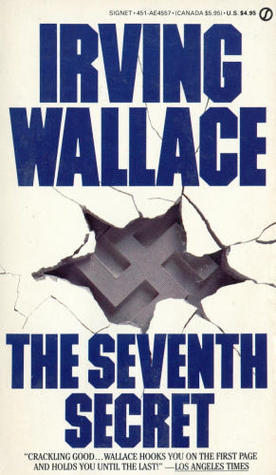
Review: The Seventh Secret

The Seventh Secret

One of those “just a little bit more highbrow than the mushiest mush” popular fiction authors, Irving Wallace had The Seventh Secret as one of his later books. This is an entry in a subgenre that can best be described as “HITLER LIVED!”, the kind of “secret history” book that embodies a trope that probably started the moment the war ended.

This book has a lot of detail that’s basically higher-brow versions of “I know the exact designation of a Scud TEL”. It has Wallace’s reputation for sleaze come across as well. While this sort of thing is common among cheap thrillers, it’s a little bit worse here. Yet the book manages to flow well in spite of these, to his legitimate credit. It also has surprisingly good buildup.

Yet the book ultimately comes across as, weirdly, both too bizarre and too mundane at the same time. Part of this is the very premise. Part of it is a comparative lack of action, with only a handful of humdrum fight scenes. The biggest part, and one that takes away from the effective buildup, is that there really isn’t that much of a villainous plot, expecting the audience to take “HITLER LIVED” as awe-inspiring enough by itself. Still, this was a satisfactory book.

Review: Supercell

Supercell

A tale of FBI agents hunting prisoners who escaped after a weather disaster, Douglas Dorow’s Supercell cannot be mistaken for anything except a light literary snack. And it’s not the “healthiest” literary snack, being a pure cheap thriller. But it is a tasty snack.

Independent publishing pretty much saved the “lightweight novella”. A long time ago, something like this could have been released by a large publisher, likely under a house name. Now, it’s the sort of thing that’s the purview of independent authors. And that enables works like this to flourish again.

Review: Kirov Season 6

Kirov Season 6

So, I’m FINALLY caught up with the entire Kirov series as of now, a feat of great effort even for me. The Season 6 “Next War” arc is, with hindsight, one of the weakest in the series. Unfortunately for me, it was the first arc I encountered. The second of four World War IIIs depicted in the series (this has to be some kind of record), it follows the World War II mega-arc.

In terms of actual writing, the individual books aren’t any worse than other Kirovs. The problem is its comparative mundanity. It’s one of the most recent examples I’ve seen of the “Captain Beefheart playing normal music” effect. It’s a contemporary World War III. Apart from a few half-hearted hypotheticals here and there, the only really substantive addition is a bigger Russian Navy, and that seems there just to have repeated large sea battles at all.

As for the time travel soap opera, there isn’t that much there. The war starts because Tyrenkov, a time traveler from the 1940s went forward , seized control of contemporary Russia, misinterpreted a possible future where he won as a definite future, and then started the war. Between that and the fetching of more of the time-keys (obvious plot MacGuffins), this is pretty restricted. About the only redeeming part there is the (sadly too small) presence of Ivan Volkov, the closest thing the series has to a primary non-historical antagonist. Volkov is a cross between a puppy-kicking supervillain and a crazy schemer who’s a lot less smart than he thinks he is, and remains my favorite character in the series. While there is some Volkov, there isn’t enough.

The only other new characterization is Tyrenkov, after fleeing to the ship as the war spirals out of control, being forgiven far too easily for my liking. The rest of the main cast stays the way they’ve always been, and they’re swamped by the shallow Steel Panthers Characters.

Otherwise, it’s a mixture of being restrained by semi-realistic orders of battle, cover ground that lots of other wargames have gone over, and, worst, having the contemporary setting give the author a justification to er, opine. It’s not the worst, but it’s still an issue the less “connected” installments didn’t have. It also feels-redundant, going over similar ground that the initial World War III in the books 4-8 arc did (to the point where I not unreasonably thought it was the exact same war), and having the same outcome (nuclear destruction and the ship timeshifting away).

Thankfully, the series improves significantly in the next arc, as a World War III in the altered reality created by the ship’s intervention in World War II allows the “wargame sandbox effect” to really flourish in a way it doesn’t here. Season 6 itself has all the weaknesses of the Kirov series as a whole and very few of the strengths. I’ve compared the series to an overly literalist lets play of an RPG. If that’s the case, this is the dungeon you always disliked.

Review: Trigger Point

Trigger Point

The first book in the Gabriel Wolfe series of thrillers, Trigger Point is a novel saved from “51%” mush by its bizarre plot. The title character is a conventional cheap thriller protagonist to a fault. Of course he’s an SAS veteran. Of course he’s haunted by the man he had to leave behind. Thankfully, this is the genre where it isn’t that much of an issue.

That being said, the bigger problem is the execution, with the action scenes and prose coming across as subpar. Another huge problem is that the plot takes a weird turn, with the antagonist being an ultra-connected billionaire plotting to take over Britain in a coup-and yet he has to rely on pathetic American hicks for the weapons-and mundane weapons at that in the form of heavy machine guns in use for a very long time. It’s this weird zigzagging between too big and too small.

Still, in an incredibly crowded genre, there’s just better books out there.

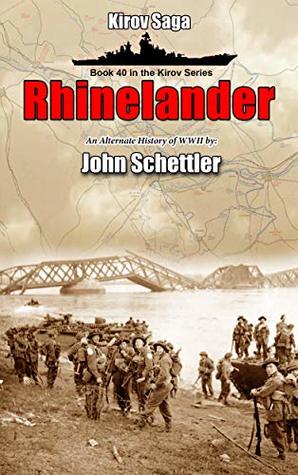
Review: Rhinelander

Rhinelander

After 31 (!) books, the World War II arc of the Kirov series concludes in Rhinelander. This is what I’ve been reading for the last month as the latest long, sequential series that I had a weird craving for. This book continues the time travel adventures which grow steadily more convoluted and more obviously a way to set up wargame sandboxes.

It also focuses on an alternate World War II where the initial Allied invasion of France came from the south and there were different tanks (including timeshifted modern ones on both sides) and… lots of changes. Much of it is reminiscent of the final battles on the historical western front, only moved up a year. A sort of “mini-Bulge” is conducted as one of the set pieces.

There was no real way that this lummox could conclude gracefully, so it gets a quick brute-force ending with a lot of exposition to smooth things over for the next timeshift and arc, a contemporary World War III that got the series to my attention in the first place. I was nonetheless content with it, and not just because the Kirov series defies normal critical scaling. Especially knowing the nature of the series and the state of the war at this point, having several books of nothing but the Allies advancing without truly serious opposition would not be ideal.