Looking At Desperation Formations

Occasionally, I dip into what I’ve called “Normandy Syndrome”, which goes something like this. Because the Normandy Campaign may be the single most studied and written about engagement in western history (with the possible exception of Gettysburg), I tend to look at other, different, more novel conflicts. However, this means that because I haven’t looked at them in some time, the big name campaigns become understudied to me in their own right, meaning that then I do take a look at them…

Generally though, I go back once I’ve had my fill. This time is partially an exception, as I’m looking at (gulp) Axis military formations. Don’t worry, this isn’t me becoming the kind of person who can memorize the name of every single Tiger II platoon commander. In fact, what interests me the most is the bad, hodgepodge, underresourced formations.

One area where Normandy Syndrome in general holds up is in force structure. It’s very easy to find and understand Soviet/American organizations as applied postwar. So thus seeing how different ones looked is distinctive to me, and I’m a sucker for OOB charts. But seeing unit TO&Es derived from limited resources, as opposed to Cold War excess, is also a good worldbuilding exercise for postwar formations under similar constraints.

First up are the Italians. Divisions with two three-battalion regiments, often “reinforced” by a Blackshirt battalion or [small] regiment, were the order of the day. I’ll get back to this formation later.

A 1943 assessment of Italian artillery (pg. 79) said it was a hodgepodge, middling force. A postwar assessment of Italian artillery (pg. 25) said-it was a hodgepodge, middling force. Contrary to the stereotype, both sources praise the crews, but note they were underequipped and unsurprisingly deployed forward more often than the Western Allied norm. Which makes sense given transportation issues and the comparative lack of direct fire support.

Then there’s ZE GERMANS. Not the wunderwaffe Germans, but the tattered, late-war, desperate Germans. For all the “lol-Italians” snickering, it’s worth noting that the Germans themselves had six battalion divisions later in the war, both of a downscaled classic type of two three-battalion regiments and a “Volksgrenadier” type of three two-battalion ones that was (on paper) equipped with more automatic weapons to make up for it.

Volksgrenadiers and Volkssturm are often confused. The former was meant to be more capable than other similar-sized formations due to a mass of automatic rifles and machine guns and even in practice was no worse than any other later-war formation, while the latter was the last-ditch pathetic old men with panzerfausts and ancient rifles militia that people know.

Then there’s my favorite, the later-war armored formations. By 1945, a “Panzer” division had only one battalion of actual tanks and one of APCs even at full strength. In fact, it reminds me more than anything of a postwar light OPFOR formation. One battalion of tanks, a few miscellaneous AFVs and vehicles (ie, for the WW2 formations, it was gun tank destroyers, for postwar ones, they’d be likely replaced by ATGM carriers), and some infantry in softskin trucks, equivalent either to a small division or just a brigade, depending on the type. In practice, well, I’ve heard multiple sources say, and I believe them, that the 1945 Germans were comparable qualitatively to the 1941 Soviets.

Because having too few resources is far more common than having too many (and this is before attrition!) I feel looking at the Axis minors and late-war Germans is a good exercise if developing fictional formations. It’s also a very refreshing and important contrast from the usual myth of waves of Tigers.

500 Post Special: On Criticism

Fuldapocalypse has reached five hundred posts. To mark the occasion, I figured I’d do a post on something that was the reason this blog even exists at all-criticism. Here goes.

  • Critics have the right to be as sneery and abrasive as they want in their reviews. As a writer, I’ve found valid points which I’ve incorporated from harsh, bad-faith reviews. The signal can be separated from the noise. Even as a reader, one of my favorite authors I found from a harshly negative review.
  • Writers have the right to ignore criticism they consider invalid. If you’re writing a literary romance and someone complains that the book doesn’t have enough explosions in it, you know that’s not what you’re writing.
  • However, both should ideally hold themselves to a higher standard.
  • Some works of fiction lend themselves more easily to criticism than others. This is why I have such a big insistence on creative control over what I review here. I don’t want this to become a chore, and knew that if reviewing was mandatory, it’d lose its quality.
  • The ideal work to review is something that’s flawed in an interesting way. Something flawed in an uninteresting way is arguably the worst type of fiction to review.
  • Perspective matters. My absolute favorite Bill James essay of all time, Inside Out Perspective, is a beauty. The difference between inside and outside is the difference between getting angry at one repetitive World War III timeline after another that you don’t see much direct criticism of on its website, and realizing that there are more action hero thrillers released in one month than there are conventional World War III stories overall-even with the most slanted accounting.
  • Basically, from the inside, you see things as being bigger than they actually are.
  • I’ve said repeatedly-being a critic has not made me a better writer in my eyes, but being a writer has made me a much better critic. Me the writer has written things in my books that me the critic would denounce if done by someone else.
  • Remember: Sample size matters. A lot.
  • Fuldapocalypse has been eye-opening, enlightening, and a lot of fun.

Drones of the OPFOR

As some of the OPFOR documents were published as the UAV revolution began and as they were based on countries known to have substantive drone programs/the means to obtain high-quality commercial ones, it’s not surprising that remote vehicles play a role. In the 1990s documents, they are referred to as “RPVs” (Remotely piloted vehicles)

The American Heavy OPFOR is mentioned as using multiple kinds of drones. Its operational/strategic drones are mentioned as having a maximum radius of around 300 kilometers. Divisions have smaller RPVs for spotting purposes. The Light OPFOR has similar units in its better-equipped formations.

The British GENFORCE-Mobile Forces goes into more detail.

  • A combined “reconaissance-strike” UCAV that can spot AND attack.
  • Strategic groupings/fronts have an UAV with a 500km range, armies/corps one with 300 km.
  • Divisions and brigades have “long” range (70 km) UAVs and “short” range (30 km) ones.
  • Artillery regiments/brigades have organic 50 km range UAVs for spotting and laser-designating for smart weapons.

The figures stated are somewhat generic, especially for the bigger and/or more advanced ones, but given the giant number of UAVs in service/development (and undoubtedly even many more since that chart was published around ten years ago!), it’s easy to find representative platforms.

Weird Wargaming: The Ambitious Special Operations of WWIII

This Weird Wargaming has the original intent of Fuldapocalypse meeting what the blog has gained a focus on-largely conventional World War IIIs mixed with elite small unit actions. I got the inspiration for this from a question of “what would the Army Rangers be doing in a conventional WW3?” Whatever the skill, level, troops like them are just far too light for the Centfront and would get bulldozed and/or bypassed. My initial thought was that they’d just get sent over to Norway with all of the other light infantry.

This was a very timid use of them (and other special forces), and the responses got my eyes lighting up. One was “Delta hunting the rail-mobile command center of GSFG, with the Rangers adding extra muscle.” To me it would be a ultra high-risk operation with an iffy reward, but hey, what else would you use them for?

Something like that would be a blast to sim, even if it’d have to use a different ruleset than the usual large-unit Fuldapocalyptic reenactments. While I have the same apprehension that it would turn into another Kidnapped with a scenario the mechanics aren’t meant to handle if you used a “hard” system, good design on either end would make it excellent. And if you used a “soft” system, well, stuff like this is what action heroes are made for.

The Question of Motivation and Interior Forces

For one alternate half-fantastical daydream war scenario I’d created (that I may or may not be simming further), I had one fictional country’s interior ministry forces fight harder and better than their regular army did. This despite them not being really designed for conventional war at all and having nothing heavier than box-APCs and crew-served weapons. Part of it was good mountainous terrain that played to the strengths of lighter forces (like them, particularly their commando units) while weakening heavier ones (like the attackers). But then it got me thinking to other parts.

  • Being all-volunteer (even if only for pay) compared to the mostly draftee military.
  • Being a sort of counterbalance to the regular army that put them on alert. (This is why they’d have antitank weapons and training, for instance…)
  • Finally and more crucially, being tied to the regime rather than the country. This meant they had more to lose in the event of a defeat.

Making a WW3 contemporary

So, Walt Gragg’s The Red Line is a book whose influence on this blog and my understanding of conventional World War IIIs in general was underappreciated. In fact, at the time I didn’t even know it. I just saw a World War III thriller that was clearly set in a Cold War gone hot but had its setting clumsily and obviously pushed into being “contemporary”.

Over two years and countless books later, I saw just how rare (to the point of being essentially nonexistent) mainstream World War III novels were that:

  • Took place after the Vietnam War.
  • Took place a significant time before the publication date of the book.
  • Were mostly conventional.

This also extends to Larry Bond-style “big war thrillers” in general. To appeal to more than a niche, they have to either piggyback on a well-known historical conflict (ie World War II), or be contemporary in some form. And after looking at and studying the issue, I’ve found that it really isn’t that hard to adapt any kind of missile-age war to a contemporary setting. And the beginning of the “missile age” can be roughly put as around the time of the…. Vietnam War. How about that?!?

For a start, the same geopolitical rivals have been more or less there for some time, and the absolute most you have to do is some kind of post-1991 technothriller enemy gimmick. Second, if it’s known that the audience won’t know/care about the technical details and/or inaccuracies, swapping names and using the same basic “feel” can be done with relative ease. It doesn’t hurt that a lot of military platforms have served for a very long period of time (just look at the B-52) in a way that the ones of the World Wars mostly didn’t.

Big Guns in Big Units

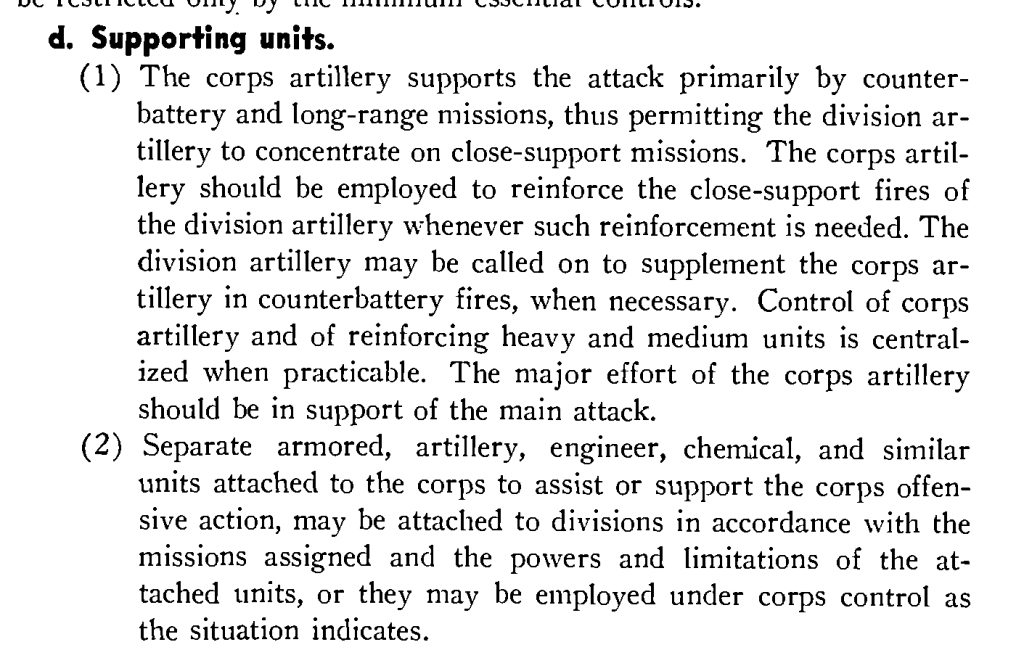
The corps/army level artillery mission hasn’t really changed that much since World War I, at least from what I’ve seen.

  • Counter-battery
  • Deep strike
  • Supporting the right effort at the right time.

As always, the Soviets were the most explicit in spelling it out, as one set of field regulations shows.

The American FM 100-15, from a similar time, had a similar statement.

As far back as 1923, the regulations explicitly state:

“The primary mission of corps artillery is the destruction or neutralization of hostile batteries, the destruction of hostile defenses, and long-range interdiction fire.”

As technology has consistently improved, command has “flattened”, and the understanding of its role has become more obviously apparent, more recent documents don’t spell it out so exactly. But the general concept is still there and present.

The Sum Of All My-Next Lives?

So bizarre crossover fanfics are nothing new. Yet this ultra-bizarre crossover fanfic idea/fusion has just leapt into my mind after seeing a few strange similarities and having my eyes light up. It’s My Next Life As A Villainess/Hamefura and-the “Ryanverse”, specifically (gulp) The Sum of All Fears. Granted, part of the appeal is just the strangeness.

The first spark is the reincarnation of “Monkey Girl” (her pre-reincarnation proper name is never given but that nickname is) being weirdly crossover-friendly. It’s impressive that it’s character-focused. Take a good-natured and sometimes right-twice-a-day (her obsession with farming, thinking she would have to fend for herself, was actually sound) but clueless about human relationships person who thinks the world runs on video game logic, and there’s a surprisingly high number of things you can do with it.

The second was how the original pre-reincarnation Katarina was a vindictive, hate-sink villainess. Who else fit that bill? Elizabeth Elliot, whose novelty made her one of my favorite technothriller antagonists. So there was a bizarre mutual overlap already. But my brain didn’t stop there. Oh no, because of the thought of bringing otome game logic to one of the most male genres in existence just felt amazing. So The Sum of All Hearts would star analyst Cathy Ryan. She’d have a man named Jack as one of several love interests, having to pursue one of them while at the same time trying to stop a nuclear war. It would be something.

Granted, the specifics would probably wreck it, but why worry about such things as “details” and “plausibility” when you have such a delightfully mushed-up concept? And hey, it’s not really any farther from Clancy’s original tone than some of the other “Tom Clancy’s” label franchises are.

(Come to think of it, “Rainbow Six” [with that number of love interests] could be the title of a romantic game…)

The Conventional Guerilla Army

Yes, I know this title sounds like a contradiction. Yet the irregular opponent operates in tiers.

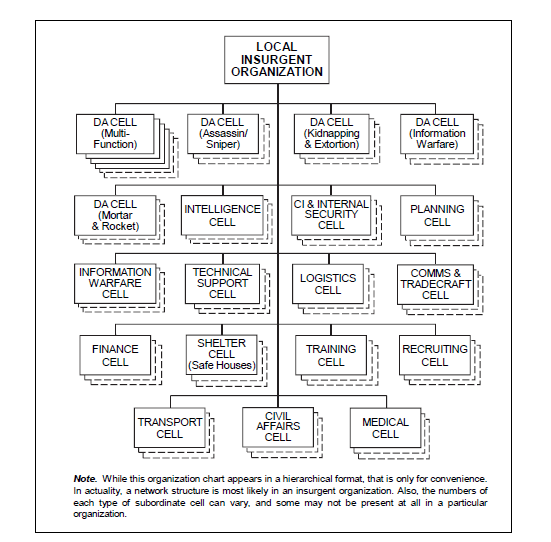
At the “bottom” tier of organization, as per Training Circular 7-100.3, Irregular Opposing Forces (source of diagram), there is what that document calls “insurgents”, ones devoted purely to doing damage.

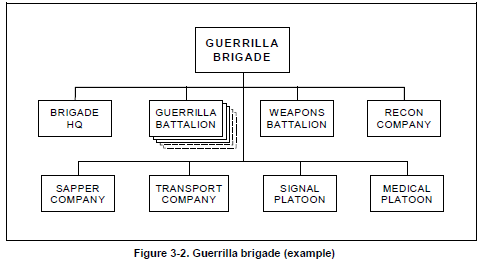
Next are what it calls “Guerillas”. The definition is “

“A guerrilla force is a group of irregular, predominantly indigenous personnel organized along military lines to conduct military and paramilitary operations in enemy-held, hostile, or denied territory (JP 3-05). Thus, guerrilla units are an irregular force, but structured similar to regular military forces. They resemble military forces in their command and control (C2) and can use military-like tactics and techniques.”

(Bolding added by me)

The document holds “guerillas” to be more organized and more capable of conventional-ish action than “insurgents.” It lists (obviously rough) organizations up to brigade size.

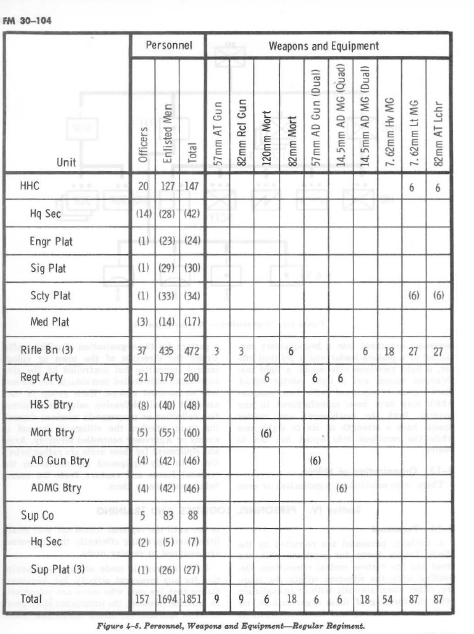
Then it gets trickier. Then there emerges “regular forces” that are intended to fight and hold ground conventionally. The Vietnam-era “Handbook on Aggressor Insurgent War” (FM 30-104, 1967) has a sample regiment of these regular forces organized as follows.

FM 30-104 rightly notes that these are organized similar to conventional Aggressor rifle regiments, only with lighter equipment. This flows right into the highest tier, consisting of…

  • Forces trained and equipped similarly to their external patrons (since very few unconventional forces can grow this powerful without outside backing). These are less interesting from an organizational standpoint, as the only things really distinguishing them are the origins of their forces and sometimes skill.
  • Irregular forces that have the size and equipment to succeed at conventional operations. These will have de facto infantry, motor vehicles (the infamous “technicals” ) and a smattering of supplied/captured AFVs, operable in what would be considered “detachments” in more structured armies in terms of their size and (lack of) organization.

The Monster Rocket

I give you the Type 762 rocket launcher, a fairly old and obscure Chinese self-propelled artillery piece. This is well, if you combined a FROG, a TOS-1, and a Giant Viper all into one platform, you’d get this.

From its stated (as always, take with a grain of salt) statistics, it has a pair of very short range (around only a kilometer!) thermobaric rockets (like the TOS-1), that are huge at 425mm diameter (only somewhat thinner than the FROGs) and which are primarily meant for clearing minefields (like the Giant Viper). Although with a rocket that big, I’m guessing that it’ll “clear” more than just land mines in the area it hits.

Truly an oddball.