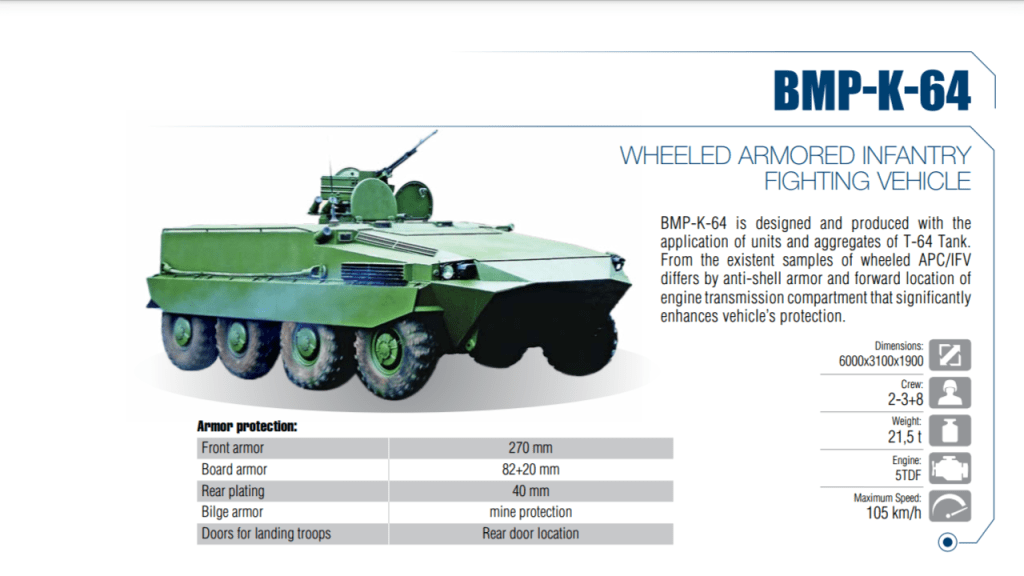
Weird Wargaming: T-64 APCs

When all you have is a hammer, everything looks like a nail. When all you have is a bunch of T-64 tanks, everything looks like it could work with a T-64. As it stood, the independent Ukraine inherited a gargantuan number of those tanks after the breakup of the USSR. As the beginning of the Donbass War showed all too vividly, it had very little else. Since the bureau that designed and the plant that built it were also in Ukraine, then… well, the hammer was even more prominent.

So, there’s the BMP-64, essentially an eastern Bradley on a tank platform. It has similar dimensions and a similar role as the famous American IFV (although a lot more dismounts). Note on the same brochure there’s more vehicles on the T-64 chassis and other tanks fitted with infantry compartments. The latter ones I’ve always envisioned as (at least theoretically) being more suited for a western armored cavalry structure. They can do the same things a tank in armored cav units can do, but they also have a few scouts to dismount when need be.

Then there’s the BMP-K-64, using the tank chassis for a wheeled APC. I find it simultaneously weird, interesting, questionable, and somehow impressive. This would be used like any other Stryker/BTR-style wheeled troop carrier, albeit with its thick front armor taken into account.

These desperation-born oddballs are the kind of armored vehicles I have a soft spot for.

Differing Fandoms, And What That Means For Alternate History

Seeing a post on the different “Eagle” and “Sparrow” fandoms made me think of this blog. After all, it started off trying to be small and selective to a small and selective group of literature. And then it ended up reviewing lots and lots of fiction in genres anything but those. Now, that post has its issues, but the general trends hold up.

Wargaming is an ideal “Eagle” fandom, small, selective, and often focused on exact details and quality. In contrast, cheap thrillers are a perfect “sparrow” fandom, where many are simply interchangeable and quite a few readers aren’t picky at all. Neither of these are bad things in the slightest. One can enjoy a deep simulator and a shallow mobile game just as much. But they are clearly different.

In conventional World War III fiction, it’s very easy to see the spectrum from “Eagles” (War That Never Was, wargames, especially advanced ones, etc…) to “Sparrows” (Ian Slater, other trend-hopping fiction). For all my criticism of Larry Bond, an underappreciated advantage of his books is an ability to balance between the extremes, making, or at least sincerely trying to make, something that’s technically adept enough for the “eagles” and relatable enough for the “sparrows”.

But where I’ve seen the biggest dichotomy is in alternate history. Like any other genre/type of fiction, it has its “eagles” and “sparrows”, and it’s made worse in my eyes from inherent divisions. IE, the same person is unlikely to consume Brad Smith’s World War 1985, Bridgerton, and Hotline Miami just because they’re all “alternate history”.

And internet alternate history, starting off as a pretty obvious “eagle”, has gradually changed. If I had to describe a lot of it, I’d use the term “a sparrow with the trappings of an eagle”, a sort of Mimikyu. There’s exposition, stock photos, and wikiboxes with exact details and little/no effort to make a broadly appealing narratives. Yet a lot of these events are contrived, ill-researched-and accepted.

The reason why I found New Deal Coalition Retained‘s conventional World War III so legitimately fascinating and not just bad was because it embodied this trend and (negatively) stood out so much from the Fuldapocalypses I knew so much about. Military alternate history (especially the American Civil War and World War II) has this reputation for being more “eagle-y” than a coordinated F-15 flyover of Lincoln Financial Field.

Here comes this war with absolutely no thought put into its logic beyond the absolute basic trappings of Clancy/Bond (which I think might have been copies of copies), a knockoff of World War II, and a desire for BIG CASUALTY NUMBERS. Yet it’s broad-scope told in a pseudo-Hackett way of pure exposition mixed with a handful of vignettes. While the most extreme example, it illustrates the strange evolution of internet alternate history through its blatant and noticeable issues.

Having A Pile of Unread Books

I’ve come around to actually liking having piles of unread books (and yes, for me that means both metaphorical and literal piles of them.) There have been times when I’ve actually “succeeded” in reading through all the books I’ve wanted to. And it’s a weirdly unsatisfying feeling.

Whereas having a variety of books in various degrees of “Ok, maybe sometime I’ll start them” means that when I do have the time and desire to read one, I can just grab one that’s ready to go. And that’s a weirdly satisfying feeling.

The Breach

One of the most difficult military operations (although to be fair, none could be considered truly “easy”), and one I’ve recently been looking at in my armchair studies, is the breaching operation. Requiring firepower and engineering in massive and coordinated amounts, its challenge is emphasized in everything that talks about it. Yet what’s equally interesting is that defending against such an attack requires just as much in the way of perfectly synced combined arms as launching it.

It’s a counterintuitive paradox that fortifications (the official term for preparing them called “survivability” ) are important to manuever war and mobile counterattacks are equally important to positional warfare. For the former, I’ll just say that artillery hasn’t exactly gotten less effective since World War I. For the latter, any position can be eventually reduced and overwhelmed with firepower if the opponent is given the chance.

The Earliest BTRs

I remember reading through a coffee table book on armored vehicles when I was very young and being strangely intrigued by the BTR-40 and BTR-152 APCs. Yes, they were just armored trucks, but armored trucks still looked so much different and weird than the later purpose-built APCs on both sides of the inter-German border. The contrast between the advanced IFVs I’ve taken to amalgamating as “BMPradleys” couldn’t be any more different.

Perhaps because of their relative lack of capability, at least one field regulation document lists APCs and ordinary motor vehicles interchangeably. And that’s understandable, there’s only so much you can write about an armored truck with a machine gun on top. Yet compared to nothing, an armored truck with a machine gun on top is quite the advance.

Since then, there’s been no shortage of truck-chassis APCs from manufacturers around the world. I guess it’s the next step up from the basic technical/jeep.

The GWRBI

Baseball is a sport full of statistics, and there’s one weird footnote of a stat that was, from 1980 to 1988, elevated to prominence. This was the Game Winning Run Batted In. Defined simply as “The RBI that gives a club the lead it never relinquishes” , it existed but never felt that prominent. The career leader in GWRBIs during this period was Keith Hernandez.

“Normal” RBIs were one of the first stats that sabermetricians slammed, and with good reason. The stat is simply too context-dependent and reliant on how good at getting on base the players batting before the RBI hitter are. Rickey Henderson didn’t have that many RBIs because he was always a leadoff hitter, so the bases were either empty or he appeared after the team’s worst hitters. GWRBIs have that and the same “reliant on the other half off the inning” issue as pitcher wins. And while meant to embody the likes of Bill Mazeroski’s famous home run, the definition of a GWRBI means that a marginal player singling in the first run early in an 11-0 squash is also credited with it.

So few people mourned the stat when it was discontinued. Yet I have a strange affection for it, for while near-useless for evaluating players, it reveals a little about the paths of individual games.

New Command Scenario For Testing

It’s been a while, but I have a new Command: Modern Operations scenario up for testing, 2KW Sub Strike.

I’ve wanted to do a scenario set in a mid-70s Second Korean War where the north smells an opportunity in the immediate aftermath of Vietnam. After much thought, I settled on “do a submarine scenario”, which also plays to one of my favorite strengths of having the player be objectively outmatched and having to manage the best they can.

With a few diesel subs, you have to take on an aircraft carrier shielded by, among others, a hypothetical guided missile battleship and a brand-new Spruance destroyer. Are you up for it?

Hanover The Key

One thing I’ve noticed in the admittedly small number of conventional/mostly conventional World War III stories is that the decisive make-or-break battle is fought in the vicinity of Hanover, West Germany. And I have to ponder how much of it is realistic, how much of it is a coincidence (since there’s only so much room and it is in the northern sector) and how much of it is literary license.

The Big Baseball Business What-If

There’s an underappreciated what-if concerning the business of baseball that I’ve considered worth exploring. Too much sports alternate history simply shuffles players, teams, and outcomes around. It feels both obvious and unsatisfying to me, the equivalent of the Red Sox unloading not just Babe Ruth but the entire core of what would become the 1923 champions on the Yankees or the A’s “Mustache Gang” all leaving in free agency when they got the chance. This is something different and could have changed the entire business model to be more like what’s in our time a vastly different type of sports.

In the 1950s, the Dodgers were intrigued by a company called Skiatron, offering pay-TV services. The technology did exist at the time but was very rudimentary. The possiblities were obvious. After all, even at a dollar per game, a six figure audience could translate to that much every home game, a huge sum at the time.

In OTL, this did not come to pass in this form. Besides the obvious ferocious opposition from the existing broadcasting industry, Skiatron’s technology and finances just weren’t viable at the time. But if something like that could be done (and I don’t know the exact plausibility-I’m not that kind of technical expert), it would be, no pun intended, a game changer. The obvious is that there’d be a big jolt of money, getting the historical broadcast windfall in earlier.

There are easy ramifications. There’d be more money in the sport, which would increase the pressure by players to get more of the growing pie for themselves. A historically unsuccessful team that used this to its advantage would result in the championship races being different. But there’s also more thoughtful ones.

One on-the-field change I could see resulting from this could be in pitcher usage. Here I’m kind of extrapolating from the “overworked for the sake of attendance” policy of Mark “The Bird” Fidrych (which may have contributed to his severe injury). I’m also extrapolating from boxing and MMA, which historically have leaned the most on PPVs. Put simply, more people have been willing to pay to see Connor McGregor than to see Valentina Shevchenko. And I’d bet more people would be more willing to see Sandy Koufax than Ned Garver.

Another, sleazier one is the notion of small-market/poor team owners simply giving up and advertising the players on the opposing team for the PPV spectacle. “Hey, [Small City], do you want to see the Yankees? The Dodgers? The [other good team with an exciting player]?” There are possibilities here.

The Thriller Genre Is Bigger Than I Thought

The raw scope of the “cheap thriller” is just something I legitimately did not understand when I started this blog. It’s gotten to the point where I’m still astounded by it. As I’ve said before, the huge number of reviews here labeled “action hero” speak for themselves.

So does me not recognizing many author names. And I’m not talking about has-beens, obscure internet writers, or people in genres I don’t really follow. Take Barry Eisler, a hugely successful author whose books even earned a film adaption-and yet I only found out about him recently. And he’s probably not alone.

Of course, the huge number of reviews here labeled “action hero” also indicate my continued enjoyment of such books…