ATP 7-100.1 Russian Tactics is Out

ATP 7-100.1, Russian Tactics, the newest OPFOR document, is now out.

Yes, it is of the nation that already had the most analysis and published doctrine there. Yes, the document includes a disclaimer that basically goes “we know you’re asking this question”:

This ATP is not meant to represent how the Russians are currently fighting in Ukraine. Many insights and observations can be collected daily to either affirm or refute Russian doctrinal strategies and tactics, but it’s far too early to acknowledge any definitive changes in doctrine. The Military District and unit diagrams in this ATP may be affected based on early observations of the conflict in Ukraine. With so many Russian units now in Ukraine, it will take some time to determine a new laydown of forces if that becomes necessary. Furthermore, with the losses Russia has suffered, it is too early to assess the structure and equipping of any Russian unit for the next 5 to 10 years. We are still studying the conflict in Ukraine and continuing to revise our assessments. Therefore, the ATP is not the correct medium for publication of our initial observations nor potential future changes for the Russian Army. Instead, this type of information will be available at https://oe.tradoc.army.mil/how-russia-fights

Still a great and highly anticipated (by me at least) resource.

My NFL Dream Team

With the Super Bowl just around the corner, I figure I’d make my thoughts on an NFL all-time-all-star team. Just the offense in this case, using the modern pro “1 RB- 3WR- 1TE” standard.

Quarterback

Ok, the most crucial decision. As someone of modern sensibilities, I want a quarterback with legs. But as someone who appreciates context, I also want someone who thrived in a pass-unfriendly era. Now is there someone who fits both those categories?

Why yes there is!

Fran Tarkenton, who can stretch defenses with his legs and be good with his arm. If I have to pick a traditional pocket QB, I’d go with Joe Montana.

Running Back

Jim Brown. I don’t think I have to explain this.

Wide Receivers

Jerry Rice as my first wide receiver, for reasons I don’t have to explain. Randy Moss as the second, likewise. For my modern representation, my third will be Justin Jefferson.

Tight End

Rob Gronkowski. Enough said.

Offensive Line

  • Tackles: Antony Munoz, Forrest Gregg. The Bengal Immovable Object will be the main QB protector. One architect of the Packers Sweep will be good.
  • Center: Mike Webster, the center-piece of the Steel Curtain
  • Guards: Bruce Matthews, Jerry Kramer: Matthews is an all-around lineman who could and did play any position there. Between him and another Packers Sweeper, it’s hard to go wrong.

Eurasia Aviation

Eurasia Aviation is a fictional company of mine that I can plop into basically any setting I want that’s appropriate.

Logo created in Stable Diffusion XL
Eurasia aircraft factory, also created in Stable Diffusion. Don’t ask exactly what the cone-thing is for, I just thought it’d look cool

Eurasia is an unashamed way for me to put any never-was alternate history aircraft (or even aircraft concept) into production. Since it’s a conglomerate with a presence on every continent, it can take designs for every one, and so on. Not the most plausible but I’m having fun with it.

The Alternate Airliner

It can be fun to put an alternate airliner into service, but unless it’s really big, really fast, or both, a lot of people wouldn’t notice much difference. That being said, the same can be said about a lot of things and it’s never stopped alternate history writers before.

I’ve even made a couple “formal” tiers:

Tier 1: Barely Noticeable

Planes like these (in this case the MD-XX and the An-218 “777ski”), are going to be barely noticeable to non-aviation afficiandos, however different they may be on the inside.

Tier 2: Standing Out A Bit

The dreaded propfan is one instance of these airplanes having one obvious standout in addition to their other more subtle features. Others include a distinct shape like the 747 fuselage or even a “four engines all in the back” like the VC-10/Il-62

Tier 3: Really Stand Out

These involve strange but technically plausible shapes like lifting bodies or circular hulls of various nature. Their mere appearance makes them stand-out. This ironically applies to delta wings and civilianized early jet bombers.

Tier 4: Exotics

These are the ones that ascend into pure science fiction.

Squishy WW3 Issues Part 1

So the World War III 1987 blog just posted “The Squishy Problem Facing World War III Writers“. And come on, there’s no way I can not write a post in response to that. Here goes. The original blog is in Italics. I’ll start with the opening.

World War III novels, movies and even blogs are as diverse and imaginative as their authors choose to make them. Even in instances where multiple works of fiction examine the same hypothetical theater or overall conflict there will not be many similarities throughout the bulk of the novels. Different writing styles, plots and points of view are guaranteed to keep the reader fixed on a uniquely original WWIII scenario brought to life in novels.

I would somewhat disagree with this. Yes, on a micro-scale they can be different on paper (ie, it turns out very few involve invading Iceland!). But even by the standards of cheap thrillers, it’s a very small and very narrow genre. This is not an insult. It’s just how it is and how a “normal” reader will look at them.

But when the final chapters and plot conclusions roll around, it’s a totally different ballgame altogether.  And so emerges the root of a squishy problem.

You see, the majority of popular NATO-Warsaw Pact, Cold War World War III novels, movies and other types of fiction end in either nuclear war or the overthrow of the Soviet general secretary and politburo just moments before the Kremlin decides to launch an all-out nuclear strike on the US and Europe. Other novels and fiction incorporate aspects of both options in their concluding chapters, creating an ending that is somewhat different from those above, but lacks the creativity to be considered entirely new and exclusive.

Ok. I’m going to argue that this is the most realistic and sensible part. Because the loser is likely to go nuclear. And if not, some plot contrivance is necessary to stop that. I guess you could have some kind of negotiated surrender, but I can understand why readers wouldn’t find that very satisfying. The alternative is either a Red Army-style clean OPFOR win or just making a horrible squash, the latter of which is not exactly appealing.

The squishy problem facing writers of the World War III genre is similar to what Zombie genre has found itself confronting in recent years: How to make an age old topic fresh and appealing when a good part of the audience or readership already has a good idea of how it is all going to end?

Good question and one that I will definitely come back to.

Wither Boeing

So Boeing planes have been in the news for…. issues. What’s surprising about it to aviation observers is how unsurprising they consider it. And as for why? Well, here’s the oversimplified and likely wrong in a few ways explanation.

So Boeing seemingly was a legend of Engineers until the evil Finance People ruined it. Anyone who has looked at the history of the auto industry will find this familiar. And while there is truth to nickel and diming, the context both on and above the ground is always more complex. If you look at the types of cars produced on both sides of the Pacific before the oil crisis/bubble popped, yes, there was a time when engineering was obvious-and obviously excessive.

In short and simply: Boeing was/is the last of the big post-WWII dinosaurs to encounter serious competition. There was no need for it to shape up because of the lack of a challenge, buoyed by their spectacular good luck concerning federal policy. The 747 came and was snapped up by airlines just in time for the oil crisis. But since the airline industry was a symbotic pampered cartel then, it was just passed on to customers to bail them out. Then came deregulation after that, with Boeing taking advantage of the boom. Then came the opening up of previously closed-off markets after 1991, and then…

…then the low-hanging fruit already got picked and the guys in Toulouse figured out how to make good airplanes. Oops.

Naming a Submarine Class

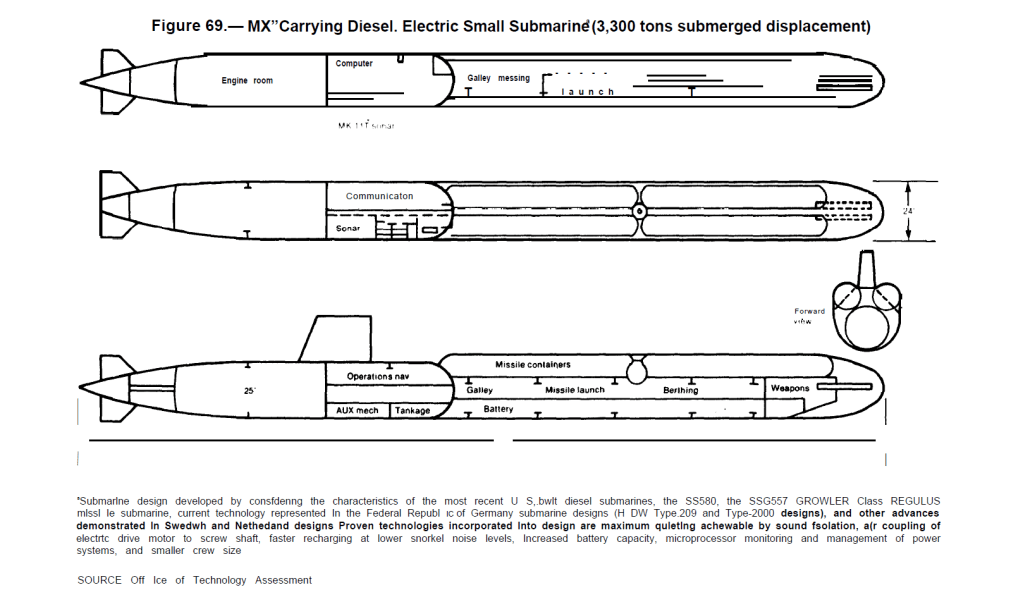
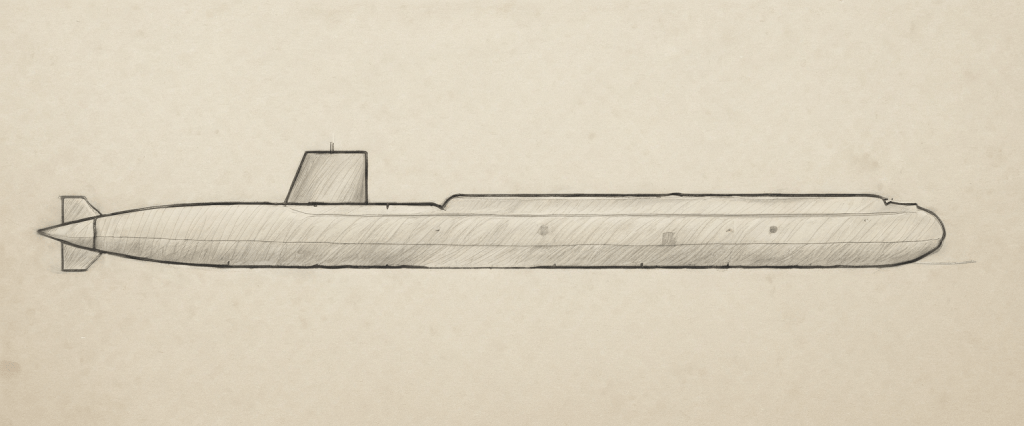
I’m torn with submarine names for the MX-SSB class, a real proposed design that I’m using in All Union

(Bottom picture made in Stable Diffusion from the outline of the sub above)

The problems are:

  • The class is large at circa 50 boats, so the naming scheme needs to support such a large class.
  • There is no historical precedent since the US never used diesel missile subs, much less in large numbers.
  • Both fish and people just don’t seem right to me (subjective I know)

I’m leaning towards lakes (ie, the Lake Tahoe class with some/all of the Great Lakes thrown in), but am wondering if there’s something that just can click. Thoughts?

One Neat Trick to Lessen Supply Requirements

What if I was to say that in certain theaters, your supply requirements can be lessened significantly? One only need compare built-up Iraq and not-so-built-up Afghanistan to see the different challenges. Or Vietnam vs. the Fulda Gap. But this is one that can best be used by an OPFOR against a wealthier foe-although rising global standards of living allow this to be applicable more and more.

Ok, so the US Army ranks different supply types by “Classes”. Now Class I, the one we’re focused on, is in short, food. Now one field manual, based on WWII experience, has it being about 7 pounds per person per day. Add that to a 20,000 strong division slice and you get 71 tons per division per day. But more room can be saved for other supplies if you adjust the Class I supply to a different amount, like say…

nothing.

Beyond what they have on their basic loads, the troops are to loot, plunder, and “requisition” food completely. Entirely. And remember: This is not neglecting enough food. This is a completely deliberate choice. What could go wrong?

(Answer: A lot.)

Cass the Heroes OC

Cassia Orsellio from Rogue Trader is one of my favorite characters in it. Yet she reminds me a lot of a Fire Emblem Heroes character: Not (just) a Fire Emblem character but a Heroes OC. She shares the following traits with the new introductions from that mobile game:

  • Is a mysterious, powerful (literal and figurative) noblewoman.
  • Is humanoid but still not human in some ways.
  • Has a central gimmick (in this case her warp eye).
  • Has a sort of “overdesigned JRPG” style about her (looking a lot more like an eastern RPG character than the western fantasy/sci fi ones of the rest of the cast).