Carver College

In the chaotic time of late 2020, Carver College stepped up to the basketball court to… lose. A lot. A tiny religious college, it was perhaps the most blatant of the tomato cans that appear in all kinds of sports. With no illusions, it stepped up to play multiple Division 1 schools as a kind of fill-in, getting badly needed money and experience.

Plenty of other colleges have done the “face a much stronger opponent for prestige and cash” before, but it’s interesting to see it going to this level. It’s one of those 2020 sports footnotes alongside things like Eastern European table tennis, the Belarusian Premier League being the most engaged one in the world, and the Denver Broncos running out of quarterbacks.

Tactical vs. Strategic Nukes

So it’s worth noting that “Tactical” and “Strategic” nuclear weapons are a vague comparison. There’s a saying I’ve heard that what defined a nuclear weapon as “tactical” in the Cold War was if it detonated on German territory or not. Certainly a lot of “tactical” warheads had/have more power than the very strategic pair of WWII bombs.

Now you can just say “use” and that’s a fair definition. But I like to define it as range of the delivery system. So even if say, the legendary “Atomic Annie” cannon’s shell is in the same yield ballpark as the Little Boy, its short range qualifies it as a “tactical” system while a bomb carried by a long-range B-29 or similar plane counts as “strategic”.

It’s as good a distinction as any.

Elvis Presto

It’s no secret that Super Bowl halftime shows prior to Michael Jackson’s historic 1993 one were rightfully regarded as throwaway novelty acts. But one in particular stands out for its “questionable” judgement. That would be 1989’s Elvis Presto.

Now there wasn’t a successful Elvis impersonator thirteen years after the death of the real one known as “Elvis Presto” already. Nor was it someone famous already doing an Elvis impression. No, this was just an Elvis impersonator doing silly magic tricks and music. Ok, that’s still in the ballpark of what old halftime shows were like, except for the small problem of that, save for one snippet of Burning Love…

NONE OF THE SONGS HE SANG WERE ACTUAL ELVIS PRESLEY ONES

It’s like “why?” It’s not like he was known as the “king of rock and roll”? I’m sure they could, with difficulty, find fifteen minutes of worthy Elvis songs to play. I mean, he was one of those artists who didn’t really record much mater-oh wait.

Yeah, there’s a reason why halftime shows are now filled with star power.

Fire Control in the Soviet Romanian War

Because I’m inspired by WWIII87 doing something similar and since I don’t think I’ll ever touch on the topic in any proper All Union successor, here it goes. It was in my mind, now it’s not. Enjoy.

Like with most wars since 1900, if not since the invention of gunpowder, the Soviet-Romanian War in All Union was won by artillery. While the Soviets had far more and far more advanced tube pieces, fire control was a lot more varied on both sides.

Top Tier

The top tier of fire control lay in the front level assets and units in the mobile corps, from battalion to corps itself. These contained most of the what the “recon strike complex” needed to succeed and did. Drone (and advanced non-drone) spotters, high performance datalinks, widespread designators for smart munitions, and advanced digital computers, all of it was present and used to great success. Perhaps the biggest air/artillery feat was the near-destruction of the Romanian 6th Tank Division before a single bullet was used in direct fire. The Romanians and allied Bulgarians had nothing like it. This was what caused a gigantic amount of alarm in the US and western militaries…

…although calmer heads pointed out that while still dangerous in the extreme, the Romanians had very little ability to disrupt the system.

Medium Tier

The medium tier was done by most regular Soviet units in the traditional division/army formation and the best Bulgarian/Romanian units. This involved fire control computers and other technological advantages, but still showed signs of stiffness and weakness in comparison to their upper tier (not the same as ineffectiveness, of course).

Low Tier

The low tier was largely manual and familiar to anyone in World War II, and was conducted by the bulk of Bulgarian and Romanian units, as well as a few low-category Soviet units mobilized for the war. There were many reasons why the southern front was less open and why the Romanian defense there was more effective: Units of mobilized Bulgarians instead of high-tech mobile brigades, the use of the Danube and more defensive lines, the proximity of Bucharest meaning that there was a “back to the wall” attitude, and many of the regime’s most loyal and stubborn units being deployed there prewar, possibly for political reasons.

Yet one has to be better C3I on the Romanian side (a large fortified area meant they could use field telephones and other such rugged measures far better) and worse such measures on the Soviet/Bulgarian side (especially as they had to go on the offensive). Which in turn made fire control better/worse.

Weird Wargaming: The All Union US Military, Part 1: Army and USMC

So the conventional forces of the United States in All Union, unlike its superpower counterparts, have not been the most central to any of my drafts (yet…). Therefore I figure I should infodump some of my musings on it right now.

Background

The reformation of the USSR brought about a period of aimlessness among the US Army. With the fall of the Berlin Wall and the former Warsaw Pact states forming an independent de facto buffer, priorities became much lower. Going from all of Germany to the northern tip of Norway and Thrace is somewhat of a downgrade.

That being said, there has been a shift of forces to the south. The US 9th Infantry Division is in Turkish Thrace to, in the event of a Thraciapocalypse, serve as a mobile counterattack force. The lighter 51st Infantry is in Northeastern Greece near the triple border to make sure the rival NATO countries play nice serve as a tripwire for any Soviet-Bulgarian push south.

The need for “Americi-BTRs” that historically was filled by the Strykers came in the form of LAVs, both the LAV-25/Piranha of real life USMC fame for that branch and the unrelated but similarly named LAV-300/600 series for the Army.

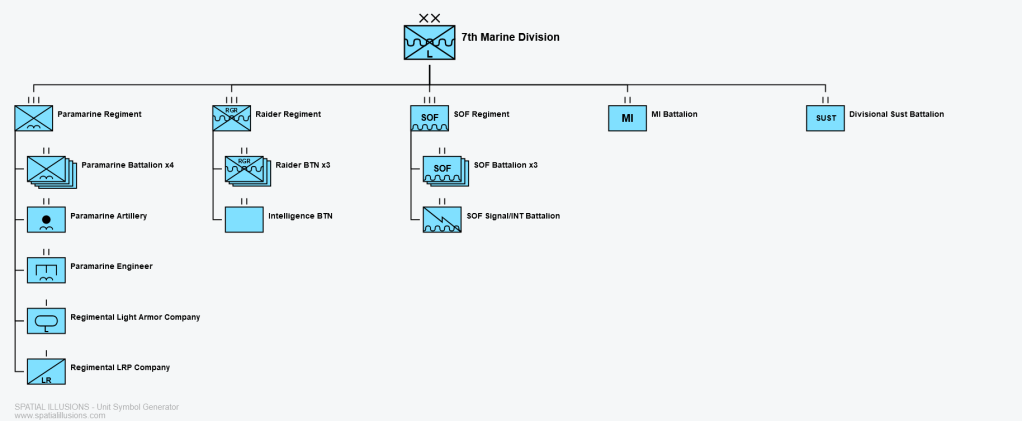
The medium-ization of the Army came as followed: Two brigades in existing heavy divisions with their Bradley mech inf brigades replaced with LAV mech inf brigades ie BMP-BTR mixes, two “medium-heavy” divisions based around LAV-300s with a divisional tank battalion that would stay behind on lower-intensity deployments, and one “medium-light” division with the LAV-300 series, more uparmored HMMVs as the infantry carrier, and no organic tanks. For the USMC, the Seventh Marine Division came into being, along with Combined Arms Regiments (mixes of tanks and LAV-Bisons proposed in real life) for the three active USMC divisions.

More to come…

Wither The Running Back

With NFL season approaching, a hot topic for (some) football fans is-the salary of running backs?

The short answer is that running backs have recently gotten a significantly smaller portion of the pie compared to other players (especially wide receivers). This is due to a decades-long trend towards more passing and also due to a more recent trend where a rookie wage scale was implemented-and almost all running backs burning out in that period before they could theoretically enjoy free agency riches. Because of this and because running backs thrive in the different college game, a team can draft a running back, use him, then draft another one.

It’s hard not to sympathize with someone whose career is short even by athlete standards and who has to be slammed by giants over twenty times a day. But it’s also important to note that the other 45 or so players on an NFL team are also facing physical pressure. There’s no realistic way that the owners and other players are going to give their share to appease players who can be reasonably considered more replaceable. And a certain subset of fan and reporter will always talk about the poor struggling running back and not the players who are earning much more (and not just in absolute terms) than they did in the past.

I do feel like the old “walking tank” running back may be more in vogue. People who otherwise would have trained as Barry Sanders-type “agility running backs” are likely to want to aim for a wealthier, safer receiver position instead. But since you can’t teach size….

Nuclear Terrorism Cont.

Back to my “hypothetical nuclear terrorism” reading, and some of the analyses have given me this impression.

So there are some ifs beyond the norm that actually make it more likely. Besides the usual “if you have the resources and personnel for the job”, there’s two things that make the job of the would-be nuclear terrorist easier and their opponents harder.

  • Being willing to take the hit of large and likely fatal amounts of radiation during transportation and construction. This is pretty self-explanatory, especially when using comparably “fresh” (and thus high radiation) spent power reactor fuel as an input.
  • Being willing to detonate the bomb in a target area closer to the assembly site, even if it’s less damaging and/or prestigious.

However, this narrows the personnel pool even more. It may be a slight narrowing, but it’s still a narrowing. It’s also worth noting that the first point makes a “factory accident” a lot more likely, perhaps countering the advantage of fanaticism.

Hungary’s Humongous Divisions

In the late 1940s, Hungary, fresh off Soviet conquest and the statistical worst hyperinflation ever recorded, was rebuilding its military. Not surprisingly, the plans reportedly called for a force structured along Soviet lines and doctrine. But surprisingly, the centerpiece was on ridiculously large infantry divisions. How large? Paper strength of at least 25,000 people, but that doesn’t describe all of it.

No, comparing the number of infantry battalions ultimately under divisional control draws this insanity into better perspective. The archetypical triangular infantry division has nine (three in each of three regiments/brigades). The square division largely rejected as too big and clunky had twelve (three in each of four regiments). This had sixteen. Four regiments of four battalions each.

There’s a reason why these actually weren’t made and why, even beyond the impact of the 1956 rebellion and short leash, Hungary’s army in actuality remained conventionally Soviet-styled for the rest of the Cold War.

Solving The Madness

Ok, “How many shells were fired in the opening megabarrage of a multi-front offensive operation, such as a Fuldapocalypse or All Union’s invasion of Romania?”

Going with the latter because it’s my book, I finally have an answer that’s easier than a vague “Over a million.” Going with “Sustainability of the Soviet Army In Battle” and “Front Operations 1977” as main sources.

A unit of fire for each artillery piece translates to about 80 for 120-122mm, 60 for 152mm, 160 for BM-21s, and 120 for smaller mortars (sust., pg 68). GENFORCE Mobile has similar numbers but adds 40 for big 203+mm pieces. I’ll just split the difference and say 70.

“Thus, for instance, in armies operating on the axis of the main attack, the expenditure of artillery and mortar ammunition in the first day of combat actions without the use of nuclear weapons may be 2.0 to 2.5 units of fire” (front. pg 309)

A front is described in the same document as having 3,400 to 4,200 artillery pieces (front pg. 12), so a very basic napkin calc for two fronts gives 1,176,000 shells. That’s about 25,000 tons even if you assume “only” the weight of a D-30 round for each shell.

So yeah, 100-150 x the number of total artillery pieces for an extremely basic ballpark figure.