Snippet Reviews: October 2019

The Press Gang

Kenneth Bulmer (as “Adam Hardy”) wrote the Fox series of age-of-sail adventures in the 1970s. The Press Gang is marked as being the second in the series in the modern Kindle format, but it was the first actually printed (chronological vs. publication order?).

In any case, the tale of George Abercrombie Fox is not the best one to ride across the waves. Bulmer’s prose, which I recognized from the Dray Prescot books, isn’t the best, and the setup is this weird hybrid of cheap thriller and Herman Melville “this is what an age of sail ship is like”.

The Enigma Strain

Nick Thacker’s first book in the Harvey Bennett series of thrillers, The Enigma Strain is a solid thriller, if a 51% one. The book features the titular park ranger and a CDC scientist as they fight to stop a plot that involves an ancient, exotic disease and multiple nuclear bombs.

On one hand, it’s in the awkward uncanny valley that plagues a lot of cheap thrillers. It’s clearly too ridiculous to be realistic, but it’s not bombastic enough to be the gonzo silly thriller that it deserves to be. On the other, it’s still competent enough to be a passable, fun reading experience, and that’s what cheap thrillers are supposed to be.

Review: Weapons

Weapons: A King And Slater Thriller

weaponscover

When I got Weapons by Matt Rogers, I didn’t really get that it was a merging of two series’ with entries in their own right. So I was a little confused at first, not helped by a slow start. Thankfully, once the story picked up, I got a huge wave of cheap thriller action. This isn’t exactly a standout cheap thriller by any means, and it has flaws.

One of the biggest is the variable competence of the characters. This book acts like a more grounded thriller until the moment the heroes are backed into a corner, at which point they gain, among other things, incredible aiming ability. It also has a mundane cheap thriller plot with my usual quibbles.

But the actual action is still well-done in spite of these issues, and that’s what a cheap thriller needs to be. You could do a lot worse if you want a basic explosive thriller.

Review: Deep Blue

Deep Blue

Reading Deep Blue, one of the later John Schettler Kirov books, brought a strange feeling to me.

Reading it, I encountered all of the issues with Homecoming, the previous book in the series I’ve read. And then some. The almost interchangeable battles are over-detailed and underwhelming to an extreme. The plotlines are clunky and shoved together. By all “normal” accounts, I should have been dismissive at best and disliking at worst. But I just wasn’t. As I read through tons of time-travel shenanigans, I felt a sense of “woah. Wow”, for lack of a better phrase.

It hit me when the ship time-warped from the current near-future World War III to another near-future World War III, only with different equipment and different sides. Everything just then clicked suddenly into place.

This is kind of like the later Survivalists-if Ahern had meticulously simmed every clash in Advanced Squad Leader or something like that and recorded the verbatim results in the books. And the time travel isn’t just a small throwaway part-it’s a a big central element, with a huge effort towards enabling this kitchen-sink wargaming. It’s like having a zombie sorceress start a Fuldapocalyptic World War III, and devoting a lot of effort to her, her rivals, and her powers as you move from 1985 to 1988 to 1981 to a 1986 with the YF-17 chosen as the light fighter and the British using a different divisional structure.

I still don’t recommend the actual books, unless you like lots and lots of barely disguised wargaming AARs. But if I had to choose a series with a lot of novelty and effort put into it or a series that just clunks along without any of those, I’m definitely picking the former. The sheer excess of the Kirov series makes it at least interesting.

Review: Alpha-A Black Flagged Thriller

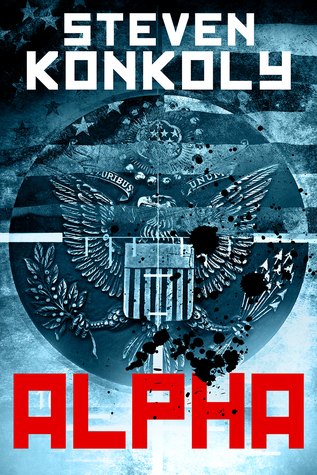
Alpha: A Black Flagged Thriller

alphacover

Stephen Konkoly’s “Black Flagged” series of spy thrillers starts with Alpha, telling the story of super-operative Daniel Petrovich as he’s pulled back into a web of plots.

Now, this book was moving uphill for me, simply because I’m not the biggest fan of the cloak and dagger genre of novel. I’ve come to the conclusion that it’s just a personal taste, and if I have to give a reason why, it’s because too many sit in this uncomfortable middle ground where they’re too spectacular to be a serious, grounded novel (which isn’t my favorite recreational book type itself), but not spectacular enough to just be an all-out crazy fun thriller.

That being said, this book is a very functional cheap thriller that hits all the right cheap thriller notes. Its plotting is a little rough and its characters a little flat, but its action scenes are very worthwhile. The whole is better than the sum of the parts, making this a good “51%” thriller.

Review: Balkan Mercenary

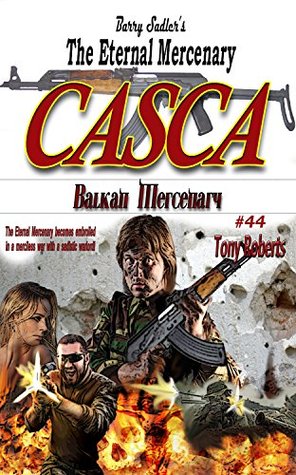
Balkan Mercenary

balkancover

Although not the latest Casca book, Balkan Mercenary is the most recent chronologically, occurring in the beginning of the Yugoslav Wars. It’s the first book in the series I’ve reviewed that’s written by Tony Roberts, who’s the current official author of the Casca franchise.

So, I have get this out of the way first. If this had no connection to Casca at all and was just the story of a man and his team of mercs going into the Yugoslav Wars to take down a war criminal and avenge the death of his loved one, it would be a modestly decent “51% book”. There are far better books than something in the same league as Marine Force One, but there also worse ones (which is why, in spite of my complaints, I still read the Casca books).

But this is the 44th installment in a long series that I think just doesn’t work as well in more modern times as it does in the distant past. It’s even mentioned in the book itself that Casca’s aliases are getting easier to track, so I can understand why Roberts seems keener to keep Casca a historical character.

Here, every reminder that this middling action-adventure tale featured a millennia-old immortal felt blatantly shoved in. A piece on how he remembered medieval Serbia. A piece on his blood being poisonous (this was present in the early books). And a tie-in with designated recurring enemies the Brotherhood of the Lamb, who feel especially forced. Balkan Mercenary, like many other Cascas, just plods to the middle, not daring to  try and take the extraordinary premise any farther than 51% of the way.


Review: Kill Or Capture

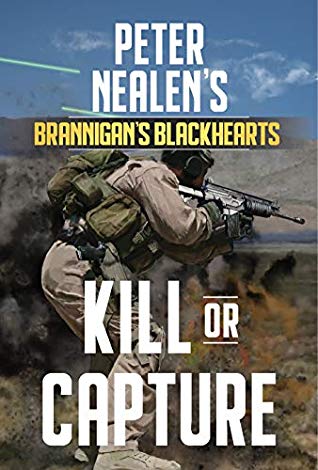
Kill Or Capture

brannigancover

Understandably pushed back because of the Maelstorm Rising series, Peter Nealen’s Brannigan’s Blackhearts continues with the just-released Kill Or Capture. It was well worth the wait.

Everything in this book reminded me of how great a cheap thriller this series is. Not just because the actual action is well-done (it certainly is) but because of all the touches that help it become more than the sum of its parts. There’s the opening where the protagonists are called back from their normal, everyday lives and families-something that distinguishes them from the Gold Eagle action automatons. There’s the super-conspiracy being both capable enough to pose a challenge worthy of a super-conspiracy and human enough to be fallible.

Of course, the actual plot is just a set-up for much action. I can sum it up in one sentence: The protagonists storm a fortified villa in northern Argentina. But the action is continuous, well-written, and solidly executed. The mountain terrain feels vivid and effective. The threats are varied. This is an excellent cheap thriller and worthy continuation of one of my favorite series.

Review: Gray Matter Splatter

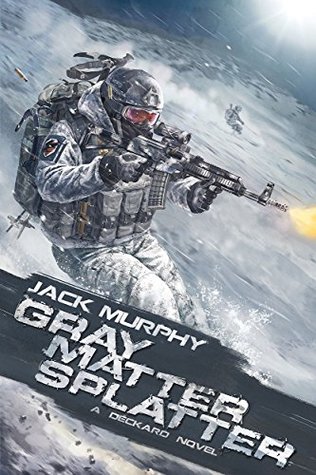
Gray Matter Splatter

gmscover

The path to opening Gray Matter Splatter was a little offbeat. I thought Jack Murphy’s debut in the Deckard series, Reflexive Fire, was wildly uneven, the kind of book that’s “Mean 51%” instead of the consistently middling “Mode 51%”. I also, similar to my experience with spacesuit commandos last winter, was getting a little worn on middling action books after reading so many of them.

So I figured, having heard that this was the craziest out of the four Deckard books, that this book with a great title was worth a shot to leap out. And so I leapfrogged over the other two and headed straight for the fourth. It was a good decision.

Now this book still has many of the problems that plagued Reflexive Fire-the political soapboxing that got in the way of the plot, the not-unusual but still irritating long descriptions of weapons, the jumpy perspectives, and the less-than-developed characters. But it’s improved to a considerable degree with the fundamentals, and the mega-conspiracy behind everything is at least tamer than the mega-conspiracy in Reflexive Fire. So there’s a little less dissonance there.

But in terms of what matters, the action is excellent and challenging as Deckard and his mercs fight their way across the entire Arctic Circle. While the sustained action may be a little more implausible than the low-level action in Reflexive Fire, I’m certainly not complaining in that sense.

This is still a cheap thriller for all its pretensions. But it’s a good cheap thriller.

Review: The Bear’s Claws

The Bear’s Claws

(Full disclosure: I was a beta reader for this book and thus received an advance review copy)

Reading The Bear’s Claws was a pleasant surprise, the likes of which I hadn’t gotten from a WWIII book since Team Yankee. This tells the story of a Soviet mechanized infantry unit as it progresses through a World War III in 1982.

Now I could mention the book’s shortcomings-in particular, its character arcs are not exactly the most unpredictable. But given the small of World War III fiction in general, having a book with all the things it did right was delightful to experience.

  • The Soviets not only win, but win handily. This does make sense for 1982, but it’s still good to see that leap being taken in popular WWIII fiction. And to add to that, it’s not portrayed as a cakewalk for the people on the ground.
  • In great contrast to the stereotypical Red Storm Rising-style type of book where viewpoint characters hop around, the “camera” here stays tightly focused.
  • Finally, it has the kind of “plotnukes” that I would normally denounce. Yet they were handled in a way that didn’t have me going “oh, come on!”. The plotnukes featured a personal connection and just the right amount of explanation.

This sort of thing doesn’t come along often. So I’m very happy to give The Bear’s Claws my thumbs up.

Review: War Breaks Out

War Breaks Out

When I got Martin Archer’s War Breaks Out, I was expecting a plodding Cold-War-Turned-Fuldapocalyptic-Hot story. The initial premise and the mediocre experience of the previous book I’d reviewed, Israel’s Next War, made me think that. Instead, I got one of the most crazy and just plain out-there examples of a World War III story I’ve ever read.

  • The timestream got scrambled. There are Eurofighter Typhoons and people who were injured in the Iraq and Afghanistan wars, but at the same time there’s a 1980s WWIII and everyone is using M60s and T-62s. Oh and Belgium has F-15s for some reason.
  • We’re introduced to the main character (who frequently appears in a weird form of first-person similar to that present in Israel’s Next War) immediately. He’s a one-star general who gets a quick promotion worthy of spacesuit commandos. The president decides he’s just that good, and needs a fighter, not those deskbound bureaucrats! (To be fair, this is officially the third in a series with the same main character, but still).
  • Said main character promptly comes up with a bunch of gimmicky tricks and special ops to turn the tide of the impending war against the USSR. These range from tricking Soviet AWACS with mass transponder changes to landing troops with ferries in the Baltic. Naturally, they all work.
  • The actual battle scenes themselves are the least amusing and most clunky and repetitive. Except for something I haven’t seen in a while-the attempted Soviet invasion of Iceland! It’s been a while, Ísland. I missed you!
  • The book ends with one of the most ridiculously blatant examples of “Foreshadowing” for the next installment in the series that I’ve seen. It’s not foreshadowing so much as building a city of giant neon signs indicating the plot point, then causing it to be lit up in a giant fireworks display that’s internationally televised, telling the plot point in a Super Bowl commercial, and then carving the plot point into the moon for good measure.


This was an experience. It’s probably as bad as “World War 1990” in terms of pure writing quality, but I had a lot more fun reading (and reviewing) it. I guess a better example would be an even more rough version of Ian Slater.

Review: Steel World

Steel World

steelworldcover

For BV Larson’s Steel World, I returned to a familiar place-the land of spacesuit commandos. Almost every single value checks out. Dystopian background? Check. The main character is a super-special spacesuit commando in a super-special spacesuit commando unit (in this case, a secret dirty tricks “Legion”)? Check. The main characters use nothing more than power armor and ray guns that don’t seem to really do much? Check. The tactics are iffy and everyone uses Roman ranks? Check.

The only novel feature, besides the use of “rules of war” that are clearly structured to enable the plot, is revivification. However, in practice all it does is remove tension, best summed up by having people -multiple times at that- want to be “killed” for the sake of convenience.

For all my complaining, Steel World manages to dodge the biggest problem with the subgenre. Its training sequences are not overly long, and I was thankful for that. And for all its issues, it’s still readable and fun as a mindless spacesuit commando novel.