Review: The Hungry Dead of Yu-Ching And Other Stories

The Hungry Dead of Yu-Ching And Other Stories

From Sea Lion Press author Paul Leone comes The Hungry Dead of Yu-Ching And Other Stories, a series of horror-fantasy-thriller tales spanning history. From the ancient past to the Cold War and beyond, he brings to life one supernatural confrontation after another. Each story is short but sharp and never wears out its welcome.

I might be biased given the preferred subject matter of Fuldapocalypse, but I liked the “Red Dawn [no relation to the movie], Operation ___” stories the best. It’s very hard to go wrong with Soviet commandos facing extranormal enemies, and I grinned at every word of those tales. Not that the others were bad by any means, but these were my favorite.

In short, this is a very fun collection. I enjoyed it a lot and highly recommend it.

Review: Whirlwind

Whirlwind

The 56th book in the Kirov series and the conclusion of its third World War III arc is Whirlwind. By this point, the same issues present in any other installment are there. The prose is what it is, and the “time travel soap opera mixed with wargame AARs” is familiar as well. A large chunk of this book doesn’t even pretend to be a conventional narrative and just recaps the war in detail.

While this (supposedly) second-to-last arc in the series doesn’t just nuke everything and overwrite the timeline like its predecessor, it leaves an uncomfortable feeling. The talk about how weapons and doctrine in-universe evolved gave me the impression that Schettler would pull the football yet again and have yet another four-books-too-long wargame sim. Especially because the main ship plot does have a lot of genuine promise.

The concept of the titular ship’s crew going back in time to stop delightful supervillain Ivan Volkov from destroying the timeline is a great one, and I know very well that you could merge such a plot with wargame scenarios. But even my patience is wearing down with the formula. The circle could be squared if the ship and its crew got a good final conclusion while allowing the toy box lets plays to continue, but I’m not really confident in that happening.

Review: Assault By Fire

Assault By Fire

Ripley Rawlings’ Assault By Fire is an invasion novel. It’s an invasion novel that features that common staple of video games-the Teleporting Russians. Yes, via some kind of supercomputer (that’s the explanation given), the Russians can conduct a successful amphibious invasion of the US. This is a “pulpy invasion” book. And it is very, very pulpy.

Everything from a main action in Appalachia to WWII weapons to a knockoff of Vasquez from Aliens is there. And it’s somehow amazing. The rational part of my brain could not comprehend or make sense of how the invasion progressed, with me asking such questions as “where are the stated MiGs staging from?”. The part of me that eagerly read every Survivalist loved every page of it.

Review: Holy Ground

Holy Ground

As readers of this blog undoubtedly know, I’ve dipped pretty deep into the small field known as [mostly] conventional World War III fiction. So when I saw an actual new release of one, Evan Currie’s Holy Ground, I felt obligated to check it out. The book is a prequel to an extensive science fiction series, and it shows. It centers around the defense of the island of Iwo Jima, on land, sea, and air.

Honestly, the setting image that came to my mind was “Command and Conquer Generals”. Not in the exact form or in it being an exact ripoff of that game-it definitely is not. But in the general (no pun intended) sense of a combination of sci-fi technology and stuff that’s visible in the obvious headlines/popular culture. Despite nominally taking place several decades in the future, there’s a lot of contemporary fighter aircraft designations. There’s also a lot of “cinematic” stuff, like missile-age aircraft using guns far more often than they realistically should.

Because of these limitations, it doesn’t succeed in being a technothriller. At the same time it’s too comparably grounded to be a Wingman-style pulpy thriller. And even judged purely on its own terms, the action isn’t the best. I want to emphasize it’s not the worst either, but I’ve definitely read better. For me it was a little fascinating to see what a technothriller in the style of a popular science fiction book looked like, but that can’t raise the novel above average on its own.

Review: Pale Horse 3

Pale Horse 3

Russell Greer’s Pale Horse 3 is the story of a B-52 in a 1980s World War III-published in 2020. So it’s another entry in the “alternate history World War III after Vietnam” genre which, as I’ve said many times, thought was too big but ended up being too small. Except this is in an even smaller field because it has nuclear weapons involved. But wait, unlike the apocalyptic For Alert Force, this falls back into limited plotnukes.

That quibble as to what tinier chuck of a tiny segment of fiction it falls into aside, how is the actual book?

The answer, I’m sad to say, is “not the best”. Given that this is only the author’s second novel, I’m not holding it against him, but the prose is still very clunky, the plot is kind of jumbled and a little slow with the backstory, and even the action gets a little too Herman Melville-y. Dale Brown at his finest this is not.

Besides the review of the book itself, this has a very bittersweet “closing the frontier” feeling for me. It’s one thing to know the “AHWW3AV” (how’s that for an acronym?) genre inside and outside, but quite another to literally read the literal last one on the current list. One reason I actually like having backlogs of books is because of the empty feeling when they’re finished, even if in a satisfying way.

Once the magic of figuring out the genre is gone, you’re left with a field that, like any other, has good, bad, and in this case middling entries. Conventional (or mostly conventional) World War III felt like something to explore. Something to help me mature when I saw how little it actually resembled the “Icelandic” picture I had in mind before. Something to start a whole blog about. Now it’s just another tag in this blog, and I’m really not sure how I feel about that.

Review: Zulu Hour

Zulu Hour

The second Kirov “Keyholders” spinoff, Zulu Hour takes a look at an alternate Battle of Isandlwana. Like the previous installment at Waterloo, this has an excuse plot that’s really forced and blatant even by Kirov standards. A pair of gambling time travelers use their time-keys to go back and try to change various historical battles for the sake of their rivalry. Don’t worry about the seemingly massive butterflies this would cause, because thanks to the mechanics of time travel, they can always “overwrite” it later.

Yeah, it’s that blatant. But this is the Kirov series, and using time travel to set up all kinds of alternate battles is the exact point of the series. Besides the battle itself and the time travelers trying to persuade Chelmsford and Cetshwayo, this also involves the Fairchild Group, another weird subplot in the series involving an oil heiress and her own personal Type 45 Destroyer. In past Kirovs, several people from that were timeshifted to… the Isandlwana site.

Once the fighting actually starts, what emerges may be one of the most legitimately good things Schettler has written. Maybe it’s just how a one-part spinoff simply has to be more concise than an eight-book series, or maybe it’s just the novelty. Yet it worked.

It could be a change of pace after seeing so many large-scope modern wargames. Or it could be that the late 19th Century is an area of warfare that I haven’t seen that much of, compared to the subject matter of the main series. Whatever it was, the action here felt and looked better than the norm for Kirov.

This long-foreshadowed book was a lot of fun. And the Kirov spinoff concept of just reenacting/changing historical battles via wargaming has a lot of possibilities. Those are taken advantage of here in an enjoyable book.

Review: Battle of the Three Seas

World War 1990: Battle of The Three Seas

It’s time to return to William Stroock, an author who I’ve previously slammed as the worst World War III writer ever. Has this been fair? And has his new Battle of the Three Seas improved on his previous entries?

For the first question, it’s a weird answer. It’s like talking about the New York Knicks or Jets. They’re still pro-level teams, and even a “bad” pro player is still among the greatest in the world. Being the 32nd-best team in the world is still an accomplishment. Similiarly, to write a long novel at all in a niche genre is a talent many don’t have, and Stroock has still gotten more basics right in the field than non-specialized authors have. (Research on military equipment, especially above small arms, is something frequently in very, very short supply). So yes, it has been unfair to simply denounce in fire-breathing terms.

Yet it’s still fair to consider the Knicks and Jets not the 32nd-best teams in the world, but the worst compared to their colleagues. They’re still bad by those (incredibly high) standards. And they’re not going against college/international teams-you judge them by who they’re up against. So, with a heavier heart, I still have to say that Stroock is one of the worse World War III specialist writers, and while this book has improved somewhat compared to the earlier ones, it’s not enough to shift the rankings that much.

The book is less one-sided in absolute terms than some of his previous books. It’s undeniably improved in prose quality. But it still has a jumbled structure with way too many viewpoint changes for its own good and writing that’s still too flat to really work. There are still bizarre subplots that don’t really add anything.

It’s ultimately just still too hard to find something in this book, or Stroock’s series as a whole, that does what another “conventional World War III” book doesn’t do better, be it characterization, tone, or technical plausibility. It might be better than a historical “sports nadir” team. But it’s still, in a now-obsolete baseball term, very much a “second-division” series.

A Thousand Words: The Henry Stickmin Collection

The Henry Stickmin Collection

It’s fitting to ring in the new year with something that celebrates what Fuldapocalypse has become. Which is to say, a blog that relishes in reviewing the most goofy and out-there cheap thrillers imaginable. And I’ve recently been playing a game that epitomizes that.

Said game is The Henry Stickmin Collection, a remaster/remake of Newgrounds classics whose general type I knew fondly when I was younger. Since Flash has been officially abandoned by Adobe, this is a fitting tribute. Ok, maybe that sentence was weird. But so is this game, and I love it.

A combination of “choose your own adventure” and quicktime events, Henry Stickmin is exactly what you’d get if you had a teenager who played too many video games and Jon Land collaborate on an action-adventure story. In a combination of slapstick and really, really blatant video game references, you pull off daring capers-or fail miserably. A lot. So often. Thankfully you can just restart at the selection-event easily, which means there isn’t really any frustration in failure. In fact, I sometimes got disappointed when I actually succeeded on the first try.

As for the references themselves, most pass my personal test for references, which is to say that you could find them amusing even if you knew nothing of the setting they’re referencing. And there’s so many that even I didn’t get some of them. But there were many more that I did, and quite a few scenes that succeed in being funny even without any references whatsoever.

And there’s some parts of it that actually have a bit of real cleverness to them. Not just the gags, but the game structure. For instance, the final chapter has many different options that you can access based on the assumptions that you completed a certain set of paths beforehand. And every character, if you can right-click on them fast enough, has an accessible defined biography, which is a nice touch.

It’s been a while since I got a new video game that really grabbed me, but this did. It’s probably just a silly novelty, but it’s a very fun silly novelty. It feels almost tailored to my exact tastes. No wonder I’ve been playing a lot of it.

Review: Enemy Of My Enemy

Enemy Of My Enemy

It’s been a long wait, but Peter Nealen’s Brannigan’s Blackhearts have finally returned in Enemy Of My Enemy, the latest installment in the series. The crew heads down into the Caucasus on a mission that’s dubious and ultra-risky even by their standards, and the result is a typically solid thriller. By now I know the structure used in the series, but that doesn’t make it a bad thing.

What’s interesting is that I’ve read this series so long that my tastes have shifted against its trends multiple times. When it was doing a giant multi-book arc, I’d gotten a little annoyed that it had abandoned light, easy standalone pieces. Now that it’s back to standalone books, I’ve gotten a little annoyed that it’s moved past big, ambitious arcs. But these are only small annoyances. They’re understandable and the works underneath are still excellent.

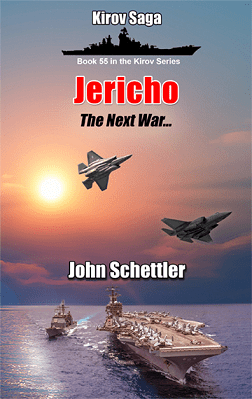
Review: Jericho

Jericho

The 55th book in the Kirov series and most recent as of this post, Jericho is a victim of the series’ structure. In it, the third World War III in the series rages on, as wargame lets plays naval fighting rages off the coast of East Asia. There amphibious landings and tense reinforcement missions. There are also big naval battles where tons of offensive missiles are fired and tons of defensive missiles are fired.

The problem is there were six books in this arc before of big modern naval battles where tons of missiles are fired. And then there was an eight-book arc before this one with plenty of naval battles where tons of missiles were fired. You see the issue here?

Even with keeping the “huge set of wargame lets plays” structure, there’s a lot that could be trimmed. The novelty of a toy box with unique force structures is bound to wear off after several books of seeing that in action again and again. It happened in the previous arcs, and despite this (deliberately) being more out-there than the earlier World War III, by now I’m used to seeing the platforms, formations, and paper-thin Steel Panthers Characters crewing them. The actual simulations could still happen while not going into detail on the least important and/or dramatic of them. One can novelize a game without detailing every single encounter.

As for the central characters, well, they’re not very significant here. Part of this is just that the series is getting ready for the next big arc (insisted yet again to be the final one in the series), but there just aren’t that many words devoted to them in this novel. They’re just there to crew ships like the other to-be-erased cutouts.

This feels like a sports game late in the regular season where nothing is really at stake for either side and there’s no traditional rivalry to spice things up. Yes it’s sports/a Kirov book with wargame battles and jumping plotlines in it, but the feeling of being something greater just isn’t there. It’s understandable given the structure, but that doesn’t change the lackluster quality of the specific novel/game.