Review: Blood Vortex

Blood Vortex

The newest Mack Bolan, Blood Vortex is the 464th (!) Executioner novel. It’s also the last Executioner book planned, or at least the last Gold Eagle/Harlequin one. Thus this marks the end of an era lasting nearly forty years.

In it, every single terror group gathers in Venezuela for a meeting and Bolan has to stop them. So basically, this is like a serious version of The Naked Gun’s opening. The tonal dissonance here is an issue I’ve noticed in other Gold Eagles. Other cheap thrillers often successfully go for either a grounded or audacious tone, but these tend to have seemingly goofy premises that are countered by a self-serious tone and flat execution.

We get long descriptions of each component of the League of Evil arriving at Venezuela. There’s not just over-description of weapons, but over-description of weapons in a very clunky way. There’s also just as clumsy exposition that reads like Wikipedia excerpts about other things. Another big issue I’ve seen with some of these men’s adventure books (including Gold Eagle Bolans) is that despite their short length, they still contain lots of really obvious padding.

Then there’s the other thing I’ve noticed in these Gold Eagles, which is that the infodumps on anything bigger than a bazooka are frequently not just wrong, but blatantly wrong. For instance, the AIM-120 and Kh-59MK2 (yes, the book uses that exact designation) are considered “equivalents”, dubious when the latter is an air-to-surface missile. And the context in which they appear is a paragraph of pure filler.

But what about the action here? Well, it manages to be adequate-at best. There’s a lot more flow-breaking internal monologues here than in other cheap thrillers, and it never rises that high. And this has the problem of going against a mega-saturated genre.

This isn’t some kind of grand finale and there’s no attempt to make it one. Like a lot of “men’s adventure” novels that stopped, it’s just one installment among others. This is like the last nondescript econobox car rolling off the assembly line, long after the rest of the auto world passed it by. This isn’t a dinosaur, it’s a trilobite, with its genre’s business model being obsoleted twice. A series that became disposable and interchangeable (really, look at all the “mass production” and “assembly line” metaphors I’ve used in past reviews) was bound to conclude in such a way.

Review: Raider Brigade: Into A Time Warp

Raider Brigade: Into A Time Warp

With the premise of “1980s American armored brigade prepares for World War III, only to get timeshifted back to World War II”, I couldn’t not check out Daniel Gilbert’s Raider Brigade: Into A Time Warp when I saw it. While my reading experience is broad enough that this is strangely not new to me (the Kirov series timeshifted a modern brigade into the past twice), examining it was inevitable.

Unfortunately, this is rather lacking in execution, even compared to the Kirov series. The enthusiasm is there and the concept is still amazing, so I don’t want to sound too hard. But the prose is very rough and there’s as much time spent on the operations order given before the battles as there is on the (predictably one-sided) battles themselves. A too-large portion of the already short book is devoted to pictures and footnotes, giving this near-Richard Rohmer levels of “padding to substantive content”.

Even at the basics, this falls short. Descriptions are either too short or too long in that “I know what all the acronyms mean, and I’ll tell you in a footnote” way. The dialogue well, leaves something to be desired. And a lot of it is just well, incoherent. There’s no other way to put it. So, with a heavy heart, I’d say that this does not live up to its concept and is not recommended.

Review: New Deal Coalition Retained

New Deal Coalition Retained

I’ve finally felt it’s time for this blog to come full circle and return to internet alternate history. Now knowing so much more about the depth and context, I feel comfortable returning at last to a topic I’ve mostly avoided since starting this blog. This has not been a light decision.

Most TLs on alternatehistory.com I’ve avoided-in hindsight, most that aren’t eventually commercialized in some fashion are shallow pieces of de facto fanfiction. I’ve found that, once one moves past the board drama, there isn’t really much to say. But for this one, I found a lot. Especially as it has a standout (in a bad way) Third World War.

New Deal Coalition Retained is one of the most infamous TLs, and it includes a conventional World War III in its second arc. Now for the others I read, I maintain by the Iceland post that they “weren’t particularly good, bad, or representative” any more than, say, Command and Conquer fanfiction. The WW3 in NDCR is bad, and it is representative, but not of conventional WW3s. In fact, its massive distinctiveness from other World War IIIs is because it’s representative of a trend in internet alternate history, what I call “trinketization”. And it seems to perfectly and eerily show that at its absolute worse.

I got this name from an Alexander Wallace post on Sea Lion Press. The entire article is very much worth reading, but here’s the most relevant part.

A mistake many newcomers make (and this is a nation encouraged by many online historical discussion fora, not just alternate historical spaces) is assuming that history is simply the aggregation of bits of trivia, whose own complex interrelationships are neglected. This reduces the study of history to a collection of trinkets rather than the system of the world that many academics spend entire lives studying but a tiny portion.

In some ways, this trinketization was inevitable. The fandom was going to grow larger and more “diluted”, and the internet made it far easier to find broad surface facts than deep knowledge. Audience attitudes shifted from nitpicking to fanfic consumption, with updating frequently and playing to the crowd taking precedence over all else.

I’ve softened somewhat on severe rivet counting because of its comparative infrequency, but also because it’s still preferable to trinketization. At least rivet-counting means substantial research has been done in at least one area.

Trinketization in practice means that it feels like just a collection of names, numbers, and events tossed out, with divergences being for their own sake and no attempt to work them into a bigger whole. Often the names are of semi-obscure figures who feel like they were just yanked out of Wikipedia or somewhere similar. AH works consisting purely of maps are often vulnerable to this, because they represent just one object. But those are nothing compare to the grand emblem of trinketization: The wikibox. Wikiboxes remove the need to add any sort of context or detail to the event. Simply put, they merely list the event itself. Imagine a sports story reduced to just the game score.

NDCR’s first act is essentially impossible to summarize beyond “Sherman Adams dies in 1957 and then a ton of weird stuff happens.” There are election wikiboxes, war wikiboxes, and stock photos interspersed with long blocks of exposition that are too big to be concise but too dull to be engaging, especially when one realizes the lack of research. Events simply happen.

One of the first things that jumped at me was Pakistan not only winning decisively against India (very, very unlikely), but annexing the Hindu nationalist stronghold of Gujarat. The alarms this set up (especially since looking up the relevant demographics is not truly difficult) were an indication of how everything else was going to go. Most relevant for the WW3 to come, there’s a bizarre and nonsensical situation where the Prague Spring ends up breaking Czechoslovakia into western-aligned Czech and eastern-aligned Slovak states.

This goes on and on. Imperial Germany and Japan somehow get restored. One of Richard Nixon’s daughters ends up marrying into the British royal family, earning the timeline the nickname “Queen Nixon” among detractors. Cuba stops being communist while Brazil starts. It’s a giant jumble.

And then comes the most legitimately creepy part, which is that almost every postwar neo-fascist figure ends up “redeemed” in some way, with the biggest example being German Gerhard Frey. What makes this stand out is that looking around for these figures seems to be the only legitimate, serious research done in the TL. Frey creates one of those “Notzi” ideologies where it comes across as “We support a state with that triumph-of-the-will stuff, but it’s for GOOD and not EVIL”. For all the alarm bells it trips up, I want to downplay this part for the review. However, it exists and needs to be mentioned.  

This jumble of trinkets clunks along until the World War III comes along to lend it some tiny attempt at cohesiveness. And here is where it gets interesting. It feels cargo-culted. It has the very basic and shallow box-checks of Hackett/Clancy/Bond knockoffs. It has a conventional WW3 happening at all, it has an invasion of Iceland, and it has a plotnuke conclusion. But when examined in any sort of detail, the World War III doesn’t feel like them in any way.

If it was shallowly copying techothrillers, the war would be over quick and involve NATO airpower and smart weapons crushing the Soviets. It isn’t that. If it was shallowly copying primary sources, it would probably resemble a knockoff The War That Never Was. It isn’t that. In fact, with its jumbled beginnings and strange numbers/conduct, this comes across as the complete antithesis of those kinds of works.

The OOB-person in me noticed the wikibox for the initial offensive listed the Warsaw Pact as having only 1,028 tanks for a force of 222,361 men (look at those exact numbers) carrying out a high-priority operation at the beginning of the war, the initial attack in the Prague area. This amounts to only around 3 or so divisions worth for something involving three whole field armies, and it’s where the formations would be as close to paper strength as possible. Also, the operation takes 37 days, longer than some estimates of the whole war, even with nukes handwaved away. (If the Soviets could stay at their planned advance rates, they’d be in Madrid by that point). For a conventional narrative, I’d be totally willing to let it slide if the story was good, but for something that’s pure description, the description needs to be of a higher standard.

But that’s small potatoes compared to what happens next. The big push appears, with close to 4 million Soviet troops grinding forward across West Germany against around 3 million NATO ones over the course of several months. To the extent where there’s any constant inspiration at all, it feels inspired by World War II. Everyone has totally mobilized drafted armies with huge numbers. Heavy bombers just level-bomb cities en masse like it’s 1943. A part of me thinks this theme might be taken at least in part from Anglo-American Nazi War, a timeline on the same site (published and reviewed as Festung Europa), which is another rote tale of giant armies and giant casualties struggling across the continent for years as seemingly horrific events are flatly described. At least it feels closer to that than pretty much any actually published World War III story.

The Soviets reach the east side of the Rhine, and the button is not pushed. They cross the Rhine, and the button is not pushed. They move some distance into France and the button is not pushed by either NATO or the French themselves. In that and every other theater there are stock photos, battles, and yes, wikiboxes. On every continent. The troop numbers are consistently too big by postwar standards, and when mentioned, the tank numbers are consistently too small-especially since they often depict situations where the explanation of realistic attrition isn’t usable.

The East Germans eventually mutiny due to “pervasive pan-German sentiment” as part of the tide turning. I should note in real life, they were considered trustworthy enough to be plugged right into GSFG-but of course, this is after thirty years of scrambling. The tide turns in more wikibox battles, with NATO eventually counter-invading the USSR itself, including an Arab-Israeli alliance pushing into the Caucasus. NATO crosses the border and the button is not pushed. Baku and Leningrad are overrun and the button is not pushed. Eventually, with Moscow on the brink, the Soviet leader orders the launch-and it’s portrayed as insane with a scramble to stop. One missile makes it aloft but a Star Wars satellite shoots it down. The end. Somehow this lasted for two and a half years of high-intensity fighting and had over forty million military deaths alone distributed evenly among the two sides.

I hope the feeling of this timeline can be determined from the review/summary here. If it sounds jumbled, it’s because it is. If it sounds like it doesn’t make any sense, it’s because it doesn’t.

There’s a postwar part which returns to the trinketization along with other creepy element common to it and some other trinketized online AH with fairly recent divergences. This is real living people turned into vastly different ones, with one of NDCR’s most prominent and bizarre examples being real actress Mariska Hargitay turned into a Freyist political figure. But little about that can be said beyond what’s been said about the first two parts.

It’s very rare that a work of fiction manages to somehow include all the negative elements of its genre in a way that highlights every single one of them. But New Deal Coalition Retained is such a work. One can sometimes get a feel for the flaws of a genre by looking at something that prominently displays them. Such is the case for later Tom Clancy books and technothrillers, and it’s the case for this and internet alternate history. If those are Chronicles of the Conference Room, this is like a research paper without any research.

Review: Tales of World War III 1985

Tales of World War III: 1985

Looking back at the progression of this blog, I’m reminded a lot of the story of trying to make a cockpit design that could fit the “average pilot”, and then finding that no one actually met that criteria. I feel similarly when I look back at just how little anything actually met my stereotype.

Brad Smith’s Tales of World War III: 1985 series comes closest, edging out Larry Bond’s earlier work. It’s done by a wargame designer and thus features the wargame-friendly setting of 1985 Europe, with battles taking place in various parts of it. There’s a lot of technical description.

I don’t feel nearly as much negativity towards it as I would have and did in the past. Smith has sincerely tried to build characterization, even if the execution is still often clunky and the characters often Steel Panthers cameras in practice. And the wargaming at least takes the series above Ian Slater in terms of technical accuracy. But it’s still a 51% entry in a niche genre, the pilot who isn’t particularly good or bad but has the dimensions to actually fit well in the “average” cockpit.

Review: Firedrake

As of now the most recent book in the Kirov series, Firedrake combines the worst and best of it all. The worst is that all of the structural problems are still there and that the wargame lets play structure is beginning to wear thin, especially with the foreshadowing that this particular timeline is getting erased/destroyed. The best is, well….

The best is that plot points involve the ship transported to a bleak, dark, empty world where only hostile mechanized drones roam the seas and skies (was it Skynet or Yawgmoth that was responsible? :p ). Then it moves into another timeline courtesy of supervillain Ivan Volkov, where a Third World War (the fourth in the series) is about to begin, one where Japan won the second thanks to Volkov giving them nuclear bombs.

The Kirov series is best when it wargames out drastically changed situations, and that is the case in half of Firedrake. The other half is wargame action as usual.

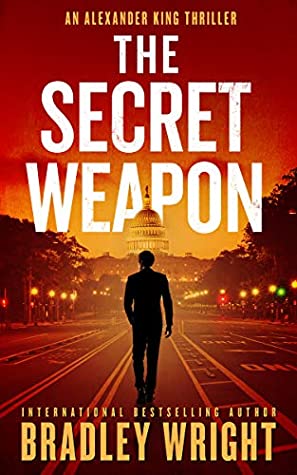
Review: The Secret Weapon

The Secret Weapon

A thriller in the Alexander King series, Bradley Wright’s The Secret Weapon is an example of how tough it is at the margins. My history with the author is a little strange. I’d read some of his books in the past, where they faded from memory as bland and mediocre. Then I saw this book, felt it was bland and mediocre-and then realized I’d read the same author before.

Anyway, the book isn’t really the worst ever. On-paper, it does what a cheap thriller is supposed to do, and only feels like its slightly below average in every category that matters-the action is slightly less exciting, the pacing slightly less efficient, and so on. Yet it’s that little bit that makes the difference.

Because the “action hero” genre is so big, has so many choices, and is reliant on execution rather than concept, for something to fall behind somewhat means there’s a lot out there that’s better. This isn’t like the much tinier “big war thriller” genre where a flawed entry like Chieftains or Arc Light can still be conceptually interesting enough to recommend. Instead, its flaws means it sadly misses the cut.

Review: ParaMilitary Action-Adventure Fiction, A History

Paramilitary Action-Adventure Fiction: A History

I have loved and respected Nader Elhefnawy’s analyses of fiction. So it’s with a heavy heart that I say that his Paramilitary Action-Adventure Fiction, A History doesn’t live up to his other work on the technothriller.

I saw one big technical error, claiming the SEAL Team Seven series was issued in the 2010s by “Keith Douglass.” In fact, it was reissued from its original run in the 1990s and 2000s after the bin Laden raid and “Keith Douglass” was a pen name used by at least two different people (William Keith and Chet Cunningham) and possibly a third or even more. But a bigger problem is structural.

My biggest criticism is the overly long amount of time spent on the socio-political context of the times, which while obviously relevant at times (such as the crime increase of the 1960s that paved the way for the vigilante novels or the Vietnam War MIA obsession that did the same for action novels in the 1980s), sometimes doesn’t feel like that. It flows a lot worse than the techno-thriller piece does and, worse, zooms out too much. There’s a saying of missing the forest for the trees. This misses the trees for the forest. It’s okay enough when talking about non-print items, but misses the mark when talking about books.

Far more important than what effects the economy had on the national mood were just the simple economics of dealing with anything low-margin, which is what these novels were. The sad, harsh, boring reality is that the kind of disposable paperbacks that the work covers are/were the most expendable bottom feeders of commercial literature. The slightest dip in the economy and/or change in customer tastes could knock out all but the most popular. I don’t blame Elhefnawy for taking the approach he did, but think he was looking in the wrong place.

Review: Hitler Invades The United States

Hitler Invades The United States

I’d thought that Hitler Invades The United States was going to be just a dime-a-dozen work of internet alternate history. I was mostly right, but one part of it was a lot weirder than I thought, and that part both makes it lower quality and more interesting to write about.

The point of divergence is that the Germans delay their campaign so that the wunderwaffe can be ready. With said wunderwaffe, they easily take over the USSR. Then they launch a successful and “essentially unopposed” (exact words) invasion of Britain. Then it comes time to-guess. It’s not exactly the most plausible or original World War II alternate history story out there.

The story itself is a clunky mess of what you’d probably get if you only looked at the most shallow and popular sources of World War II, and then decided that an American invasion had to happen. The Axis invades the US and is only stopped when the Americans drop a nuke on Nuremberg-at which point the war ends instantly. But the real “star” is the conference room.

Barring a few “recollections” from participants, this book is entirely conferences and meetings, written in a fashion that feels like the script for a stage play. I know this genre has a lot of conference room scenes, but this takes the cake. And they’re not even done well.

What I think makes this interesting to look at is how something like this compares with Robert Conroy, who also wrote technically inaccurate alternate history tales of the US getting invaded. At least with Conroy you had a proper novel, even with often-subpar execution.  Here, it’s the kind of “semi-exposition” alternate history that in theory should be used in places where a normal narrative wouldn’t work, but in practice I feel is used likely because it’s easy to write.

What this has in conclusion is the negative elements of two types of alternate history “traditions” (as per Alexander Wallace’s excellent article) amplified at the same time. One perceived negative element of the “print tradition” is that it’s less plausible and tends to focus on the most visible and obvious trends, like the American Civil War or World War II. This is that. However, it also has the issues with storytelling (and then some) that the “internet tradition” can have. The result is the worst of both.

Review: Ward

Ward

The sequel to Spacebattles darling Worm, Ward arrived to much fanfare, to the point where the end of its author’s last web serial was overshadowed by antsy fans waiting for it to start. Now Ward itself has just finished.

When I started reading it, I saw that Wildbow’s literary issues didn’t change. The prose was too flat. The action likewise was too flat. The pacing had only two speeds: “Way too fast” and “Way too slow”. The descriptions are either overdetailed or underdetailed. I’d tried to follow all of his serials after Worm itself when they were written, and ended up just abandoning them.

Reading more of Ward, it has Worm’s problems, if not more. The structural issues mentioned above. The tendency to write into a corner and then ESCALATE out of it. The way the cosmology becomes ridiculous (you don’t include precognition as a power without good reason, much less two super-precogs, and that’s just one problem).

But really, Ward is a tragedy. I don’t mean inside the story itself, although it has plenty of dark moments. I mean that it’s dragged down by two big factors. The first is the legend of Worm bringing up unrealistic expectations (something Wildbow himself mentioned in his retrospective). The second is that its predecessor had just the right amount of factors to make it popular. Lightning was never going to strike twice.

One strange effect was that an improvement in the characterization actually doomed the serial. Worm’s fandom success hinged on Taylor, its protagonist, and her lack of what would normally be considered substance. Someone who was about 30% power fantasy of fighting back against the people who were just UNFAIR TO HER and 70% blank slate camera RPG protagonist created some strange incentives.

If you saw Worm as something that was more of a superhero RPG let’s play than anything else (which it comes across as), then the fanfiction boom made sense. Taylor’s bug power was just one “build” among others, and if the sole part of her character that filtered down was that wish fulfillment, then it’s easy to see why (combined with bandwagon inertia) why it got all the fanfiction it did on one small part of the internet.

So Victoria Dallon may have been an improved character, but the mystique was lost. Ward ended up as feeling to me like the kind of webfiction that, if you’re into it from the start (I wasn’t) you’d follow until it finished and then leave it behind.


Box Press released

Box Press, my second Smithtown Unit ebook, has been released by Sea Lion Press. While the first installment  aimed to pay homage to the “men’s adventure” genre in all its forms, this one has a narrower and more obscure foundation. That would be the weirder books in the 1970s that tried to move beyond just shooting mobsters and brought in stranger antagonists as a result.

Enjoy the next adventure of Bill Morgan.