Review: Operation Sea Lion

Operation Sea Lion

The most infamous invasion that never was, Operation Sea Lion holds a special place in the annals of alternate history. Richard Cox’s book takes a 1974 wargame of it at Sandhurst and turns it into a Hackett-esque big picture tale. This can be described as a World War II version of The War That Never Was, taking simple wargame results and giving them a tiny fig leaf of “plot” via various vignettes.

Not surprisingly to anyone knowledgeable about alternate history, the wargame, despite deliberately going easy on the first wave (to have a substantive ground element at all) ends with the Royal Navy cutting the lines and the Germans defeated. It’s not Cox’s fault, but something with the outcome never in doubt is hard to make exciting for someone who knows the context.

That being said, this remains an amusing little historical alternate history footnote. It’s aimed at a popular audience who wouldn’t necessarily know the context, and is at least more literary than a rote after action report of the wargame itself would have been.
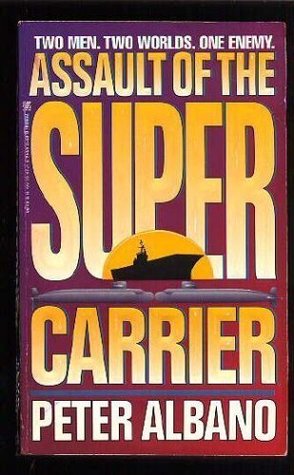
 

Review: Assault of the Super Carrier

Assault of the Super Carrier

supercarrierfinale

Peter Albano’s Seventh Carrier series comes to an ignominious end in Assault of the Super Carrier. The action has gotten incredibly repetitive, the worldbuilding feels like even more of a toy box, the novelty has worn off for a long time, the characters are horrifically stereotypical, and the base writing just isn’t good enough for eleven books.

There’s two things that make this last entry especially disappointing. The first is the “girl of the book” subplot becoming its sleaziest, most useless, and most distracting yet. The second is that there really isn’t an ending. There’s a battle that feels like every other battle in the series, a victory that should have been an arc-level one at best, and then the novel-and the whole series- just ends quickly.

What I’ve found after searching out books with novel setups is that they alone can’t carry a series. And this is the best example. Take away the goofy “carrier thaws out, jet/rocket engines get insta-zapped” setup, and all you’d have is something like Ian Slater, only with (even?) worse writing and a fixation on World War II military equipment. And like Slater, that’s not enough to sustain a huge amount of books by itself. Maybe the Seventh Carrier saga could have worked with three books. It couldn’t with this many.

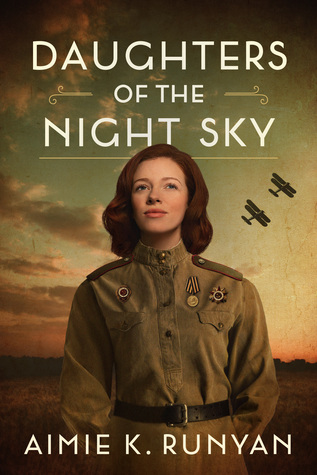
Review: Daughters of the Night Sky

Daughters of the Night Sky

nightskycover

With Aimie Runyan’s Daughters of the Night Sky, Fuldapocalypse moves into yet another new genre-the Romance Centered Around Night Witches. It’s a little tricky to review, but I’ll try. The first “issue” is that this is obviously chick-lit, which is not something normally associated with the Eastern Front, for good reason. That the heroine falls in love with an artist is kind of the icing on the cake.

The second issue is that it feels like chick-lit and not like characters who are actually in the middle of a horrendous world war. What this came across as was “romance characters, plus add a few obligatory flying scenes and the occasional stereotype like a reference to blocking detachments.” While the author admits she wasn’t that knowledgeable about Russia or military aviation, it just feels too generic.

And that brings me to the third issue, which is that the actual flying isn’t very good. While I wasn’t expecting Dale Brown and while it’s actually admirable to not try and dwell on something you admit you don’t have much knowledge of, this still falls short. The problem is there’s too much of it and not enough research.

It would be like if a writer was making a story about American football (hey, I’m posting this review on NFL Draft day) and only knew the basic positions, such as quarterback and receiver. This would be obvious to those who read it and knew even a bit about the subject matter, but the writer still insisted on showing several games. This is like that, only with Polikarpovs instead.

As a whole, this is just a fluffy romance novel with World War II flying scenes and the characters having Russian names.


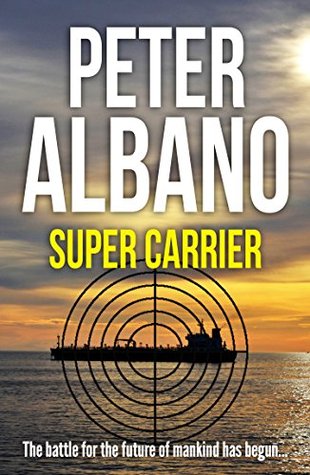
Review: Super Carrier

Super Carrier

supercarrier

Peter Albano’s “epic” series about a thawed-out Shinano fighting in a world where the clock is turned back lasted for eleven books. With me not considering the first two of be of the highest quality, and hearing that they got very repetitive, I jumped to the second-to-last installment, Super Carrier.

And I probably didn’t jump far ahead enough, for the tenth book is very much like the second, only worse. A gigantic chunk at the beginning is devoted to a overly long mission in a B-24. A smaller but still horrendous portion consists of a tank battle that is not exactly the equal of Team Yankee or Tin Soldiers. Then there’s the “romances” and the girlfriends getting killed horribly for “poignancy”. Neither is written well.

The retro dogfighting also appears clunkier than I remembered it being in the first two books, and the list of horribly written national stereotypes grows even larger. This book is only recommended to people who really liked the past Seventh Carrier entries.

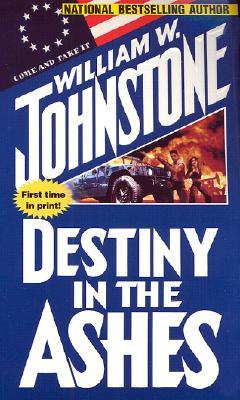
Review: Destiny In The Ashes

Destiny In The Ashes

ashesdestinycover

William W. Johnstone’s Destiny in the Ashes is the 32nd (!) book in the series. Released near the end of Johnstone’s life, there are legitimate questions as to whether it’s the work of Johnstone the person or “Johnstone”, the pen name used by his niece and an army of ghostwriters behind ironclad NDAs since his death. I will only say that it reads like the real Johnstone and certainly isn’t any better than anything unambiguously written by the real Johnstone.

It took over ten books for Jerry Ahern’s Survivalist to stop being truly post-apocalyptic. It took Johnstone less than one. Instead it was focused entirely on societal commentary, if the commentary came from a pretentious, incoherent redneck.

The “plot” of this book is a Middle Eastern terrorist is striking the “US” run by the EVIL LIBERAL GUN GRABBERS, and they are forced to call upon Raines in the Great People’s SUSA Utopia for help. Raines steps up, in part with lectures about the inferiority of helicopters for troop insertion compared to HALO jumps. Naturally, the Americans go in with helicopters and get killed, while the Rebels HALO drop with ease.

The “military action” in this book (and the whole series, I must add) is legitimately strange and not just poorly written. It would be one thing if, by accident or design, it involved unrealistic and overly cinematic action. There’s some of that, but there’s also hunched strategy sessions that just make no sense and end in Mary Sue stomps.

The conclusion of this book involves an effortless jaunt out to Iraq in a passage that reads like a far worse version of a Chet Cunningham SEAL Team Seven novel. This continues the trend made far earlier in the series when Johnstone ran out of domestic “punks” for Raines to kill and had to send him abroad to get more.

The writing is terrible, the pacing is only somewhat bad, the plotting is terrible, and the characterization is extra-terrible. Yet, if it makes sense, the Ashes series is genuinely and distinctly terrible. A horrendous writer got a conventional publisher to produce and distribute literally dozens of his picture-book war stories and become successful enough that he endured as a “Tom Clancy’s” -esque brand name. That’s what makes it stand out.

An Old Story Draft Of Mine

So, a long time ago I had this idea in my mind. Now, granted, I didn’t know how to proceed from there, but it was this idea I had in my mind. Maybe it could still work as a very short story by itself.

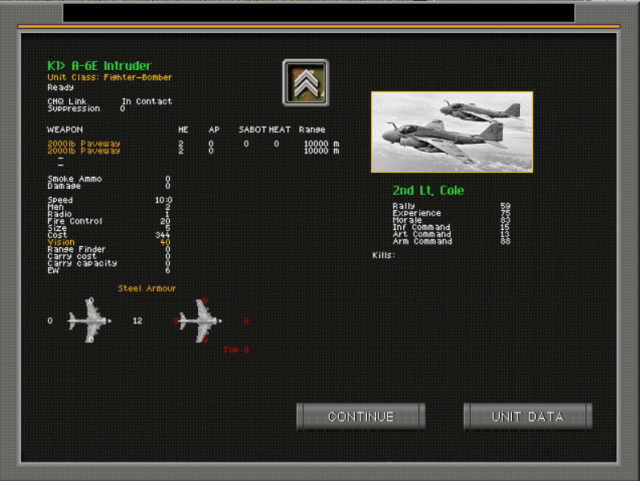
I’ve talked before about “Steel Panthers Characterization”, derived from this:

spexample

Basically, in Steel Panthers, a unit has a nationally appropriate name and rank applied to it. Being otherwise interchangeable, this means nothing else in terms of characterization.

I came up with the term “Steel Panthers Characterization” to describe situations when characters were not just underdeveloped, but seemed to exist solely to put a certain piece of military equipment into action.

Fortunately, just as there were many, many fewer “Big-War Thrillers” than I’d thought, there are equally as few Steel Panthers Characters. Yet as a formative experience, this introduction stuck in my mind.

Basically, there would be a pilot in a two-seat, side-by-side aircraft, like an A-6 (as in the illustration) or an F-111 or an Su-24. It would dive in, release its weapons, and fly away on a routine mission.

Suddenly, the pilot would realize something wasn’t right. He looks at the other crewman, clad in his flight suit. Lifting up the visor, the pilot sees absolutely nothing underneath it. Same thing with the gloves and sleeves. Unnerved, the pilot simply ejects. His fate would be left ambiguous in a short story, but in a longer one he would become one of the characters.

What’s soured me on the concept is that I’ve felt it’s not only too harsh a critique, but also too inaccurate of one, given how few works really sink to that level. And the ones that do either make up for it in some way or are just unfairly easy targets. But still, the draft of the pilot’s story is something I feel I should share.


Review: The Gambit

The Gambit

Take a stilted first novel, add a difficult genre, and you have Brad Carlson’s The Gambit. This tale of Iranian plots and the Americans out to stop them reminds me of, if anything else, an even rougher version of Gavin Parmar’s Unseen Warriors. The problem is that technothrillers are harder to do right than small unit thrillers. I don’t want to be hard on the author. This is a first novel, I know firsthand how much effort writing any kind of long fiction is, and everyone has to start somewhere. But I have to be hard on the book.

There’s the clumsy prose, but there’s also the awkward pacing. There’s the action that falls well below even the standards of Marine Force One, but there’s also a ton of conference rooms and really rote instances of military equipment doing its thing (I hesistate to use the term “action” for the scenes describing it). There isn’t even an out-there premise. It’s just “shoot the terrorist” and stopping the most basic and mundane plots, all the while moving through something horrendously unpolished.

There are good independent first novels. This is not one of them.

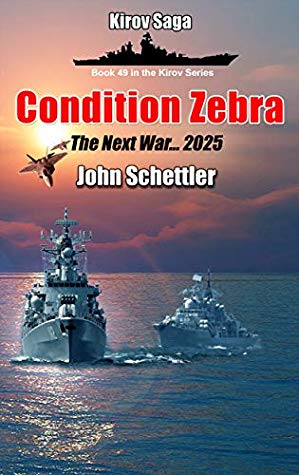
Review: Condition Zebra

Condition Zebra

conditionzebra

The (supposedly) final arc of John Schettler’s epic Kirov series, now exceeding even The Subspace Emissary’s Worlds Conquest in terms of word count, begins with Condition Zebra. This is the story of a contemporary World War III, after the Kirov timeshifted away from another contemporary World War III, possibly making it the first series to have multiple World War IIIs in it.

Having read two books in the 49-and-counting series, I figured it would at least be the same as before.  I was wrong. It somehow managed to be worse. And it manages to be worse in ways that might be considered contradictory at first glance.

One one end, the basic nuts and bolts writing has all the problems of the past Kirov books (characters who exist solely to operate military equipment, rote technical descriptions of the battles that give away the wargames used to sim them, and overall clunkiness) and just feels sloppier, with the dialogue, grammar, and even structure seeming worse.

On the other, the giant timeline tangles get bigger, more confusing, and somehow more pointless-seeming than ever. Knowing the end result and purpose, it just feels like the developers of Madden, 2K, or The Show making up a gigantic plot about time machines and time-traveling team general managers to explain why past players can appear in a game with current stars.

Maybe it’s those above flaws and maybe it’s just that the novelty of seeing the world’s longest wargame let’s play has worn off after three books, but this doesn’t even seem bad in a bemusing way anymore. It’s just bad.


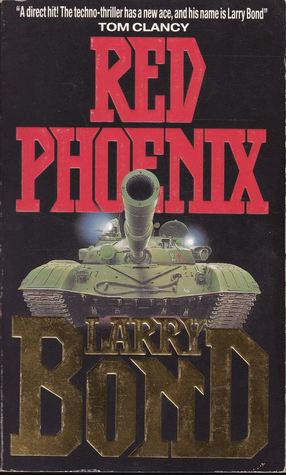
Review: Red Phoenix

Red Phoenix

redphoenixcover

Larry Bond’s Red Phoenix, telling the story of a second Korean War, is something I’ve struggled with for a while but now, after a lot of other books read, have the words to successfully describe. In short, it’s the Marine Force One of “big war thrillers”.

Every archetype of the small genre is there. The shifting viewpoints from top to bottom. Going into every part of the theater. And so on. And they’re executed with enough skill to not be bad, but not enough to be truly memorable or standing out.

What does stand out, and which I also have a more nuanced view of than I used to, is the long intro setting up the war. I’ve thought it, from a literary perspective, to be less than ideal. It’s taking a huge amount of effort to set up something the reader already knows will happen.

But from a plausibility perspective, given the massive unlikelihood of a Second Korean War even at the height of the north’s power, I can forgive it for putting in the effort to set up a situation where it could happen. It’s certainly better and less ridiculous than Cauldron at any rate.

And what else is there to say? This is very much a “if you like the genre, you’ll like this book. If you don’t, you won’t” kind of novel.

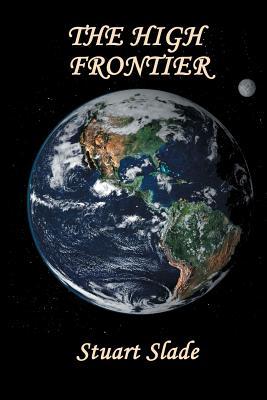
Review: The High Frontier

The High Frontier

highfrontiercover

The High Frontier is the de facto ending to the The Big One series. The end of the Easy Mode Cold War is, for most intents and purposes, the end of the main published series. And, like The Sum Of All Fears, it’s a good stopping point.

This entire franchise has the slight misfortune of bad context for me. You can see why and what in the entry for the main series. That being said, while The High Frontier may not be the worst book ever, it still stands out only for its plot “novelties”. What plot novelties?

Well, for this individual book, there’s, among other things…

  • A very cheap shot at the Space Shuttle program right off the bat, where the Columbia disaster occurs right after the Challenger disaster. It’s actually semi-realistic in a rivet-counting way. The second post-Challenger mission had foam hit the heat-shield and barely survived, and the Space Shuttle program’s many, many issues are well-known. But the narrative intent is obvious.
  • Exposition where the Chipanese [yes] antagonists lament the inferiority of their military compared to the (awesome) Americans.
  •  The Chipanese campaign in Vietnam, featuring the equivalent of the Soviet general secretary personally running into Afghanistan to command forces there and then getting killed.
  • In said campaign, there are so many names of historical Vietnam War figures that I couldn’t tell if it was just bad naming or the real people (who’d be much older, and in some cases, dead.)


Finally there’s the climax, the biggest missed opportunity in the whole book. Having read The Sum Of All Fears makes it look even worse than it did when I first read it. Here’s an opportunity to foil the plot by showing restraint in the face of apocalyptic provocation-and instead it’s the equivalent of having the protagonists stop the nuke from going off in the first place.

Then the book ends with Ronald Reagan asking about the Seer and one final infodump about the nature of the unaging mutants with catlike eyes who serve as combination plot devices, Mary Sues, and ways to not have to create more characters. Of course they happen to stop aging at convenient times, have an ability to sense other long-lifers, are disease-resistant but not immune, and it took as long as it did for one person to find them out. Hmmm….

The book itself is par for the course for the TBO series, which is to say, it’s substantially below-average. Yes, a lot of its negative reputation comes from the gauntlet-throwing and internet drama accompanying its initial release. Yes, it doesn’t look quite as bad in context when compared to the worst of either internet alternate history or post-1991 technothrillers. Yes, a lot of its flaws aren’t unique to it.

But it’s still clunky, hopping around characters and events. It’s still flat, with characters being either Mary Sues, placeholders, or strawmen.  The worldbuilding is still ridiculously stacked in favor of the Americans. The action is still either bland and one-sided or extra-bland. The stiff dialogue in this book (and in the whole series) is distinctly bad, even by the standards of low-end fiction. It’s still just not good.