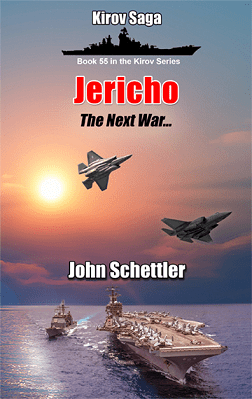
Review: Jericho

Jericho

The 55th book in the Kirov series and most recent as of this post, Jericho is a victim of the series’ structure. In it, the third World War III in the series rages on, as wargame lets plays naval fighting rages off the coast of East Asia. There amphibious landings and tense reinforcement missions. There are also big naval battles where tons of offensive missiles are fired and tons of defensive missiles are fired.

The problem is there were six books in this arc before of big modern naval battles where tons of missiles are fired. And then there was an eight-book arc before this one with plenty of naval battles where tons of missiles were fired. You see the issue here?

Even with keeping the “huge set of wargame lets plays” structure, there’s a lot that could be trimmed. The novelty of a toy box with unique force structures is bound to wear off after several books of seeing that in action again and again. It happened in the previous arcs, and despite this (deliberately) being more out-there than the earlier World War III, by now I’m used to seeing the platforms, formations, and paper-thin Steel Panthers Characters crewing them. The actual simulations could still happen while not going into detail on the least important and/or dramatic of them. One can novelize a game without detailing every single encounter.

As for the central characters, well, they’re not very significant here. Part of this is just that the series is getting ready for the next big arc (insisted yet again to be the final one in the series), but there just aren’t that many words devoted to them in this novel. They’re just there to crew ships like the other to-be-erased cutouts.

This feels like a sports game late in the regular season where nothing is really at stake for either side and there’s no traditional rivalry to spice things up. Yes it’s sports/a Kirov book with wargame battles and jumping plotlines in it, but the feeling of being something greater just isn’t there. It’s understandable given the structure, but that doesn’t change the lackluster quality of the specific novel/game.

Review: The Sixth Battle

The Sixth Battle

Barrett Tillman’s The Sixth Battle is an interesting book. The 1992 novel of a gigantic combined battle over South Africa can either be considered the last Cold War “big war thriller” or the first post-USSR one. Because of its timing, the plot has to be kind of, er, forced a little, but that’s a small issue.

When I started reading the book, my thoughts turned to Red Phoenix. The similarities are there in that both are big picture thrillers that need to have a certain type of structure (most notably a lot of viewpoint characters and a setup period) to get that wide view across to the reader. For me personally, the perils of this is that since I already know a lot of what the authors are trying to communicate to a less knowledgeable audience, I see more of the downsides to this approach than the upsides.

However, I can also see-and appreciate-how rare a book like this is. “Big war thrillers” with this level of detail and knowledge behind them are and were very hard to come by. The Sixth Battle goes for a distinct setup, thinks it through, and competently executes the action in an evenhanded way.

Taking my biases into account and trying to adjust for them, I still recommend this book. It does feel a little clunkier than the best “big war thrillers”, but it’s never unreadably so. And it offers an all-too-uncommon experience that’s rarely duplicated elsewhere.

The Oderpocalypse

This could only have been produced in a very short time period, after the Berlin Wall and end of the Warsaw Pact but before the actual breakup of the USSR. Because of this, this RAND report looks interesting, especially in its “long-term” ramifications.

Having an intact, hostile USSR but no Warsaw Pact means that to threaten Germany, it has to move through Poland first, can only put two fronts against Germany directly due to Poland not being that wide (the third has to either be a reserve/second echelon or swing through the Czech Republic), and puts the initial front line considerably farther to the east, with the Oder river being the first big obstacle. It’s an interesting piece.

The Conventional War In The Air, 1970s

I’ve come across a declassified CIA document from 1972 illustrating a speculative Soviet air campaign in a Cold War turned conventionally hot. Having just emerged from the nuclear monomania of the past decade, it shows the weaknesses of the Soviet air forces in what was new territory for them. Almost everything was either too short-ranged, too vulnerable, carried too small a bomb load for conventional war, or a combination of the above.

That being said, it still would be very formidable to oppose, especially by the standards of “we only need to hold the air above the North German Plain for a few days”.

Review: For Alert Force

For Alert Force: KLAXON KLAXON KLAXON

Having essentially run low on World War III books that both held interest to me and weren’t already read has been a slight issue for this blog. Thankfully, I found some newer ones. One of these was Jim Clonts’ FOR ALERT FORCE: KLAXON KLAXON KLAXON, an awkwardly-titled book telling the tale of SAC crews in World War III.

This is a near-immediate 1980s nuclear World War III with none of the contrivances to keep it conventional for any length of time that appear in other works. Clonts, a veteran of B-52s himself, tells their story of fighting in these apocalyptic conditions. The book is good for what it is, but tends to wobble a little.

It has the exact strengths and weaknesses of what something written by someone with personal experience brings. On one hand, it’s detailed and a lot of it is accurate (as far as I could tell). A lot of the scenes are tense and well-done. On the other, it has tons and tons of Herman Melville-grade explanations of everything minor and technical.

Still, it could have been a lot worse than it is, and works as an aviation thriller. It’s not the most pleasant, but as this is about nuclear war, that’s to be expected. A more focused Chieftains (albeit with airplanes instead of tanks) is not a bad thing.

Finally, I noticed that it openly declares itself an “alternate history” on the cover, something a lot of fiction, even the kind that could easily qualify as such, doesn’t do. This fits the description unambiguously. It takes place long before its writing time and has history-changing events. So it’s interesting that Clonts felt comfortable enough to label it as such.

In short, I didn’t regret reading this book.

Weird Wargaming: OPFOR as “Actors”

In some of my Command scenarios, I’ve depicted exercises. Many similar scenarios use the “characters”, the foreign platforms they’re simulating. Therefore there would be a lot of Soviet origin fighters. And there’s no problem with that. But I’ve decided to do things a little differently in my own.

I’ve decided to frequently use the “actors”, the western units painted up as “aggressors” to play the enemy during the operations. Part of this is just for the sake of distinct novelty, and part of it is to provide a non-contrived way for advanced western platforms to fight each other.

A general substitution rule I’ve used is this.

MiG-21F-5
MiG-23F-20
MiG-29F-20, F-16
Su-27F-15
Su-24F-111

There are of course even more variants, but those are the general ones.

The next part is setting the side proficiency of the OPFOR to “Ace”, the highest one. It’s there to simulate both highly trained crews (hi Jester and Viper) and give the player more of a challenge.

That’s my small personal guideline for exercise scenarios.

Review: Exxoneration

Exxoneration

The American invasion of Canada finally begins in Richard Rohmer’s second book on the subject, Exxoneration. The previous installment, Ultimatum, ended with the US announcing its intention to annex Canada. Here, it moves ahead.

As far as its literary quality goes, I’ll just say this: I’ve read field manuals that were less cumbersome and infodumpy. Seriously. The mega-padding is still there, including such things as aircraft takeoff instructions. And the er, “lopsided” nature of a Canadian/American armed conflict means the book has to twist to have its cake and eat it too.

There’s only one fairly brief semi-battle in the novel itself. In it, the Canadians ambush a flight of American aircraft landing at Toronto who falsely assume the invasion will be unopposed. Basically, the Canadians need to win but there’s obviously no way for them to win conventionally so they have to rely on American public opinion (plausibly) promoting a backlash however the tone of the book is such that it wouldn’t do to have Canada devastated by war, so the only onscreen conflict needs to be short and neat.

Most of the book is just about the later efforts by Canada to purchase Exxon (hence the title). Needless to say, this is not exactly the most scintillating topic. While a better author could have made it exciting, Rohmer does not.

I want to compare this to Mike Lunnon-Wood, who wrote about slightly ridiculous to highly ridiculous scenarios in a matter-of-fact manner, but Lunnon-Wood’s prose is significantly better than Rohmer’s. It takes some effort to make a book about a Canadian-American war dull, but Rohmer does so.

Review: Kirov Season 6

Kirov Season 6

So, I’m FINALLY caught up with the entire Kirov series as of now, a feat of great effort even for me. The Season 6 “Next War” arc is, with hindsight, one of the weakest in the series. Unfortunately for me, it was the first arc I encountered. The second of four World War IIIs depicted in the series (this has to be some kind of record), it follows the World War II mega-arc.

In terms of actual writing, the individual books aren’t any worse than other Kirovs. The problem is its comparative mundanity. It’s one of the most recent examples I’ve seen of the “Captain Beefheart playing normal music” effect. It’s a contemporary World War III. Apart from a few half-hearted hypotheticals here and there, the only really substantive addition is a bigger Russian Navy, and that seems there just to have repeated large sea battles at all.

As for the time travel soap opera, there isn’t that much there. The war starts because Tyrenkov, a time traveler from the 1940s went forward , seized control of contemporary Russia, misinterpreted a possible future where he won as a definite future, and then started the war. Between that and the fetching of more of the time-keys (obvious plot MacGuffins), this is pretty restricted. About the only redeeming part there is the (sadly too small) presence of Ivan Volkov, the closest thing the series has to a primary non-historical antagonist. Volkov is a cross between a puppy-kicking supervillain and a crazy schemer who’s a lot less smart than he thinks he is, and remains my favorite character in the series. While there is some Volkov, there isn’t enough.

The only other new characterization is Tyrenkov, after fleeing to the ship as the war spirals out of control, being forgiven far too easily for my liking. The rest of the main cast stays the way they’ve always been, and they’re swamped by the shallow Steel Panthers Characters.

Otherwise, it’s a mixture of being restrained by semi-realistic orders of battle, cover ground that lots of other wargames have gone over, and, worst, having the contemporary setting give the author a justification to er, opine. It’s not the worst, but it’s still an issue the less “connected” installments didn’t have. It also feels-redundant, going over similar ground that the initial World War III in the books 4-8 arc did (to the point where I not unreasonably thought it was the exact same war), and having the same outcome (nuclear destruction and the ship timeshifting away).

Thankfully, the series improves significantly in the next arc, as a World War III in the altered reality created by the ship’s intervention in World War II allows the “wargame sandbox effect” to really flourish in a way it doesn’t here. Season 6 itself has all the weaknesses of the Kirov series as a whole and very few of the strengths. I’ve compared the series to an overly literalist lets play of an RPG. If that’s the case, this is the dungeon you always disliked.

Review: I Jedi

I, Jedi

Michael Stackpole’s I, Jedi may be my favorite Star Wars novel ever. It’s also a book that has absolutely no business being as good as it is. After all, Stackpole is a writer who isn’t the best prose-wise and tends to take game mechanics literally. Corran Horn, his protagonist, is the ur-example of someone parachuting their own Mary Sue into an existing franchise. The first part of the book uses the same plot as a book by the infamously subpar Kevin J. Anderson.

And yet, it somehow works brilliantly. Part of it is that Stackpole’s writing is in better form than usual, in everything from starfighter battles where Corran fights his old teammates and can sense their thought processes to everyday life on a backwater world. Another part of it is that by being small-scale and comparably low-stakes, it manages to actually make the universe look bigger and more wondrous.

Stackpole’s epic might be helped along by the other books of the time, which tended to have a random ex-Imperial using the superweapon of the week and an inappropiately small number of Star Destroyers to threaten the entire galaxy. But even on its own, it works. It embodies the “distant vista” principle, restores a sense of awe, and just succeeds as a story in its own right.

Review: Air-Mech Strike

Air-Mech Strike

The book Air-Mech Strike holds the origin of the infamous “Gavin” nickname for the M113. It’s also extremely dated and, for the most part, badly written. This is a very 1990s book, despite being published in the early 2000s.

The “Gavin” name is a little more forgivable in this context because it’s meant to refer to a heavily modified and upgraded M113 instead of just the stock vehicle itself. The problem is that the authors want to have their cake and eat it too-they want an existing vehicle to fill the “medium motorized” infantry role out of legitimate concern that a big procurement wouldn’t happen in the post-USSR budget crunch, but also want a lavishly upgraded one. Yes, they give supposed cost figures, but I’m still skeptical (to put it mildly).

There are huge lists of TO&Es, to the point where I could probably just say “read the book itself” if I was doing a Weird Wargaming on the “air mech strike force”. There are piles and piles of 1990s NETWORK SMART WEAPON BUZZWORDS. There’s a utopianism that goes far beyond the reasonable arguments to mechanize existing airborne forces.

This is only backed by lopsided and unconvincing hypothetical case studies with absolutely no effort to “stress-test” the proposal. There’s a cakewalk in Central Asia against ragtag (conventional) opposition, a Kosovo intervention with pushover Serbs that might have been understandable before the actual war, but which feels like it would turn into the next Market Garden with the knowledge of their abilities gained after it, a Second Korean War where a risky deep attack is brushed aside as succeeding in one paragraph, and a Kuwait defense scenario that rightfully argues it’d be better than a footbound “speedbump”, but doesn’t examine how much better.

Ultimately, it just comes across as being enthralled by a certain type of theoretically possible toy. This is the land warfare equivalent of arguing for an air doctrine built around flying aircraft carriers, a naval doctrine built around submarines of various sizes, or any other gimmicky weapon that could be technically buildable.