Review: Stuck On The Drawing Board

Stuck On The Drawing Board: Unbuilt British Commercial Aircraft Since 1945

Passenger planes made in Britain followed an almost exactly stereotypical British pattern: At first bold and trend-setting, then fell behind due to both luck and skill, finally becoming just an international cog. The could have beens and never weres of this are shown in Richard Payne’s Stuck on the Drawing Board.

This is a fun, if niche, book for aviation enthusiasts. The big problem from the nature of the planes it describes. For passenger planes that are all essentially just tubes with different capacities, VTOLs and odd shapes are the absolute most different you’re going to get.

But this isn’t the book’s fault, and you’re left with a fun look at what could have happened before the 707 and its successors crushed any hope of a full-scale British aviation industry.


Review: Raven

Raven

William Kinsolving’s 1983 novel Raven is an aviation pop epic about one Buck Faulkner and his family. Faulkner starts his aviation company in the 1930s, which starts with a 21 seat airliner and moves up. Like many other traditional pop epics of the time, we get a mixture of semi-spicy personal drama and big picture discussion about airline orders.

This is no technothriller and Kinsolving is clearly just modeling the planes on famous existing ones. However, (and this sounds like faint praise), he at least knows the basics. This is no Ian Slater. Some of the names may be a little goofy, but that’s it.

As for the novel itself, it’s a good 51% book. It’s not the absolute greatest, but as a brief time passer, it works. Plus it manages to avoid at least some of the pitfalls of authors writing about technology, so it has that in its favor.

Fictional and Alternate Historical Airlines

Airplane manufacturing is a very tough process. Barring some strange point of divergence, it’s hard to avoid large airplane builders sorting out into a few giants. Yet airlines are another story altogether. It’s interesting how in the “Goldilocks businesses”, airplane builders and airlines fall on opposite disadvantageous ends.

For the manufacturers, it’s the “too many barriers to entry, thus you end up with a oligopoly” issue. For the airlines, where existing planes and even crews are just a few lease deals away, it’s the “too few barriers to entry, which leads to too many participants chasing too small a market”. In many cases both of these are unavoidable. (Novels, sadly, were the latter even before the rise of internet self-publishing).

What this means is that it’s incredibly easy to change the fates of the airlines, and even easier with a point of divergence after the large and successful deregulation of the late 1970s.

Review: Aircrew Confidential

Aircrew Confidential

Pilot Chris Manno’s Aircrew Confidential is a set of short stories about airliner crews. He does a convenient disclaimer saying “Oh some is true some might not be, that’s how gossip goes”. I obviously have no way of verifying that but it’s important to note its not being claimed as totally 100% factual. The only real solid historical benchmark is one story that takes place during 9/11.

For all the “look behind the cockpit door”, it’s really nothing one with even the slightest bit of knowledge or experience hasn’t seen or heard a million times before already. None are particularly shocking or funny or even engaging. I just can’t recommend this book.

Review: Dragon’s Wings

A 2013 book by noted PLAAF watcher Andreas Rupprecht, Dragon’s Wings is one of the first looks behind the curtain of the Chinese aircraft industry. Though now obviously old, it’s still a good snapshot into the past. Besides the familiar J-6/7s and the newer domestic J-8/10-etcs, it provides a look at many of the never-were (and frequently technically impossible at the time) aircraft proposed.

However much it’s shown its age, it’s still a great book. It’s an excellent coffee table book for aircraft enthusiasts.

Eurasia Aviation

Eurasia Aviation is a fictional company of mine that I can plop into basically any setting I want that’s appropriate.

Logo created in Stable Diffusion XL
Eurasia aircraft factory, also created in Stable Diffusion. Don’t ask exactly what the cone-thing is for, I just thought it’d look cool

Eurasia is an unashamed way for me to put any never-was alternate history aircraft (or even aircraft concept) into production. Since it’s a conglomerate with a presence on every continent, it can take designs for every one, and so on. Not the most plausible but I’m having fun with it.

The Alternate Airliner

It can be fun to put an alternate airliner into service, but unless it’s really big, really fast, or both, a lot of people wouldn’t notice much difference. That being said, the same can be said about a lot of things and it’s never stopped alternate history writers before.

I’ve even made a couple “formal” tiers:

Tier 1: Barely Noticeable

Planes like these (in this case the MD-XX and the An-218 “777ski”), are going to be barely noticeable to non-aviation afficiandos, however different they may be on the inside.

Tier 2: Standing Out A Bit

The dreaded propfan is one instance of these airplanes having one obvious standout in addition to their other more subtle features. Others include a distinct shape like the 747 fuselage or even a “four engines all in the back” like the VC-10/Il-62

Tier 3: Really Stand Out

These involve strange but technically plausible shapes like lifting bodies or circular hulls of various nature. Their mere appearance makes them stand-out. This ironically applies to delta wings and civilianized early jet bombers.

Tier 4: Exotics

These are the ones that ascend into pure science fiction.

Asialink

Here is a logo for Asialink, a fictional airline I’ve made headquartered in Singapore and focused on linking all of one continent (guess which ).

The yin-yang (Asia) and circular chain (link) were made seperately in Stable Diffusion XL and edited together externally. The text was manually added and uses the Shojumaru font.

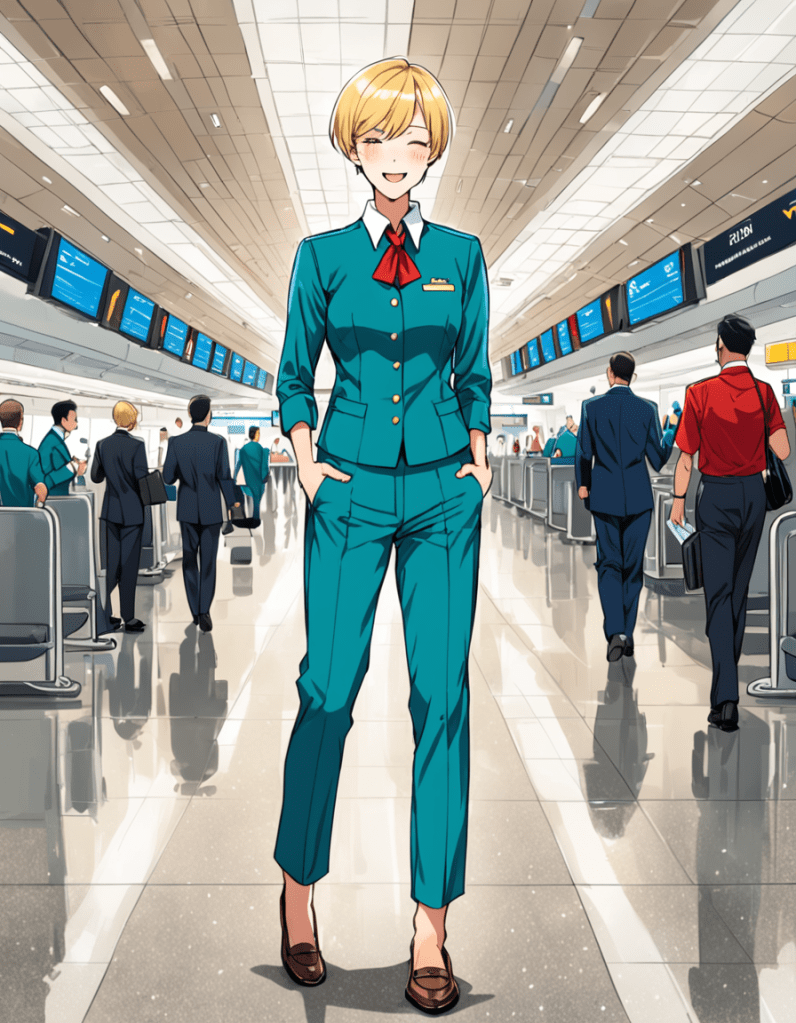
Asialink flight attendant uniforms are the same combination of teal and/or light green with red neckwear.

Wither Boeing

So Boeing planes have been in the news for…. issues. What’s surprising about it to aviation observers is how unsurprising they consider it. And as for why? Well, here’s the oversimplified and likely wrong in a few ways explanation.

So Boeing seemingly was a legend of Engineers until the evil Finance People ruined it. Anyone who has looked at the history of the auto industry will find this familiar. And while there is truth to nickel and diming, the context both on and above the ground is always more complex. If you look at the types of cars produced on both sides of the Pacific before the oil crisis/bubble popped, yes, there was a time when engineering was obvious-and obviously excessive.

In short and simply: Boeing was/is the last of the big post-WWII dinosaurs to encounter serious competition. There was no need for it to shape up because of the lack of a challenge, buoyed by their spectacular good luck concerning federal policy. The 747 came and was snapped up by airlines just in time for the oil crisis. But since the airline industry was a symbotic pampered cartel then, it was just passed on to customers to bail them out. Then came deregulation after that, with Boeing taking advantage of the boom. Then came the opening up of previously closed-off markets after 1991, and then…

…then the low-hanging fruit already got picked and the guys in Toulouse figured out how to make good airplanes. Oops.

Review: Pilot Error

Pilot Error

The first Fuldapocalypse review of 2024 is of a nonfiction book by pilot and aviation commentary Sylvia Wrigley. Pilot Error looks at the plane crashes where it was obviously the pilot’s fault. And not being unlucky or something, but just really, really bad.

There’s a reason why most of the crashes in this book are private light planes and why many are not fatal. It’s because Wrigley is by her own admission trying for dark humor and some of the most horrendous crashes like the pilot trying to land blindfolded for a bet/dare on a flight with dozens of passengers are not funny but just horrifying.

So in this you get drunks, idiots, and drunken idiots. It’s enough to make you glad that 99.9999% of the people in a very demanding role are not like the ones in this book.