Review: Quantifying Counterfactual Military History

Readers of Fuldapocalypse should not be surprised to learn that when I saw a book called “Quantifying Counterfactual Military History“, I instantly bought and read it. The premise is simple: The authors use the Approximate Bayesian Computation method to get a large sample size in their various simulations-much, much larger than conventional wargames.

Starting off with one of the easiest and most popular ones, Jutland, that chapter made me go “a-ha! They got it.” My favorite quote is “but unlike in a wargame, our goal is to simply understand what is plausible and what is not.” This “War of the Spreadsheets” has its roles provided one knows its limitations, which the authors do. Then comes the Battle of Britain (where the goal is temporary German air superiority, along with a controversial conclusion. There’s Vietnam where the authors actually remember the large northern conventional forces that were always there. It concludes with Cold War game theory.

There’s some technical topics that are beyond me, but this is overall an excellent book whose authors know their own limitations. As someone who loves these kinds of simulations, I was delighted to read this.
Review: Icebreaker

Icebreaker

Perhaps Viktor Suvorov’s most infamous work is Icebreaker, a revisionist historical book that claims that Stalin was juuuuuust about to invade the rest of Europe from the east when the Germans launched a preemptive attack in 1941. What makes this not just wrong in the sense that his book on the hyper-Spetsnaz was inaccurate but outright disturbing is that someone else publicly stated such a claim repeatedly. Said someone else was famously portrayed in a movie by Bruno Ganz.

Thankfully, the book itself does not make the best case for this incredible claim. It’s not just that with hindsight and primary sources (that Suvorov inaccurately claimed were destroyed to cover them up) the image of the shambling wreck in peacetime formations that was the 1941 Red Army facing off against the bunched-up offensive force of the 1941 Wehrmacht. (Fun fact BTW: The Germans actually had a 3-2 numerical advantage in the early part of Barbarossa, and even more in practice if you account for the terrible logistics of the Soviets then).

The only evidence besides ‘trust me bro’ that Suvorov puts forward is basically “The Soviets had lots of ____ [such as fast tanks and/or paratroopers] that clearly meant they were meant for an offensive into western Europe.” It couldn’t just be that their doctrine was on mobile warfare and that they tried and failed to implement it defensively.

I knew about how bad its premise was, but I wasn’t expecting so weak an argument. Which is probably a good thing. Unlike this book.

Review: Hooves, Tracks, and Sabers

Hooves, Tracks, and Sabers

Raconteur Press’s Hooves, Tracks, and Sabers is an anthology of alternate history cavalry stories. You get helicopters in Southeast Asia (but not the way you might think), airships (of course) in the American Civil War, and plenty of good old horsies. While none of the stories are bad, a lot just feel like historical fiction with different names, which is a problem a lot of alternate history unavoidably has (I think that World War IIIs actually avoid this by being something so completely different from say, the Vietnam War, but that’s another story).

Thankfully, there are ones that go above and beyond that. My favorite is a World War I divergence where the Tsar Tank actually works. How can you not love a giant armored tricycle? Anyway, while the execution may not be the best in every case, the concept is so great that I still recommend this collection (and lament that I couldn’t write a story about armored recon units in the Soviet-Romanian War for it).

The Worst Pilot Ever

On May 22, 2020, Pakistan International Airlines Flight 8303 crashed in Karachi, killing 98 people. Its pilot, Sajjad Gul, may have exhibited the worst judgement and skill of any pilot involved in an air disaster ever, and he and almost a hundred other people paid the price.

In written and video form, it’s horrifying to behold. There was good weather, a familiar and established plane, no mechanical issues, no foul play, and nothing save for someone who went in on a crash course, had countless opportunities to step back from the brink, and did not.

Absent pilots who crashed on purpose or otherwise did things like make bets that they could land blindfolded (they couldn’t) or reenact the flight of Icarus, this is the least competent aircrew I’ve seen. By the final too-late moments, Gul and copilot Usman Azam were apparently trying to do two contradictory things (which gives you a sign of how bad the crew resource management was).

Review: Star Eagles

Having loved Starmada, I eagerly embraced Star Eagles as a fighter equivalent. I wanted a small unit space fighter game that balanced customization with play-ability and am happy to note that it succeeded in sating that desire. Star Eagles is based on movement templates, activation dice, and special playing cards that a player can use.

It’s not perfect, but I’ve been able to do viable battles with a lot of ships adapted from a lot of different ideas, and that’s what matters. I recommend it to tabletop space battle enthusiasts.

Review: Weapons and Tactics of the Soviet Army

Weapons and Tactics of the Soviet Army

David Isby’s 1988 edition of Weapons and Tactics of the Soviet Army is perhaps the missing link in the OPFOR puzzle. I have to give the obligatory “this is a Cold War western source” to get it out of the way. That being said, once basic prudence is applied, this is an amazing compendium.

It covers every single major weapons system in the 198X Soviet army detailing not just the paper specs but also the intended doctrinal use and actual combat experience in Afghanistan or with foreign armies. This comprehensive look at the whole and not just the sum of the parts is sadly too rare and is very welcome here.

This is a rare, expensive, and massive book. But it is well worth it to any scholar of the Fuldapocalypse.

Review: Midnight Ops

Midnight Ops

Midnight Ops is the latest Duncan Hunter book by Mark Hewitt . It is also not just the worst in the series but the worst “thriller” novel that I’ve read. Ever. At least as of this post. And I do not mean this lightly. Having read literally hundreds of these books, I’ve reached the point.

So the Amazon blurb mentions a defecting F-22 that flew to North Korea as the MacGuffin. Well you will be “glad” to hear that it takes two thirds of the book to even reach that point at all. And then it goes back to what it was previously doing. What was it doing?

Political rants. I’d say it’s like reading the Facebook page of your boomer uncle from rural Oklahoma, but that would be an insult to boomer uncles from rural Oklahoma. If you trained an AI model on nothing but conspiracy talk radio transcripts and then let it rip for five hundred pages, you’d have this book. But I’m still pretty sure the AI could do better.

The worst part is that I used to like this series! It had the same ridiculously right-wing politics and unstoppable Mary Sue, but could be fun in a Mack Maloney manner. This isn’t. The actual ‘action’ is the same repetitive easy victories that feels like an afterthought. It’s easy to tell the real emotion is in the rants.

So yes, I’ve found the new worst (thriller) novel ever. Welp.

UAV Classes

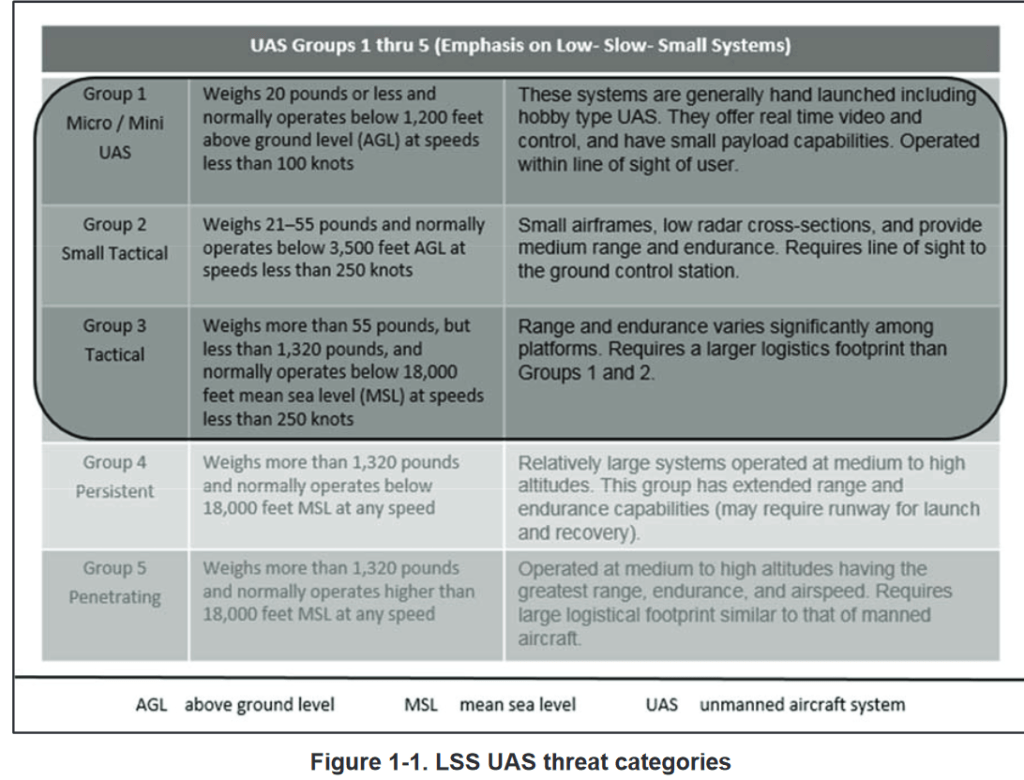
The US Military has five official group of UAVs/drones.

(from ATP 3-01-81)

The standard hobby drone is a Group 1. Smaller military drones are groups 2 and 3. The ScanEagle is the best American example of a Group 2. The classic Iowa spotter Pioneer is a Group 3, so is the RQ-7 Shadow. Heavy attack drones like the Predator and Bayraktar TB2 are 4, while monsters like the Reaper and Global Hawk are 5.

Review: Super Mirage 4000

Super Mirage 4000

Finally translated into English, this is a look at what was to France what the Avro Arrow was to Canada, the TSR-2 was to Britain, the Lavi was to Israel, and the Osorio tank was to Brazil. (Or what the AMX-32 and AMX-40 tanks were to… France).

It’s what you’d expect from a small coffee table book whose sources came from inside the program: A combination of knowledge and bias, mixed with tidbits without being the deepest. This isn’t a bad thing if you know what you’re getting into, and the plane is certainly worthy of such a book.

On Star Wars

Now I want to say that I’ve liked a lot of Star Wars stuff. I don’t mind the setting, I’ve seen 2/3s of the official movies. Like any big setting it has its ups and downs. But I definitely don’t hate this.

However, I feel obligated to say one thing about Star Wars that I believe. It is the most overrated work of modern fiction, and this overrating has made it impossible to judge. What you have is first a trio of fun sci-fi pulp movies that get treated as if they were more than fun sci-fi pulp movies, because they were a breath of fresh air in the pretentious dark tone of 1970s science fiction. Then you have a giant franchise.

Next you have the prequels, which are basically what happens when a Dunning-Krugered director gets free reign to run amuck. People nowadays are swinging towards defending the prequels in a dose of inevitable “defend midsize sedan cars the minute they stop being popular” hipsterism. Although I don’t blame them, because…

Then George Lucas cashed out and the Mouse Machine made the sequel trilogy. Now I had little desire to see them in full personally, and everything I saw and heard reinforced that desire. When I finally, recently looked at them in more depth, I was even gladder. At least the first six were works of genuine artistic imagination. These are just rehashed play it too safe mush piles that don’t understand the feel of their setting.

(Not so small side note: Devereaux’s excellent blog has the point in a review of fellow cash grab Rings of Power that authors are obsessed with winning battles via an unrealistic One Neat Trick. That plus “why didn’t they fly in on the eagles” ”’rationalism”’ leads to the infamous hyperspace ram.)