Review: Shadows of the Empire

Star Wars: Shadows of the Empire

In the mid-1990s, an unusual multimedia product occurred. George Lucas and company released Shadows of the Empire, a Star Wars side story set between The Empire Strikes Back and Return of the Jedi. The results for Steve Perry’s primary novel were… interesting. First off, the book itself is not so bad that it falls into the tier of “horrible tie-ins”, but is nowhere near good enough to overcome the problems which every anime fan would know.

Yes, I said anime fan. Because this is like one of those movies that are based off a sequential anime (which is itself based on a sequential manga). In other words, everything has to be completely self-contained, every loose end has to be either tied up or cut loose, and the status quo for the series overall can’t really change. That every major character introduced in this book is killed off at the end shows the limitations it was working under, and Perry could not write his way past such a major obstacle.

I supposed it works if you just want Star Wars filler, but there’s better choices even in that regard.

A Thousand Words: Eco Fighters

Eco Fighters

Capcom decided to make an arcade “shmup” with an environmentalist science fiction theme. The result was Eco Fighters, a very well made game with one massive flaw. And no, the massive flaw was not the environmental theme. The massive flaw has to do with how you aim.

See you control a spaceship that has a rotating arm/turret. It sounds good, but in practice it’s a gimmick that’s hard to work and control. This and the fact that you’ll often unavoidably run into a weapon change that you don’t want (which gets rid of something you do) sours it a little.

But only a little. It’s still a good side scrolling spaceship shooter, and the graphics and music are typically excellent for the time period. It just tried something distinct and fell short in that regard.

Review: Inheriting the Bomb

Inheriting The Bomb: The Collapse of the USSR and the Nuclear Disarmament of Ukraine

I’ve looked forward to few nonfiction books as much as I anticipated reading Marina Budjeryn’s Inheriting The Bomb, about how nuclear weapons were removed from Ukraine after the USSR’s breakup (the word choice is deliberate). I was not disappointed. This is an amazing book that can for all intents and purposes clear up the “could Ukraine have kept its nukes” confusion.

I’ve already posted about WMDs and the non-Russian SSRs. Short answer is “They never had control or the necessary pieces to maintain the arsenal of nuclear weapons on their territory, but they nonetheless had the raw technical ability to make an arsenal”. Raw technical ability but little else. Budjeryn doesn’t go into that much detail on counterfactuals (though she does wisely defer to credible experts in that regard and cites them).

She does go into lots and lots of detail on the political twists and turns and not just for Ukraine itself. Yet it was far more reticent than Belarus or Kazakhstan were and viewed itself as a legitimate holder of the weapons. Factors from the fact that Russia was threatening Ukraine almost literally from day one (and by Yeltsin officials and not Zhirinovsky-ist fireeaters) to the desire to preserve jobs in the giant Dnepropetrovsk missile plant are mentioned. This is a great, indispensable book about a very important topic, and I cannot recommend it enough.

Review: Aircraft Projects of the Commonwealth Aircraft Corporation

Aircraft Projects of the Commonwealth Aircraft Corporation

I’m a sucker for big historical reference books, so I got Aircraft Projects of the Commonwealth Aircraft Corporation, a detailed look at Australia’s aviation company from WWII to its buyout postwar. Everything from the semi-improvised military aircraft of the war to their license-built airplanes designed by other firms (ie Sabres and Mirages) to their ambitious designs is covered.

The last segment includes some pretty crazy things like a trainer/low-end ground attacker that’s swing-winged and an interceptor powered by four very small engines. The latter is a good example of how much the designs had to fit the parts rather than the other way around. This book is a well written, well-laid out treat and I highly recommend it.

Review: Nixon’s War

Nixon’s War

Rick Kester’s Nixon’s War is one in an “alternate presidents” series of alternate history novels. How is it? Well, uh, not very good.

This alternate Cuban Missile Crisis gone hot starts in a conference room. And continues in a conference room. I can sympathize trying to balance exposition with storytelling (after all I’ve had to do it myself many times). This doesn’t really strike a balance. Especially as it jumps to everyone from Lee Harvey Oswald to Elvis Presley to random civilians. All of whom talk like they were in a conference room.

(There’s a lot of exposition, ok?)

Anyway, the B-59 goes ahead with the nuclear torpedo launch that it avoided in real life, and World War III begins. This is at least a slight improvement over the conference room mania, simply because you can’t make a nuclear war completely boring. However, the exposition continues apace. Worse, it’s not even accurate as constant references to “5.7mm” bullets are made, a caliber that didn’t come into being until decades after the events of the book. And apparently the US Army is adopting the Browning Hi-Power (I guess the author likes FN weapons?)

The last third of the story propery after the (realistically) skewed war is mostly just people bumbling around in an uninteresting fashion. The reader is treated to philisophical debates and infodumps on everything from child care policy to plutonium reactors. In fact, the final section of the book is nothing but historical exposition. And this isn’t a small afterward-it’s about a quarter of the whole thing!

I don’t want to be too hard on this book. It does sincerely try to have a wide variety of characters reacting to World War III, does have a large number of battles, and tries to be a good “big war thriller”. It just doesn’t really succeed, which is a shame.

Big Vs. Little Targeteering

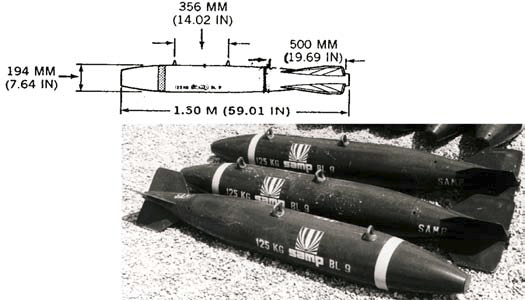
With regards to unguided bombs, one of those things that’s still a little iffy to me is what’s more suited for a few big bombs and what’s for a bunch of little ones. I can guess, with something like a strongpoint or large building being viewed as worthy of a giant demolisher while a group of enemy infantry/soft-skins is better suited for a large stick of small fragmentation ones.

I also have this suspicion that general purpose bombs are acceptable for most aerial targets. This is backed up by the data from the Gulf Wars showing the bulk of dropped bombs being Mk82s and derivatives. And of course, anything that can explode is not useless. Both of these below have uses and both can be deadly.

A Brief History (And Explanation) of Rocket Tossing

Anyone who has recently seen any footage of helicopters in Ukraine has witnessed what I call “Rocket Tossing”. The helicopter lifts its nose, fires off a ton of rockets indirectly, and then peels away. It has the impression of an improvised, ineffective tactic. But it’s not the former and is arguably not the latter.

It’s important to note that doctrine of the 198X Fuldapocalypse era, both western and eastern, details rocket tossing at length. The huge helicopter losses of Vietnam, the precedent of the Iran Iraq War (where the tactic was used constantly), and that air defense wasn’t exactly getting worse all made for sound reasons to know it. So indirect helicopter fire isn’t that surprising.

So how effective is it? Well, it’s basically a light multiple rocket launcher that can fly. Unguided multiple rocket launchers are area weapons, optimized to cover a large piece of land quickly at the expense of long-term rate of fire. (This is why rockets are considered ideal for chemical warfare). Ideal? Not really. Cost-effective? Probably not. But useless? Nah.

Review: The Han Solo Adventures

The Han Solo Adventures

Originally published in three installments from 1979 to 1980, the Han Solo Adventures by Brian Daley were the first books in what would become the Star Wars expanded universe. Star Wars fans tend to love them, and I’m one of them. Without restrictions or a desire to one-up the movies (I’m looking at you, Kevin J. Anderson), the books are a fresh fun romp through the Corporate Sector.

Daley can write everything from prison breaks to starfighter bouts to duelists well, and he does in these books. Every Star Wars fan, science fiction fan, or just fiction fan should read these.

Review: Carrying the Fire

Carrying The Fire: An Astronaut’s Journeys

Long considered one of the two best astronaut memoirs (the other being Mike Mullane’s Riding Rockets), Carrying the Fire is the autobiography of Apollo 1 command module pilot Michael Collins. He got to go to the moon but not walk on it. Collins insisted on writing the book all by himself without assistance, and it paid off. Not only was he a capable pilot and astronaut, but he turned out to be an excellent author as well.

With both humor and majesty, Collins tells the story of flight and the moon program. Anyone interested in outer space should get this. It’s an excellent book and even greater autobiography. While it’s not nearly as fresh as it was in 1974, that’s a small and inevitable “problem” to have. This is a great book.