Review: Nixon’s War

Nixon’s War

Rick Kester’s Nixon’s War is one in an “alternate presidents” series of alternate history novels. How is it? Well, uh, not very good.

This alternate Cuban Missile Crisis gone hot starts in a conference room. And continues in a conference room. I can sympathize trying to balance exposition with storytelling (after all I’ve had to do it myself many times). This doesn’t really strike a balance. Especially as it jumps to everyone from Lee Harvey Oswald to Elvis Presley to random civilians. All of whom talk like they were in a conference room.

(There’s a lot of exposition, ok?)

Anyway, the B-59 goes ahead with the nuclear torpedo launch that it avoided in real life, and World War III begins. This is at least a slight improvement over the conference room mania, simply because you can’t make a nuclear war completely boring. However, the exposition continues apace. Worse, it’s not even accurate as constant references to “5.7mm” bullets are made, a caliber that didn’t come into being until decades after the events of the book. And apparently the US Army is adopting the Browning Hi-Power (I guess the author likes FN weapons?)

The last third of the story propery after the (realistically) skewed war is mostly just people bumbling around in an uninteresting fashion. The reader is treated to philisophical debates and infodumps on everything from child care policy to plutonium reactors. In fact, the final section of the book is nothing but historical exposition. And this isn’t a small afterward-it’s about a quarter of the whole thing!

I don’t want to be too hard on this book. It does sincerely try to have a wide variety of characters reacting to World War III, does have a large number of battles, and tries to be a good “big war thriller”. It just doesn’t really succeed, which is a shame.

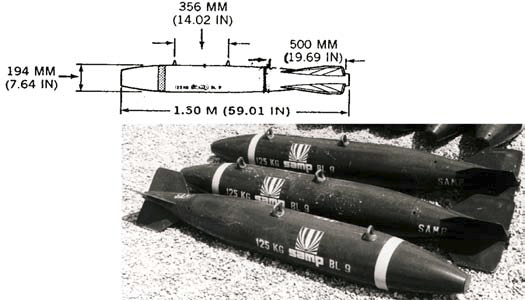
Big Vs. Little Targeteering

With regards to unguided bombs, one of those things that’s still a little iffy to me is what’s more suited for a few big bombs and what’s for a bunch of little ones. I can guess, with something like a strongpoint or large building being viewed as worthy of a giant demolisher while a group of enemy infantry/soft-skins is better suited for a large stick of small fragmentation ones.

I also have this suspicion that general purpose bombs are acceptable for most aerial targets. This is backed up by the data from the Gulf Wars showing the bulk of dropped bombs being Mk82s and derivatives. And of course, anything that can explode is not useless. Both of these below have uses and both can be deadly.

A Brief History (And Explanation) of Rocket Tossing

Anyone who has recently seen any footage of helicopters in Ukraine has witnessed what I call “Rocket Tossing”. The helicopter lifts its nose, fires off a ton of rockets indirectly, and then peels away. It has the impression of an improvised, ineffective tactic. But it’s not the former and is arguably not the latter.

It’s important to note that doctrine of the 198X Fuldapocalypse era, both western and eastern, details rocket tossing at length. The huge helicopter losses of Vietnam, the precedent of the Iran Iraq War (where the tactic was used constantly), and that air defense wasn’t exactly getting worse all made for sound reasons to know it. So indirect helicopter fire isn’t that surprising.

So how effective is it? Well, it’s basically a light multiple rocket launcher that can fly. Unguided multiple rocket launchers are area weapons, optimized to cover a large piece of land quickly at the expense of long-term rate of fire. (This is why rockets are considered ideal for chemical warfare). Ideal? Not really. Cost-effective? Probably not. But useless? Nah.

Review: The Han Solo Adventures

The Han Solo Adventures

Originally published in three installments from 1979 to 1980, the Han Solo Adventures by Brian Daley were the first books in what would become the Star Wars expanded universe. Star Wars fans tend to love them, and I’m one of them. Without restrictions or a desire to one-up the movies (I’m looking at you, Kevin J. Anderson), the books are a fresh fun romp through the Corporate Sector.

Daley can write everything from prison breaks to starfighter bouts to duelists well, and he does in these books. Every Star Wars fan, science fiction fan, or just fiction fan should read these.

Review: Carrying the Fire

Carrying The Fire: An Astronaut’s Journeys

Long considered one of the two best astronaut memoirs (the other being Mike Mullane’s Riding Rockets), Carrying the Fire is the autobiography of Apollo 1 command module pilot Michael Collins. He got to go to the moon but not walk on it. Collins insisted on writing the book all by himself without assistance, and it paid off. Not only was he a capable pilot and astronaut, but he turned out to be an excellent author as well.

With both humor and majesty, Collins tells the story of flight and the moon program. Anyone interested in outer space should get this. It’s an excellent book and even greater autobiography. While it’s not nearly as fresh as it was in 1974, that’s a small and inevitable “problem” to have. This is a great book.

The Nuclear-Pentand?

The term “nuclear triad” is a familiar one. It means the three main delivery systems-aircraft, land installations, and naval ones. Or rather, the three main American delivery systems. See, it’s easy to see the grouping of three when you have only deployed three types of strategic platforms: Silos, aircraft, and submarines.

From this American point of view, mobile ICBMs in use by other countries fit into the land part of the triad, and the oft-proposed surface ship bases would fit into the naval part. However, the proposed anchored capsules on the bottom of the sea have more in common with silos than mobile submarines.

So in a different world where nuclear basing was more widespread, the term “Tetrad” or “Pentad” could be used. A tetrad of silos, mobile land missiles (whether via truck, train, hovercraft, or Wienermobile), aircraft, and submarines. Or a pentad of all that plus surface ships.

Weird Wargaming: The Emperor of Bombs

In Nuclear War Simulator, one of my favorite creations to use and drop is something I’ve called the “Huangdi Bomb”. The name, after Chinese for “Emperor”, is a pun on Tsar Bomba. Only this has a bigger boom at 75 megatons. It’s also, in the backstory, a lot more advanced and sophisticated. Unlike the publicity stunt that was the Tsar, the Huangdi is a mass-produced, deployable weapon capable of fitting inside either an H-6 or large ICBM without issue.

It’s also, judging by the maximum payload of the Badger and its yield (the classic yield-weight calculation), the most efficient nuclear weapon ever made. As it has a multi-decade lead on the other megabombs, this isn’t surprising. As for how and why such a beast is used, the theories for the gargantuan warhead are hitting extremely large targets, making accuracy issues irrelevant for simple countervalue operations, improving warhead efficiency in a big design before trying to apply it to smaller ones, and contributing to deterrence by intimidating would-be-opponents with its yield.

In various NWS scenarios, I have about twenty Huangdis made overall, in both air-dropped and missile carried versions.

A Thousand Words: Carrier Air Wing

Carrier Air Wing

Capcom’s 1990 Carrier Air Wing is a fairly standard side scrolling plane shooter. Except for one thing that elevated it massively in my eyes. That’s the surprisingly detailed and (in a visual sense) accurate depiction of military hardware. You can control either a Hornet, a Tomcat, or an Intruder (which is marked as an A-6F. Wonder if they knew of the never-was upgrade or if it was a happy coincidence because they chose the next letter after E.)

When I saw Tu-22 Blinders as enemies in the first level, I was in love. When I saw Yak-38s in a later stage, I was even more in love. This is quite possibly the most Fuldapocalyptic shmup there is, and I loved playing every second of it. Yes, there’s the sci-fi superweapons (such as a final boss that includes a Buran shuttle) but it’s otherwise very grounded-looking compared to other games of its time and nature.

This is basically a video game adaptation of a Mack Maloney novel. What’s not to like?

A Thousand Words: Progear

Progear

What do you get when you push an inherently limited genre as far as it can go? Probably something like Progear, a 2001 Capcom arcade “shmup”, the classic Gradius-type arcade game where you control a little spaceship moving around on a scrolling field. Only this “spaceship” is a World War I-type fighter plane, and the game has a very dieselpunk theme that I like. The graphics are very good, being (or at least looking like) beautiful sprites in an age of polygons.

The story is utter nonsense, and I have to wonder how much of it is due to iffy translations and how much is due to just limited information. Basically a group of young pilots have to fight off a conspiracy of posh Victorians led by a lion-man, and I’m not making that up. It feels like you only got ten seconds of a thirty-minute show and had to piece everything together from there. But this is a classic video game where such stuff was par for the course.

The gameplay is nothing to write home about, as it’s the same “fire away, use limited power ups, and try and dodge at least some of the impossibly large number of projectiles heading your way” formula. But that’s a fun formula for a reason. And whether by accident or design, one boss seemed to mock the formula. In a game where your ship faces right and only right, the boss tries to counter by…. moving to the left of the screen. Too bad you have homing missiles.

This is not a deep game, even by the standards of arcade classics. It’s not the most polished or fair game. But it is quite the fun game, and a sign of how far “handmade” graphics could go.

Review: A Dream Of Empire

A Dream Of Empire

A recent work of alternate history by someone with the pen name “Grey Wolf”, A Dream of Empire is about a war between 19th Century Britain and a surviving Byzantine/Eastern Roman Empire. There are lots of characters. And there are airships. Because this is an alternate history work set in the 1800s, there has to be airships.

This isn’t bad, but it feels a little overstuffed and shallow. It’s trying to be a “big war thriller” and a spy thriller, but that’s hard to do with something that’s one third the length of a normal book, much less a big and sweeping one. That’s the literary critique. The alternate history nerd critique is that a Byzantine Empire surviving, Victorian semi-steampunk, and airships are all genre archetypes, if not cliches.

You could do a lot worse for the very low purchase price than this book. But it could have also been a lot more and a lot better than what it actually was.