Soviet Romanian War Aircraft Losses

For the Soviet Romanian War in All Union, since World War III 1987 is doing aircraft losses, I figured I might as well too. (Also, enjoy the Sovereign Union’s flag in picture detail!)

Sovereign Union

  • 22 aircraft lost in the war to hostile fire. Of those, three were lost in aerial combat, two to radar SAMs, and the remaining seventeen to AAA/MANPADS.
  • Around 10 more lost to friendly fire and accidents (the former being folded into the latter for obvious reasons)
  • 30 helicopters lost in the war to all causes.

Bulgaria

  • 19 aircraft lost in the war to hostile fire. Two in aerial combat, the rest to AAA/MANPADS. Worse equipment, training, and heavy intense support of the Danube forcing contributed to the lopsided ratio.
  • 8 more to friendly fire and accidents.
  • 16 helicopters lost in the war to all causes.

Romania

  • The Romanian air force of around six hundred prewar aircraft was completely destroyed, save for thirteen confirmed escapes to Hungary and U̴̪͇̺͒̽̚ṅ̴̬͖å̶͇̦͚̈́u̷̧͓̞̿t̸̬͛͒̌h̴̳͆o̴̤̍̐͝r̶͈͑̊͘ĭ̶̡̈ͅz̸̜̗̤͒̾̇è̷̡͙̊̿d̶͍̖̄͗̑ ̷̡̩͋͆̊ͅC̴̨͂͗͜l̷̰̤͎̊͝͠ẽ̷͈̟̅̍a̸̱͑r̵̨̯̽̆ä̴̞̠́n̷͉̘͊c̸͓͇̪̍͆e̷͕̾̀͆ ̶̫͔͔͑D̵̢̻̊̽E̸͍̗͆͝T̵̘̽͆̚E̶̞͐̓͝Ċ̵̟́T̶̢̖̔Ę̸̋Ḋ̵̯̒.
  • Over four fifths of the Romanian Air Force was destroyed on the ground in the initial fire strike. Of the remaining not overrun/eliminated in the same way later, sixty one were downed in aerial combat, thirteen escaped to Hungary, thirteen more were lost to friendly fire, and only eight were taken out by the vaunted air defenses. (SAMs were on a tight leash as the planners knew there’d be a lot more friendly ones in the sky).

Operation El Paso

OPLAN El Paso was a proposed campaign in the Vietnam War to block off the Laos trails by land. One southern and two American divisions would deploy by air and hold the terrain. This corps-sized blocking force could theoretically do what no amount of airpower realistically could: stop the flow of troops and supplies south.

It may have been a missed opportunity to decisively change the (conventional) course of the Vietnam war-or a chance for the northerners to inflict a huge number of politically sensitive casualties on the Americans in a place where it was near its supply bases and they were farther. If one of the people responsible for the plan was skeptical that it could work, you know it could very well end up going the way of the similar Lam Son 719.

Review: Secret Luftwaffe Projects

Secret Luftwaffe Projects

Through diligent research and the uncovering of the original drawings and plans, Walter Meyer sheds some light in Secret Luftwaffe Projects. As a basic guide to the Luftwaffe wunderwaffe napkinwaffe, this is excellent. It also doesn’t pretend to be anything that it’s not, and doesn’t extrapolate or make wild claims.

But what it is is (deliberately) broad, shallow, and focused entirely on the basics. Each wunderplane gets a very short description of its role and a sheet of its (intended) stats. There’s no context or even reasonable speculation, but this isn’t the kind of book for this. It’s an encyclopedia of planes that never were, and in that role succeeds beautifully, complementing rather than competing with other books on the same subject.

And besides, it’s very fun to see all the crazy contraptions one after another. I recommend this book to any aviation enthusiast or anyone interested in the bizarre, because a lot of the planes here are just weird. But what did you expect?

Review: An Untaken Road

An Untaken Road

Steven Pomeroy’s An Untaken Road is officially a book explaining why mobile ICBMs never caught on with the US military the way they did elsewhere. It’s that, but it’s also a history of the many, many, many different proposals for missile basing of all sorts. That alone makes it very good, especially since there’s a huge synergy with Nuclear War Simulator (after all, you can easily build and uh, “test-fire” a lot of the platforms described here).

At times the central argument can get a little pretentious and a little too focused on abstract themes. But as a pure source of information, this is excellent. There were a lot of nuclear missile base proposals right out of cheap thrillers, and this book is a great resource on them. It’s also a serious and informative look at nuclear war strategy. So I highly recommend it.

A Thousand Words: Iron Eagle II

Iron Eagle II

The budding Iron Eagle franchise was walloped by two things. The first was actor Jason Gedrick, who played Doug Masters, being occupied with the movie Rooftops, forcing his character to be killed off. Ask Alien fans how they feel about star characters being unceremoniously disposed of. So there was one misstep.

The second was glasnost. “Teaming up with the Soviets against a Middle Eastern petty dictatorship” doesn’t have the same appeal as fighting them. And if Mirages/Kfirs as “MiGs” are questionable, F-4 Phantoms as “MiGs” are downright laughable, being a far better known and far more distinctive shape. The plot is similar to the much later Top Gun: Maverick, in that a vague opponent has a nuclear facility that needs to be blown up, and then things blow up. However, that MacGuffin is common enough that I can believe it as just a legit coincidence.

For all the stumbling, this movie still has explosions, and is cheesy to a degree that makes the first look like a serious art film drama in comparison. Come for the terrible accents, stay for the “BMP” that’s an M113 vismod on the level of the costumes on dogs in The Killer Shrews. It’s not art, but you probably weren’t expecting a movie called Iron Eagle II to be art. It is extremely stupid fun.

Review: White Horizon

White Horizon

TK Blackwood’s 1990s continued Cold War gone conventionally hot series continues in White Horizon, an excellent installment. The Fuldapocalypse not only continues apace but features the powerful but often overlooked country of Sweden as a major setting. Featuring everything that has made the past installments so good, this was a joy to read.

The only real “problem” was teasing a successor. But that’s a good problem to have. This shows that the “cold war gone conventionally hot” subgenre still has quite a bit of life in it.

Review: Infiltrated

I recently finished Infiltrated, the latest (as of this post) entry in the Duncan Hunter series by Mark Hewitt. I was extremely relieved to be done with it, having gone ahead with the final two books out of plain curiosity. It probably was not the wisest decision out there.

By now the main character is an internet Navy SEAL meme done unironically. The set pieces are reduced to the same old superplane gimmick that’s already been repeated many times over. But those are small problems compared to the absolute biggest sign of devolution: The series has become more than ever like William W. Johnstone.

Like Johnstone, the final two books have been taken over more and more by repetitive political rants. They reach a particular low in Infiltrated, not helped by a change in tone. The conspiracies go from “The Hindenburg was destroyed by communists and Amelia Earhart kidnapped by a Soviet submarine and sold into slavery in the Middle East” to boring, annoying, and slightly creepy internet conspiracy theories turned real. It’s like going from “Actually, JFK was killed by a combination of Jackie and the car’s driver” to someone going on tirade after tirade on the “international bankers”.

So yeah, I’m glad to be finished. It was a fun ride for a few books, but overstayed its welcome without a good stopping point.

Review: Wet Work

Wet Work

Mark Hewitt’s Hunter series continues its crazy in Wet Work, the fifth installment. It gets harder to review a later book in a long series unless the quality changes massively in either direction. This is not the case here. Like most of its predecessors, it’s a sprawling technothriller with a ridiculous main character who makes John Rourke look like an everyman in comparison.

Thankfully, one thing about this book is different and better. The final action set piece is actually tense and well written. But even that can’t break it out of the pack of “I love reading them, but don’t really recommend them for other people” that the first four established.

VTOL Landing Zones

Finding the (ideally) safe landing zone radius for hypothetical VTOL transports is a little hard because there haven’t been that many of them. The first precedent is the ideal landing radius for a V-22.

From a Marine Document, we get:

V-22s are about 84 feet wide at their widest. So that ranges from 2.1 times their width/wingspan to 4.1 times.

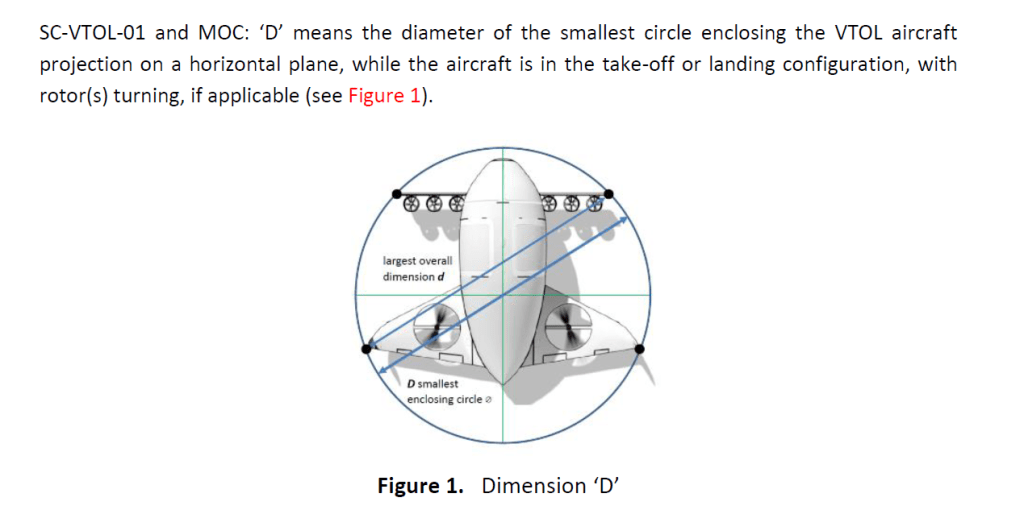
The second is an EASA draft regulation on “vertiports”. The “D” value is defined a circle around the aircraft when its thrusters are in takeoff/landing mode.

Credit EASA

The draft describes the safe landing area as at least 1.5 times the D-value of the aircraft plus a safety buffer of at least 3 meters or 0.25 times the D-value, whichever is greater. These are of course just guidelines (and keep in mind they’re for constant civilian travel, not military action), but they’re still good rules of thumb.