The Plutonium Red Team Study

In the mid-1990s, a “Red Team” (simulated adversary) was launched by the Sandia national laboratory. It looked at all the processes for disposing of excess plutonium (especially after the fall of the USSR) and studied their potential vulnerabilities for unsavory acquisition of nuclear materials. The report is a very interesting read.

Everything from fuel assemblies to mixed/ceramic encased disposed plutonium is studied. The vulnerabilities studied include both accessing it at the storage site and separating the weapons-usable material. It’s quite interesting, yet gives the impression that most nuclear thieves would need to be employed by either a state or the cast of Payday 2. Which is kind of the point, showing the difference between more and less plausible points of failure.

The Mountain Flip Flop

Despite otherwise having little in common save for lots of mountains, Switzerland and Afghanistan have a shared reputation in popular culture as being impregnable, untameable countries. Which led me to go: What if circumstances flip-flopped their history and outcomes?

In Central Asia, a Dari-speaking nation arises in the mountains of what we’d call northern and central Afghanistan. Close to many major trade routes, it takes advantage of its geographic security and reputation for studious neutrality to develop a thriving financial sector. This and the wealth generated by it enable this to develop a reputation for exporting luxury, advanced artisanal goods as well. Meanwhile in Europe, an artificial clump of different ethnicities in the Alps becomes a weak, tumultuous, war-torn “western Yugoslavia”.

Yes, it’s a very soft alternate history. But it’s the kind of thing that alternate history was made for, and it’d work great as a story’s setting.

Weird Wargaming: The Axis Contraptions

After World War II, various veterans of the vanquished (to put it that way) offered to design and make various military platforms. Only a few actually entered production. Kurt Tank designed the HF-24 Marut and sputtered-out Pulqui jet fighters. An Italian submachine gun, the TZ-45, found its way into the Burmese Army. Most fell victim to the same culprits: A combination of Cold War military aid and cheap Allied surplus sweeping them aside, while not being high-performance enough to beat them that way.

Yet for alternate historians/wargamers/writers wanting to add various wunderwaffe to their scenarios, it’s not that implausible that a few could slip through here and there. They’d mostly be out of the way unless history moved to that region (for instance, the Willy Messerschmidt-designed HA-300 would undoubtedly see service in the Arab-Israeli Wars if it entered mass production.) But they could still be done.

What would be most interesting would be the really exotic and large Luft 46 aircraft and wunderpanzer tanks. Those would probably need veto-able foreign engines (or other less obvious components) and would be no picnic to design. But they would be the most fun to play.

People Playground Peoples

People Playground Peoples

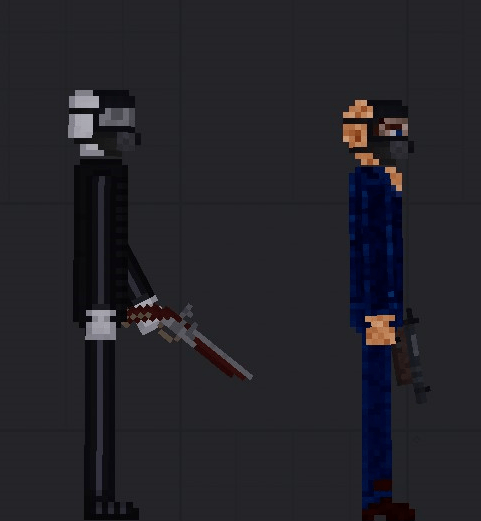
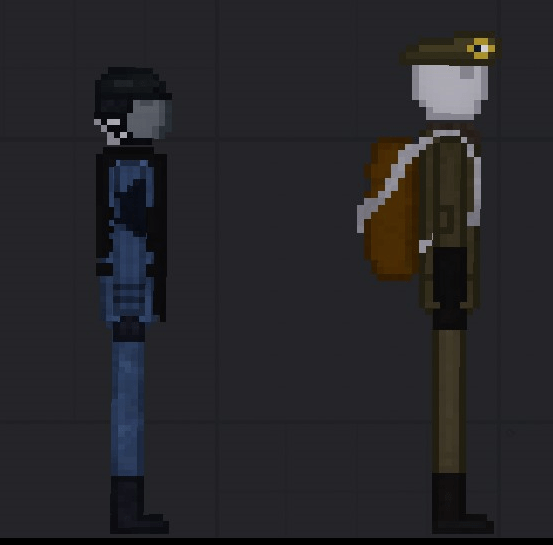
My favorite go-to relaxing game now, especially after I’ve discovered the massive and excellent mod scene, is People Playground. I of course act out a lot of scenarios-ok, a few types of scenarios, involving the mysterious mad science facility. And here are the “roles”.

Subjects

Represented usually by the default “humans”, subjects are the test subjects who are either being killed in terrible ways (don’t feel too bad for them, they struggle to walk several steps) or rebelling in some form (and usually ending up getting killed in terrible ways).

Technicians

Dressed in work-esque outfits, technicians usually sport some kind of chemical mask. They’re often placed by pieces of machinery, where they operate them and oversee experiments (very, very frequently becoming collateral damage). Unlike troopers, technicians mostly use a min-max arsenal-either finicky destructive contraptions or simple/improvised-type weapons that they built themselves.

Troopers

Troopers are the enforcement arm of the facility, being dressed in various kinds of military uniform and carrying a large variety of conventional weapons. Don’t worry, they always get killed in quantity too.

Commanders

Clad in various types of ornate and/or formal clothing, commanders wield sidearms and direct the “experiments”. However, a field commander is just as vulnerable as anyone else on the playground.

The Warhead Mystery

David Seed’s magisterial analysis of nuclear terrorism in fiction has confirmed one large suspicion I had about such books: The warhead MacGuffin is, far more often than not, stolen or donated by a sinister benefactor instead of being scratch-built. The Sum of All Fears is one big exception, just as how Red Storm Rising has Iceland invaded and the war staying completely conventional from start to finish. Because I love overthinking stuff like this (in violation of the wise words of literary theorist Mr. Hippo that not every story has to have significance), I have a few possible theories.

Theory 1

Theory 1 states that this is an example of being, even accidentally, technically reasonable. There are large practical issues with constructing even the simplest Little Boy-esque designs. The biggest and most obvious is appropriate fissile material, but there’s more that’d be hard to do and harder to do in secret. Of course, most authors would probably be going with their gut telling them it’s just easier to skip that step. Seeing so many writers get absolute basic technical details wrong makes me think it’s more a broken clock being right at that moment than anything else.

Theory 2

Theory 2 is less generous and states that it’s because it’s easy to write, means you don’t have to research, and can just say “here, they got a nuke.” Even The Sum of All Fears, as (over)-researched at it was, did this in a way by almost literally dropping the Israeli bomb into the laps of the antagonists.

Theory 3

Theory 3 is simply the result of bandwagoning. Because everyone else is having the nukes being sold or donated, the authors are simply writing what they know. Tom Clancy is weird in that while a lot of people adopted his themes, his exact style is not replicated nearly as much (and understandably so)

_ _ _

The warhead issue symbolizes something I’ve noticed about fiction: Realism is often not really that much of an asset. Roughly speaking, a lot of the people won’t know any better, many of the ones who do know won’t care, and a giant subset of those who do care will find issue no matter what. This combined with thrillers almost always succeeding and failing based on execution and not concept means my advice would just be to write what you’re comfortable with.

My personal take is this: Since I’ve been reading so much on the topic, and since I find the stolen/gifted nuke overused, I feel like I’d have the warhead be scratch-built if I wrote a book on the subject.

Reactor Grade Plutonium

Reactor-grade (as opposed to weapons-grade) plutonium has been hotly (no pun intended) argued over as to its suitability for nuclear warheads. From the open-source claims I’ve been reading, there are arguments that I’m not qualified to address the technical side of, but a couple of common themes have emerged:

  • Every extant nuclear power has chosen to go ahead with the additional expense of weapons-grade plutonium rather than trying to make something out of reactor-grade material. There have been tests and rumors, but that’s it.
  • Reactor-grade plutonium is hotter, more dangerous when exposed [making design and handling more difficult], requires more material for less explosive power, and is far more likely to fizzle (detonate instantly with a much lower yield).
  • However, even the low yield (less than a kiloton) is still a radioactive Beirut explosion, raising fears of nuclear terrorism with stolen reactor-grade materials.
  • Improved design can remove many of the shortcomings of reactor-grade plutonium.
  • The increased yield uncertainty makes it less attractive for tactical operations.

Still, the technically “easiest” way just to make a nuclear explosion with national-level resources would be to use civilian reactor-grade plutonium to put together an atomic charge. The list of countries that could do such a thing is much longer than the conventional nuclear states. Granted, they’d be facing a large backlash to make an explosive charge that’s 1940s-level at best and has little practical military utility, but it’s what’s the most possible in spherical cow terms.

The Super-Mansion

The conclusion of The Sure Bet King took place at a Los Angeles super-mansion. My current WIP is also focused around a super-mansion. The super-mansion is one of those setting places that I just love. They’re (impractically) big, they can have a lot of stuff, and they can have very different themes.

The closest thing to an official definition of a “mansion” is “a luxury home at least 5,000 square feet in size”. Super-mansions are even more nebulous, with their only real distinguishing feature being their bulk. My own definition is “it’s a super-mansion if any one room in it is bigger than an entire normal mansion”.