From (where else) Australia, this motorcycle chariot racing was apparently a real sport at some point.

From (where else) Australia, this motorcycle chariot racing was apparently a real sport at some point.
In Unclear Physics, Malfrid Braut-Hegghammer takes a look at the ultimately unsuccessful nuclear weapons programs of Saddam’s Iraq and Libya. Instead of a technical perspective, she looks at them from a political/organizational one, showing how poor state structures (in the case of Iraq) and nonexistent ones (in the case of Libya) hampered them. From the outside, there aren’t any shocking revelations: Iraq could have had a bomb by the mid-late 1990s without the Gulf War or a similar catastrophe, while Libya’s was going nowhere by 2003.
But from the inside, it’s a detailed look at human failure,in terms of dealing with low technology, dictator paranoia, dictators not understanding, and disorganized factionalism. Some of it comes across as legitimately fun to read.
Unclear Physics has two big apparent weaknesses. The first is its academese tone. The second and worse one along the similar nature is that she writes in a kind of inside baseball tone as if this an argument among nonproliferation academics, saying “the conventional wisdom says ______” when she means the previous conventional wisdom among people in that very small niche. It’s arguments that I’ve never even heard, for better or worse, as someone who’s for an amateur read up a lot about nuclear proliferation.
But this is still a great book at showing the soft human side of an otherwise hard technical issue.
Fair warning: This is done by an armchair enthusiast with absolutely no practical experience and whose sole experience comes from reading things. I could be totally and completely wrong about many things. Now that that’s out of the way, a look at how a Fuldapocalypse-centric doctrine has skewed perceptions of artillery to the point where Ukraine came as a surprise to many.
To put a long story overly short, the current paradigm in Ukraine is:
So you can see why smaller, easier to conceal towed guns are liked more.
Now compare this to the Fuldapocalypse:
See the difference?
Now the interesting thing is Caesar-style “truck SPGs”, ie artillery pieces on open wheeled chassis. They have shown the weaknesses of both-ie they’re soft like a towed gun and big like an SPG (and even less maneuverable). However, they’re not really designed for either kind of large-scale war.
Finally translated into English, this is a look at what was to France what the Avro Arrow was to Canada, the TSR-2 was to Britain, the Lavi was to Israel, and the Osorio tank was to Brazil. (Or what the AMX-32 and AMX-40 tanks were to… France).
It’s what you’d expect from a small coffee table book whose sources came from inside the program: A combination of knowledge and bias, mixed with tidbits without being the deepest. This isn’t a bad thing if you know what you’re getting into, and the plane is certainly worthy of such a book.
A very timely book, Einat Wilf and Adi Schwartz’s The War of Return is a look at the Israel-Palestinian conflict. That the two support a two-state solution and a return of Israel to pre-1967 borders makes it all the more credible. Trying to go and see why the Palestinians have been more intractable than even the other Arab states, they come to a “temporary UN program”.
I knew about the legitimate beefs the Palestinians have with Israel (yes they exist), and how the other Arab nations have used them entirely as political props and tools for decades without wanting to care for them. Yet the key in the lock they’ve explained is the UNRWA, which ended up becoming both a local government (seriously) with an international fig leaf and something that fanned the fires by using the term “refugee” in a way completely different than what everyone else, including the rest of the UN, uses.
(Short oversimplified version: The UNHCR which handles refugees literally everywhere, has a narrow definition and formal apoliticality. Once someone is settled, they aren’t a “refugee” anymore. So WRT Syria, if they’re settled they’re no longer a refugee. Be it in Turkey, Germany, the UAE, Ireland, America, or Bangladesh, that’s that. Also, whether they were pro-or-anti-Assad is irrelevant in that case. In contrast, the UNRWA has effectively made every single Palestinian family into a dynasty of “refugees”.)
It’s hard not to read this book and think that just a bit of negotiation here and a settlement there can still work (or could even before the current war). This makes it a sad but excellent and true story.
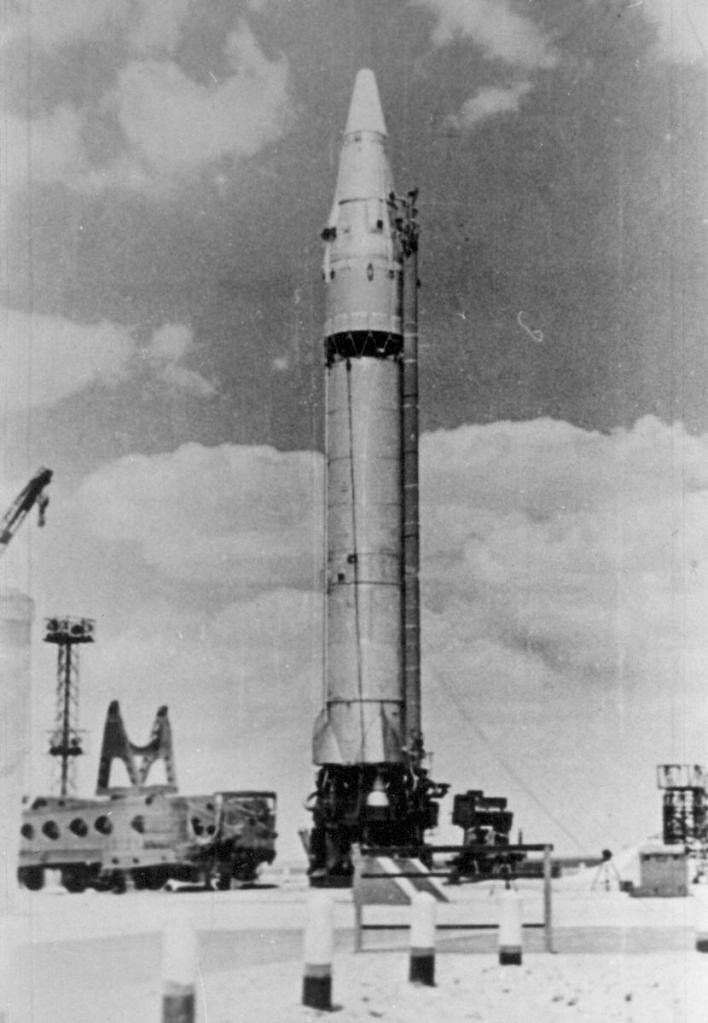
Readiness issues with liquid oxygen rockets historically retired them from the ICBM role once alternatives became practical (be it storable liquid or solid fuels). Yet one technological curiosity was an attempt to work around the issue.
A variant of the R-9/SS-8 ICBM with the typically obtuse Soviet industrial designation of 8K77 had the vacuum flask principle applied to its oxygen tanks. At least in theory, it would keep the liquid oxygen cold long enough for a fueled missile to wait on alert in a crisis. Vacuum flasks are of course better known in the capitalist west by their brand name turned generic name, the thermos.

It would be very cold and then very, very hot.
An Osprey book on the air war in WWII’s final year, Eastern Front 1945 is about the often-overlooked in the west clash in the eastern skies. It basically does every Osprey book thing right. While it’s not the most detailed, it provides an excellent overview of the somewhat different air war (ie, where the P-39 shined even as it flopped in other theaters).
One thing I particularly liked was how the book accurately showed the air campaign’s influence on postwar Soviet/Russian doctrine. Instead of a “big blue blanket” smothering every enemy in its tracks, it was focused on targeted air superiority and supporting maneuver formations. Which led to February 1945 when the Luftwaffe actually regained air superiority for a time. ( In short, they pulled more or less every propeller fighter away from the fruitless bomber interceptions and were were able to operate from intact developed airbases while the Soviets were worn and had their field strips wrecked by bad weather)
It’s a good look at both Soviet air doctrine being successful and at the eastern air war.
Passenger planes made in Britain followed an almost exactly stereotypical British pattern: At first bold and trend-setting, then fell behind due to both luck and skill, finally becoming just an international cog. The could have beens and never weres of this are shown in Richard Payne’s Stuck on the Drawing Board.
This is a fun, if niche, book for aviation enthusiasts. The big problem from the nature of the planes it describes. For passenger planes that are all essentially just tubes with different capacities, VTOLs and odd shapes are the absolute most different you’re going to get.
But this isn’t the book’s fault, and you’re left with a fun look at what could have happened before the 707 and its successors crushed any hope of a full-scale British aviation industry.
A 2013 book by noted PLAAF watcher Andreas Rupprecht, Dragon’s Wings is one of the first looks behind the curtain of the Chinese aircraft industry. Though now obviously old, it’s still a good snapshot into the past. Besides the familiar J-6/7s and the newer domestic J-8/10-etcs, it provides a look at many of the never-were (and frequently technically impossible at the time) aircraft proposed.
However much it’s shown its age, it’s still a great book. It’s an excellent coffee table book for aircraft enthusiasts.
So Boeing planes have been in the news for…. issues. What’s surprising about it to aviation observers is how unsurprising they consider it. And as for why? Well, here’s the oversimplified and likely wrong in a few ways explanation.
So Boeing seemingly was a legend of Engineers until the evil Finance People ruined it. Anyone who has looked at the history of the auto industry will find this familiar. And while there is truth to nickel and diming, the context both on and above the ground is always more complex. If you look at the types of cars produced on both sides of the Pacific before the oil crisis/bubble popped, yes, there was a time when engineering was obvious-and obviously excessive.
In short and simply: Boeing was/is the last of the big post-WWII dinosaurs to encounter serious competition. There was no need for it to shape up because of the lack of a challenge, buoyed by their spectacular good luck concerning federal policy. The 747 came and was snapped up by airlines just in time for the oil crisis. But since the airline industry was a symbotic pampered cartel then, it was just passed on to customers to bail them out. Then came deregulation after that, with Boeing taking advantage of the boom. Then came the opening up of previously closed-off markets after 1991, and then…
…then the low-hanging fruit already got picked and the guys in Toulouse figured out how to make good airplanes. Oops.