SOF Infiltration Techniques

I’ve decided to kick off the new year on Fuldapocalypse with my current “I justify it by claiming it’s for book research, but really it’s mostly for its own fun sake” obsession. This is the way special forces teams are infiltrated (moved in to their target, almost always with the intention of stealth).

Granted, there are elite teams moving about in All Union (without spoiling any specific element), and the Soviet-Romanian War saw the biggest deployment of special forces in modern history. But it’s still a fascinating topic. So in rough order from least to most complicated…

  • On Foot. This is the most basic type, with very obvious limitations. In this case the borders are already packed with conventional troops (including recon ones), so very few to no SPF teams would go in that way.
  • Helicopter/VTOL. This needs little explanation. Both its strengths and weaknesses are pretty obvious to those with basic military knowledge.
  • Boat. This also doesn’t need much explanation. In this specific case, it’s hindered by Romania having only a small amount of coastline suitable for amphibious landings. One 1970 CIA analysis put it at only nine miles (page 10), but this admittedly would be far less a problem for small SOF craft as opposed to large landers.
  • Ground Vehicle. AKA the Desert Rats. This gives the force a lot more mobility once in the target area, but it also makes it more noticeable and adds to their logistical areas. And especially for the more prosaic role of most spetsnaz, this also overlaps to a large extent with the horde of BRDMs and long-range patrols in “conventional” units.
  • Static Line Parachute. This is less precise than helicopters but can take advantage of (often) longer range or higher-performing aircraft. The type of aircraft also differs-I have a soft spot for planes like the An-2 and C-145 Skytrucks that are small for mass paradrops but quite able to release small teams.
  • Infiltration in Peacetime. This uses secret agents and other “peaceful” means to help bring the SPF in before the fighting starts. The problem is that you need a good network of secret agents to succeed this way.

These are the mundane, usual, “boring” techniques. Now for the “interesting” ones.

  • Free fall parachute jumps. Requiring more skill and risk, this is further divided into the “easier” HALO (High Altitude, Low Opening) and “harder” (High Altitude High Opening) jumps. The former is mostly intended for unconventional war to keep the drop plane hidden (in a visual and sound sense) and less vulnerable, while the latter is an extreme jump that involves the parachutists gliding a considerable distance.
  • Ultralight aircraft and paramotors. Mentioned in both the GENFORCE-Mobile and TC 7-100.2 manuals for special forces insertion, these seemingly silly devices have been considered a serious way of moving in. The performance of motorized paragliders and ultralight planes varies, but can be “increased” if only a one way trip in is needed.
  • Wingsuits. The most exotic yet, these are mentioned in TC 7-100.2 and the various Worldwide Equipment Guides. Still conceptual as of this writing and the absolute hardest to use, these squirrel-gliders are nonetheless, well, awesome. Especially the powered ones.

It’s important to note that the majority of historical spetsnaz from the 1950s to 1991 were still two-year draftees. The best and most motivated two-year draftees, but still two-year draftees. Infiltrators in the second category in a Soviet-style military would have to be officers or professional volunteers with longer-term contracts to get the time to master such exotic techniques.

A massive number of Soviet, Bulgarian, and Afghan special purpose forces participated in the invasion of Romania. The very first substantial Soviet casualties in the war came when a Romanian MiG-23 shot down a transport carrying SPF for a parachute insertion, killing all eighteen people on board. While those three nations are well known, there have also been rumors of other SPF as well as western mercenaries disguised as employees for humanitarian NGOs.
Review: The Eleven Days of Christmas

The Eleven Days of Christmas

For Christmas, I feel like I should review a Christmas book. A Christmas book that’s also a Fuldapocalyptic history book is Marshall Michel’s The Eleven Days of Christmas, about the final significant bombing campaign in the Vietnam War. Michel, himself an aviator veteran of the war, left no stone unturned to try and get the full story. To try and find the truth about Linebacker II, he went not only to American sources, but as many North Vietnamese ones as he could access, and even esoteric ones like the memoirs of Joan Baez (who was in Hanoi at the time).

The result is a masterpiece that illustrates Strategic Air Command as this clunky newbie that had sat out the war and then blundered into it. And also spun its clumsy, ineffective performance into a great victory. This is perhaps the biggest unintentional weakness of the book: The claim that Linebacker II was mixed at best and ineffective at worst is a lot less controversial now than it was at the time he wrote it.

Still, anyone interested in the Vietnam air war has to get this book. Merry Christmas and happy holidays to all!

Review: Taiwan’s Former Nuclear Weapons Program

Taiwan’s Former Nuclear Weapons Program: Nuclear Weapons On-Demand

David Albright and Andrea Stricker’s 2018 book on the abandoned nuclear weapons program of Taiwan tells the true story of one of the biggest nuclear programs that never resulted in a functioning bomb. The authors themselves note the similarities to the previously-reviewed underground South African program-and the huge differences.

The big catalyst was, unsurprisingly, the mainland’s successful deployment of nuclear weapons in 1964. What followed was a decades-long game that lasted as long as the Taiwanese military regime itself, where it tried to slip nuclear construction ability under the nose of the Americans who feared escalation. A tale of both technical and political detail, it’s excellently told.

Where I differ book is in its conclusion. Albright and Stricker argue that the Americans were fully in the right in stopping the program. To me, I would feel a lot more comfortable about Taiwan’s security if it had the ability to make Shanghai and other close, large cities disappear in a fireball. Many Taiwanese themselves made legitimate arguments against them that were quoted in the book: It would trigger the PRC to rev up earlier, and Taiwan was so small that they’d be vulnerable to a counterforce strike. But I still think a submarine deterrent would go a long way.

Still, opinions aside, this is a great look at an underappreciated weapons program.

Review: Forever And Five Days

Forever And Five Days

Fitting the “lurid true crime” genre exactly, Forever and Five Days tells the story of female lovers and serial killers Gwen Graham and Cathy Wood, nurses aides at a Grand Rapids care home who murdered several patients. The story of a questionably run facility filled with dispirited elderly people, the description of Alpine Manor would be creepy even if there were no murders.

The saga of Graham and Wood is yet more proof that serial killers are not Lex Luthor evil geniuses. The two made so many unsuccessful attacks that their prospective victims openly claimed people were trying to kill them, only avoiding suspicion as long as they did because many old people were delirious.

While it has the weaknesses of the sensationalist true crime book, this also has the strengths. If you like historical stories of serial killers, I’d recommend this.

Operation Causeway

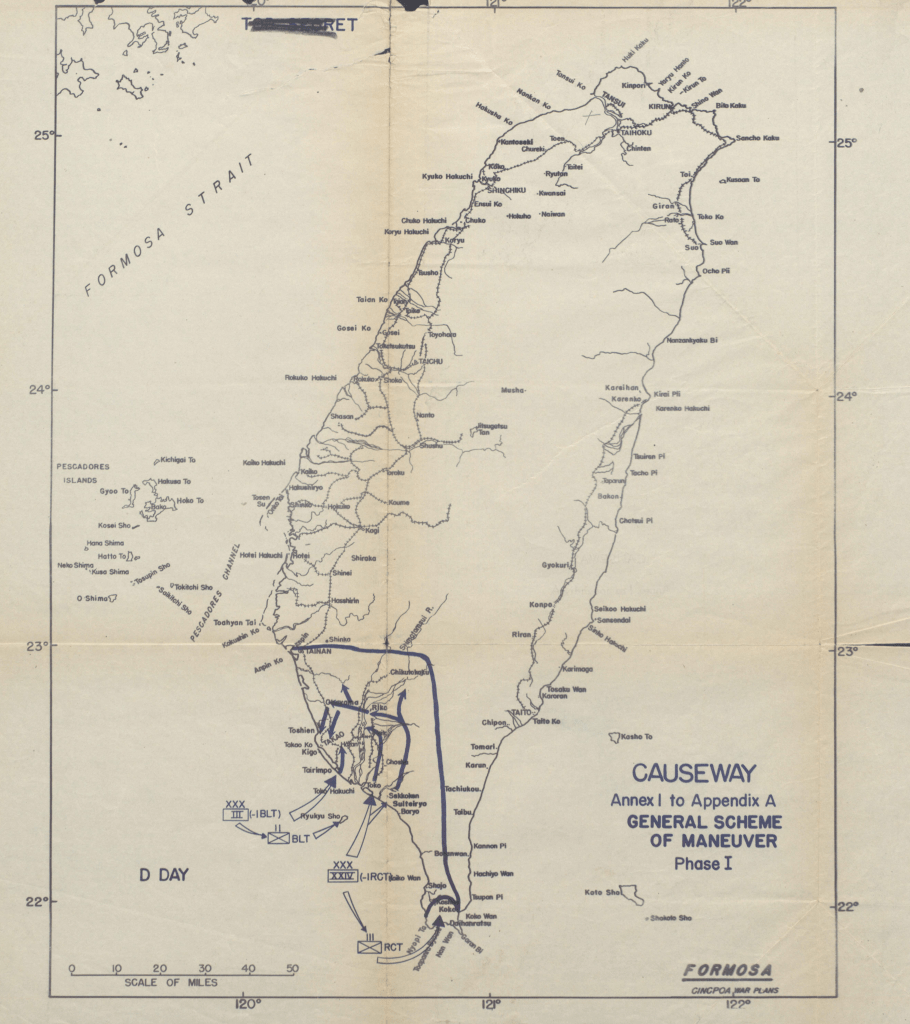
Operation Causeway was a proposed plan by the US military in World War II to land on Taiwan. It would have been a massive high risk, high cost, and high reward operation. In actual history, Causeway was shelved in favor of landing in Luzon.

The initial landing sites for Causeway would be in the south.

The Causeway documents are useful not just as an alternate historical reference, but also as a general guide to what a large amphibious invasion of Taiwan would entail (something that, for some mysterious reason, has remained relevant postwar).

The Bullpups

First, a description of what a “bullpup” rifle is: The firing chamber/action/magazine is located behind the trigger instead of in front of it. There have been numerous bullpup designs, and they came into a fad in the 1980s. Of course, this brought up the biggest issue with them.

Basically, it’s easy to make a bullpup simply by flipping around a conventional rifle. However, that doesn’t make for a good bullpup the way a ground-up design does. However again, rifles are such a small part of (especially high-intensity) war that the decision to make a big investment in them is not made lightly. However however again, the impetus for bullpups was basically “they need to be short so they can fit in vehicles more easily”, with performance being less of a concern.

Of course, shorter-barreled conventional rifles took most of the wind out of the bullpup’s sails. But they continue to be used. They just haven’t dominated.

Review: Will To Fight

Will To Fight

In the Will To Fight study/book, RAND analysts tried to take a look at one of the most important yet hard to study parts of war-the will of the soldiers to fight. It’s a mixed bag. On one hand, it’s sincere in trying to tackle something essential, and its detail is excellent.

On the other, it’s centered around a chart that resembles what you see in the dreaded DoD Powerpoints of Doom. This is not the most surprising thing, but it is still a little too awkward. And beyond the well done simulations and descriptions of games with morale factors and how they affect outcomes, it still has the feeling to trying to directly quantify what’s admitted in the study itself as not directly quantifiable.

Nonetheless, the topic is well-cited and well handled, and is important enough that “mixed” quality still makes it well worth a read.

Review: Wings Over The Hindu Kush

Wings Over The Hindu Kush

Lukas Muller’s Wings Over The Hindu Kush shines a light on an obscure footnote in aviation history: The Afghan air forces (yes, plural) between the Soviet withdraw and Enduring Freedom. Leaving behind a large quantity of helicopters and aircraft, there were enough parts and willing pilots for the Taliban and its rivals to create air forces up until 2001. As someone aware of their existence and interested in how functional air units could be maintained from such “scraps”, this book was an easy purchase.

In a complex, fluid situation without the best documentation, getting the detail that Muller did was no small feat. The book isn’t the biggest or most absolutely detailed, but it does tell the story of these helicopters, Fitters, and Fishbeds. And it’s a very interesting story.

The strike aircraft were far from the most capable or effective (the transports in a place with poor infrastructure were far more vital), but their mere presence in such conditions was surprising. And this book clears up the surprise in a great way.

The Eternal Death (And Life) Of The Tank

The year is 1916. Someone peers through his binoculars and sees an artillery shell smashing into one of these new tracked machines called “tanks”, destroying it. Shaking his head, he goes “These can’t amount to anything, they can be destroyed so easily.” (Even with modern tanks, if a big artillery shell hits it, it’s gonna hurt.)

The year is 2022. Someone looks on the internet and sees a drone launching a smart munition and destroying a tank. Shaking his head, he goes “these must be obsolete, they can be destroyed so easily.” Some things never change.

I could point to 1918 and heavy machine guns (really, the M2 Browning was considered a prime antitank gun at its introduction), 1944 and bazookas, 1973 and ATGMs, 1991 and laser-guided bombs, 2003 and smart cluster shells-you get the idea. Many others have said with far more knowledge and eloquence than me about the importance of armor, mobility, and firepower, regardless of its destructibility. So I’ll take another route.

Imagine something that is objectively less well armed and less armored than a tank. Now imagine that it, vulnerable to everything a tank is and so much more, is nonetheless not obsolete but remains totally indispensable. I’m talking of course about the classic basic box-APC, proof against small arms and some shrapnel. There’s a reason why Ukraine in the current war has been so eager to receive any kind of vehicle with an engine and armor plating, and why released footage of its current offensive in Kherson has shown them being put to good use.

There’s a reason why, especially on any kind of open terrain, armored forces are so much more accomplished than unarmored ones. And no amount of anti-tank gadgets can change that.