Saddam’s Almost-Bomb

Saddam Hussein’s Iraq had a legitimate nuclear weapons program that was, by most accounts, very close to building a functioning Fat Man-level device before the invasion of Kuwait. A draft nuclear operations manual was even made. For all intents and purposes, it was destroyed in the 1991 Gulf War and there was no serious attempt to restart it prior to 2003.

The WMD swing-and-miss isn’t really the subject of this post. It was a combination of the inherent untrustworthiness of the Iraqi regime (which still would have more than willing to make genuine WMDs), a desperate desire to avoid a false negative after 9/11, and a bizzare bluff aimed at Iran by a Saddam who was increasingly believing his own propaganda. I have increasingly believed that, after 1991 and especially after 2001, that the Iraq War, or at least the country undergoing a catastrophic meltdown (see the Syrian Civil War), would have been inevitable given that element and the inherent instability of it, but that’s for another time.

Anyway, the Iraqi design was a spherical implosion device centered around 15-18 kilograms of highly-enriched uranium. The first incarnation of it was very wide (over a meter), with the big Tu-16 and Tu-22 bombers being the only delivery systems capable of dropping it. Later it shrank to the point where it could fit inside a ballistic missile, and active programs were focused on making longer-ranged missiles that could carry such a device. The yield is unknown and the only available references to them in open sources I’ve found are understandably redacted. One theory based on text size I’ve seen argued that the small design had the strength of only one kiloton and the big one three, which fits with the yield of early North Korean (pure test) designs. More generous estimates put it around 10-20. Regardless, it was unlikely to be more than low double digit kilotons in terms of blast strength. It’s worth noting that even the lowest-end estimate would still mean a radioactive version of the 2020 Beirut explosion.

Barring the invasion of Kuwait or other serious external interference, the program could have been up and churning out warheads by the mid-1990s. Of course, there would be serious external interference. Israel’s hyped attack on the Osirak reactor arguably owed more to the mania of Menachem Begin than any practical effect. Begin was the admitted inspiration for the supervillain Magneto (to give an idea of his temperament), and someone who embodied Alexander Wallace’s “hurt people hurt people” statement. Osirak was physically unsuited to producing weapons-grade material in quantity, and its destruction led to a much more hardened and dispersed program. Nonetheless, the Israelis would try.

Would they succeed? Would having the bomb actually lead to a calming effect, as argued by some? (Given the Kargil and Ussuri wars, I’m skeptical). As with everything involving the “devices”, there’s a thankfully small sample size to consider. There are many, many unknowns. But the atomic wolf was truly there.
Minnesota Weird

Minnesota is home to a very strange demographic: Just as how North Carolina has an unusually large number of basketball colleges, the Land of Ten Thousand Lakes has an unusually large number of “romantic” scandals involving female politicians. And they have ranged from the most powerful (state Senate Majority Leader Amy Koch, forced out after a relationship with a subordinate), to the most embarassing (State Rep Tara Mack, literally caught in the act with another legislator), to the absolute most bizarre.

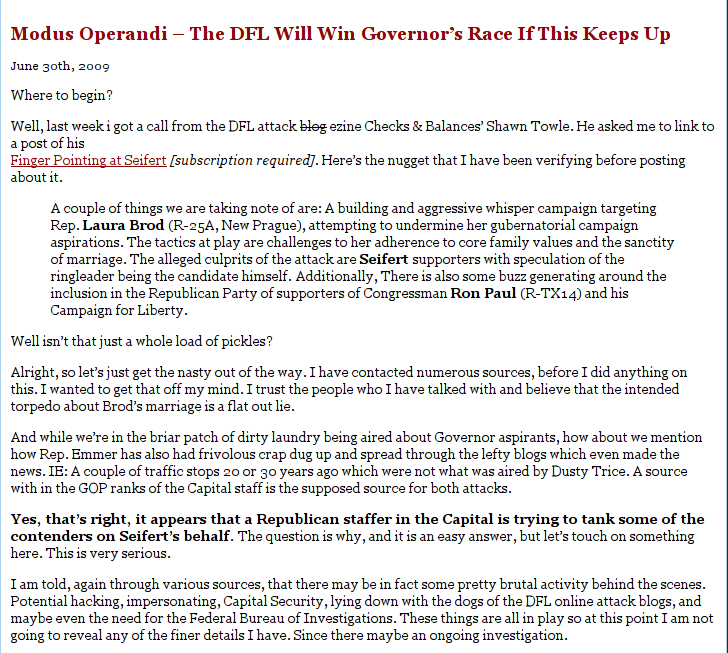
Even after nine tumultuous years, I still haven’t seen a political scandal as utterly bizarre as the Laura Brod one. And it’s not about anything she did or was accused of doing (consensual affair and posing for an ill-considered photo). It’s about how it unfolded.

Much of the stuff is only accessible via archives, but as far as I can tell, this is how I’ve read it went down. In August 2008, State Rep. Laura Brod had an affair and posed for a naughty photo. In 2009, when she was expected to run for governor, a ton of internet gossip and drama went out (but no real concrete evidence). There was legal action involving her and a “John Doe”. Brod bailed out of her expected campaign for governor for “health reasons”, and then did not run for reelection in 2010.

Hacking, impersonating, yikes!

In 2011, she was appointed to the University of Minnesota Board of Regents. Around the same time, the Koch/Michael Brodkorb scandal broke, and Brodkorb sued for gender discrimination, alleging that women who slept with male superiors weren’t punished the way he was. A list of his allegations against specific people mysteriously and briefly ended up online, in what was largely regarded as a deliberate mudsling.

In July 2013, out of nowhere, a single-use Tumblr appeared with the Brod photo and the words “This is a picture of University of Minnesota Regent and former State Rep. Laura Brod. A thousand words describe this picture and the story behind it.” But those ‘thousand words’ did not appear (until now, arguably). The now-defunct City Pages ran a series of articles about the Brod photo, talking about its supposed political importance, and eventually going into the details of when the picture was taken and that Brod had spent campaign money on legal fees afterwards. They did not mention or even really speculate on anything like who the photographer/”other man” was, if the relationship brought about any conflict of interest, or anything that would make it a legitimate scandal and not just a tawdry swipe at someone no longer in office.

The result was that everyone expressed sympathy for Brod, and rightfully so. Everyone from her divorcing husband to people who called themselves staunch political opponents spoke on her behalf. The articles about the photo trailed off, no real news about investigative results emerged, and everyone moved on. Laura Brod later remarried and had a successful life outside of government.

The strange thing is the slow drip nature of it, which, combined with the lack of actually identifying or speculating, has made me wonder if that meant the people releasing it were covering for the photographer/”other man”.

Of course, that was a little long ago, but Minnesota couldn’t resist keeping the “streak” going. State GOP Chair Jennifer Carnahan was forced out amid a trafficking (!) scandal, and drunkenly stated that she didn’t care about her ill congressman husband because he’d “soon be dead”. Then came the retaliatory gossip on the internet alleging that she had multiple abortions.

Meanwhile, New York political scandals tend to be boring. Then again, we never elected a pro wrestler as governor…

Review: McNamara’s Folly

McNamara’s Folly: The Use Of Low-IQ Troops in the Vietnam War

Involving applicants and draftees who would previously have been rejected, Project 100,000 was one of the least-covered but most horrendous parts of the Vietnam War. Hamilton Gregory, who served along multiple “entrants”, writes one of the most scathing and personally touching history books in McNamara’s Folly. I say “personal” because I have some mental conditions, and growing up, went to school with others with traits very similar to those described in the book. To send these people into battle, whatever one thinks of the Vietnam War as a whole, feels particularly wrong-as did the theory that military service would make them better.

Project 100,000 was done mostly to avoid tapping into a National Guard/reserve force that came from a wealthier and more politically sensitive background (only around a hundred National Guardsmen were killed in action in the whole war). Its recruits were killed in action at a rate three times greater that of serving soldiers as a whole. Officers of all ranks hated the program, and their reactions ranged from trying to steer the “Moron Corps” (or less nice terms) people into the least dangerous areas to having them be the point man on patrols because of perceived expendability. Gregory is clear to point out that he could not find any confirmed cases of Project 100,000 recruits being deliberately executed by their compatriots to prevent their ineptitude from resulting in more deaths, but the constant rumors are telling.

Weaving personal experiences (such as one particularly chilling story of a fellow recruit who didn’t even know that the Vietnam War was happening when he entered boot camp) with scholarly research, this is an excellent recounting of a project that benefited no one, save for maybe the North Vietnamese.

Review: Building The Tatmadaw

Building The Tatmadaw

Likely because it’s lacked the direct confrontation with a major western power that North Korea or Middle Eastern states have had, Myanmar is one of the more forgotten and undercovered of the militarized pariah states. That military dictatorships are not exactly known for their openness and transparency doesn’t help things. Thankfully, Maung Auyng Myoe has risen to the challenge with Building The Tatmadaw.

The often murky and convoluted history of the military, as well as the brutal but often underreported internal wars, is shown in depth. As is the Tatmadaw’s force structure and conventional paper doctrine. For the former, it follows (at least as of the writing of the book) a common in Southeast Asia pattern of having “regional forces” tied to a certain area and mobile reaction forces (known here as “light infantry divisions”) that can travel where needed. Regarding the latter, Myoe’s description comes across as basically a Light OPFOR right out of Central Casting. The picture is that of an infantry-heavy force where advanced and heavy equipment is present but not dominant, and where the strategy against an external opponent consists of fortifications and irregular tactics to counter the material disadvantage.

Published in 2009, this is bound to be outdated, especially given the massive tumult that has happened since then (the “thaw”, the anti-Rohingya campaign, and the military re-takeover). But as always, that’s not the author’s fault. I did notice a few slip-ups and a bit of clunkiness when talking about specific military issues, but none of those are very big or bad. If you want to learn about the Tatmadaw, this book is an excellent resource.

Review: The Soviet/Russian Aircraft Carriers

The Soviet/Russian Aircraft Carriers

It’s time to ring in the new year with…. another history book. This one is Simon Beerbaum’s book on Soviet and Russian aircraft carriers. It’s not just about the Kiev and Kuznetsov classes, which I feared it might have been. On the contrary, it has everything from pre-WWI czarist proposals to post-revolution plans for converting surplus ships (with limited technology/resources, it would have been easier to finish a large warship as a carrier rather than an armored, big-gun battleship) to never-weres like the Ulyanovsk and Project 11780 Kherson “Ivan Tarava” helicopter amphib based on the Kiev.

This is an amateur enthusiast project, so it has issues with formatting and inconsistent quality in the line drawings. Those are small issues, and if I had a bigger gripe, it’d be that far too little attention is given to the actual air wings of those carriers-the entire reason they’re built. It’s vague, especially when there’s no shortage of equally fascinating never-were carrier planes as well (from the Yak-141 to navalized MiG-23s to other exotics).

Still, this book does what it sets out to do. For a country whose carriers have arguably all been prestige peacocks, a lot of designs were made. If you want an intro to these flattops, you could do a lot worse than this book.

Review: US Battleships

US Battleships: An Illustrated Design History

Norman Friedman’s US Battleships: An Illustrated Design History was one of the first really big, really crunchy, really technical books on military equipment that I got. It’s obviously not light reading (at least for normal people), but it flows well. And I honestly think battleships are the best suited to a historical chronicle like this.

Since 99% of their history was in the past tense (the sole exception being the Iowa reactivation at the time of the book), it means there’s less sensitive info around. And since battleships are gigantic and awesome (don’t lie), it makes for fascinating reading. In battleships, you can see the US Navy going from its humble beginnings to its World War II juggernaut.

Technical naval warfare fans should definitely get this book. It’s one of the best of its kind.

The Artillery Growth Spurt

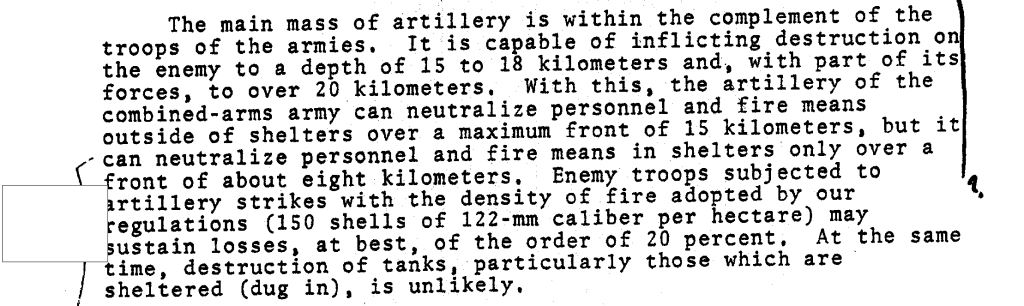
I was looking through my old planning documents and noticed something very interesting. In a 1969 piece on conventional-only operations that was one of the first of its kind, the Soviet planners estimated their artillery could inflict a maximum of 20% enemy losses in the opening fire strike.

By 1974, just five years later, when their conventional balance was arguably at its height, it had grown to the more familiar OPFOR ratio of 30-40% in a similar document.

I’m thinking (pure idle speculation), various combinations of bigger guns, more mobile guns, more accurate guns, better shells (cluster warheads that make conventional SSMs more than just a nuisance are mentioned in the same document), and probably stuff I missed.

What I find extra-fascinating is that the Azeri’s Nagorno-Karabakh opening half-hour mega-strike apparently destroyed 40% of the Armenian artillery-which is in line with the previous estimates, especially if you take into account technical superiority and massive, massive advancements in smart weapons. (Also, though, for all that, the war still lasted a month and a half and claimed around Azeri 3,000 KIA by its own admission.)

The Pom-Pom turned Bazooka

Having gotten the chance to read a lot of late-WWI and early interwar doctrine pieces, one thing struck me in particular. Not the focus on trench lines or the different communications with no radios, but the presence of “1 pounder guns” like this.

The 1-pounder was described as being meant to hit targets like machine gun nests and armored vehicles. It was almost always intended to be used for direct fire. In other words, it filled the same niche that far less clunky recoilless and rocket launchers did in World War II and beyond. I found that interesting.

(And, of course, the widespread use of light AA guns for ground attack means even the original concept hasn’t gone away. That the pom-pom was also one of the first effective AAA pieces means the connection is even greater).

Review: Super-Squad

Super-Squad: The Now Missing Component

It’s time to look at one of the most prolific military theorists: Vietnam veteran H. John Poole. Poole’s recent Super-Squad is a detailed call for improved light infantry tactics and a different squad organization, along with a historical study of various opponents from World War I to the present.

I may have never, ever encountered a “mean 51%” nonfiction book like this one. Poole is an infantry veteran who’s walked the walk. His desires are sincere and heartfelt, and many of his goals are valid or at least understandable. Yet there’s just so much else wrong in presentation and even theory here.

The book could probably be around half of its length and work with a concise message of “This is my proposed squad organization. This is how various limited-resource opponents across history used maneuver and skill to counter their lack of direct resources. You cannot always assume superior resources, so this is vital.”

Instead, it’s a long rambling bunch of anecdotes and illustrations, often from old field manuals. Anything that shows the “eastern army” succeeding is trumpeted. Anything that shows them failing is quickly glossed over. The writing lacks humility, to put it mildly. There are statements like “no combined infantry/tank attack has succeeded except on open terrain”, which is simply untrue. The ridiculous lumping of every possible Asian opponent into generalized “eastern armies”, combined with an obsession with ninjas (really!) doesn’t exactly help much. Neither does (especially if you want change) the constant bashing of the existing American military, something that will put most people on the defensive.

This has to be understood as being like Curtis Lemay calling for a giant fleet of super-bombers dropping souped-up nuclear weapons. If your experience involves a hammer, everything looks like a nail. Everything. It gets kind of repetitive and even a little annoying at places.

I don’t regret getting this book. As an “OPFOR light infantry tactics and case studies as written by your kooky old granddad who’s convinced he can save the economy through multi-level marketing” book, it (and many of Poole’s other books, given their similarities) works for what it is. Just don’t really expect it to be anything more.