Review: Stalin Strikes First

World War III 1946: Stalin Strikes First

I’ve said before that I don’t really consider 1940s World War IIIs to really be in the same genre as post-Vietnam ones. However, they still meet the very basic definition. One such work was World War III 1946, which was involved in internet controversy about its quality and plausibility before it got commercialized. The first printed installment is Stalin Strikes First.

This is not the most ideal story. The first issue is that its writing system just isn’t that good. It’s a mixture of snippets, conference rooms, and vignettes that never really rise beyond exposition. The second and more fascinating issue is how the war develops, with the Soviets skill on the ground being downplayed while they pull one superweapon in an area of historical weakness after another out of their hats. There’s also a bit of taking primary sources too literally, especially dated ones. Imagine a 1980s World War III where the Warsaw Pact armies could consistently move at their maximum on-paper speeds at the same time that NATO air power was inflicting its maximum on-paper attrition and you’ll get the idea.

This particular book has the Soviets winning the initial advance. And not through their existing strengths or through Red Army-style showing how they can be more than the sum of their parts. No, it’s through author fiat handing them one victory after another on a silver platter. There is obvious enthusiasm put into this book, but I still cannot recommend it. There are just so many better World War IIIs out there.
The Men’s Adventure Weapon That Could Have Been

There exists a Hungarian rifle called the GM6 Lynx. This semi-auto bullpup represents an attempt at making the comparably least bulky .50BMG rifle available. Although given the size of the cartridge, that’s a very tall order. It’s all relative.

Anyway, I bring this up because I find it interesting and not just for its own sake. My first thought to using this in fiction would be as an anti-monster gun, because it would be the comparably least clunky attempt to harm big beasties (given how the original King Kong eventually succumbed to lighter .30-06 bullets, a few people with these could probably take him down.) But then a different thought came to my mind. This gun came at the wrong time from the wrong country for fictional prominence.

See, men’s adventure writers unsurprisingly often focused on size and “exotic” qualities over practicality. Mack Bolan used a .460 Weatherby elephant gun. The Desert Eagle is actually reasonable compared to the infamously buggy Automag, but that was the weapon of choice before the former came into being. So my thought is “if a comparably small .50BMG rifle that wasn’t from a then-Soviet-aligned country existed at the height of the men’s adventure boom, you bet every action hero would be using it a lot.”

As it stands, a predecessor to the GM6 by the same manufacturer, the GM1 (which looks a lot more like the classic PTRD/M82 style .50 rifle), appeared in Phantom of Inferno, used by Ein on a sniper mission. The gun was almost as long as she was tall. It has since been used in fighting games as her super move.

Review: ATP 7-100.3 Chinese Tactics

ATP 7-100.3 Chinese Tactics

After seeing the excellent work on North Korea, I eagerly awaited the next installment in the ATP 7-100 series on the most potential opponents. When ATP 7-100.3, Chinese Tactics dropped, I was not disappointed. Well detailed and well laid out, this is the first comprehensive unclassified analysis of the PLA in decades.

In some ways, being a far more advanced opponent that’s far closer to the fictional maximum-challenge “composite OPFOR” than North Korea is means that the tactics shown feel a lot more mundane and slightly less interesting. But showing the (deliberately overcomplicated and confounding) organization is where this shines. The modern PLA is organized a lot like the old “GENFORCE-Mobile” OPFOR with a bunch of brigades and combined arms battalions jumping straight to corps-equivalents with six line brigades each.

This is a great resource and I highly recommend reading it. Besides its topicality, seeing a force structure diverge from the classic Russo-American style is interesting to see and valuable for wargamers.

The Uses of Big Pistols

Giant pistols have very, very limited applications, especially with the development of first submachine guns and later short carbines. The only semi-practical use I can think of for the giant Dirty Harry-style monster is hunting/defense against large angry animals.

Otherwise, well, even before the advent of widespread body armor, pistols were very limited to the point where many troops have unhesitatingly just taken extra rifle ammunition to fill the space and weight that would have been taken by them instead. The only other niche role is as a backup/close weapon for someone who carries around something bulky (ie, a big launcher/machine gun or piece of heavy equipment). Except even there there have been better options. Especially since a big pistol would almost certainly require an exotic caliber that would be harder to resupply.

Of course, cheap thriller writers are infamous for just giving their characters the biggest guns possible. Before the Desert Eagle, Mack Bolan wielded an Automag and a .460 Weatherby rifle, something that Jerry “Detonics .45” Ahern took issue with.

Flipping The Ranks

Words are weird. English words are weirder, thanks to that language’s status as an unashamed word thief. Military rank words, coming from even more different backgrounds, are arguably the weirdest yet. After some brainstorming, I’ve thought of a way where the rank structure we know could be flipped on its head. Even more so than, for lack of a better word, the “radical” rank system used by the SS and 1930s USSR, which involved variants of plain “unit leader”.

The lowest tier of personnel could be called “generals”, because they would make up the general population of the military. The highest tier could be called “privates”, because it would be a holdover from the time when leaders (openly) had private armies. May not be the most plausible, but it’s still an interesting worldbuilding exercise.

Large Special Forces Units

The term “special forces” can have many different meanings. The western definition of “special operations forces” implies the ultimate operators. The Soviet definition of “special purpose forces” just means those trained for a certain role. Thus engineers and chemical personnel technically count as “special troops”, and many “SPF” are mainly recon personnel.

Training Circular 7-100.2 differentiates “SPF” and “commandos”, the former capable of things comparable to western-style SOF like training/leading allied irregulars and the latter capable of more “muscular” missions that require a bigger conventional force (commandos are listed as being able to operate at up to battalion level, something SPF never would even during direction action missions). There is a large amount of overlap, and they are more similar than different.

Then there are the “special forces” that would be considered just larger light infantry formations by the standards of other countries. Or not even that, with Stryker/BTR formations viable for (and sometimes expected to be used in) air assault operations due to their larger dismount size and some “SF” riding in APCs when operating with mechanized forces and/or facing threats that require appropriate protection.

Thus the clearest definition boils down to a vague “units with personnel trained to at least theoretically higher standards and intended to conduct tasks above and beyond those assigned to run of the mill formations”. Interestingly, I’m seeing (with the precedent of Syrian commandos in Lebanon and the proposed TRICAP Ranger/Helicopter formations) certain “special forces” being used an antitank reserve with their increased skill, more and better AT weapons than comparable line infantry formations, and the ability to be deployed quickly.

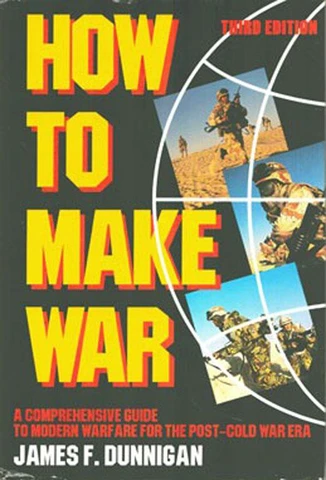
Review: How To Make War

How To Make War

Written by acclaimed and prolific wargame designer James Dunnigan, How To Make War is an impressive one-volume entry on both the basics of military operations and wargaming them. It’s not an easy feat to stuff so much into one book, but he manages it. Every facet of post-WW2 warfare is covered inside, along with simple but generally effective formulas for determining a unit’s “combat power” and stuff like average attrition in personnel and equipment.

Some of the “flaws” are clearly not his fault. For instance, it’s not his fault that (like most aficionados, to say nothing of actual veterans) I already knew most of what he was saying in his basic description of various unit types. It’s also not his fault that some of the book is dated (the latest edition was made in 2003). I’ll even excuse its frequent yet understandable bias, which is exactly what you’d expect from an old western Cold Warrior.

The biggest drawback that I’m not so willing to let slide is how its two central parts don’t really gel. It’s trying to both teach someone to walk (ie, the intro to all parts of the military) and run a marathon (do calculations for exact combat power). It just feels a little awkward to have “here’s the basic differences between infantry-heavy and tank-heavy formations” and “here’s how to calculate the combat power of a Syrian armored division” close to each other in the same book.

Still, this is a very good and very convenient resource for people wanting to learn more about missile-age warfare and/or wargaming. For fictional country simulations/story concepts, I’m already finding his formulas very useful for translating an order of battle into a general feel of its relative strength (which is the most important part). While some specialists may already know its material, you still can’t go wrong with getting this book.

Review: North Korean Tactics

North Korean Tactics

One of the best OPFOR manuals I’ve seen, and one of the most recent, is ATP 7-100.2, North Korean Tactics. The manual itself is a good read, and the “Breaking Doctrine” podcast that comes along with does a great job explaining how both it and other OPFOR documents (a long weird guilty pleasure of mine) have come into being.

Thus the manual isn’t a direct “They will do this” the way that some of the more overly rigid Soviet-inspired ones were. But it does show the characteristics of the secretive country (light infantry, high willingness to take casualties, artillery over tanks, etc…) and has to focus on its specific qualities instead of just lumping them in with a generic OPFOR designed for challenge above adherence to any specific country.

It’s not perfect, but it’s intriguing and well-done, showing the seeming contradiction of mass asymmetric warfare in action. Ones for China and Iran are planned, and I’m awaiting them. (There’s one for Russia announced, but it’s kind of in limbo. My hunch is that the need for something so specific is less for a country that’s already studied and already fairly close to the generic OPFOR).

Weird Wargaming: From The Periphery to the Centfront

The force deployments of the Cold War Central Front have been one of the most obsessively studied and analyzed of all time. Yet some surprising curveballs can still emerge. One of them I recently found was unadopted suggestions to move either Turkish or Italian forces to permanent bases in West Germany. The Turkish force I heard was two divisions. The Italian one was undefined.

The biggest (purely military and not political) risk I felt was that a significant portion of these nation’s heavy formations (the only viable ones for a conventional Fuldapocalypse) would have to be moved. Thus they would need to be either reequiped with cheaper and less capable superpower surplus, beefed up expensively, or have fewer mechanized units on their own territory.

As for where to put them, there were a few options. One was the obvious use of them to shore up the always vital and always vulnerable NORTHAG. Another was to put them in Southern Germany and/or other areas with good defensible terrain (such as the Harz Mountains) to free up Bundeswehr troops to go elsewhere.

However they were equipped and wherever they went, having these alternate deployments seems like it would make for an interesting wargame scenario.

Review: Dodgebomb

Dodgebomb

Darrin Pepple’s Dodgebomb is a historical fiction novel about the Iraq War. I will freely admit that plain historical military fiction, as opposed to alternate/never was conflicts, just isn’t my favorite (sub)genre. Nonetheless, this is a very good book.

The work of a veteran, it shows. Everything rings true, and it’s overall a well-written piece. Occasionally there are overly clunky paragraphs and/or descents to Herman Melville levels of detail, but those are small nitpicks. This is an excellent novel and I highly recommend it. Often it’s hard to describe how I like something as opposed to how I didn’t like it, but trust me-I liked this book.