The Yearly Blog Year In Review Post

So 2020 happened. The worth of this blog in getting me through a lot of stress this year cannot be overstated. It’s been an amazing experience. What’s also been an amazing experience is seeing just how me becoming more broad-minded about fiction has manifested. What might have been exactly the sort of thing I would dismiss with a firebreathing sneer. Now I read and enjoyed it. I’ve been reading and reviewing far more alternate history than I had in the past as well.

I also feel comfortable with how I stopped the Creative Corner. That blog was becoming nothing but filler posts for the sake of a perceived obligation, and I found that once I made the conclusion post, it just felt right to concentrate entirely here.

There’s two book series I read this year that really stand out. The first is John Gilstrap’s Jonathan Grave series, which happened at the right time. I was having what I call the “D-Day Effect” where something big and covered you’ve previously dismissed becomes novel simply because you haven’t experienced it. This has happened to me and “grocery store books”, and this series was proof that some mainstream successes are deserved.

Of course, the second and much bigger series is Kirov. This is weird. Not just in its “three mediocre Final Countdown/Axis of Time knockoffs turning into a combination of wargame lets play and time travel soap opera” content, but in how I enjoy it without necessarily recommending it for others to read. But I enjoy it nonetheless, and love how I took so much to a series with a ton of jumping Steel Panthers Characters, wargaming lets plays, and World War IIIs (plural). Knowing that I embraced a series that, before the beginning of this blog, I would have done nothing but sneer at has warmed my heart.

However, there’s also been a bittersweet side to this blog, and that’s in seeing a lot the distant vistas close. Seeing the conventional World War III subgenre at its limits and piecing together what happened to the “Men’s Adventure” fiction that seemingly disappeared after 1990 can be fun, but it can also evoke a feeling of “that’s it”? Then there’s also seeing that some pieces of fiction are just easier and more interesting to actually review than others, even if they’re both equally fun to read. If the blog goes in the direction of those, so be it, but I feel obligated to bring that up. While I obviously haven’t completely dropped them, a “51%” thriller just isn’t as good to review or analyze as an ambitious, conceptually interesting work.

This brings me to the announcement. My answer to “what do you do if you’ve seen all there is of conventional World War III?” is “Write your own take on it.” So I’ve started writing my own supernatural/weird-tinged conventional 1980s World War III novel.

This concludes my 2020 posts on Fuldapocalypse.
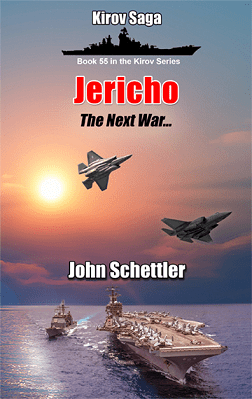
Review: Jericho

Jericho

The 55th book in the Kirov series and most recent as of this post, Jericho is a victim of the series’ structure. In it, the third World War III in the series rages on, as wargame lets plays naval fighting rages off the coast of East Asia. There amphibious landings and tense reinforcement missions. There are also big naval battles where tons of offensive missiles are fired and tons of defensive missiles are fired.

The problem is there were six books in this arc before of big modern naval battles where tons of missiles are fired. And then there was an eight-book arc before this one with plenty of naval battles where tons of missiles were fired. You see the issue here?

Even with keeping the “huge set of wargame lets plays” structure, there’s a lot that could be trimmed. The novelty of a toy box with unique force structures is bound to wear off after several books of seeing that in action again and again. It happened in the previous arcs, and despite this (deliberately) being more out-there than the earlier World War III, by now I’m used to seeing the platforms, formations, and paper-thin Steel Panthers Characters crewing them. The actual simulations could still happen while not going into detail on the least important and/or dramatic of them. One can novelize a game without detailing every single encounter.

As for the central characters, well, they’re not very significant here. Part of this is just that the series is getting ready for the next big arc (insisted yet again to be the final one in the series), but there just aren’t that many words devoted to them in this novel. They’re just there to crew ships like the other to-be-erased cutouts.

This feels like a sports game late in the regular season where nothing is really at stake for either side and there’s no traditional rivalry to spice things up. Yes it’s sports/a Kirov book with wargame battles and jumping plotlines in it, but the feeling of being something greater just isn’t there. It’s understandable given the structure, but that doesn’t change the lackluster quality of the specific novel/game.

Review: Field of Glory

Field of Glory

With Field of Glory, the Kirov series shifts into another subplot involving-you guessed it-time travelers changing the outcome of famous battles. In this case it’s a French and British time traveler manipulating history with their time-keys as part of a rivalry, with this book being about changing the outcome of the Battle of Waterloo. This entire “Keyholders Saga” was set up early in the series as a possible direction after the initial arc, shelved as an alternate World War II was focused on, and then revived later on as a way to show off wargames in other time periods.

This book is even more blatant than usual about being little but a lets play/after action report. While anyone crazy enough to make it through the Kirov series wouldn’t be surprised by any of this, this is intended as a spinoff. And for what it is, it’s not too bad.

At first it may be confusing and incomprehensible to have a story shift from the World Wars to the distant past, but once the gimmick is understood, it becomes better. Especially since a problem of some of the other Kirovs is that they linger too long on one certain war/campaign. A one-off book doesn’t have that issue.

Review: Firedrake

As of now the most recent book in the Kirov series, Firedrake combines the worst and best of it all. The worst is that all of the structural problems are still there and that the wargame lets play structure is beginning to wear thin, especially with the foreshadowing that this particular timeline is getting erased/destroyed. The best is, well….

The best is that plot points involve the ship transported to a bleak, dark, empty world where only hostile mechanized drones roam the seas and skies (was it Skynet or Yawgmoth that was responsible? :p ). Then it moves into another timeline courtesy of supervillain Ivan Volkov, where a Third World War (the fourth in the series) is about to begin, one where Japan won the second thanks to Volkov giving them nuclear bombs.

The Kirov series is best when it wargames out drastically changed situations, and that is the case in half of Firedrake. The other half is wargame action as usual.

Review: Kirov Season 6

Kirov Season 6

So, I’m FINALLY caught up with the entire Kirov series as of now, a feat of great effort even for me. The Season 6 “Next War” arc is, with hindsight, one of the weakest in the series. Unfortunately for me, it was the first arc I encountered. The second of four World War IIIs depicted in the series (this has to be some kind of record), it follows the World War II mega-arc.

In terms of actual writing, the individual books aren’t any worse than other Kirovs. The problem is its comparative mundanity. It’s one of the most recent examples I’ve seen of the “Captain Beefheart playing normal music” effect. It’s a contemporary World War III. Apart from a few half-hearted hypotheticals here and there, the only really substantive addition is a bigger Russian Navy, and that seems there just to have repeated large sea battles at all.

As for the time travel soap opera, there isn’t that much there. The war starts because Tyrenkov, a time traveler from the 1940s went forward , seized control of contemporary Russia, misinterpreted a possible future where he won as a definite future, and then started the war. Between that and the fetching of more of the time-keys (obvious plot MacGuffins), this is pretty restricted. About the only redeeming part there is the (sadly too small) presence of Ivan Volkov, the closest thing the series has to a primary non-historical antagonist. Volkov is a cross between a puppy-kicking supervillain and a crazy schemer who’s a lot less smart than he thinks he is, and remains my favorite character in the series. While there is some Volkov, there isn’t enough.

The only other new characterization is Tyrenkov, after fleeing to the ship as the war spirals out of control, being forgiven far too easily for my liking. The rest of the main cast stays the way they’ve always been, and they’re swamped by the shallow Steel Panthers Characters.

Otherwise, it’s a mixture of being restrained by semi-realistic orders of battle, cover ground that lots of other wargames have gone over, and, worst, having the contemporary setting give the author a justification to er, opine. It’s not the worst, but it’s still an issue the less “connected” installments didn’t have. It also feels-redundant, going over similar ground that the initial World War III in the books 4-8 arc did (to the point where I not unreasonably thought it was the exact same war), and having the same outcome (nuclear destruction and the ship timeshifting away).

Thankfully, the series improves significantly in the next arc, as a World War III in the altered reality created by the ship’s intervention in World War II allows the “wargame sandbox effect” to really flourish in a way it doesn’t here. Season 6 itself has all the weaknesses of the Kirov series as a whole and very few of the strengths. I’ve compared the series to an overly literalist lets play of an RPG. If that’s the case, this is the dungeon you always disliked.

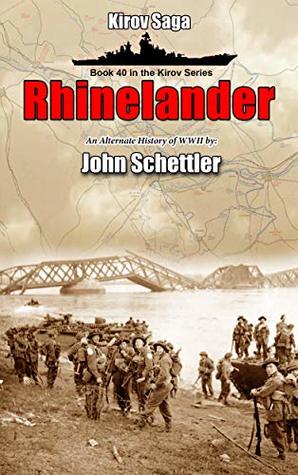
Review: Rhinelander

Rhinelander

After 31 (!) books, the World War II arc of the Kirov series concludes in Rhinelander. This is what I’ve been reading for the last month as the latest long, sequential series that I had a weird craving for. This book continues the time travel adventures which grow steadily more convoluted and more obviously a way to set up wargame sandboxes.

It also focuses on an alternate World War II where the initial Allied invasion of France came from the south and there were different tanks (including timeshifted modern ones on both sides) and… lots of changes. Much of it is reminiscent of the final battles on the historical western front, only moved up a year. A sort of “mini-Bulge” is conducted as one of the set pieces.

There was no real way that this lummox could conclude gracefully, so it gets a quick brute-force ending with a lot of exposition to smooth things over for the next timeshift and arc, a contemporary World War III that got the series to my attention in the first place. I was nonetheless content with it, and not just because the Kirov series defies normal critical scaling. Especially knowing the nature of the series and the state of the war at this point, having several books of nothing but the Allies advancing without truly serious opposition would not be ideal.

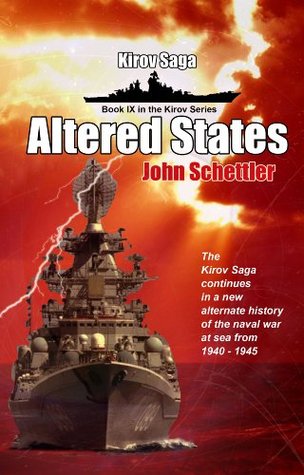
Review: Altered States

Altered States

The ninth Kirov book, Altered States, is where the series really starts to hit its stride. By Schettler’s own admission, the response to the question of “should I write about the missile cruiser’s later adventures or an alternate World War II where the German surface fleet was bigger?” was “Yes.” And he was glad to oblige, combining the cruiser soap opera with a huge naval battle in a location I haven’t seen in a while-the GIUK gap.

(There’s a Kirov, but there’s not any Backfires or Aegis cruisers or F-14s. It’s like my original vision of Fuldapocalypse mixed with what the blog later became)

This sets the stage for the giant wargame sandbox/time travel soap opera that the rest of the series would become. Not quickly or even the most effectively, but it still does. I’ll admit that the “alternate sandbox” approach is my own favorite way of wargaming, which is why I’ve grown fonder of the series. I’ve found later, similar installments in a series hard to review, and this is one of them. But still, this is where it really clicks into place.

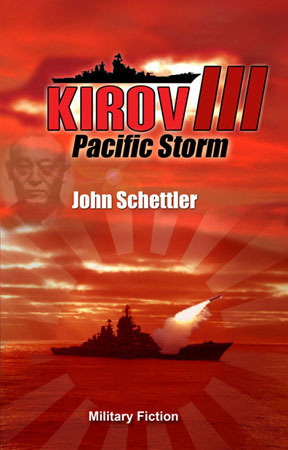
Review: Pacific Storm

Pacific Storm

The Kirov series is over fifty books long and counting. But the third entry, Pacific Storm, was planned as a potential stopping point, according to the introduction of a later entry. And while I normally criticize series from Jack Ryan to the Survivalist for passing good opportunities to conclude, it’s for the best that this one sailed right by it.

After having fought through the Mediterranean in the second book, the missile cruiser battles in the Pacific in the third. Besides the issues with the prose, the encounters fall short because the disparity between World War II ships that don’t know what they’re dealing with and a futuristic warship that does means that all the battles have to be contrived in some fashion. Pretty much the only things that work are various surprise gimmicks, close range, and pure numbers, and that’s barely enough to sustain a three-book series.

The ending still involves sequel hooks, but features the ship going back to its present with its crew having realized they started the (nuclear) World War III by firing on an American submarine. When they see the submarine after their “excursion”, they avoid attacking it. Meanwhile, their experiences have changed the “past” significantly. This would be a perfectly good conclusion that still gave room to continue, but it would have concluded three stilted, modestly out-there books. Instead, the series got bigger, more complicated, and, yes, better.

Review: Eagle Rising

Eagle Rising

The Kirov series, of which Eagle Rising is the 47th (!) installment, is strange. If I’d read it three years ago, I’d probably have unfairly denounced it as the worst series of all time. In my more recent reviews, I’d sort of wavered from criticizing the individual books to admiring the ridiculous (in a good way!) plot and premise of the setting.

Now I have this weird feeling that’s settled. I unironically love the craziness and excess that the series gets into, while remaining just as critical of the many flaws of the individual books. I’ll take this flawed excess standout over a hundred “51% books” any day.

That being said, this book itself has essentially two set pieces spread out of over many pages and takes place in an entire arc with a forgone conclusion stated as early as the first book in the series. Whatever the author’s intention, the impression I got of this arc, with this particular WWIII having long since been established as ending in a nuclear fireball (hence the time travel and changing it in the first place…), was that it served mainly to show off wargaming set pieces.

The set pieces are a big Russo-NATO showdown in Eastern Europe and the shenanigans of the ship and its crew. The former is a strangely intriguing example of what happens when you rely on wargame simulations to an incredible and unprecedented degree. Besides the obvious issues with such a stilted de facto let’s play, there’s also problems when the simulations produce an undramatic (however realistic) result and there’s not much “cushion” of characterization or low-level danger to balance them. Another issue is that this particular conflict setup is not exactly undergamed.

The latter, a far more out there plot, involves the use of a time travel MacGuffin and some of the crew going onto an island and fighting a pack of wolves (it’s a bit of a long story). It also involves long scenes of clunky dialogue, which is less fun.

In a way, this book, with time travel shenanigans and wargame AARs, is its own series in a nutshell. Is this a good or bad thing? Well, it depends on what you want and/or like.