Review: Assault of the Super Carrier

Assault of the Super Carrier
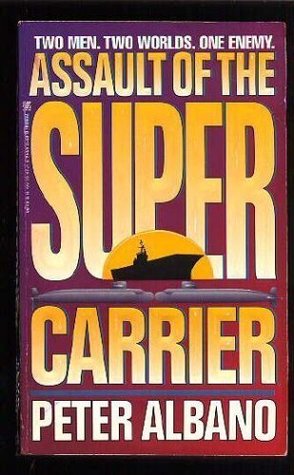
supercarrierfinale

Peter Albano’s Seventh Carrier series comes to an ignominious end in Assault of the Super Carrier. The action has gotten incredibly repetitive, the worldbuilding feels like even more of a toy box, the novelty has worn off for a long time, the characters are horrifically stereotypical, and the base writing just isn’t good enough for eleven books.

There’s two things that make this last entry especially disappointing. The first is the “girl of the book” subplot becoming its sleaziest, most useless, and most distracting yet. The second is that there really isn’t an ending. There’s a battle that feels like every other battle in the series, a victory that should have been an arc-level one at best, and then the novel-and the whole series- just ends quickly.

What I’ve found after searching out books with novel setups is that they alone can’t carry a series. And this is the best example. Take away the goofy “carrier thaws out, jet/rocket engines get insta-zapped” setup, and all you’d have is something like Ian Slater, only with (even?) worse writing and a fixation on World War II military equipment. And like Slater, that’s not enough to sustain a huge amount of books by itself. Maybe the Seventh Carrier saga could have worked with three books. It couldn’t with this many.
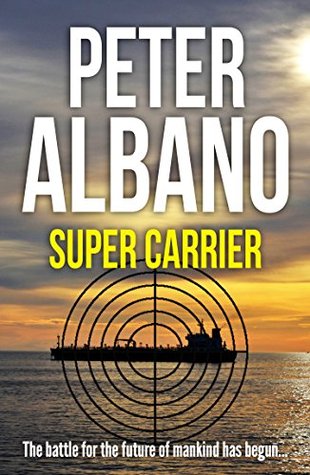
Review: Super Carrier

Super Carrier

supercarrier

Peter Albano’s “epic” series about a thawed-out Shinano fighting in a world where the clock is turned back lasted for eleven books. With me not considering the first two of be of the highest quality, and hearing that they got very repetitive, I jumped to the second-to-last installment, Super Carrier.

And I probably didn’t jump far ahead enough, for the tenth book is very much like the second, only worse. A gigantic chunk at the beginning is devoted to a overly long mission in a B-24. A smaller but still horrendous portion consists of a tank battle that is not exactly the equal of Team Yankee or Tin Soldiers. Then there’s the “romances” and the girlfriends getting killed horribly for “poignancy”. Neither is written well.

The retro dogfighting also appears clunkier than I remembered it being in the first two books, and the list of horribly written national stereotypes grows even larger. This book is only recommended to people who really liked the past Seventh Carrier entries.

A Thousand Words: The Hunt For Red October

A Thousand Words: The Hunt For Red October

Probably my first exposure to technothrillers came on the screen, when I watched The Hunt For Red October long ago. The movie is both a classic and, in my controversial opinion, better than the book.

Yes, I said it. The movie distills the essence of the book into one brief tour de force. The main plot is simple enough to distill into screen form without most of the clunkiness that Clancy had even back at the beginning. Yes, there’s more “Hollywood-ism”, but there’s also less of Clancy’s bias.

Technothrillers in general are hard to adapt to the screen because they require a big budget to be effective. In this case, the filmmakers got the budget, got the actors (Sean Connery’s accent notwithstanding), and knew how to separate the wheat from the chaff. The result is one of the best film adaptations of all time.

Review: Covert Action

Covert Action

Chet Cunningham’s Covert Action was one of his last books released, out on a small independent press. While I didn’t think too much of it upon my initial readthrough, now I think it clarifies something that’s been bothering me.

Having read some of Cunningham’s SEAL Team Seven novels, the book itself is basically one of those. The names are obviously changed, but the plot structure of hyperactive zipping around the world and constant action remains unmistakable to someone who’s read the “Keith Douglass” books helmed by him. The problem is that thanks to even iffier fundamentals and considerably worse proofreading, it goes from “ok” to “bad.” The book itself I’d just leave and not really recommend.

But what was the “a-ha” moment for me was how this affected reviewing. This is an example of how some cheap thrillers can feel interchangeable-because in some cases they are. There’s this. There’s the same author doing most of the work on both the MIA Hunter and Cody’s Army series. And finally, in one of the most extreme examples, the “Sharpshooter” and “Marksman” series of ‘shoot the mobster’ novels in the 1970s shared so much and were so rushed that manuscripts from the latter were used for the former, to the point where the main character’s name didn’t stay consistent.

There’s going to be a lot of overlap in a genre that’s formulaic by nature. And not all, or even most of the books I read reach this extreme. But there’s an undeniably sour feeling I’ve been getting as I reach for the keyboard.

The kind of “51% book” that Marine Force One still stands as the best example of can still be perfectly fun to read. But I’m finding, much like I’ve found with books in the same series, that repeated examples of those are getting harder and harder to actually review.

Review: Black Sea Terror

Black Sea Terror

Eric Meyer and Todd McLeod’s SEAL Strike: Black Sea Terror is a short story. The story of SEALs preventing a shipment of S-400 missiles to Syria, it reminded me of Chet Cunningham’s SEAL Team Seven novels. Or rather, it reminded me of a hypothetical Chet Cunningham SEAL Team Seven novel that was shrunk to a fifth of its size to fit in a magazine.

The S-400 system itself is treated as a multirole missile that’s somehow incredibly dangerous on its own (and no, it doesn’t have any kind of different warhead) instead of just being a high-end SAM. The action is just passably good enough, in a “small bag of potato chips” way.

In fact, a “small bag of potato chips” accurately describes the entire book. It’s tiny, insubstantial, and not truly “good” by any measure, but it’s still quite “edible”.

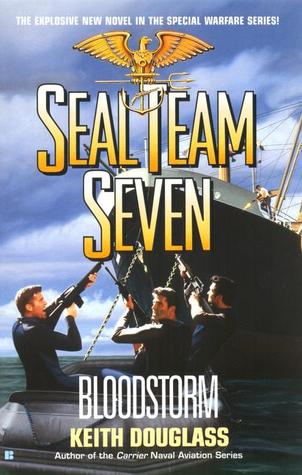
Review: Bloodstorm

SEAL Team Seven: Bloodstorm

st71 cover

A Chet Cunningham SEAL Team Seven novel, Bloodstorm is a strange book. It features a globetrotting chase to hunt down loose ex-Soviet nukes, going everywhere from Libya using them in a Dale Brown-ist fashion to Afghanistan (in a pre-9/11 book) to Syria.

There’s the usual tons of weapon descriptions, including a “Bull Pup” (two words) that matches the ill-fated OICW in terms of what it does. Like Frontal Assault, this is a hyperactive thriller that zips around the world over the span of a comparably short book-and yet it still feels overly padded. Cunningham was no stranger to writing out large quantities of books very fast, and this feels like one of them, with a huge amount of  sloppiness. While a cheap thriller is better off moving too quickly than moving too slowly, there are better books of this type out there.

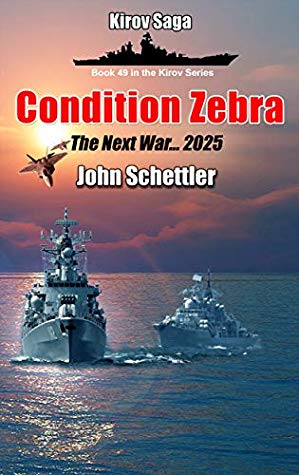
Review: Condition Zebra

Condition Zebra

conditionzebra

The (supposedly) final arc of John Schettler’s epic Kirov series, now exceeding even The Subspace Emissary’s Worlds Conquest in terms of word count, begins with Condition Zebra. This is the story of a contemporary World War III, after the Kirov timeshifted away from another contemporary World War III, possibly making it the first series to have multiple World War IIIs in it.

Having read two books in the 49-and-counting series, I figured it would at least be the same as before.  I was wrong. It somehow managed to be worse. And it manages to be worse in ways that might be considered contradictory at first glance.

One one end, the basic nuts and bolts writing has all the problems of the past Kirov books (characters who exist solely to operate military equipment, rote technical descriptions of the battles that give away the wargames used to sim them, and overall clunkiness) and just feels sloppier, with the dialogue, grammar, and even structure seeming worse.

On the other, the giant timeline tangles get bigger, more confusing, and somehow more pointless-seeming than ever. Knowing the end result and purpose, it just feels like the developers of Madden, 2K, or The Show making up a gigantic plot about time machines and time-traveling team general managers to explain why past players can appear in a game with current stars.

Maybe it’s those above flaws and maybe it’s just that the novelty of seeing the world’s longest wargame let’s play has worn off after three books, but this doesn’t even seem bad in a bemusing way anymore. It’s just bad.


Review: The Third World War, August 1985

The Third World War: August 1985

hackettcover

John Hackett’s Third World War was, even more than Red Storm Rising, the book that started off the subgenre this blog was founded on. Thus I figured making it my first review of 2020 was an appropriate milestone.

This is incredibly hard to review. I was initially very dismissive of this book when I read it. And in an isolated “spherical cow” sense, I still feel that way.

Compared to Team Yankee, Red Army, Chieftains, and even RSR itself, it offers very little in terms of literary quality. It’s dated (there’s a reference to Abrams as “XM1s”, which is kind of like calling T-64s “Object 432s”). It’s a mixture of straight “pseudo-history” and clunky, sometimes dubiously written vignettes, all stuffed together awkardly. It has, with the Birmingham-Minsk “trade”, one of the worst examples of plotnukes ever. The whole thing is a political lobbying document in the shape of a novel.

And yet, this is perhaps the most context-affected book I’ve ever read. To someone like me who treated the Heavy OPFOR Tactical as casual reading and has seen many, many primary sources, it’s not novel in any way. To someone of that time period, especially someone who wasn’t an analyst, it definitely would be. The nature of this book makes its novelty even more essential than normal, due to its shortcomings.

Hackett’s Third World War has a few interesting scenes, like the chapter detailing how the general public saw the war. It deserves credit for being the first out of the gate. While I originally thought that it was a bad influence on later books of its type, a more thorough reading of the “big war thriller” subgrene reveals that it really wasn’t.

That being said, to a modern audience, it’s still really nothing more than an even more dated version of The War That Never Was, with all the baggage you might expect from it. It’s a very important historical piece and is worth a read for that alone, but it hasn’t aged well.

Review: The Second Voyage Of The Seventh Carrier

The Second Voyage Of The Seventh Carrier

secondvoyagecover

The Seventh Carrier series by Peter Albano continues in its next installment.

There, the plotline that takes up the rest of the series begins. As Japan and the rest of the world get to grips with the existence of the Yonaga and its aged but living crew, a haywire killer- satellite system launched by the Chinese begins immediately destroying anything with a jet or rocket engine. Then Kadafi (of all the spellings of the Libyan dictator’s name, Albano uses this one) buys up a bunch of WWII surplus equipment and launches a campaign against Israel. Suddenly a carrier with old propeller fighters is a valuable asset, and it sails into battle again.

Most of the issues with the first book remain. The characters are all national stereotypes, and now there’s more nations to stereotype. The premise is goofy and turns into an excuse to have another slugfest with World War II weapons (which include surface warships as well the carrier and aircraft).

In spite of this, the action is good, as long as one considers the kind of book that it is. Yet I felt a sinking feeling in me (pun partially intended) when I read it. See, this is the second book in an eleven book long series. I’m not sure I want to read that many of Albano’s adventures.


Review: Dragon’s Fury

Dragon’s Fury

dragonsfurycover

Jeff Head’s Dragon’s Fury is a very interesting book, and I mean this without any snark. Viewed in one light, it’s just a clunky 800-page self-published book with robotic prose, a “Heroic Eagleland vs. the Alliance Of Evil” (which somehow includes India) plot,  and a lot of axe-grinding, the kind that would seemingly be just forgettable.

But viewed in another light, it’s weirdly impressive how many technothriller cliches it has. They’re all there, even contradictory ones. Take something with…

  • The bloat and diversion into domestic politics for the sake of soapboxing of later Tom Clancy. (Although Dragon’s Fury’s politics make Executive Orders’ seem restrained, tasteful, and left-wing in comparison)
  • The sci-fi excesses of Dale Brown at his most out-there (there’s a battle in Dragon’s Fury featuring space battleships).
  • The “look out, it’s the MacGuffin superweapon” theme of many technothrillers, especially post-1991 ones.
  • Similarly, the “a thousand viewpoint characters and a million technical descriptions” style common to the genre.
  • The robotic “play by play” battle description of books like The War That Never Was.

All these come together into something worse than the sum of their parts. The bloating and tangling keep it from being a  breezy “51% book”, turning it instead into a total clunkfest. The sci-fi and superweapon components aren’t crazy-fun like Blaine McCracken taking one of his periodic trips into outer space, just out-of-place. The battles get uninteresting very fast, especially given the “show everything in every theater” aspect of it. The big, detailed descriptions don’t work in a setting that isn’t grounded.

If it had the same “political manifesto as told by an early, monotone text-to-speech device” prose but was half the length, and had only two or three of those technothriller staples instead of all five, I’d dismiss it as “forgettably bad.” However, by incorporating all of them, by somehow taking every military/technothriller plot device and using them so consistently poorly in a way that not even Patrick Robinson can manage, Dragon’s Fury manages to become something different. It manages to become unforgettably bad. That the book is an audacious, sweeping tale of a multi-year world war (in a time when many technothrillers were lowering their scope and/or stakes) just amplifies everything.

It’s not enjoyably bad. Even I had a hard time getting through this book. But it is indeed unforgettable in its ambition. It’s as if Florence Foster Jenkins tried not only singing but writing an epic Wagnerian opera accompanied by an unironic Portsmouth Symphony Orchestra. I’d put this book, alongside the previously mentioned Patrick Robinson novels, as an example of the depths the technothriller sunk to in the 2000s. Robinson’s works were the “conventional commercial publishing” side, and this is the “self-publishing” side.