Review: Battle of the Three Seas

World War 1990: Battle of The Three Seas

It’s time to return to William Stroock, an author who I’ve previously slammed as the worst World War III writer ever. Has this been fair? And has his new Battle of the Three Seas improved on his previous entries?

For the first question, it’s a weird answer. It’s like talking about the New York Knicks or Jets. They’re still pro-level teams, and even a “bad” pro player is still among the greatest in the world. Being the 32nd-best team in the world is still an accomplishment. Similiarly, to write a long novel at all in a niche genre is a talent many don’t have, and Stroock has still gotten more basics right in the field than non-specialized authors have. (Research on military equipment, especially above small arms, is something frequently in very, very short supply). So yes, it has been unfair to simply denounce in fire-breathing terms.

Yet it’s still fair to consider the Knicks and Jets not the 32nd-best teams in the world, but the worst compared to their colleagues. They’re still bad by those (incredibly high) standards. And they’re not going against college/international teams-you judge them by who they’re up against. So, with a heavier heart, I still have to say that Stroock is one of the worse World War III specialist writers, and while this book has improved somewhat compared to the earlier ones, it’s not enough to shift the rankings that much.

The book is less one-sided in absolute terms than some of his previous books. It’s undeniably improved in prose quality. But it still has a jumbled structure with way too many viewpoint changes for its own good and writing that’s still too flat to really work. There are still bizarre subplots that don’t really add anything.

It’s ultimately just still too hard to find something in this book, or Stroock’s series as a whole, that does what another “conventional World War III” book doesn’t do better, be it characterization, tone, or technical plausibility. It might be better than a historical “sports nadir” team. But it’s still, in a now-obsolete baseball term, very much a “second-division” series.
Review: Dance of the Vampires

Dance of the Vampires

The ebook Dance of the Vampires is a behind-the-scenes look at the wargaming Larry Bond used for what would become Red Storm Rising. It’s fascinating to see how this battle was conducted. For someone who’s worked on Command, seeing this comparably ancient system is like looking at one of Naismith’s original basketball games.

Most of the book is composed of after action reports and figures detailing the games. Besides the ones that play out similarly to the actual book, there’s a short summary of the “Keflavik Turkey Shoot”, a scenario where the Soviets attempted to force the GIUK Gap with heavy bombers and got crushed (despite legitimately clever play on their side). This was what required them to take Iceland in Red Storm Rising proper. The smaller-than-I-thought presence of that country in World War III fiction started here.

This is in many ways a book about struggles, because they were on unfamiliar ground, and not just about rivet-counting specifics. When something like this hadn’t been done in this way before, there’s bound to be issues. And there were. But the results were still impressive, and so is this chronicle of the wargames. For those interested in this kind of history, I can recommend this book.

Review: Jericho

Jericho

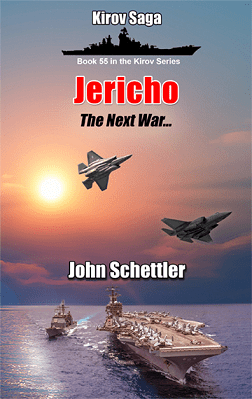
The 55th book in the Kirov series and most recent as of this post, Jericho is a victim of the series’ structure. In it, the third World War III in the series rages on, as wargame lets plays naval fighting rages off the coast of East Asia. There amphibious landings and tense reinforcement missions. There are also big naval battles where tons of offensive missiles are fired and tons of defensive missiles are fired.

The problem is there were six books in this arc before of big modern naval battles where tons of missiles are fired. And then there was an eight-book arc before this one with plenty of naval battles where tons of missiles were fired. You see the issue here?

Even with keeping the “huge set of wargame lets plays” structure, there’s a lot that could be trimmed. The novelty of a toy box with unique force structures is bound to wear off after several books of seeing that in action again and again. It happened in the previous arcs, and despite this (deliberately) being more out-there than the earlier World War III, by now I’m used to seeing the platforms, formations, and paper-thin Steel Panthers Characters crewing them. The actual simulations could still happen while not going into detail on the least important and/or dramatic of them. One can novelize a game without detailing every single encounter.

As for the central characters, well, they’re not very significant here. Part of this is just that the series is getting ready for the next big arc (insisted yet again to be the final one in the series), but there just aren’t that many words devoted to them in this novel. They’re just there to crew ships like the other to-be-erased cutouts.

This feels like a sports game late in the regular season where nothing is really at stake for either side and there’s no traditional rivalry to spice things up. Yes it’s sports/a Kirov book with wargame battles and jumping plotlines in it, but the feeling of being something greater just isn’t there. It’s understandable given the structure, but that doesn’t change the lackluster quality of the specific novel/game.

Review: The Sixth Battle

The Sixth Battle

Barrett Tillman’s The Sixth Battle is an interesting book. The 1992 novel of a gigantic combined battle over South Africa can either be considered the last Cold War “big war thriller” or the first post-USSR one. Because of its timing, the plot has to be kind of, er, forced a little, but that’s a small issue.

When I started reading the book, my thoughts turned to Red Phoenix. The similarities are there in that both are big picture thrillers that need to have a certain type of structure (most notably a lot of viewpoint characters and a setup period) to get that wide view across to the reader. For me personally, the perils of this is that since I already know a lot of what the authors are trying to communicate to a less knowledgeable audience, I see more of the downsides to this approach than the upsides.

However, I can also see-and appreciate-how rare a book like this is. “Big war thrillers” with this level of detail and knowledge behind them are and were very hard to come by. The Sixth Battle goes for a distinct setup, thinks it through, and competently executes the action in an evenhanded way.

Taking my biases into account and trying to adjust for them, I still recommend this book. It does feel a little clunkier than the best “big war thrillers”, but it’s never unreadably so. And it offers an all-too-uncommon experience that’s rarely duplicated elsewhere.

Review: Fire Ice

Fire Ice

The novel Fire Ice holds a great deal of importance to me. It was, without a doubt, the first real “cheap thriller” a young me read. This makes it hard to truly judge its literary quality. After all, young me saw the name Clive Cussler on the cover and didn’t know at the time about how the “co-author” system worked, so I assumed it was all him (which had the thankful effect of leading me to earlier Cussler books that were indeed all his own).

With its big locales, action, and high-stakes plot with a Russian oligarch and a supervillain scheme, this has all the ingredients a Cussler thriller and a cheap thriller in general needs. Certainly, for one’s first cheap thriller, you could do a whole lot worse than that. While my reading habits are such that another cheap thriller probably would have taken its place, I still owe Fire Ice a lot for getting me into them.

Review: British Battleships

British Battleships

Oscar Parkes’ 1957 British Battleships: Warrior to Vanguard is exactly what it says: A gigantic encyclopedia on every large armored warship the Royal Navy operated from 1860 to the then-present. This has been one of the oldest, rarest, biggest, and most expensive books I’ve owned, and it’s amazing. This is a big, comprehensive look at British capital ships, from the famous ones of the World Wars to weird 19th Century contraptions.

The mid/late 1800s are the most interesting time period as battleship design zigzagged around, but every part of the book is effective. There are numerous cutaway drawings, and they’re well done. The writing is descriptive and engaging as well.

Yes, being made in the 1950s means a lot of it is dated now. Yes, it’s a little more broad than it is deep, a consequence of having to cover so much ground. But it is still an amazing, incredible history book. When published, the age of the battleship had just ended, making this book a fitting tribute.

Review: Periscope Red

Periscope Red

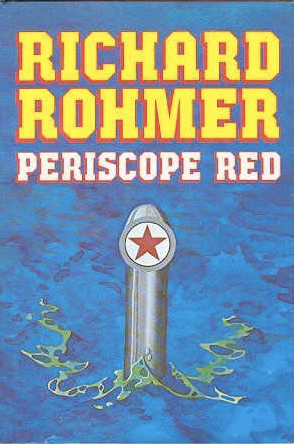
Richard Rohmer’s Periscope Red is a novel ahead of its time in the worst ways. That its concept of a Soviet covert-to-overt campaign against the world’s oil tankers is interesting makes the flawed execution all the more disappointing. The presence of numerous conference rooms and technical infodumps without any substance or excitement to “balance” them leads to a mismatch. It’s the equivalent of watching a sporting event where quarterbacks throw tons of incomplete passes as rushers stay on the side, basketball players attempt and miss three pointers by the dozens, or where baseball hitters strike out en masse but have absolutely no power when they do make contact.

That the literary fundamentals are slightly improved from Ultimatum and Exxoneration in a way doesn’t help it. It’s still not good by any means, and this quality makes it slightly more generic. Going from “interestingly bad” to “un-interestingly bad” isn’t necessarily a good trade off.

Thus this book is somewhat more realistic than Rohmer’s “invasion of Canada” novels, but lacks their out-there premise. It’s somewhat smoother in its pacing than those, but lacks the weird “appeal” of seeing just how blatant the padding can get. By conventional literary standards, it’s still very, very, bad. The technothriller style would have to wait until better authors than Richard Rohmer came along to achieve mainstream prominence.

A Thousand Words: Waterworld

Waterworld

Guns N’ Roses November Rain is widely recognized as the final, out-with-a-bang entry of the musical niche known as the “power ballad.” Kevin Costner’s infamous Waterworld kind of feels like the movie version of this. Of all the movies labeled the worst ever, this deserves it the least in hindsight-though it’s perhaps fitting, since critics never cared much for hair metal anyway.

The plot and setting make no sense, and the acting is nothing special, barring Dennis Hopper’s typically hammed-up villain. But what this movie offers is spectacle. Before CGI truly came along and money became tighter, the huge practical effects epic had to have one final giant push. And in the form of the evil ski-jumpers, hamfisted environmentalism (from a movie that had to make a giant, inevitably polluting, artificial island in its production), and piles of (oil-burning) pyrotechnics, it succeeded.

This movie can’t really be considered “good”, but I had a lot of fun watching it.

Review: Firedrake

As of now the most recent book in the Kirov series, Firedrake combines the worst and best of it all. The worst is that all of the structural problems are still there and that the wargame lets play structure is beginning to wear thin, especially with the foreshadowing that this particular timeline is getting erased/destroyed. The best is, well….

The best is that plot points involve the ship transported to a bleak, dark, empty world where only hostile mechanized drones roam the seas and skies (was it Skynet or Yawgmoth that was responsible? :p ). Then it moves into another timeline courtesy of supervillain Ivan Volkov, where a Third World War (the fourth in the series) is about to begin, one where Japan won the second thanks to Volkov giving them nuclear bombs.

The Kirov series is best when it wargames out drastically changed situations, and that is the case in half of Firedrake. The other half is wargame action as usual.

Review: Kirov Season 6

Kirov Season 6

So, I’m FINALLY caught up with the entire Kirov series as of now, a feat of great effort even for me. The Season 6 “Next War” arc is, with hindsight, one of the weakest in the series. Unfortunately for me, it was the first arc I encountered. The second of four World War IIIs depicted in the series (this has to be some kind of record), it follows the World War II mega-arc.

In terms of actual writing, the individual books aren’t any worse than other Kirovs. The problem is its comparative mundanity. It’s one of the most recent examples I’ve seen of the “Captain Beefheart playing normal music” effect. It’s a contemporary World War III. Apart from a few half-hearted hypotheticals here and there, the only really substantive addition is a bigger Russian Navy, and that seems there just to have repeated large sea battles at all.

As for the time travel soap opera, there isn’t that much there. The war starts because Tyrenkov, a time traveler from the 1940s went forward , seized control of contemporary Russia, misinterpreted a possible future where he won as a definite future, and then started the war. Between that and the fetching of more of the time-keys (obvious plot MacGuffins), this is pretty restricted. About the only redeeming part there is the (sadly too small) presence of Ivan Volkov, the closest thing the series has to a primary non-historical antagonist. Volkov is a cross between a puppy-kicking supervillain and a crazy schemer who’s a lot less smart than he thinks he is, and remains my favorite character in the series. While there is some Volkov, there isn’t enough.

The only other new characterization is Tyrenkov, after fleeing to the ship as the war spirals out of control, being forgiven far too easily for my liking. The rest of the main cast stays the way they’ve always been, and they’re swamped by the shallow Steel Panthers Characters.

Otherwise, it’s a mixture of being restrained by semi-realistic orders of battle, cover ground that lots of other wargames have gone over, and, worst, having the contemporary setting give the author a justification to er, opine. It’s not the worst, but it’s still an issue the less “connected” installments didn’t have. It also feels-redundant, going over similar ground that the initial World War III in the books 4-8 arc did (to the point where I not unreasonably thought it was the exact same war), and having the same outcome (nuclear destruction and the ship timeshifting away).

Thankfully, the series improves significantly in the next arc, as a World War III in the altered reality created by the ship’s intervention in World War II allows the “wargame sandbox effect” to really flourish in a way it doesn’t here. Season 6 itself has all the weaknesses of the Kirov series as a whole and very few of the strengths. I’ve compared the series to an overly literalist lets play of an RPG. If that’s the case, this is the dungeon you always disliked.