Review: The Modern Bodyguard

The Modern Bodyguard

Peter Costerdine’s The Modern Bodyguard is an excellent research resource for realistic “executive protection”. Written in a typically sharp, slightly sneery British style, it delivers the blunt realities of the job, especially for civilians who lack both financial and legal resources compared to government personnel. For instance, it points out that private security, especially traveling private security, will almost always be unarmed for legal/political reasons (at least as of the time of writing).

It’s not perfect, and it says something about the type of genre that even Costerdine goes into tirades about various types of firearms. But its positives outweigh the negatives substantially. If you’re curious about realistic, limited-resource protection, I cannot recommend this book enough.

Review: Nonstate Warfare

Stephen Biddle’s Nonstate Warfare aims to debunk the myths around warfare featuring nonstate actors and point out that there really isn’t as clear a line as thought between “conventional” and “unconventional” warfare. As I’ve been annoyed by the use of the terms “Hybrid War” and especially “4th Generation War”, I was eagerly awaiting this book. However, I found the execution significantly flawed.

Now, the premise is sound and well supported, which makes the flaws in outcome all the more severe. Basically, even the most mass-mobilized total wars with the clearest defined front lines have an irregular and/or deep element (he uses the excellent example of partisans on the Eastern Front in World War II). Likewise, even non-state elements can and have fought battles with large forces, heavy weapons, and the aim to hold territory. Very few people would dispute this. Biddle also points out that the progress of industrial-age technology means that ill-equipped irregulars can have weapons that the most advanced world powers didn’t have a few decades prior.

None of this is really controversial, and simply stating that would make for a very short book. What would be useful would an example of middle-level armies that don’t fit categories very well. Biddle does do this, with his descriptions of the Sadrist militias in the Iraq War and Adid’s forces in Somalia fitting well. He also has an interesting analogy with a spectrum from “Fabian” operations (a reference to the Roman strategy of avoiding defeat) to “Napoleonic” ones (a reference to seeking decisive battlefield victory). To be snarky, Fabian operations to excess are Kalib Starnes spending the entire MMA fight running away from Nate Quarry, while Napoleonic ones are the bandit in a Bethesda game charging the player in super-armor.

Unfortunately, this is written in clunky academese. Biddle uses a rigid scale to rank various forces from “Fabian” to “Napoleonic”, one that I found to be too rigid for an inherently arbitrary judgement. His writing is full of hair-splitting and nitpicking of what honestly feels like a strawman that everything is either phalanxes on a field or nothing but backstabbing. There’s weird hangups like a fixation on force density for its own sake, obsession on individual technical examples (so Adid had TOWs? So what? Even in 1993 it wasn’t like they were stealth fighters), and not enough focus on non-state forces supplied by state ones.

I wanted to like this book. And I don’t disagree with the overall point. But it could have been made just so much better. This feels like an academic squabble in academic language, when a plain-text history of case studies with “conventional irregular armies” would have been far more suitable in promoting the argument.

Review: On The Path of Songun

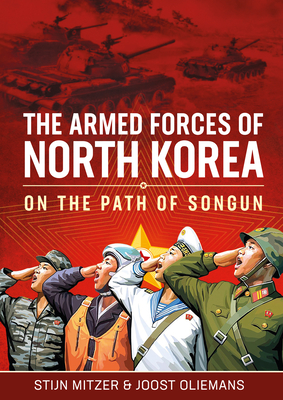
The Armed Forces of North Korea: On The Path of Songun

It’s been a while since I read a really, really good military nonfiction reference. Thankfully, Stijn Mitzer and Joost Olieman’s The Armed Forces Of North Korea: On The Path Of Songun takes the cake. The product of the same people behind the legendary Oryx Blog of military intelligence, this took a while to finally get going. Thankfully, it’s well, well, well worth the effort.

So why is it so good? Well, for a start, it’s incredibly well researched, written, and photographed. It’s not an OPFOR manual or a ridiculously broad order of battle chart. What it does do is go into legitimate detail and depth about the KPA and its rise, fall, and rise. What made me absolutely fall in love with this was how this is the rare military book that doesn’t fall into either extreme of “unstoppable or helpless”. When I saw the self-proclaimed intent to the debunk the notion that the KPA wasn’t/isn’t a threat, I feared it would go too far in the opposite direction.

That was not the case. I was treated to a very evenhanded look that amounts to “Yes, there’s modernization, yes there’s legitimately advanced indigenous developments, but as of now it’s limited and foreign support is undoubtedly there” and doesn’t hesitate to point out their shortcomings and material issues. The authors are even good at pointing out what they can verify and what they can’t, a must for dealing with a country as secretive as North Korea.

For enthusiasts, general audiences, wargamers, and anyone, really, this is a great book that I highly recommend.

Review: Tupolev Tu-22

Tupolev Tu-22

The Tu-22 “Blinder” is one of those “overshadowed by more famous successor” aircraft, the Backfire, which was doing the “let’s keep the same nominal designation for a new aircraft to pretend its more similar than it actually is” long before the Super Hornet. Sergey Burdin and Alan Dawes’ history of the Blinder is one that does it justice.

Though this is a very dry and very technical book overall, it does have some humorous anecdotes, such as how the Libyans used their Tu-22s (spoiler alert: Not very well). It also defends the bomber, with evidence, from the charge that it was a deathtrap. The authors make the good, backed-up case that it was no more dangerous than any other 1950s design, a period known for its high attrition. I’m reminded of the tale of it being unusual when the flagpole at Nellis wasn’t at half staff.

As for why a 1950s design stayed in service so long, the combination of the Soviet packrat attitude and its ability to carry monster ASMs a decent distance meant it was still viable. This “redemption of the ugly duckling” makes me eager for a similar book on another Soviet aircraft with a poor reputation, the MiG-23.

Really, this is a great book for aviation enthusiasts. I didn’t mind the reams of charts, and it goes into detail on lots of things. And the “use oddball tactics” side of me loved the passage where they trained/experimented with using the tail gun against ground targets. This is a solid work and I recommend it.

Review: Firepower

Firepower: A History of the American Heavy Tank

R. P. Hunnicutt was the dean of American tank history, and in Firepower he turned his attention away from the famous Shermans, Pattons, and Abrams’ to something more obscure-heavy tanks. Due to the issues needed to ship them across the oceans, the American military was never the fondest of heavy tanks (a similar issue with being able to travel on bad roads and be easily shipped across the Eurasian landmass has always constrained the size of Soviet/Russian tanks). Excluding the Pershings considered “heavies” while operating alongside lighter Shermans, the only heavy tanks actually produced were a handful of M103s.

But their doctrine was heavily (no pun intended) spelled out and there were, as this reference book shows, a lot of interesting designs. These range from the produced M103 to the World War II boondoggle that was the M6 to the French-esque autoloaded Cold War heavies that languished in obscurity until the World of Tanks computer game. And of course, there’s the monstrous, monomaniacal T28.

This is a dry reference book that reads like a dry reference book. Yet its subject matter is obscure and fascinating, and I highly recommend it to tank enthusiasts and people who like “what-ifs”.

Big Guns in Big Units

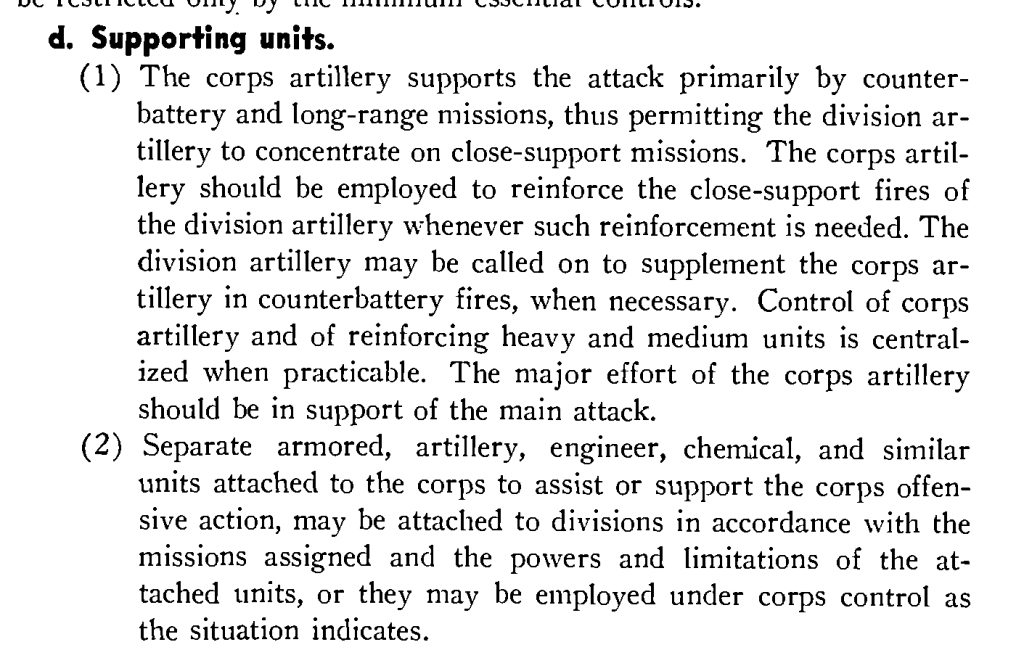
The corps/army level artillery mission hasn’t really changed that much since World War I, at least from what I’ve seen.

  • Counter-battery
  • Deep strike
  • Supporting the right effort at the right time.

As always, the Soviets were the most explicit in spelling it out, as one set of field regulations shows.

The American FM 100-15, from a similar time, had a similar statement.

As far back as 1923, the regulations explicitly state:

“The primary mission of corps artillery is the destruction or neutralization of hostile batteries, the destruction of hostile defenses, and long-range interdiction fire.”

As technology has consistently improved, command has “flattened”, and the understanding of its role has become more obviously apparent, more recent documents don’t spell it out so exactly. But the general concept is still there and present.

Review: Soviet Military Operational Art

Soviet Military Operational Art: In Pursuit of Deep Battle

David Glantz is one of the most famous and prolific western Sovietologists. In his 1991 Soviet Military Operational Art, he took a big yet close look at their conduct of campaigns, from theory to practice, from the revolution to the then-present. As with everything he’s written, it’s dry history. But it’s excellent for what it is.

Special focus needs to be given to his looking at the more obscure and lesser-known periods of Soviet military history, such as the revolution and Russian Civil War itself, the interwar period, and the immediate post-WW2 one. These tend not to get as much attention as WWII itself and the 1980s hypothetical WW3s, but are just important historically and frequently very different tactically. Looking at the layout of a Russian Civil War division, so different from the formations I knew, I thought “this was like when baseball pitchers threw underhand”.

The book is still a little dated in some areas, and has a few issues. I think the most glaring one is Glantz overstating the effect of the Stalin purges. While they didn’t help the Red Army, looking at later Russian sources gives me the impression that its biggest problem was expanding too much too quickly and that the purges were just the icing on the cake. Khrushchev-era politics would give an obvious incentive to blame Stalin directly for as much as possible.

But this is a small issue and the book itself is still excellent.

The Monster Rocket

I give you the Type 762 rocket launcher, a fairly old and obscure Chinese self-propelled artillery piece. This is well, if you combined a FROG, a TOS-1, and a Giant Viper all into one platform, you’d get this.

From its stated (as always, take with a grain of salt) statistics, it has a pair of very short range (around only a kilometer!) thermobaric rockets (like the TOS-1), that are huge at 425mm diameter (only somewhat thinner than the FROGs) and which are primarily meant for clearing minefields (like the Giant Viper). Although with a rocket that big, I’m guessing that it’ll “clear” more than just land mines in the area it hits.

Truly an oddball.

Review: The Rules of The Game

The Rules of The Game: Jutland And British Naval Command

In the seventh game of the 2001 World Series, Mariano Rivera faced Tony Womack, giving up a game-tying hit and setting the stage for Luis Gonzalez to win the series for the Diamondbacks. In that plate appearance, Womack triumphed. In the rest of their careers, it was quite potentially the greatest relief pitcher ever (Rivera) against a poor hitter whose sole virtue was speed in baserunning (Womack). A sample size of one doesn’t lead to good results.

Unfortunately, this is what Andrew Gordon tries to do in The Rules Of The Game: Jutland and British Naval Command, a history epic that is equal parts awe-inspiring and frustrating. When younger, I hung on this book’s every word. Now, it comes across highly erratic. See, the writing quality is still amazing. The research and attention to detail is excellent as well. In terms of historiography, Gordon stands out.

It’s just a shame that in terms of slant, he stands out as well.

Gordon is one of the few historians who stands with David Beatty over John Jellicoe, and his defense is weird. In the actual book, Gordon points out Beatty’s flaws -he put the slower but most-armored Queen Elizabeth battleships in the back of his formation, he didn’t coordinate more, he was a ‘difficult’, arrogant person that nobody liked, and so on. And yet he still supports the BCF commander on “his heart was in the right place” grounds. You know, he was scrappy, and he had that clutch spirit.

With a bias towards a decisive victory that never truly needed to happen, the book comes across as not what it could have been. Gordon takes that sample size of one (hey, remember the time a relief pitcher with only two career plate appearances managed a double off of Randy Johnson? The time Muggsy Bogues blocked a shot from Patrick Ewing?) and seems to just miss the forest for the trees-or if he doesn’t, he barely dwells on it.

This book is still a huge accomplishment and one very much worth reading. It just needs to be understood that it’s not exactly the most neutral in tone.

Review: Storied Independent Automakers

Storied Independent Automakers

Charles K. Hyde’s Storied Independent Automakers tells the tale of the American-owned car companies that were not the Big Three. It’s a story worth telling, because they illustrated just how ruthless and consolidating the car industry is. These car companies went under or were bought out at the height of the domestic auto industry’s success (one ironic silver lining was that many of their left-hanging dealers turned to import brands and proceeded to make a fortune from them).

They had one brief moment of popularity due to a completely artificial boom when World War II resulted in years of pent-up demand. And now and then they managed to pull an innovation out that gave them a temporary edge (like compacts for AMC) until the big three caught up. But that was mostly it, and other than that it was all uphill. Hyde rightly points out it was impressive that they lasted as long as they did, and gives credit where it was due.

Though written in a history book tone (ie, it’s not exciting for anyone other than me), Hyde’s book is light enough to be readable while still containing lots of well-researched statistics on cars. It tells the story of an overlooked but important part of the auto industry’s history. Any enthusiast should enjoy it.