Review: Handbook of Military Knowledge For Commanders

Handbook of Military Knowledge For Commanders

One of the biggest treats I’ve read is the translated 1980s Chinese document called the “Handbook of Military Knowledge For Commanders”. Exactly as it implies, the document is a hundreds of pages long and highly deep look into the Cold War’s least advanced and most secretive major army. Because of this, it’s an excellent resource not just for the Cold War PLA, but also many of the client states/units equipped, trained, or even just inspired by it. As well for less-advanced (compared to major powers) armies in general.

A lot of this contains basic stuff that any field manual reader won’t find surprising. The layout, at least of the translated version, leaves something to be desired. And there are a few translation quirks like keeping the romanized Chinese word “Fendui”, instead of just saying “units” or “subunits” (as would be appropriate for the context.) In fact, the document has the worst of both worlds in that it shows “Fendui” but not the original characters, making it confusing for both English and Mandarin native speakers.

Still, this is an excellent study of not just that specific army at that point in time (mid-1980s), but also of many principles applicable to all forces at any time. If you have the time to dig through four hundred pages of field manualese, it’s well worth your while.
Review: Children of the Night

Children of the Night: The Strange and Epic Story of Modern Romania

With All Union and my Soviet-Romanian War project, I figured getting a good one-volume history of the Southeast European country would be nice. And Paul Kenyon’s Children of the Night delivers. It starts in 1442 with Vlad “Dracula”, or “The Impaler” Tepes, and more or less concludes with the execution of Nicolae Ceausescu in 1989. The book is a magisterial epic of Romania’s frequently bizarre and violent history.

One consistent theme is Romania being perched on an unsteady point and being tugged on in multiple directions for centuries. Whether it be the Hungarians and Turks, the Russians and Turks, or the east and west in the Cold War, Romania always feels like an odd one out, a Latin enclave in a Slavic realm. The most blatant example of this was Romania spending the first part of World War I figuring out who it should support (it sided with the Entente eventually), but this was shown throughout history. The most ghoulish is Ion Antonescu’s regime conducting some of the worst massacres of the Holocaust, but suddenly changing its mind on the deportation of Jews-conveniently right after the encirclement at Stalingrad.

But it’s its postwar history where the book shines. Ceausescu’s reign of terror is well documented, and the scenes of his fall and execution read like they could have come straight from The Death of Stalin. It also shows that his tendencies towards what can be called “independent totalitarianism” started under his predecessor, Gheorge Gheorghiu-Dej.

If you could only read one book on the history of Romania, this would be a good contender for the choice. It’s definitely worth reading.

The Ultimate Trench and Dugout Building Guide

I stumbled into this 1920s American training document on building fortifications with the lessons of World War I in mind. The full piece has detailed guides on everything from “the kind of thing you build when you have only a few hours” to “the kind of thing you build when you have a few years”. Both fighting positions and gargantuan medical/residential/command underground dugouts (or “cave shelters” as the document calls them) are there.

There are a couple things I found interesting in particular. The first is that antipersonnel mines, despite becoming a hallmark of later fortifications, are only mentioned very briefly and dismissively. According to it, they take too much effort to emplace for something that’s going to be knocked aside/detonated by the big artillery preparation already. (Antitank mines, including ones rigged to be sensitive, are treated somewhat more favorably.)

The second is that what became known as an overpressure system (ie, higher pressure in the area than out of it, pushing clean air out instead of poisoned air in) is talked about as a counter to poison gas for large bunkers. I didn’t know it was talked about that early, and thought it was a Cold War invention. So that was interesting.

The third is that while machine guns were present, very few of the later infantry support weapons were. Besides indirect mortars, the only thing talked about for forward emplacement is the 37mm infantry support gun. So this was a very interesting time capsule, and some of its TTPs (techniques, tactics, and procedures) are still relevant. After all, artillery hasn’t exactly gotten less lethal since the 1910s.

Review: Small Unit Infantry Ambush Tactics

Small Unit Infantry Ambush Tactics

It’s very rare that I find a book that’s essentially a “strictly worse” version of another one. Where another work exists that can do literally everything it can and do it better. Yet that is the case for Small Unit Infantry Ambush Tactics, a how to fight guide about-look at the title.

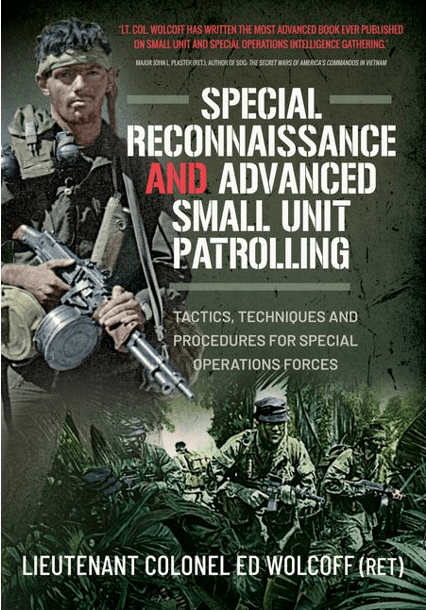
By itself it’s not too bad, showing different ambush types and critiquing rote training. But it’s just that Special Reconnaissance and Advanced Small Unit Patrolling has everything it does and so much more. Plus the latter book has a far better tone, giving credit to the establishment where the author thinks it’s due instead of the more overly critical one of this book. So I feel comfortable in saying: Get Wolcoff’s masterpiece instead.

Review: A History of Cavalry From The Earliest Times

A History of Cavalry From The Earliest Times

Now long since in the public domain (the first edition was in 1877 and later ones were published to 1913), George Denison’s A History of Cavalry From the Earliest Times was a look back at thousands of years of mounted operations. It’s an interesting time capsule. The aim was a sincere chronicle of cavalry and a look forward into an age of increased firepower. It’s a successful one given the limitations of the time.

The biggest problem, besides a 19th Century perspective on the world, is that Denison only had famous text sources to work with. Still, you can’t blame someone for being a product of their time or not having resources that only emerged later on. And he gets both important analyses essentially right. The first is how the role of mobile forces hasn’t really changed for thousands of years. Even if they swapped their horses for motorized vehicles. The second is how firepower and lethality was increasing, with him citing vastly higher casualties in recent (as of publication) battles compared to earlier ones with muzzleloaders.

Of course, the flame of cavalry would be briefly extinguished when offense against it rose massively by 1914 while defense did not. But another vehicle would soon pick up the torch. In any event, this is a good piece of classical military history.

Review: Luxury Fleet

Luxury Fleet

Professor Holger Herwig’s Luxury Fleet is the single best book on the Imperial German navy that I’ve read. It manages to be both detailed and fun, going into political squabbles and technical details while remaining easy to read. Reading it really gets you a feel for the “Luxury Fleet”, or “Tirpitz’s Folly”.

It’s great to read this alongside Andrew Gordon’s The Rules of the Game, an equally effective study of its adversary. But if you’re into naval history at all, this is well worth a purchase on its own.

Review: Special Reconnaissance and Advanced Small Unit Patrolling

Special Forces (specifically MACV-SOG) veteran Edward Wolcoff has created a masterpiece in Special Reconnaissance and Advanced Small Unit Patrolling. Despite the long and clunky title, the book itself is very accessible. The goal was to create a list of tactics, techniques, and procedures determined by both theory and practice. It was also to present them in a way that was easily accessible and not written in field manualese (indeed, taking issue with official doctrine is stated in the introduction as a big motivation for the entire book). Wolcoff succeeds admirably in both parts.

This is not just for people who actually do light infantry patrols. Even armchair writers like me will find it very useful for both research and curiosity. Few stones are left unturned. This aims to be comprehensive and it succeeds. It does arguably focus a little too much on the past, but given the author’s Vietnam service, this is quite understandable. While “tone” isn’t the most relevant for a book like this, I enjoy how this comes across as being critical of official doctrine and often greatly so, but not in a bitter or axe-grinding way (Wolcoff has said that he submitted this book to a security review and cooperated with the Pentagon in its publication, FWIW).

What I particularly like is how Wolcoff makes it very clear that failure is as big a teacher (if not more) as success. Survivorship bias can skew things massively, so it’s important to look at what didn’t work as well as what did. This is a great resource for well, anyone, and well worth a purchase.

Review: The Eleven Days of Christmas

The Eleven Days of Christmas

For Christmas, I feel like I should review a Christmas book. A Christmas book that’s also a Fuldapocalyptic history book is Marshall Michel’s The Eleven Days of Christmas, about the final significant bombing campaign in the Vietnam War. Michel, himself an aviator veteran of the war, left no stone unturned to try and get the full story. To try and find the truth about Linebacker II, he went not only to American sources, but as many North Vietnamese ones as he could access, and even esoteric ones like the memoirs of Joan Baez (who was in Hanoi at the time).

The result is a masterpiece that illustrates Strategic Air Command as this clunky newbie that had sat out the war and then blundered into it. And also spun its clumsy, ineffective performance into a great victory. This is perhaps the biggest unintentional weakness of the book: The claim that Linebacker II was mixed at best and ineffective at worst is a lot less controversial now than it was at the time he wrote it.

Still, anyone interested in the Vietnam air war has to get this book. Merry Christmas and happy holidays to all!

Review: High Intensity Military Urban Combat

High Intensity Military Urban Combat

The book High Intensity Military Urban Combat focuses on exactly what the title says. It aims to teach in the very relevant task of high intensity war in built-up areas. To an extent (being adopted from an official use only instruction) it’s focused on a military audience and having them “unlearn” the circumstances of low-intensity urban war (superior resources, ability to do complex operations, rightful focus on collateral damage) compared to a slugfest in Seoul/Tallin/Taipei (or wherever. There are a lot of big cities!)

Focused on squad level operations, it’s well-illustrated and detailed. To a degree, it duplicates what’s in existing publications, although trading field manual-ese for clear text and good diagrams is a welcome tradeoff. I can’t say how helpful it’d be to a professional audience, but to an armchair observer like me it’s illuminating.

Review: Little Girls In Pretty Boxes

Little Girls In Pretty Boxes

Joan Ryan’s gut-wrenching nonfiction book Little Girls in Pretty Boxes is a beautifully written book about a hideously ugly topic. That is gymnastics, one of the most horrifying and least cost-effective sports ever. One horror story after another comes out of it. Fatal crashes, eating disorders, and girls forced into horrendous discipline and generally ruined by something that almost all of them see absolutely no benefit from. The aging curve is so ridiculously steep that at 24 , Simone Biles was considered the equivalent of athletes with freakish longevity like Jamie Moyer or Frank Gore.

Ryan’s only “problem” is that she’s so good at telling something where stage parents leave their daughters in the hands of a Ceausescu-vintage slave driver (and, with recent revelations after the book’s publication, someone far, far, worse). Most sports involve the participants getting bigger and stronger. Gymnastics forces them to stay small and underdeveloped. There’s been understandable talk of banning American Football, but Ryan makes a much better case for gymnastics.

It’s a good book about a bad sport.