Review: McNamara’s Folly

McNamara’s Folly: The Use Of Low-IQ Troops in the Vietnam War

Involving applicants and draftees who would previously have been rejected, Project 100,000 was one of the least-covered but most horrendous parts of the Vietnam War. Hamilton Gregory, who served along multiple “entrants”, writes one of the most scathing and personally touching history books in McNamara’s Folly. I say “personal” because I have some mental conditions, and growing up, went to school with others with traits very similar to those described in the book. To send these people into battle, whatever one thinks of the Vietnam War as a whole, feels particularly wrong-as did the theory that military service would make them better.

Project 100,000 was done mostly to avoid tapping into a National Guard/reserve force that came from a wealthier and more politically sensitive background (only around a hundred National Guardsmen were killed in action in the whole war). Its recruits were killed in action at a rate three times greater that of serving soldiers as a whole. Officers of all ranks hated the program, and their reactions ranged from trying to steer the “Moron Corps” (or less nice terms) people into the least dangerous areas to having them be the point man on patrols because of perceived expendability. Gregory is clear to point out that he could not find any confirmed cases of Project 100,000 recruits being deliberately executed by their compatriots to prevent their ineptitude from resulting in more deaths, but the constant rumors are telling.

Weaving personal experiences (such as one particularly chilling story of a fellow recruit who didn’t even know that the Vietnam War was happening when he entered boot camp) with scholarly research, this is an excellent recounting of a project that benefited no one, save for maybe the North Vietnamese.

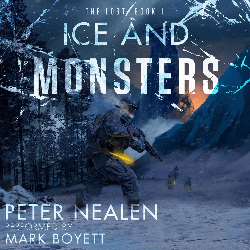
Review: Ice and Monsters

Ice and Monsters

When I saw that Peter Nealen was doing an entry in the same “Wargate” military isekai series as Forgotten Ruin, I knew I had to instantly get it. So I did instantly get Ice and Monsters. It has the same basic concept as Forgotten Ruin, only the deliberate expedition gives way to an inadvertent gate transport, as recon marines on an exercise near Norway find themselves in a Norse-themed horror fantasy world. It also has the same basic strengths-and weaknesses.

The strengths are that the action is good and the modern forces weaknesses and vulnerabilities are emphasized instead of their capabilities and advantages. The weaknesses involve not taking advantage of the potential for worldbuilding in favor of just an artificial swarm of trash mobs. What’s grated upon me after seeing it the second time is the nominal commander being a cross between a Gorman-style out-of-his-depth boss and a “we need to talk things out” nebbish. As the narrator even admits, you should have to see what local ties you can forge when severely outnumbered.

But nope, the captain is clearly duped by the Evil Magic Viking one-dimensional savages from the get-go, and all hints of moral ambiguity are tossed aside once the protagonists find a set of imprisoned “good guys”. How convenient! Yes, it’s a cheap thriller in what’s openly stated as an Adventure Friendly World. But a little more worldbuilding would go a long way.

Also there’s a personal stylistic nitpick, which is that Nealen clearly is comfortable writing in first person when I prefer his third person thrillers. But I kind of expected that. This is a decent cheap thriller but it still could have been better with just a bit more thought and finesse.

Review: Blue Masquerade

Blue Masquerade

T. K. Blackwood’s Blue Masquerade is a treat I knew I had to read. First, it’s one of those beasts that are as rare as left-handed baseball catchers or male calico cats-the conventional World War III novel that takes place as an alternate history after the Vietnam War. That its premise involves two of my personal tropes I wish got used more often made it even more appealing.

The first premise is that instead of the USSR backsliding after a successful August Coup or something like it, it reforms enough to avert such a thing. This happens here. Don’t expect to see MiG 1.42s or robot-turret supertanks here-it’s just the classic tanks and BTRs/BMPs. Still, it’s heartening to see this gimmick after wanting to for so long. The second is Yugoslavia, the tinderbox of Europe, being the catalyst for the war. This is a lot more plausible than some other World War III novels you may have heard about.

As for the substance of the book, I would call it a “51% World War III big war thriller”. It gets enough of the basics right and never comes across as truly “bad” in any way. That being said, I have seen everything it does being done better in other books. However, I’ll adjust for context, since this subgenre is extremely hard to do well. In that case, a 51% book is quite the accomplishment, like a baseball pitcher having a positive win-loss record while playing for an otherwise bad team.

If you like alternate history, conventional World War IIIs, or both, check this out. For another opinion, see Alexander Wallace at Sea Lion Press.

Review: Building The Tatmadaw

Building The Tatmadaw

Likely because it’s lacked the direct confrontation with a major western power that North Korea or Middle Eastern states have had, Myanmar is one of the more forgotten and undercovered of the militarized pariah states. That military dictatorships are not exactly known for their openness and transparency doesn’t help things. Thankfully, Maung Auyng Myoe has risen to the challenge with Building The Tatmadaw.

The often murky and convoluted history of the military, as well as the brutal but often underreported internal wars, is shown in depth. As is the Tatmadaw’s force structure and conventional paper doctrine. For the former, it follows (at least as of the writing of the book) a common in Southeast Asia pattern of having “regional forces” tied to a certain area and mobile reaction forces (known here as “light infantry divisions”) that can travel where needed. Regarding the latter, Myoe’s description comes across as basically a Light OPFOR right out of Central Casting. The picture is that of an infantry-heavy force where advanced and heavy equipment is present but not dominant, and where the strategy against an external opponent consists of fortifications and irregular tactics to counter the material disadvantage.

Published in 2009, this is bound to be outdated, especially given the massive tumult that has happened since then (the “thaw”, the anti-Rohingya campaign, and the military re-takeover). But as always, that’s not the author’s fault. I did notice a few slip-ups and a bit of clunkiness when talking about specific military issues, but none of those are very big or bad. If you want to learn about the Tatmadaw, this book is an excellent resource.

Review: The Day After Tomorrow

The Day After Tomorrow

Allan Folsom’s debut novel, The Day After Tomorrow (no relation to the 2000s movie) is-something. It’s definitely one of the best worst novels I’ve read recently. The prose is as blocky as it is purple (including, yes, the love scenes), and most importantly, much of the book is just people traveling. It’s supposed to be an unwinding conspiracy thriller…

…But it has an anti-Goldilocks effect. It’s too unrealistic and bombastic to be a cloak-and-dagger story, too dull and clumsily written to be an action novel, too narrow in scope to be a pop epic, and too shallow to be a character novel. And then there’s the big twist.

See, this book is basically a novelization of They Saved Hitler’s Brain, down to his actual head playing a role in the plot (although this one is not yet alive). It boils down to using convoluted superscience to clone/revive Hitler, for….. uh….. Anyway, the biggest part of the plot is foiled by someone other than the doctor and detective who serve as the protagonists, leaving a reasonable assumption of “what’s the point”?

Well, the point is that I learned of this book from a bad review. And while I don’t recommend it to anyone “normal”, I had a blast reading it.

Review: A Pius Legacy

A Pius Legacy

If A Pius Man was weird, this is weirder. With the pope kidnapped and put on trial, a “thriller” ensues. This book suffers from a research failure comparable to that of a “Clive Cussler’s” novel where a random Brazilian spoke Spanish. Only that was a one-off not really central to the plot, and this concerns the main element. It has The Hague listed as being in Belgium. Repeatedly.

The same weird thriller elements continue in this installment. The political defenses of Catholicism turn into everything short of digging up the corpse of John XXIII for Cadaver Synod 2, Traditionalist Boogaloo. There are subplots reminding me of Lunnon-Wood’s Dark Rose where seemingly everyone both armed and Catholic turns into defenders of the Vatican.

This is a very quirky book. But I like quirky.

Review: Invasion Chronicles

Invasion: Chronicles

DC Alden’s “epic” ends with less than a bang in the last two installments, gathered with the previously reviewed two in the Chronicles omnibus. The politics do take an interesting turn, and that’s that the Evil Continental Caliphate is actually too feminist. It has women in its military in exactly the same places as its opponents (including such non-nurse/clerk roles as AWACS radar operator and explosives technician). And of course the evil collaborator ex-lawyer turned butcher governor (and not a figurehead one either) is a British woman. This all felt deliberate on the author’s part. It wasn’t a redeeming quality or the act of adapting something else. It made “sense” given how more of the vitriol was aimed at the “traitorious British” than the actual invaders, but adds to the creepiness of the books.

The last two entries, Frontline and Deliverance, have all the same issues of their predecessors. The camera is either jumping around various viewpoints or focusing on big arcs involving unsympathetic characters. Having to combine these together leads to plot contrivances clearly designed to make them tied when they shouldn’t have been. Sending a super-secret stealth aircraft to rescue several AWOL squaddies on an ill-conceived raid into Birmingham is the biggest example of this.

The conclusive battle involves a clumsy attempt at Fortress London that’s designed to try to fit a square peg into a round hole. Having to tie the high and low level parts together means it couldn’t just focus on individual danger, and having the previous war be so one-sided means a broad-scope view doesn’t work. There’s more contrived, artificial drama and a very strange series ending that’s at best a sappy dream sequence and at worst implying that the whole thing was just a nightmare (that would explain the military inaccuracies at least…)

So yes, having read this entire series, I can say that it deserves the infamy and scorn it’s gotten. Even accepting its premise as an invasion novel with all the inherent baggage, this could have been executed a lot better. As it stands, it was not.

A Thousand Words: Tucker The Man And His Dream

Tucker: The Man And His Dream

Imagine a movie that depicted the infamous Juicero in a romantic and fluffy way. Why, its founders were plucky little upstarts who wanted to save the world and make a buck but they got ground down by the evil monolithic force of Big Juice Squeezer. You know, instead of being an obviously doomed-from-the-start project.

Replace “juice squeezers” with “cars” and you have the big problem with Francis Ford Coppola’s Tucker: The Man And His Dream. A biopic about entrepreneur Preston Tucker and his attempt to start a car company, the actual movie is well-acted and well-made. Its just that it romanticizes an inevitable failure.

Henry Kaiser’s car company with far more resources only succeeded in the gargantuan seller’s market that was the immediate postwar period (when there was a ridiculous amount of pent-up demand). Then it became the second of four Jeep Zombies. And Kaiser knew a thing or two about supply chains, which let him take advantage of that boom. Meanwhile, Tucker’s project would have rammed right into a righted market and the Korean War-if it made it that far. It was less that suppliers and financiers were crushed by the Evil Establishment and more that they were rightfully reluctant to work with such a ramshackle operation.

No one said historical films had to be 100% accurate. But the message here is so whiny and maudlin, and Tucker’s saga so misinterpreted that it squanders the production. The Tucker Tiger, a would-be scout car in World War II, is mentioned as being rejected because “gosh, it was too fast”. The reality was that it had absolutely no off-road capability, a rather serious problem with a scout car.

Preston Tucker was not a martyr, and the film tries to make him one. The walls and furniture of this movie are good, but they can’t make up for a talc foundation.

Review: The Years of Rice And Salt

The Years of Rice and Salt

Kim Stanley Robinson’s The Years of Rice And Salt is probably the most highbrow and audacious work of alternate history printed by a mainstream publisher and aimed at a wide audience. A sweeping magical realist epic, this starts with the question “what if there was no Europe?”

To achieve this, Robinson uses a plot disease to wipe out Europe’s population in the Middle Ages while leaving the rest of the world mostly unscathed. It’s basically the literary, sophisticated version of The Seventh Carrier’s haywire satellites knocking out every jet and rocket engine. While there are many contrivances and valid criticisms, it’s clear what the author is trying to do. Alternate history by English-speaking authors can understandably be kind of Eurocentric, something which he takes a chainsaw to with his divergence. Robinson tries to be different.

And he succeeds, going from character to character in a millennia-long saga, with excellent prose and a great sense of wonder. It manages to achieve the not-easy feat of being both broad and human at the same time. The writing style and structure helps a lot in this regard.

Unfortunately, even something as distinct as Rice and Salt can still fall victim to a common issue with alternate history: Getting worse as one gets farther away from the point of divergence. The last part of the book has both clunky historical parallels (like a giant decades-long World War I static conflict) and political soapboxing ramped up. But even this can’t harm the book too much.

Alternate history fans should read Rice and Salt. It’s a rare anomaly in an otherwise constricted genre.

Review: Invasion Uprising

Invasion: Uprising

DC Alden’s Invasion: Uprising follows the Anglo-American counterattack into occupied England, and manages to be (even?) worse than its predecessor in all that matters. The only real highlights are some middling amounts of mediocre cloak-and-dagger stuff and a few C-list infantry firefights, neither which can make up for the collapse elsewhere.

First, the big battles come across as something that could have been written by post-Sum of All Fears Tom Clancy. They involve Americans with supertech handily crushing their hapless opponents. Needless to say, they’re not very good. The weird and slapdash enemy arsenal is still there, as is the politics.

Criticizing an invasion novel for its politics is kind of like criticizing a professional wrestling match for its melodrama. But I feel obligated to note that the book seems to direct less of its anger towards the invaders themselves and more towards the British who enabled and allied with them, in a message that is not exactly subtle. From a series that started off iffily, this book has the “achievement” of sinking lower.