Review: The Chosen One

The Chosen One

Walt Gragg’s The Red Line was one of the first books I reviewed on Fuldapocalypse-and how could I not, with it being a Russo-American World War III, the kind that was supposed to be the blog’s bread and butter? Now his second book, The Chosen One, is out. And I felt I had to review it.

So, an Algerian man somehow becomes recognized as the “Madhi”, gets a huge army, is able to unify most of the Middle East, equip said huge army, and launch a conventional World War III. It doesn’t take place in the Fulda Gap, but the book does have all the hallmarks of the “big-war thriller” that I had in mind when starting the blog.

It has tons of viewpoint characters from top to bottom, lots of battles, a focus on air, land, and sea (via a cruise missile strike on the American fleet), and the general tropes of the subgenre. So I can say I feel very comfortable in declaring this a World War III book.

A lot of the big-picture stuff doesn’t make much sense (even in a spherical cow lines on a map way), which I’d be more forgiving of if it wasn’t brought up repeatedly in conference room exposition scenes. It’s not quite at the level of The Red Line’s convoluted way to turn the clock back to the 1980s, but it’s still there in force.

There are a few too many viewpoint characters for the book’s own good, they’re not exactly the least stereotypical, and they make the pacing jumbled (the kind of thing I sadly expected). Part of this is a cutaway to the antagonist’s stereotypical childhood. I’ll just say that A: I was reminded of Life Of Brian, and B: you shouldn’t be reminded of Life of Brian in what’s supposed to be a serious story.

As for the actual action, it’s strange. The prose descriptions are ridiculously melodramatic (not that that’s necessarily a bad thing, but still, given the tone, it clashes), but it also has more than its share of dry weapon over-description as well. There’s also anachronisms with the weapon names (which isn’t so bad if you don’t mind every enemy tank being an “M60” or “T-72”) and tactics (which is understandable but still a little out of date to see carrier aircraft flying at low altitude and having trouble hitting hardened shelters).

It’s not the absolute worst, but it’s still not what it could have been. The conclusion is also a stumbling point, which has a firefight inside an Egyptian pyramid (Ok?) that’s taken seriously and focused on while a big tank battle occurs elsewhere and is only mentioned in passing (not ok), and ends with a really, really blatant sequel hook.

This is a sort of oddball novelty-it has the roughness and er, “quirkiness” of some of the more uneven independent “big-war thrillers”, yet it’s a mainstream publication. And regrettably, its fundamentals just aren’t good enough to be more than an oddball novelty.

A Thousand Words: Iron Eagle

Iron Eagle

Time for a nostalgia piece from my past. I watched Iron Eagle a lot on DVD when I was younger. It is an amazingly stupid and stupidly amazing action aviation movie that is incredibly 1980s.

So, a fighter pilot is shot down over “Libya” and his son, with the aid of a fellow pilot, “acquires” a pair of F-16s to rescue him, causing a massive number of explosions in the process. Because the actual US Air Force was not exactly keen on sponsoring a movie where kids can steal F-16s, the filming was in Israel, with Kfirs playing the role of “MiG-23s.”

The movie’s gotten a lot of understandable comparisons to Top Gun which I think are off-base, and not just because Iron Eagle was actually released before it. Top Gun is a very “Tom Clancy” movie, an idealized story that still has a fig leaf of grounding. Iron Eagle is a very “Mack Maloney” movie, something that just goes “Prepare film for ludicrous speed” and never looks back.

So yeah, there’s a lot of explosions, an F-16 that never runs out of ammunition, an F-16 that lands on a convenient runway in the film’s climax, a water treatment plant that stands in for an oil refinery, the politics you’d expect from an 80s action film, buildings exploding after getting hit with individual Vulcan rounds, a convenient in-universe excuse to play the (excellent) soundtrack at every opportunity, and so much more.

There’s a reason why I watched it so much, and it’s not because the acting was Oscar-worthy. This movie is classic ridiculous 80s fun.

Review: Operation Zhukov

Operation Zhukov

It’s been a while. But John Agnew’s Operation Zhukov has brought me back. Back to the time when I started Fuldapocalypse.

So in an alternate 1992 with the USSR still going, the just-reunified Germany clashes with Poland, and it expands into a (conventional) Fuldapocalypse. And yes, there is a reference to the Fulda Gap, although most of the action follows British units farther north.

And this brought a weird feeling to me, a feeling of strange comfort and nostalgia. This is a book of constant clunky jumping around between paper-thin Steel Panthers Characters who exist purely to operate military equipment. This is a book of conference room and makeshift conference room infodumps. This is a book of clashes too grounded and technically “realistic” to be over the top fun but too detailed to be genuinely realistic (what fog of war?).

Because of all that, it’s a callback to the day where I was expecting to review books in a spectrum so narrow that I’d highlight the (in)accuracy of tank unit TO&Es to see how the book differed from the others in the pack. Here, I can say that it has more accurate T-80s in the GSFG arsenal and not the more commonly used but technically inaccurate T-72s. A similar pattern exists throughout the entire book-while there’s undeniably some issues somewhere in the “there’s this many roadwheels on this type of tank” type of description, I didn’t see any big red flags (no pun intended).

I would probably have been frustrated with this book had I read it some time ago. Now, knowing that there are many individual authors who’ve written more books than the entirety of the “Conventional World War III” genre, I feel strangely nostalgic.

This kind of book isn’t crowding out any genre and isn’t setting any bad trends. This specific book isn’t badly made for what it is, not having any truly massive errors or truly gigantic bloat. Yes, I consider it a little flat, but “flat” isn’t the worst thing a book can be. Operation Zhukov can be summed up as the World War III version of Marine Force One, a “51% book” that fits its (in this case, narrow) genre with the most basic competence but doesn’t go above or beyond it.

Review: Enemy Unidentified

Enemy Unidentified

enemyunidentifiedcover

The third book in the Brannigan’s Blackhearts series, Enemy Unidentified takes it in a different direction. See, there’s a (then) unidentified group that has carried out one of the bloodiest terror attacks ever, and the right people to take out the perpetrators on an oil platform in the Gulf of Mexico are- John Brannigan and company. How surprising!

Now the book itself is typical action-adventure. I could sum up the basic plot with one sentence as always, that sentence being “The Blackhearts storm an oil rig.” But it’s very well done, and contains one of the best cliffhangers I’ve read. Yet this falls into the problem of stuff like this being hard to describe, even in good terms. What I find more interesting is the direction the series took, and how I felt about it.

Starting here, the books became somewhat more serialized. When I first read them, my feeling was disappointment, especially after the high of Burmese Crossfire. Now, especially having actually written an action-adventure book, I feel differently. The concept of a big-picture series has grown on me. If it can keep the author motivated, it makes the stories better than just somewhat interchangeable “51%” potboilers.

Review: Seven Days In May

Seven Days In May

Fletcher Knebel and Charles Bailey’s “foil the American coup attempt” novel Seven Days in May is one of those interesting books. I’d liken it to seeing the original Street Fighter, Wolfenstein 3D, Command And Conquer, or any early, genre-defining video game.

On one hand, it’s clear to see how much of a foundation it set for countless “Nation In Crisis” thrillers to follow.  One the other, well, even after accepting that this is the kind of book that isn’t centered around explosions, it’s still too dry for my tastes.

It’s almost exactly like seeing an old fighting game, realizing what it laid out for the genre-and then finding that in actual gameplay, it’s a clunkfest where a special attack is almost impossible, but if you can pull it off, it’s an instant match-winner. The prose is stuffy even by the standards of the time, and even by the standards of nonviolent political novels, I’ve seen better-written suspense elsewhere. But at the same time, I’d think it would come across as far fresher if actually read at the time it was originally published, and can appreciate it for its historical value if nothing else.

Review: Lions of the Sky

Lions of the Sky

lionscover

The F/A-18 centric Lions of the Sky is naval aviator Paco Chierici’s first novel.

If I was to make a comparison, I’d say it’s like a modern version of Sweetwater Gunslinger 201 with a few more technothriller elements thrown in. Or, to use a less obscure pop culture reference, a modern version of Top Gun in print form with somewhat higher stakes.

I’m willing to forgive a lot of the roughness in a first novel, especially if I ultimately still found it enjoyable (which I did). Yet I feel obligated to point out that it is indeed there. The problem is that the sum of the parts seem like more than the whole. In particular, the entire “Spratly Islands Technothriller Plot” that winds in and out through the book is the least interesting part of it. What went through my mind as I read every section involving it was “it didn’t need to be like this. To set up the final action set piece, there doesn’t need to be a stakes-raising gimmick like what happens here.”

Beyond that, it doesn’t flow the best. There’s no real exact way to describe it and it’s clearly just the rough edges every first novel has, but the slightly clunky pacing is still apparent.

When the actual aircraft action scenes occur, they’re well written. Many of the on-the-ground relationship scenes are also well written. There’s definite talent here, and I hope, if/when Chierici completes any more books, he plays to his strengths and makes it a little more coherent in one direction or another. Lions of the Sky itself isn’t bad by any means, but it still feels like just a decent orange dish that has a few apple slices awkwardly stuffed in.

Review: The Eighth Trumpet

The Eighth Trumpet

Kimberlain_Jared1

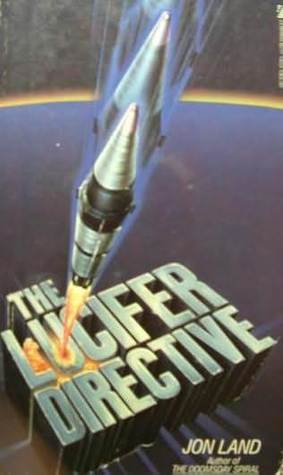
Fresh off the first Blaine McCrackens, Jon Land introduced fellow super-agent Jared Kimberlain for a similar absolutely bonkers thriller. The Eighth Trumpet not only has offbeat fight scenes, it also has a plot centered around an, uh-Jerry Ahern-ian grasp of geography. By this point the formula has solidified, especially with the Hulking Strong Sidekick Protagonist who fights the dedicated Hulking Strong Antagonist hand to hand during the climax.

That being said, it manages to out-McCracken even some of Land’s other books with how ridiculous-and fun- some of the set pieces are. It’s not that much different “plot”-wise from many of Land’s other books (at least to someone like me who has actually read a ton of them), but it definitely has a huge spark of “WOAH!” in it, making it very worthwhile.

Review: Shadow Tyrants

Shadow Tyrants

shadowtyrantscover

Deciding to try my luck with grocery store novels, I grabbed Shadow Tyrants, a “Clive Cussler’s” book written with Boyd Morrison. It was an Oregon Files novel, and it followed my rule of “go for the most out-there premise.” This had infighting amongst an ancient conspiracy, with only the Oregon and Juan Cabrillo able to stop them. What could go wrong?

The biggest problem is the prose. It’s not unread-ably bad, but still comes across as kind of simple and bland. Thus a premise that could have supported a delightfully goofy adventure ends up being hobbled and coming across as a 51% technothriller. (Although the super-conspiracy is still better and more capable than Casca’s Brotherhood ever was-those guys are the St. Louis Browns of super-conspiracies). There’s headline namedrops and clear “I know the name but not much else” descriptions of weapons systems.

There’s a lot of contrived deus ex machinas in close proximity to each other. I’d be more forgiving if the prose had cushioned it, but it instead amplified them. For instance, what could have been a excellent naval battle (the best use of the Oregon) ends up being just a disappointing clash of the technothriller gimmicks.

Worse, the “historical tie-in” seems even more forcefully shoved in. It’s not like the superweapons had an ancient component. It’s just that these ancient scrolls led to the super-conspiracy, and we get a shoved-in epilogue to remind us that Cussler books are supposed to feature grand adventures with historical artifacts, not just be middling technothrillers piggybacking on his reputation. Unfortunately, that ship sailed decades ago.

This is still a good enough “51% technothriller”, and it’s still more engaging and fun than just a rote “shoot the terrorist” thriller novel. But it, much like a lot of the other Oregon books, doesn’t live up to its potential.

Review: Advance To Contact

Advance To Contact

advancetocontactcover

In the early stages of Fuldapocalypse, I reviewed Andy Farman’s Stand To, a World War III tale. Or rather, a sleazy spy tale that became a World War III tale that involved everything I thought I’d be seeing en masse on Fuldapocalypse, and then some. Lots of descriptions. Lots of viewpoint characters. Lots of meticulously described battles.

Now I’m in one of those full circle moods. I still had the remaining books in the series left unread, so I decided to return to that mostly untapped World War III vein and read the second Armageddon’s Song book, Advance to Contact.

Farman has had decades of legitimate expertise as a soldier and police officer, and indeed the infantry fighting scenes in this book sometimes actually work. The key word here is “sometimes”. Often they blur together (since the characters are so forgettable and interchangeable). Often Farman fills it with infodumps on the exact levels of equipment and/or author lectures on whatever topic is technically relevant. Often the viewpoints are yanked away and yanked back. Often they’re overdescribed to the point where it loses its focus. Still, I should give legitimate credit where credit is due. There’s one scene with doomed Belarusian soldiers where he actually writes well, doesn’t get too infodumpy, and keeps the ‘camera’ focused on them instead of jumping a continent away after a few paragraphs.

Another instance of deserved credit is that the plotting and pacing is a little better than in Stand To. The war is underway, so the goofy spy plot is less prominent and the viewpoint jumping merely at the level of “exaggerated technothriller” rather than the wrenching shifts of Stand To.

That being said, it still has most of the problems mentioned over a year ago in the review of Stand To. The times when details are gotten wrong (given the ridiculous amount of description) are annoying. Farman doesn’t focus on where he’s most skilled and comfortable but instead gives giant air/sea battles. There are bizarre events like B-2s being used as tankers and Tu-160s as special forces insertion craft. The dialogue for anyone not in the military is frequently awkward. And the pacing is just glacially slow.

Still, like with the first book, I couldn’t feel mad about this and frequently felt amused. This is an earnest series by a first-time fiction writer. It’s just that what could have been at least a rival to Chieftains with some more focus turned into this clunked-together technothriller kitchen sink.

Snippet Reviews: October 2019

The Press Gang

Kenneth Bulmer (as “Adam Hardy”) wrote the Fox series of age-of-sail adventures in the 1970s. The Press Gang is marked as being the second in the series in the modern Kindle format, but it was the first actually printed (chronological vs. publication order?).

In any case, the tale of George Abercrombie Fox is not the best one to ride across the waves. Bulmer’s prose, which I recognized from the Dray Prescot books, isn’t the best, and the setup is this weird hybrid of cheap thriller and Herman Melville “this is what an age of sail ship is like”.

The Enigma Strain

Nick Thacker’s first book in the Harvey Bennett series of thrillers, The Enigma Strain is a solid thriller, if a 51% one. The book features the titular park ranger and a CDC scientist as they fight to stop a plot that involves an ancient, exotic disease and multiple nuclear bombs.

On one hand, it’s in the awkward uncanny valley that plagues a lot of cheap thrillers. It’s clearly too ridiculous to be realistic, but it’s not bombastic enough to be the gonzo silly thriller that it deserves to be. On the other, it’s still competent enough to be a passable, fun reading experience, and that’s what cheap thrillers are supposed to be.