Review: Eye Of The Storm

Eye Of The Storm

eyeofthestorm

The first book in the “Black Eagle Force” series by Ken Farmer and Buck Steinke, Eye Of The Storm is a delightfully cheesy exercise in Mack Maloney-style military melodrama.

Starting a Super Secret Task Force With Super Tech and Super Planes, the men, women, and high-tech aircraft of Black Eagle Force battle a Mexican billionaire whose last name is an obscenity in Spanish (uh…) and who has a private island with a pyramid-lair and a gigantic arsenal of soldiers and military equipment (ok…).

I was impressed. Oh, it’s not the best ever. Even beyond its cheesiness, cliche-ness, and dubious character names, it’s about a hundred pages too long. But its downsides are thankfully much fewer than its upsides. I just really like Mack Maloney-esque “over the top but not really science fiction” military action, and when the action happens, it happens well.

The nature of the story means any “errors” or “contrivances” are easily forgiven. The BEF gets opponents of an appropriately challenging nature-no small feat. It has just the right amount of threat and “look at ’em go.” This is an excellent “popcorn book” and one I was overjoyed to uncover.

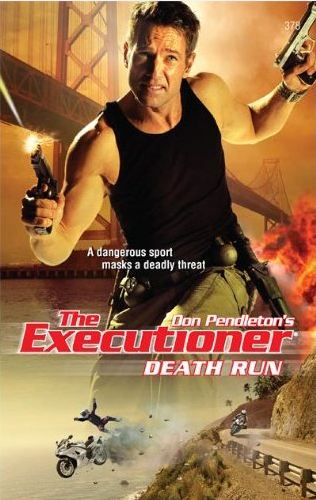
Review: Death Run

Death Run

deathrrun

It was inevitable that my run of at-least “decent enough” later Mack Bolans would come to an end at some point.

The blurb was promising enough. To stop a nuke, Mack Bolan gets caught up in the world of motorcycle racing. It felt like the kind of zombie sorceress plot I enjoy, and I was wondering “So, how are these going to connect?” It reminded me of one of those missions in Grand Theft Auto games everyone hates where the boss-of-the-week forces you into this linear, nonsensical set-piece with dubious mechanics where a more direct approach is seemingly better. Something like:

“Ok, Claude/Tommy/CJ/Niko/Michael/Franklin/Trevor, the nuke is in a shack with only three guards. Last mission you killed thirty armed people, but you can’t just grab your minigun and storm the shack. No, you first have to win a motorcycle race against computer opponents who do everything but throw blue shells at you. What, that’s unfair? Well, we could have put trains in! Be lucky we didn’t do that!”

The actual book is not nearly as amusing as that hypothetical thought. The motorcycle racing plot is mostly just A: A way to set up the various Macguffins, and B: A way for the author to talk about motorcycles and motocross. Cue some of the most generic, third-rate action possible to defeat some of the most generic “evil terrorists” possible, and conclude with one of the most stereotypical “defuse the bomb” scenes.

It’s kind of a little hard to even criticize because of how shallow and generic it seems. But yeah, in short it’s shallow, generic, and the motorcycle racing plot isn’t taken advantage of in an amusing way.


Review: Hunter-Killer

Hunter-Killer

hkcover

Before I start my review of Hunter-Killer (or its original title, Firing Point), the submarine thriller novel about the rogue commander of the Russian Northern Fleet and the American submarine out to stop him, I must mention that I have not seen the movie adaptation. What I’ve heard about said adaptation from other people ranges from “bad, but in an amusing way” to “bad, and not in an amusing way.” But I wouldn’t know any better.

So, for the book itself, what I got was something that was neither bad (amusing or not) nor really all that good. It was a sort of middle-of-the-road technothriller (this is not an insult) that was too bulky for its own good (there’s a big plotline barely related to the submarine stuff about Russian mobsters manipulating the stock market that only exists as a form of additional ‘crisis overload’) but still managed to avoid the clunkiness of say, a later Tom Clancy book.

The submarine action itself? Passable. The SEAL action? Passable. The characters? Ehh, a little less than passable. The book was published in 2012, but feels incredibly 1990s in its depiction of Russia, some of its technology, and its overall tone. That’s one of the few really interesting things about it, and it wouldn’t surprise me if it turned out that some of the drafts were written in that decade. Other than that, Hunter Killer/Firing Point is just a humdrum popcorn technothriller that unfortunately embraces length for length’s own sake. There’s a lot worse out there, but there’s also a lot better.

Review: Northern Fury H-Hour

Northern Fury H-Hour

(note: I received a review copy).

When I first got into Command: Modern Air/Naval Operations, I noticed a scenario set called Northern Fury, describing a third world war with a surviving USSR in the early 1990s. One of the first scenarios I played was one of the smaller ones there, called “A Cold And Lonely Place.”

Since then, I’ve been following the scenario set, and was delighted to hear that the novel had been announced. Having gotten a review copy and been cleared to post, I can say that H-Hour, the first book in the Northern Fury series, works well and dodges a lot of the pitfalls it could have fallen into. The August Coup has succeeded and the Third World War is not far off, with this story focusing not on Central Europe but in other theaters, particularly Norway and its waters.

First, it needs to be said: This book wears its technothriller heritage and inspiration on its sleeve, for better or worse. It has many of the prime technothriller elements in it. That being said, it handles them well, and in particular manages to escape-and escape completely- two pits that fiction like it tends to fall into.

The first is that it does not feel like just a rote let’s play/after action report of Command. Without giving too much away, focusing a lot on land makes it seem better, deeper, and out of the sim’s comfort zone, so to speak.

The second is more impressive and more important. Northern Fury manages to avoid what I call “Steel Panthers Characterization.” Named after how in the computer wargame “Steel Panthers”, units will have a rank and surname in the language of their nationality, Steel Panthers Characterization is when Character Name X controlling Military Weapon Y will appear in scene Z, with no characterization save for maybe a thrown-in national or rank stereotype. They will appear, operate the necessary piece of military equipment, and often die in the process. Then another flat character will appear.

In Northern Fury, this doesn’t happen. While there is a lot of viewpoint hopping, all the characters and their arcs have meat on their bones. This was an impressive feat that did a lot to raise my opinion of the book.

So, to briefly conclude, Northern Fury: H-Hour is both an excellent example of how a simulation can be used in the creation of a novel (like the original Harpoon tabletop version was for Red Storm Rising) and a very good throwback to the technothriller/WWIII fiction of days past.

Northern Fury: H-Hour releases on May 6. Its official website is here

Review: SEAL Team Seven

SEAL Team Seven

st7 coverjpg

This book about a certain amphibious special forces unit is quite possibly one of the best 1990s military/techno-thrillers I’ve read. It spawned a huge series, and I can see why. SEAL Team Seven is very, very good.

The book tells the story of Lt. Blake Murdock, the son of a powerful political family (while present, the clunky politics in this book aren’t too bad) and his titular team as they’re called to action in a big crisis. Because this is a 90s thriller, the antagonists are a zombie sorceress-assisted mix of renegade Japanese and renegade Iranians who’ve taken control of a freighter loaded with plutonium. SEAL Team Seven has good fundamentals and manages to have its cake and eat it too.

It starts with a well-written battle in post-Desert Storm Iraq. Then the opening act introduces and humanizes the characters. When the main conflict starts, the action is highly well done and manages, for the most part, just the right mixture of “grounded” and “fantastical”.

SEAL Team Seven isn’t literary fiction or anything like that, it’s still ultimately just a cheap thriller that has a lot of cheap thriller components and cliches. But it’s an excellent cheap thriller.

Review: Casca The Eternal Mercenary

Casca 1: The Eternal Mercenary

Casca The Eternal Mercenary

So the Casca series is a little off the Fuldapocalyptic beaten track for me. But really, I of all people couldn’t resist a series written by Barry Sadler of ‘Ballad of the Green Beret’ fame with the premise of “The Roman soldier that stabbed Jesus with the spear is fated to be a soldier/warrior forever”, fusing the Longinus and Wandering Jew mythologies. That part brings a very different song to my mind.

The first book opens in Vietnam where the main character heals ridiculously fast from a seemingly fatal head wound, and one “hypnotic narrative” later, returns to nearly two thousand years in the past. After the event, he gets in a fight with his “sergeant” over a girl and ends up with a deep wound… …which heals, because in practice, he turns into essentially Marvel’s Wolverine without claws. Cue a long stretch of time where he fights throughout dynasties of Roman history, then a final scene in the then-present where Casca/Casey has escaped from his Vietnam hospital-and is fighting in the Arab-Israeli wars.

This is very much a pop-historical “sword and sandal epic” rather than trying for any serious attempt at realism, and is all the better for it. Casca becomes a slave, he becomes a gladiator, and he enjoys a bit of peace before returning to his horror.

One of the low points of the book is its cultural er- insensitivity. While an action novel in the 70s is not going to top anyone’s “most progressive” list, this has a few moments that made me raise eyebrows. The walking stereotype Chinese martial arts master (yes, in ancient Rome, it’s a long story) who teaches Casca I was more bemused by than anything else. I went ‘uhh….’ at both the vicious savage African gladiator whose victims included (of course) a young blonde woman and the man whose marriage improved after he started hitting his wife.

But even the worst I found tolerable, because it only felt offensive and not offensive and creepy. This is, after all, a 70s action novel. And what it does well, it does very well. The Eternal Mercenary can make its action dramatic even with an immortal protagonist, and that’s no small feat.

Casca: The Eternal Mercenary is lightweight sleaze, but it’s good lightweight sleaze.


Review: The Saudi-Iranian War

The Saudi-Iranian War

saudiiranianwar

As my first Command LIVE scenario was a conflict between Iran and Saudi Arabia, when I saw Ted Halstead’s The Saudi-Iranian War, I knew I had to check it out. I was sadly disappointed.

The Saudi-Iranian War is a technothriller through and through. Not only does it depict a military conflict with jumping viewpoints at all levels, but it does so through the lens of technological spectacle. It reads like a cargo-culted classic technothriller that manages to have even less of a human element than the stereotype would predict.

Halstead takes us on an all-tution paid semester in Rivets 205 at tem wur cool leg. The book just starts with character after character after character saying what they’re going to be doing, along with such important DEEP HISTORY details as the horsepower of a jeep’s engine. It’s the worst kind of knowledge-detail, the kind that goes “I know [or looked up] the exact designation of a Scud TEL, so I’ll write it out”, rather than leveraging any of it into making an actually better story.

The early part of this is rote description, metaphorical conference room scenes, and literal conference room scenes. It’s about as exciting as it sounds.

Halfway into the book, the “action” finally starts. If, by action one means “there’s descriptions of tanks, followed by descriptions of tanks firing, with a description of the exact shell [ie, M829A2] the tank fired.” Not only are the large battles treated purely as deterministic clashes of military hardware, but they’re also dull to the point where I’ve read more melodramatic Let’s Plays/AARs of various wargames. The smaller scale “cloak and dagger” stuff is also not ideal, but even it’s still better than the big battles.

Perhaps the most disappointing part is the setup. Iran hopes to defeat Saudi Arabia via a series of technothriller set pieces. Everything just feels like it’s one isolated, stilted technothriller set piece after another instead of anything that seems like it’s genuinely flowing. The tanks are a technothriller set piece. The aircraft are a technothriller set piece. The WMDs are a technothriller set piece. Not helping matters for a story so centered around military equipment is said equipment being a mix of “The Wikipedia page for Saudi and Iranian equipment”, plus a few shoved-in ‘exotics’ like T-14 Armatas and J-20s.

I’d recommend something like Raven One for a modern technothriller where an Iran with an expanded arsenal is the opponent. The Saudi-Iranian War just feels like a rote, box-checking IKEA Technothriller that has far more of the genre’s bad parts than its good ones.


Review: Terror Descending

Terror Descending

terrordescending

When I browsed the Stony Man Executioner spinoffs on mackbolan.com , I followed one of my personal rules-when in doubt, go for the most ridiculous. Upon seeing the ridiculous commentary about Terror Descending, I went “go for it” and got it.

A 1960s relic left-wing terror group is using B-52s disguised as 707s to hit targets around the world with the aid of Cray supercomputer-launched cyberwarfare, and the Stony Man Farm team must stop them. This zombie sorceress-licious premise made me get the book. One reviewer compared it to a Mack Maloney book-this especially made me want to get it.

Terror Descending has the problem of “going into big technical detail and getting it wrong” with a vengeance. “F-17 Eagles”, F-22s staging from aircraft carriers, B-52s being “common” with thousands built, B-52s being disguisable as 707s, “Chinese-made Stingers”, and “MiG-8” fighters. And that’s without the “interesting” aircraft procurement this world has made (Austria uses F-14s). Oh, and despite the book being released in 2009, “Yugoslavia” still exists. This would have been more of a problem if I had the slightest expectation of genuine realism out of this book. Fortunately, I did not. The Mack Maloney comparison is very apt indeed.

Terror Descending, like the previous Gold Eagle Bolan Season of Slaughter, is rather overstuffed. There’s everything from skinhead gangs to airstrikes to a dogfight over Chad to every single flashpoint in the world from the Aegean to the Korean DMZ flaring up to South American prisons. And that’s just the villains. Having to use both Able Team and Phoenix Force as the heroes doesn’t help matters. While workable, the action isn’t good enough to really compensate for all of these flaws.

Still, I’d rather have “fun/crazy bad” than “dull bad”, and Terror Descending is definitely the former.

Review: Technokill

Technokill

The novel Technokill is easily the worst Starfist novel I’ve personally read. Back a few Thanksgivings ago, I had to pass the time and chose this book, which had been sitting unread on my shelf until then. Welp.

Who and What

This is the story of MARINES, bird-aliens, and criminals selling forbidden weapons to the bird-aliens. It’s long. It’s dull. It has weaving, tangled subplots. It has descriptions of twisted fetishes of various characters that feel like they’re as long as the few “battles”.

DEEP HISTORY OF TEM

This isn’t that much worse than the rest of Starfist, at least.

Zombie Sorceresses

At least nothing beyond the normal Starfist MARINES in Space Vietnam with a few gadgets contrivances.

Tank Booms

Ok, so at the height of this book, the MARINES face the challenge of (hold on to your seat belts) bird-aliens with these. And not some futuristic equivalent, the description is very close to the actual takedown .22 survival rifle. Even the (literal) tank army in Steel Gauntlet was better and more intimidating. The battle isn’t even that well-written and has no gimmick to make it better than it would seem. Then there’s an afterthought (literal) spacesuit commando scene that’s equally underwhelming, even by the series’ standards.

The Only Score That Really Matters

This is the low point of the Starfist series for me. It’s mostly just dull, and not in a good way. The low-powered opponent is only slightly amusing and doesn’t make up for the bad fundamentals.


Review: Cody’s Army

Cody’s Army

Earlier on this blog, I reviewed a later Cody’s Army book, DC Firestrike. Now I got the chance to read the first installment.

Who and What

Cody’s Army tells the story of former CIA super-agent John Cody, who mutinies after one dirty job too many , only to be roped back into the “game” and teamed up with Texan “Hawkeye” Hawkins, Brit Richard Caine, and pilot Rufe Murphy to create a top-secret 80s action super-team. Their first mission-save hostages on a plane that’s been taken to Lebanon.

It’s mostly the 80s action stuff known well (perhaps fitting, the characters are ‘B-List’ versions of creator Stephen Mertz’s other big hit, the MIA Hunter novels), although I had to smile a bit at the series title-an “Army” of only four people. This reminded me of the World War II joke about how the “[single digit number] Tank Army” was called that because it had only [a single digit number] of tanks in it”.

DEEP HISTORY OF TEM

Regrettably, I could see the trend here (and it’s a trend that by and large did not exist in the first wave of action adventure books in the 1970s) of going into huge detail on some existing piece of military hardware-and getting it wrong. Seeing the names of real rifles being applied in a weird way and worse, seeing a UH-1 with “40mm cannons” in turrets. (I could assume they meant grenade launchers, it’s the only way I can make sense of it)

Zombie Sorceresses

While this is full of 80s action novel stuff and some eyebrow-raisers like the protagonists using a B-52 as a normal transport, what was the most zombie sorceress about it to me involved characterization. John Cody goes from being a war-weary recluse to an eager fighter in the course of a single chapter.

Tank Booms

From the opening to the ending, the action is as ridiculously gory and over the top 80s as you might expect. It’s good enough for this kind of novel, especially as it ends with a particularly satisfying and spectacular helicopter dogfight.

The Only Score That Really Matters

This is still the start to a B-list 80s action series. But it’s a fun start to a B-list 80s action series, and works for anyone who likes the genre.