Review: Magestic Book 1

Magestic Book 1

Geoff Wolack’s Magestic (the spelling is deliberate-it’s a code phrase in universe) is a gargantuan work about a time traveler going back to hopefully change his own apocalyptic time. The first entry is split into 18 volumes, which is still enormous by normal standards, but looks a little less so to someone who’s read a 27 and 54 (and counting) volume series.

Anyway, this is extremely ambitious in concept but less effective in execution, at least as of now. The actual writing is a little crude and jumpy, but I’m willing to let it slide for the time being. The bigger problem is how it handles time travel. The main character keeps predicting events and benefiting from them without any butterflies as of yet. Thus it comes across as bland.

The concept-which reminds me a lot of Asimov’s Foundation- is good enough and the core writing adequate enough for me to continue with the series. If disruptions and challenges do emerge, it’ll look much better. But as of now, the series doesn’t feel like it started on a good note.

Review: Decisively Engaged

Decisively Engaged

It’s been some time since I read a nice, proper spacesuit commando novel. And C. J. Carella’s Decisively Engaged fits the bill. Because boy, is this of the biggest spacesuit commando books ever. It’s Space America vs. The Alien Hordes. Sure there’s a backstory, but all you really need to know is it being (literal) Space America vs. the Alien Hordes.

The military sci-fi cliches are present here in such massive qualities that they stop being annoying and start being oddly endearing. This and the fact that the action is actually decently written-not the best, but at least decently enough-is enough to make the book enjoyable for me. The worst part is overly jumpy perspective shifts, not helped a few clumsy flashback “interludes”.

This is the sort of pulpy cheap thriller that doesn’t feel like “good” would be the right word to describe it. Yet it’s enjoyable, and that’s ultimately what matters more.

A Thousand Words: Time Gal

Time Gal

The 1983 video game Dragon’s Lair pioneered a feature to get around the then-primitive graphics of the time. Animated scenes would play via laserdisc while the player engaged in what are now called quick-time events. One of the more memorable versions of this is 1985’s Time Gal.

First, it has legitimately good-quality animation, no doubt due to the presence of the big-time Toei Animation doing the work there. Second is its premise. Basically, someone stole a time machine and Reika, the game’s heroine, must pursue him throughout many times, from the far past to the far future. Goofy anime antics and quick-time events galore ensue. There’s a tiny bit more depth in that from time to time, the game will briefly stop and allow the player choices, only one of which will succeed.

One of the more bizarre coincidences of the game is the one that ties it to Fuldapocalypse. The “AD 1990” stage features Reika avoiding M1 Abrams tanks and an AH-1 Cobra helicopter on a battlefield. The closeness of the then-future date to the actual Gulf War is uncanny, especially given how pop-culture to outright wrong everything else is.

This is a goofy spectacle that was meant to be a goofy spectacle. For the voice acting to be technically “better” or the animation to be more recent and even smoother would ruin the experience. And while many “interactive movie” games were cheap bandwagon-hoppers, this is not.

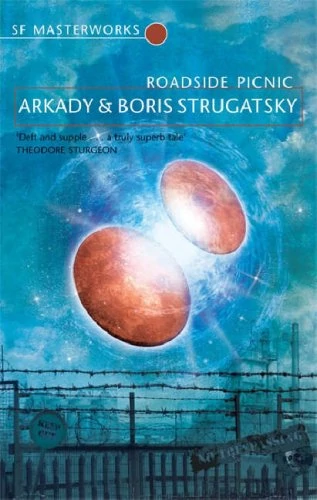
Review: Roadside Picnic

Roadside Picnic

It’s time to review another classic of science fiction, the Strugatsky brothers’ Roadside Picnic. It’s famous for leading to the “Stalker” movie and video game series, as well as gaining extra prominence after the Chernobyl disaster. But how does the book itself hold up?

Sadly, my thought after reading it is “not the best”. Maybe this is just the translation, but I felt constantly felt like the concepts were far better than the execution. The execution felt like it was either dull or pretentious with nothing in between, while the concepts of both “ultra-advanced aliens nonchalantly passing by” and “weird zone full of weirdness” are more interesting.

Perhaps this kind of higher-brow science fiction just isn’t my genre. But I could see why the book was both influential (because adaptations could take advantage of the really, really good concepts) and at least in some places less prominent by itself (because the actual novel doesn’t work as well).

Review: Firedrake

As of now the most recent book in the Kirov series, Firedrake combines the worst and best of it all. The worst is that all of the structural problems are still there and that the wargame lets play structure is beginning to wear thin, especially with the foreshadowing that this particular timeline is getting erased/destroyed. The best is, well….

The best is that plot points involve the ship transported to a bleak, dark, empty world where only hostile mechanized drones roam the seas and skies (was it Skynet or Yawgmoth that was responsible? :p ). Then it moves into another timeline courtesy of supervillain Ivan Volkov, where a Third World War (the fourth in the series) is about to begin, one where Japan won the second thanks to Volkov giving them nuclear bombs.

The Kirov series is best when it wargames out drastically changed situations, and that is the case in half of Firedrake. The other half is wargame action as usual.

Review: I Jedi

I, Jedi

Michael Stackpole’s I, Jedi may be my favorite Star Wars novel ever. It’s also a book that has absolutely no business being as good as it is. After all, Stackpole is a writer who isn’t the best prose-wise and tends to take game mechanics literally. Corran Horn, his protagonist, is the ur-example of someone parachuting their own Mary Sue into an existing franchise. The first part of the book uses the same plot as a book by the infamously subpar Kevin J. Anderson.

And yet, it somehow works brilliantly. Part of it is that Stackpole’s writing is in better form than usual, in everything from starfighter battles where Corran fights his old teammates and can sense their thought processes to everyday life on a backwater world. Another part of it is that by being small-scale and comparably low-stakes, it manages to actually make the universe look bigger and more wondrous.

Stackpole’s epic might be helped along by the other books of the time, which tended to have a random ex-Imperial using the superweapon of the week and an inappropiately small number of Star Destroyers to threaten the entire galaxy. But even on its own, it works. It embodies the “distant vista” principle, restores a sense of awe, and just succeeds as a story in its own right.

Review: Tiberium Wars

Command And Conquer: Tiberium Wars

The Keith DeCandido novelization of Command and Conquer: Tiberium Wars was widely denounced upon release. I was there on Spacebattles, and I saw the critiques. I read it, and I agreed.

If the book itself was in an original setting, it would be forgettable and bland, a spacesuit commando Marine Force One with a Mary Sue protagonist. The only real quibble would be extremely rapid procurement of new rifles. But as it stands, it doesn’t gel well with the Command and Conquer game. At all.

There might be a mitigating factor in that I’ve also heard that DeCandido got background material for “Tiberium”, the cancelled C&C FPS project and based the book of of that, which would explain some things like the abundance of rifles. However, whatever the circumstances, this is a book to avoid.

Review: If It Bleeds

If It Bleeds

A collection of short stories featuring the infamous Predator alien hunters, If It Bleeds is the first anthology I’ve reviewed on Fuldapocalypse. From ancient history to futuristic fighting rings, the Predators come to hunt.

In many ways, these aliens are ideal crossover/setting shifters. A combination of a sense of (comparative) self-restraint and a desire for (by their standards) a “fair” fight mean they can be put almost anywhere, and they are. Compare this with the other half of the “Alien vs. Predator” franchise. The xenomorphs are one-dimensional and will inevitably either devour everything or get crushed themselves.

The various writers take advantage of this to bring about various “prey”. For the most part, they’re successful. However, there’s a few small issues. The first is that the stories that go for some kind of mystery don’t work because you know what the anthology features. The second is that there is no story where Theodore Roosevelt fights a Predator.

Otherwise, this is a very fun group of stories that any science fiction or action fan should enjoy.

Review: Aurora Invasion

Aurora: Invasion

What better book series to review on the Fourth of July than the ridiculously star-spangled Black Eagle Force? Aurora Invasion is a later entry in Steinke and Farmer’s “masterpiece”, where the BEF battles a new opponent-aliens.

This is a weaker entry in the series. Part of this is because its authors never were the best in terms of literary fundamentals to begin with, something very true here as well. A bigger reason is that, believe it or not, the rest of the series is so bizarre that fighting UFOs is actually more grounded than some of the other stuff the BEF gets up to.

This is still a decent out-there cheap thriller, but there are better books even in its own series.

Review: Area 51

Area 51

The first book in a long series, Bob Mayer’s Area 51 (originally published under the pen name “Robert Doherty”) is a “secret history” flying saucer thriller story. By itself, it’s a decent enough 51% book. What brings it down is, weirdly, the plot. Oh, there’s a few technical inaccuracies like having F-16s be around in 1970 and putting them on aircraft carriers, but the real issue I found was structural.

What my binge of Cussler-esque “find the ancient MacGuffin” books has taught me is that premise alone doesn’t make for a good read. And this is definitely the case with Area 51.

Here, there’s two problems with the alien technology. The first is that it’s too powerful in context. Not only does it function as a convenient plot enabler and deus ex machina, but it basically turns the entire book into watching a tale of the aliens. And that tale is dull and cliche. The second problem is that flying saucers don’t embody majesty and secrecy, but rather goofy Plan 9 From Outer Space kitsch.

The result is that the book is little but a throwaway curiosity.