A Thousand Words: WMMA5

WMMA5

Grey Dog Software’s World of Mixed Martial Arts 5 is an excellent mixed martial arts simulator/tycoon game. It’s best to keep your game worlds small as loading times are still an issue, but that’s the only (small) sour note in a very sweet game. As a tycoon, you can participate in building your own MMA empire, and learn the hard way that trying to do right by either your fighters or your fans has financial consequences.

Or you can just smash the figures together in the game’s Quick Fight mode, which is where I spend most of my time with it. The character editor means you can create anything from all-rounders to monomanical specialists who can’t strike or can’t grapple (or both!) As MMA has even more “moving parts” than boxing, making a proper sim is tough. Thankfully, this delivers.

Review: The Clinch

The Clinch

Nicole Disney’s The Clinch is a yuri (female/female) MMA romance. Boy, I never thought I’d be having one of those highlighted on Fuldapocalypse. Anyway, it works very well as both a romance (the main character Eden Bauer is very well developed) and as a mixed martial arts book (Disney is experienced in martial arts herself, and it shows.)

There are a few quibbles, all of which are still highly forgivable. In the book the UFC women’s featherweight division is big and prestigious. In real life it’s a tiny skeleton consisting of just Amanda Nunes and her next tomato can victim. There’s also characters having too much situational awareness in the middle of a fight, which is understandable for literary reasons but still comes across as a little forced and unrealistic.

Still, this is the best mixed martial arts novel I’ve read, romance or not.

Soft and Sharp Sportsbooks

Here’s a great post on the two main kinds of sportsbooks, “sharp” ones that allow skilled bettors to play and actively shift their lines, and “soft” ones that focus more on marketing/entertainment, just follow the lead of the sharp books regarding lines, and will, often massively, stop skilled bettors.

As for the ethics question of it, well, I do think soft books are unethical the way that other types of gambling are unethical. After all, I remember very well all of those New York State Lottery commercials promising riches just one ticket away. And the highest margin business model of sports betting is often called the “parlay lottery” for good reason.

Though to be fair, the odds have to be staked in favor of the house for the sportsbooks to survive at all. The analogy I use is basketball. If it’s a soft book, you’re playing a rigged carnival version. If it’s a sharp book, you’re playing one on one against a pro player who’s good at stealing the ball even from other pros. As betting expert Joseph Buchdal put it:

How about this one [warning label]: “95% of sports bettors will lose at UK bookmakers. The other 5% will be banned. 99.9% of sports bettors will lose at bookmakers who let you win.

On Sports Betting Media

The legalization of sports betting in the United States has brought about a wave of media devoted to it. And even in the offshore era, there were no shortage of websites talking about gambling. After looking at sports betting media, it didn’t take me long to sour on it. Even with less direct knowledge, it came across as being extremely shallow at best and, more often, something sinister seeming. It felt like trying to goad people who knew basic sports trivia into playing a stacked against them game (even back then, I knew the fundamentals of how gambling worked).

And after finding out more, studying more, and getting the spark that would lead to The Sure Bet King, I feel weirdly proud to say that well, I was completely on point. The conflicts of interest are there. Sportsbooks themselves and their loss share affiliates (people who get others to sign up to the books in exchange for a share of the house winnings) obviously have no direct incentive to help punters win and much motivation to help them lose. There’s a reason why sportsbooks hype up the people who hit a monster parlay/accumulator (where multiple outcomes all have to win), because those are where the house has the biggest edge. The idea is to get Joe Sportsball Fan to be convinced that if he follows his gut and knowledge of trivia, like how Aaron Rodgers doesn’t have that clutch spirit, then the jackpot will be his.

Even more innocently, I think (no pun intended) that even without this conflict, a lot of sports betting shows are just basic sports opinion pieces given a gilded gambling coating. The indispensable “Sports Truth with William Leiss” channel (who I actually thanked in the dedication to my book, and with good reason), has two videos showing this, which is dubbed the “think tank.” There isn’t any actual statistical analysis (not that most sports hosts could really do it beyond “Oh, he’s hitting .230”), just stuff like “I think that the Giants offense isn’t ready yet so I think the Colts will cover.”

Then there are the few sharp bettors who are (of course) magnified on social media. To be honest, after seeing what it entails, I would chose one of my old jobs that involved hauling carts back to a rickety old, cramped supermarket, often in bad weather, for six days a week, in an instant over being a professional sports bettor. It just feels almost wasteful, like a strange form of slumming from people who have the drive and/or intelligence to succeed at other careers that are far less zero-sum and far more relaxing. Learning that a lot of the “sharps” win not by being better handicappers but by a combination of manipulating the lines and doing the equivalent of coupon-clipping and bargain hunting, further drove my opinion down.

In fact, despite me maintaining every bit of negative feelings for the sleazy tactics of the bookmakers, I actually began to take their side to an extent regarding the banning/limiting of winners (one of the most vocal complaints from the sharps). And it wasn’t just “oh, they have to make money.” It was more like “oh, they have every right to keep munchkins from plundering them. Good for them.”

And then there are the touts, or tipsters. These pick-sellers are nearly all scam artists, and when I saw how they worked, I knew that one would be the perfect topic for a novel. Touts got amplified because for the longest time they were the only sports betting figures who could operate semi-openly (see the infamous infomercials), and they took advantage of it post-legalization.

Finally, there are the various governments who treat sports betting as a tax-producing cash cow. New York is particularly ham-fisted in this regard, which is even more counterproductive because there’s the far more lenient New Jersey right next door. So yeah, there’s that too.

So I came away from my research with even less regard for the sports betting industry than I had before-and more of a feeling that it would be great subject matter. So I wrote my first full-length novel about that very topic. And I had lots of fun doing so.

Review: Sporting Blood

Sporting Blood

Carlos Acevedo’s Sporting Blood is a nonfiction chronicle of boxers at their worst. Not at their worst in the ring, but at their worst out of it. His writing is excellent and well-handled (legendary boxing historian Thomas Hauser praises him in the foreword, no easy feat). It’s just the book can get a little repetitive.

There’s some interesting entries, like a 1920s prizefighter prolonging his career through quack medical surgery. But so much of the book is just one entry after another detailing how a boxer got beat up, lost his brain, lost his temporary money, lost his prestige, and sank back into the terrible life he came from. And then there are the stories of how many of them had terrible upbringings-the tale of boxing trainer Tony Ayala Sr. and how he treated his sons was especially disturbing. (Sadly but unsurprisingly, one of them became an absolute monster).

This isn’t the author’s fault, but it does make for melancholy reading. And it also details why the talent pool of American boxers shrank so dramatically after World War II. Because given a choice between that and another career, athletic or note, who would want to subject oneself to the vicious free-for-all of boxing?

Review: WagerEasy

WagerEasy

It took me a long time to actually read the sports betting-centric thriller/murder mystery WagerEasy by Tom Farrell. This is simply because I was writing my own book centered around that industry, and didn’t want any, however accidental, cross-contamination or subconscious comparisons. So I only took it up after I finished The Sure Bet King.

That being said, I needn’t have worried (at least in hindsight). WagerEasy is a first-person thriller where the same general subject matter is the only thing it has in common with my own novel. It’s very much an apple to an orange.

So how is it as a book? The answer is-very good, even with me not being the biggest fan of first-person narration or the “hardboiled” style it tries to go for.While I feared it would be just dreary and grubby at first, WagerEasy turns out to have high stakes in a clever way and effective action set pieces. In fact, one of the action scenes in the middle of the novel had me going “Really?” And I meant it in a good way. Like, this could have been written by Jon Land. And Farrell definitely knows his stuff concerning sports betting itself (although I was a little surprised there wasn’t more discussion of the reputation European sportsbooks have for banning/ultra-restricting winning bettors). So I enjoyed this a lot.

The Advantages of Boxing Fiction

Boxing (or MMA, or any other individual combat sport) offers a few advantages when it comes to literature. The first is logistical. A boxing match can theoretically happen in any place big enough to fit a ring. Thus they can be, and have been staged in areas from small rooms to gigantic stadiums. Other sports require a specialized field, but officially sanctioned boxing matches have been held everywhere from mansion lawns to prisons.

The second is personal. While there are important trainers/promoters/managers/cut specialists, boxing is a clash between individuals in a way that any team sport is not. The character implications of this are obvious. Finally, the inherent shadiness of boxing makes it a perfect setting for a thriller or mystery story.

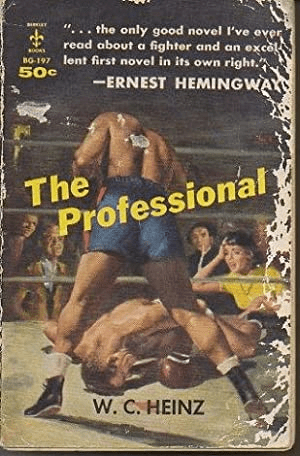
Review: The Professional

The Professional

A tale of middleweight contender Eddie Brown, The Professional is a novel by legendary sportswriter W. C. Heinz. What’s interesting is comparing it to Malamud’s The Natural, as they take extremely different paths but arrive at the same level of quality. This deserves more explanation.

Malamud did not know much about baseball. Heinz knew boxing inside and out. Book Roy Hobbs is an ass that you’re not supposed to root for. Book Eddie Brown is meant to be a decent, sympathetic figure in a bad sport. The Natural loved making flourish and mysterious performance shifts depending on the plot. The Professional is grounded and realistic to a fault. The Natural is a third-person book. The Professional is a first-person book. The prose is blocky in both, but while Malamud is excessively flowery, Heinz is very Hemingway-esque (not surprisingly, that author loved the book). And yet both come across as being stilted, pretentious, and dated.

Its main characters are not very good. Brown is not a bad protagonist but he can’t make up for the faults of the other two, which are massive. The two other central figures are Brown’s hideous Mary Sue of a trainer/manager and the first person sportswriter narrator, who fits the “character as camera” archetype I’ve seen in other negative reviews of first-person books.

As for the book itself, it consists of realism-as-padding, outright padding, and expects the reader to treat the technical decline of boxing as some great tragedy. I could be a little harsh on it because it would be far more novel and revealing to a 1950s reader who only knew boxing from television and the pulps (not surprisingly, there’s a scene where Heinz, via one of his mouthpieces, swipes at them for their inaccuracies). But to someone much later who’s read a lot of excellent nonfiction on the sport, it just felt plain and empty.

Review: Friday Night Fighter

Friday Night Fighter

Troy Rondinone’s Friday Night Fighter is the story of both a boxer and a time period. It is the story of boxer Gaspar Ortega. It is also the story of a huge-in-its-day sporting event, the time when boxing aired en masse on network television and attracted a viewing share comparable on the low end to the NFL playoffs today. It is the story of a far more unified sport than the later “alphabet belts”.

Rondinone’s writing is excellent and Ortega, a boxer who appeared on television many times, is arguably the perfect figure for this age. On one hand, he was much more than a small journeyman who appeared on television a few times. On the other, he wasn’t the kind of already-immortal figure that everyone already knows about (ie, Marciano, Patterson, Liston). A contender who never got to actually wear the belt, he illustrates the time period exactly.

Another impressive element of this book is that it rarely sinks into Good Old Days nostalgia despite boxing being the one sport where it’s the most viable. It makes it clear that boxing gave up on network TV because network TV gave up on boxing, with viewership substantially down even before Benny Paret’s death. Yes, TV played a role in diluting the talent pool and closing down the old clubs and gyms that served as the fighter pipeline, but so did simple demographic change. And it doesn’t hesitate to tackle the sleaze in the sport.

The best complement I can give to this book is that it truly takes the reader into another time, and that’s something a lot of history books just can’t manage. Friday Night Fighter is one of the best works of sports history that I’ve read, and I highly recommend it.