Review: The Dragons of Dunkirk

The Dragons of Dunkirk
dragonsdunkirkcover

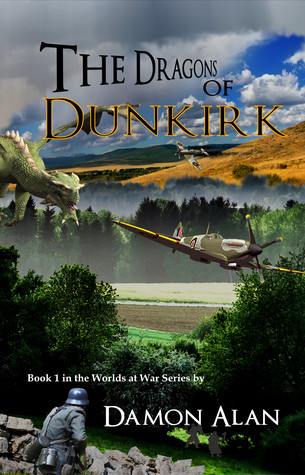
Damon Alan’s The Dragons Of Dunkirk grabbed me the moment I looked at the cover. Naturally, I thought of Harry Turtledove’s Worldwar series, only with fantasy invaders instead of sci-fi ones. I also thought of an early Fuldapocalypse review, Dark War Revelation, only set forty years earlier.

So, the German supernatural unlocking goes horrifically wrong, leaving the world exposed to a classical fantasy realm ruled by an ancient wizard (but not a zombie sorceress, sadly). Multiple characters of both sides take in the conflict as it ensues.

There’s a lot this book hasn’t done well. The dialogue is a little stiff, and the action not the best. The worldbuilding on the fantasy side isn’t the most truly distinctive.The characters, while adequate, aren’t more than that.

But what it does do well outweighs that. Alan manages to keep the conflict between a magical and technologically advanced side balanced in a way that doesn’t seem too contrived. (I’ll just say that bullets are something they can withstand to a big degree, but artillery shells are something else).

It has a great concept and an execution that, though imperfect, doesn’t squander it in any way. What’s not to like?

 

Review: Vortex

Vortex

Jon Land’s third novel, Vortex, is easier for someone like me who’s already read many books to review. This is because this is where the writing finally clicks. This is where Jon Land goes from “out-there thriller author” to “Jon Land.”

For all that The Doomsday Spiral and The Lucifer Directive were out-there, this manages to one-up them with its tale of cosmic manipulation, a conspiracy that threatens the universe (yes, the universe), and psychic powers. The foot is on the crazy car gas pedal and it never leaves. From here, it’s just a short step to the “majesty” of Blaine McCracken.

Review: God Of Death

Casca: God Of Death

casca2cover

So I figure I should mention the best Casca book in my eyes. That would be the second, God of Death. By some accounts in the confusing internet tangle of rumor and whisper surrounding the series, it’s the last book Sadler personally wrote. I have no knowledge or evidence for any of this being true or not, but figure I should mention it.

In the book itself, Casca sails with the Vikings and ends up in pre-Colombian Central America. Then he gets his heart cut out-and puts it back in what should have been the defining scene of the series. Cue many of the Casca staples. The doomed romance, the “exotic” historical eras, and the lack of strict accuracy.

What makes this Casca stand out is that it actually runs with the supernatural qualities and the immortality gimmick in a way that many of the later ones simply don’t. It could be that the series was still fresh and new, or it could be that the vagueness of this time and place gave Casca more breathing room than a more documented one where he ultimately has to stick to history. Whatever it is, God Of Death is one of the few books where Casca’s premise lives up to its potential.

Review: Balkan Mercenary

Balkan Mercenary

balkancover

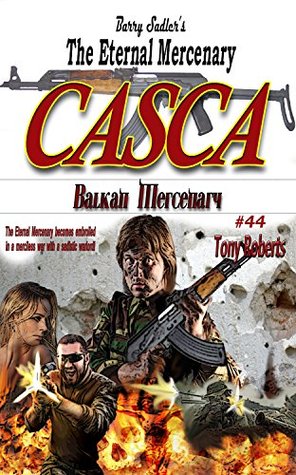
Although not the latest Casca book, Balkan Mercenary is the most recent chronologically, occurring in the beginning of the Yugoslav Wars. It’s the first book in the series I’ve reviewed that’s written by Tony Roberts, who’s the current official author of the Casca franchise.

So, I have get this out of the way first. If this had no connection to Casca at all and was just the story of a man and his team of mercs going into the Yugoslav Wars to take down a war criminal and avenge the death of his loved one, it would be a modestly decent “51% book”. There are far better books than something in the same league as Marine Force One, but there also worse ones (which is why, in spite of my complaints, I still read the Casca books).

But this is the 44th installment in a long series that I think just doesn’t work as well in more modern times as it does in the distant past. It’s even mentioned in the book itself that Casca’s aliases are getting easier to track, so I can understand why Roberts seems keener to keep Casca a historical character.

Here, every reminder that this middling action-adventure tale featured a millennia-old immortal felt blatantly shoved in. A piece on how he remembered medieval Serbia. A piece on his blood being poisonous (this was present in the early books). And a tie-in with designated recurring enemies the Brotherhood of the Lamb, who feel especially forced. Balkan Mercenary, like many other Cascas, just plods to the middle, not daring to  try and take the extraordinary premise any farther than 51% of the way.


Review: Cold Allies

Cold Allies

coldalliescover

Patricia Anthony’s debut novel Cold Allies is a distinctive book. But it is not exactly distinctive in a good way.

First, there’s two awkward plots. One plot is the surrealist tale of blue alien orbs that suck people in. The second plot is a sort of “World War III” where an “Arab National Army”, fleeing the drought and famine of an ecologically devastated world, invades Europe. There are (even by technothriller standards) a ton of shallow viewpoint characters who are constantly being shuffled around, taking out what little coherence might have existed.

The war plot is one of those weird cases where one might think the biggest issue would be the book being too political. And yes, a lot of the characters are shallow stereotypes, seemingly contributing to it. But it’s handled just totally matter-of-factly, kind of like Dark Rose or Ian Slater’s USA VS Militia series. For the alien plot, it crosses the line from “surreal” to “pretentious” pretty handily. This book is little but a bizarre novelty.


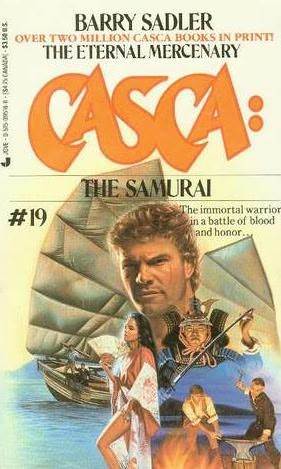
Review: The Samurai

The Samurai

cascacover

With the nineteenth entry in the series, The Samurai, Casca swings and misses dramatically like a called-up minor leaguer facing Nolan Ryan. Of all the Casca books I’ve read, this is the worst of them (so far). I’ve heard conflicting answers as to who was actually writing the later Casca books before Sadler’s death, but whoever was did not succeed here.

Knowing the history of the series, I was expecting a clumsy, stereotypical depiction of ancient Japan. And I got it. But it also has very blocky, clunky prose and flat fight scenes that take away the biggest strength of the Casca series-the ability to have effective action despite its protagonist being, you know, immortal.

Not that it really matters much, because here Casca himself might as well just be a second-rate hired gun in a dull story about dull rivals fighting for power in dull battles. Having all the weaknesses of the Casca books but none of the strengths, The Samurai is something I wouldn’t recommend even to fans of the series.

Review: The Alpha Deception

The Alpha Deception

alphadeceptioncover

It’s not Jon Land’s fault that his first Blaine McCracken book left big shoes to fill. How does the second, The Alpha Deception, fare? In it, Blaine McCracken has another crazy adventure as he fights a rogue Soviet general with a death ray and an army of cheap thriller flunkies.

The book starts with a scene where a Hind-D helicopter is treated like it’s some kind of Airwolf-style superweapon. It only gets more ridiculous from there, from a fight with a pet panther to McCracken being subjected to a combination Dr. Evil Deathtrap and Greek mythology reenactment to a giant submarine/crab-mecha.

There’s a few stumbles with the plot. First, the ending is, well, a little Indiana Jones-y, and not in a good way. More important is the plot centered around the villain’s takeover of a small town and the resistance of its residents, which is far less interesting than McCracken’s own exploits (until, of course, they intersect). But those stumbles are very small, and The Alpha Deception maintains all the charm of the first book and then some.


Review: Casca The Eternal Mercenary

Casca 1: The Eternal Mercenary

Casca The Eternal Mercenary

So the Casca series is a little off the Fuldapocalyptic beaten track for me. But really, I of all people couldn’t resist a series written by Barry Sadler of ‘Ballad of the Green Beret’ fame with the premise of “The Roman soldier that stabbed Jesus with the spear is fated to be a soldier/warrior forever”, fusing the Longinus and Wandering Jew mythologies. That part brings a very different song to my mind.

The first book opens in Vietnam where the main character heals ridiculously fast from a seemingly fatal head wound, and one “hypnotic narrative” later, returns to nearly two thousand years in the past. After the event, he gets in a fight with his “sergeant” over a girl and ends up with a deep wound… …which heals, because in practice, he turns into essentially Marvel’s Wolverine without claws. Cue a long stretch of time where he fights throughout dynasties of Roman history, then a final scene in the then-present where Casca/Casey has escaped from his Vietnam hospital-and is fighting in the Arab-Israeli wars.

This is very much a pop-historical “sword and sandal epic” rather than trying for any serious attempt at realism, and is all the better for it. Casca becomes a slave, he becomes a gladiator, and he enjoys a bit of peace before returning to his horror.

One of the low points of the book is its cultural er- insensitivity. While an action novel in the 70s is not going to top anyone’s “most progressive” list, this has a few moments that made me raise eyebrows. The walking stereotype Chinese martial arts master (yes, in ancient Rome, it’s a long story) who teaches Casca I was more bemused by than anything else. I went ‘uhh….’ at both the vicious savage African gladiator whose victims included (of course) a young blonde woman and the man whose marriage improved after he started hitting his wife.

But even the worst I found tolerable, because it only felt offensive and not offensive and creepy. This is, after all, a 70s action novel. And what it does well, it does very well. The Eternal Mercenary can make its action dramatic even with an immortal protagonist, and that’s no small feat.

Casca: The Eternal Mercenary is lightweight sleaze, but it’s good lightweight sleaze.


Review: Worm

Worm

This is a weird story to be reviewing on Fuldapocalypse, and it’s a weird context. But Worm has been so crazy on Spacebattles to the point where the mods had to make a separate forum specifically for Worm fanfics.

Worm is a story about a teenage girl in a rough and tumble city who, after being shoved into a filthy locker by bullies, develops superpowers. Much, much, much more happens after that.

Worm has a lot going for it. It’s a superhero story that keeps the basic archetypes everyone knows and loves while shedding every last piece of baggage the big two comics have dragged over decades. The powers are interesting and distinct-for instance, the closest prominent figure you can find to the main character’s power set of insect control is a boss in Metal Gear Solid 3. There aren’t lazy “Superman” or “Batman” figures made with the minimum distinction. The characters are well developed and sympathetic in a truly dark world. It sounds very good……


……until it’s actually read. The fundamentals are ‘iffy’ enough that it becomes a slog. Especially early on, events happen and pass very quickly, not helped by the prose. But on the other side of the coin, the story as a whole is over one and a half million words long-longer than War and Peace and Atlas Shrugged combined. And I’ve found the prose to be simply dull.

In no small part because of this, every flaw in the worldbuilding comes up in a way that it wouldn’t in a better story. The biggest issue I’ve found is trying to have its cake and eat it too. Worm goes into a huge amount of in-universe detail to try and justify its common superhero-vs-supervillain tropes. To me the amount of raw effort required has the effect of making it seem less, rather than more plausible.

But I don’t want to be too hard on Worm-I can see its appeal, and consider it “not for me” rather than outright “bad”. It just didn’t really “click” for me, and I don’t want to read a million+ words of something that didn’t do that.


Review: Houdini vs. Rasputin

Houdini vs. Rasputin

I was in the mood for a change of pace, and upon seeing Houdini vs. Rasputin I felt I had to give it a shot. I was not disappointed.

Who and What

Harry Houdini makes an ahistorical second trip to Russia in 1911, brought over by the head of the secret police to try and deal with the mystic Rasputin. What follows is a book-long adventure as the mystic and the escape artist match wits and trade blows. Pitting the two larger-than-life figures against each other is brilliant.

DEEP HISTORY OF TEM

Almost all the descriptions are for something actually important to either the plot or scene at hand. Imagine that!

Zombie Sorceresses

This just isn’t the kind of book where this category is important or even viable. I could argue “not even memetic Houdini could escape from that” but this isn’t the kind of book for that. I could argue “is it a coincidence he runs into everyone from Stolypin to Lenin?” but this isn’t the kind of book for that. This is the kind of book where you just run with it.

Tank Booms

After dozens of books of red-blooded Mack Bolan wannabes, tanks booming, clinical technothriller battles, and spacesuit commandos, the earnest old-fashioned adventure here, beautifully written, is highly refreshing. I could almost imagine a John Williams score in the background for some of the scenes.

The Only Score That Really Matters

Houdini vs. Rasputin is a fresh, earnest, amazing tale. Not since the first few volumes of Jerry Ahern’s Survivalist have I read with such  totally along-for-the-roller-coaster-ride enthusiasm. I highly recommend it.