Review: For Alert Force

For Alert Force: KLAXON KLAXON KLAXON

Having essentially run low on World War III books that both held interest to me and weren’t already read has been a slight issue for this blog. Thankfully, I found some newer ones. One of these was Jim Clonts’ FOR ALERT FORCE: KLAXON KLAXON KLAXON, an awkwardly-titled book telling the tale of SAC crews in World War III.

This is a near-immediate 1980s nuclear World War III with none of the contrivances to keep it conventional for any length of time that appear in other works. Clonts, a veteran of B-52s himself, tells their story of fighting in these apocalyptic conditions. The book is good for what it is, but tends to wobble a little.

It has the exact strengths and weaknesses of what something written by someone with personal experience brings. On one hand, it’s detailed and a lot of it is accurate (as far as I could tell). A lot of the scenes are tense and well-done. On the other, it has tons and tons of Herman Melville-grade explanations of everything minor and technical.

Still, it could have been a lot worse than it is, and works as an aviation thriller. It’s not the most pleasant, but as this is about nuclear war, that’s to be expected. A more focused Chieftains (albeit with airplanes instead of tanks) is not a bad thing.

Finally, I noticed that it openly declares itself an “alternate history” on the cover, something a lot of fiction, even the kind that could easily qualify as such, doesn’t do. This fits the description unambiguously. It takes place long before its writing time and has history-changing events. So it’s interesting that Clonts felt comfortable enough to label it as such.

In short, I didn’t regret reading this book.

Review: Tales of World War III 1985

Tales of World War III: 1985

Looking back at the progression of this blog, I’m reminded a lot of the story of trying to make a cockpit design that could fit the “average pilot”, and then finding that no one actually met that criteria. I feel similarly when I look back at just how little anything actually met my stereotype.

Brad Smith’s Tales of World War III: 1985 series comes closest, edging out Larry Bond’s earlier work. It’s done by a wargame designer and thus features the wargame-friendly setting of 1985 Europe, with battles taking place in various parts of it. There’s a lot of technical description.

I don’t feel nearly as much negativity towards it as I would have and did in the past. Smith has sincerely tried to build characterization, even if the execution is still often clunky and the characters often Steel Panthers cameras in practice. And the wargaming at least takes the series above Ian Slater in terms of technical accuracy. But it’s still a 51% entry in a niche genre, the pilot who isn’t particularly good or bad but has the dimensions to actually fit well in the “average” cockpit.

Nuclear World War IIIs

So I figured: How true was my stereotype of “conventional” WW3s? I decided to take a look and see. For this exercise, “yes” means a full nuclear exchange, “partial” something like say, Hackett’s infamous plotnuke, and “no” means the war stays completely conventional. This is an incomplete, unscientific list, but still.

  • Hackett-PARTIAL
  • Red Storm Rising-NO
  • Team Yankee-PARTIAL
  • Red Army-NO
  • Chieftains-YES
  • Black’s “Effect”-PARTIAL
  • Kirov-YES
  • Arc Light-YES
  • Red Hammer 94-YES
  • Bear’s Claws-PARTIAL
  • Cauldron-PARTIAL
  • War That Never Was-NO
  • Ronsone/Watson’s Red Storm-PARTIAL
  • Zone-PARTIAL
  • Weekend Warriors-NO
  • The Red Line-PARTIAL
  • Andy Farman’s Armageddon’s Song-PARTIAL
  • Wingman-YES

Besides the possibility of me remembering wrong, the line between “Partial” and “Yes” is sometimes blurry-for instance, I had a hard time deciding whether or not to include Arc Light as “Partial” or “Yes.” And in Team Yankee, which follow’s Hackett’s plot, the nukes are offscreen. Still, it was a little surprising how few outright “no’s” there were and how many “Partials”. It’s just the biggest “no” was Red Storm Rising.

Review: Firedrake

As of now the most recent book in the Kirov series, Firedrake combines the worst and best of it all. The worst is that all of the structural problems are still there and that the wargame lets play structure is beginning to wear thin, especially with the foreshadowing that this particular timeline is getting erased/destroyed. The best is, well….

The best is that plot points involve the ship transported to a bleak, dark, empty world where only hostile mechanized drones roam the seas and skies (was it Skynet or Yawgmoth that was responsible? :p ). Then it moves into another timeline courtesy of supervillain Ivan Volkov, where a Third World War (the fourth in the series) is about to begin, one where Japan won the second thanks to Volkov giving them nuclear bombs.

The Kirov series is best when it wargames out drastically changed situations, and that is the case in half of Firedrake. The other half is wargame action as usual.

The Lack of Mainstream AH WW3

So, a look at alternate history conventional World War III novels revealed a very small number of them. Even smaller is the number of novels that were alternate history, took place after 1980, and made by larger/mainstream presses. Granted, like in that previous post, I used only the most unambiguous examples. But even I was a little surprised by the number I ended up with.

Zero.

I found two games that fit the criteria. These were World in Conflict and Eugen’s Wargame series. But those are games, and I think they’re a different paradigm. If I wanted to stretch things, I’d go with the Command and Conquer: Red Alert games. Those are kind of like including the Wingman novels in with Hackett and Bond, but they’re alternate World War IIIs.

Yet I’ve seen no actual novels, and if they existed, they’d probably be well below any “too obscure to really ‘matter'” standard. Everything has been either futuristic or contemporary. What I find very telling is the case of Walt Gragg’s The Red Line. That was crudely transformed into a “contemporary” setting instead of being sold as alternate history.

And the big-name AH authors have stayed away. Harry Turtledove has made a series about a 1950s World War III but not a 1980s Fuldapocalypse. The closest Robert Conroy came to one was a book (and one with nukes involved) set in 1963. Of all the topics that other authors choose when they dip into alternate history from time to time, the “conventional WW3” simply isn’t one of them.

Now, there are several reasons I’ve theorized for this. Perhaps the biggest is that it’s a small genre to start with, and there’s little incentive to not go for either a conflict that actually happened or a contemporary one, both of which have more mass appeal. There’s far more of a hook and comfort (as weird as it is to say) with a realistic nuclear conflict. The second-biggest is that much mainstream AH is generally meant to be metaphorical, to represent some contemporary issue through the lens of a different past. To be frank, the prevailing style of most conventional World War III fiction is not the ideal medium to express these. About the best you can get is something directly related to the military in some way.

So this makes printed alternate history World War III something that’s the domain of enthusiasts, for better or worse. While I already knew that to be true in general terms, I didn’t know the extent until I counted it. And the reverse is also true-Tom Clancy, Larry Bond, and Harold Coyle quite understandably did not write tales of a Cold War gone hot a decade or two earlier.

Review: Kirov Season 6

Kirov Season 6

So, I’m FINALLY caught up with the entire Kirov series as of now, a feat of great effort even for me. The Season 6 “Next War” arc is, with hindsight, one of the weakest in the series. Unfortunately for me, it was the first arc I encountered. The second of four World War IIIs depicted in the series (this has to be some kind of record), it follows the World War II mega-arc.

In terms of actual writing, the individual books aren’t any worse than other Kirovs. The problem is its comparative mundanity. It’s one of the most recent examples I’ve seen of the “Captain Beefheart playing normal music” effect. It’s a contemporary World War III. Apart from a few half-hearted hypotheticals here and there, the only really substantive addition is a bigger Russian Navy, and that seems there just to have repeated large sea battles at all.

As for the time travel soap opera, there isn’t that much there. The war starts because Tyrenkov, a time traveler from the 1940s went forward , seized control of contemporary Russia, misinterpreted a possible future where he won as a definite future, and then started the war. Between that and the fetching of more of the time-keys (obvious plot MacGuffins), this is pretty restricted. About the only redeeming part there is the (sadly too small) presence of Ivan Volkov, the closest thing the series has to a primary non-historical antagonist. Volkov is a cross between a puppy-kicking supervillain and a crazy schemer who’s a lot less smart than he thinks he is, and remains my favorite character in the series. While there is some Volkov, there isn’t enough.

The only other new characterization is Tyrenkov, after fleeing to the ship as the war spirals out of control, being forgiven far too easily for my liking. The rest of the main cast stays the way they’ve always been, and they’re swamped by the shallow Steel Panthers Characters.

Otherwise, it’s a mixture of being restrained by semi-realistic orders of battle, cover ground that lots of other wargames have gone over, and, worst, having the contemporary setting give the author a justification to er, opine. It’s not the worst, but it’s still an issue the less “connected” installments didn’t have. It also feels-redundant, going over similar ground that the initial World War III in the books 4-8 arc did (to the point where I not unreasonably thought it was the exact same war), and having the same outcome (nuclear destruction and the ship timeshifting away).

Thankfully, the series improves significantly in the next arc, as a World War III in the altered reality created by the ship’s intervention in World War II allows the “wargame sandbox effect” to really flourish in a way it doesn’t here. Season 6 itself has all the weaknesses of the Kirov series as a whole and very few of the strengths. I’ve compared the series to an overly literalist lets play of an RPG. If that’s the case, this is the dungeon you always disliked.

Review: Red Army

Red Army

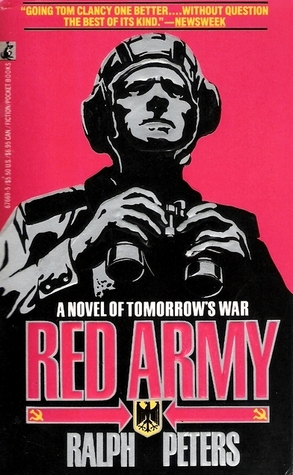
So I actually haven’t done a formal review of Ralph Peters’ masterpiece Red Army on this blog yet. I think I should, because well, it’s my clear choice for “best conventional World War III book of all time.” It has fewer competitors for that title than I originally thought when I first read it, but still manages to stay above them.

The story of a conventional WW3 in 198X, the book jumps between the perspectives of various Soviets as they carry out the war. One of the best “big war thrillers” at managing the viewpoint jumps, it never feels awkward or clunky in that regard. The characterization is very good, especially by the standards of the genre. And it works very well at avoiding an excessive focus on technology.

Of course, Peters has the Soviets win, and thus deserves extra credit for going against the tide. At the time the book was published, there was a (justifiable) sense of increasing triumphalism. Having them win and win handily was a good move. Especially since it doesn’t come across as being done for cheap shock value.

There’s a few sour parts. While the viewpoint jumping is good, the two messages of “humanize the Soviets” and “show how they can beat NATO” sometimes don’t work well, especially as the latter means characters done just to explain things (granted, as someone who’s read the translated Voroshilov Lectures and similar materials for fun, I understand it in ways a casual reader at the time almost certainly wouldn’t). There’s criticism of how the Soviets advance too fast, which is valid but which I consider a mild issue, no worse than Team Yankee’s similar problem with lopsidedness. My biggest complaint is how the situation is set up to let the Americans almost entirely off the hook for NATO’s defeat.

But these are small problems at most. Red Army is an excellent book, and I have no problem considering it my favorite “Conventional WW3” novel of all time. And it has one of my favorite book covers ever.

Review: The Bear Marches West

The Bear Marches West

A short, small, and simple compilation, Russell Phillips’ The Bear Marches West is a list of prospective wargame scenarios made out of the three most iconic 1980s conventional World War III novels: Red Storm Rising, Team Yankee, and Red Army.

The book itself is basic: You get a listing of forces, a listing of the situation, and that’s essentially it. This is so that it doesn’t get tied to any one rules system. For enabling reenactments of scenes in the classics, this book works well enough, although anyone who knows 198X WWIII wargaming (not exactly an underused or underexplored area) should likely be able to do something similar with just a bit of knowledge. Still, it’s an inexpensive novelty, and it would be interesting to see what ruleset generates results closest to what actually transpired in the original novels.

Review: Pacific Storm

Pacific Storm

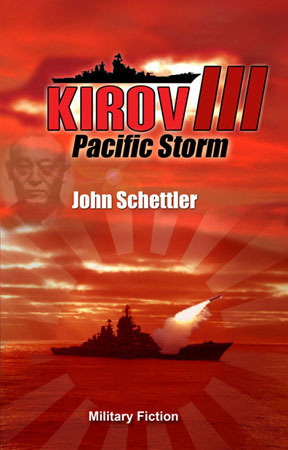
The Kirov series is over fifty books long and counting. But the third entry, Pacific Storm, was planned as a potential stopping point, according to the introduction of a later entry. And while I normally criticize series from Jack Ryan to the Survivalist for passing good opportunities to conclude, it’s for the best that this one sailed right by it.

After having fought through the Mediterranean in the second book, the missile cruiser battles in the Pacific in the third. Besides the issues with the prose, the encounters fall short because the disparity between World War II ships that don’t know what they’re dealing with and a futuristic warship that does means that all the battles have to be contrived in some fashion. Pretty much the only things that work are various surprise gimmicks, close range, and pure numbers, and that’s barely enough to sustain a three-book series.

The ending still involves sequel hooks, but features the ship going back to its present with its crew having realized they started the (nuclear) World War III by firing on an American submarine. When they see the submarine after their “excursion”, they avoid attacking it. Meanwhile, their experiences have changed the “past” significantly. This would be a perfectly good conclusion that still gave room to continue, but it would have concluded three stilted, modestly out-there books. Instead, the series got bigger, more complicated, and, yes, better.

Review: Eagle Rising

Eagle Rising

The Kirov series, of which Eagle Rising is the 47th (!) installment, is strange. If I’d read it three years ago, I’d probably have unfairly denounced it as the worst series of all time. In my more recent reviews, I’d sort of wavered from criticizing the individual books to admiring the ridiculous (in a good way!) plot and premise of the setting.

Now I have this weird feeling that’s settled. I unironically love the craziness and excess that the series gets into, while remaining just as critical of the many flaws of the individual books. I’ll take this flawed excess standout over a hundred “51% books” any day.

That being said, this book itself has essentially two set pieces spread out of over many pages and takes place in an entire arc with a forgone conclusion stated as early as the first book in the series. Whatever the author’s intention, the impression I got of this arc, with this particular WWIII having long since been established as ending in a nuclear fireball (hence the time travel and changing it in the first place…), was that it served mainly to show off wargaming set pieces.

The set pieces are a big Russo-NATO showdown in Eastern Europe and the shenanigans of the ship and its crew. The former is a strangely intriguing example of what happens when you rely on wargame simulations to an incredible and unprecedented degree. Besides the obvious issues with such a stilted de facto let’s play, there’s also problems when the simulations produce an undramatic (however realistic) result and there’s not much “cushion” of characterization or low-level danger to balance them. Another issue is that this particular conflict setup is not exactly undergamed.

The latter, a far more out there plot, involves the use of a time travel MacGuffin and some of the crew going onto an island and fighting a pack of wolves (it’s a bit of a long story). It also involves long scenes of clunky dialogue, which is less fun.

In a way, this book, with time travel shenanigans and wargame AARs, is its own series in a nutshell. Is this a good or bad thing? Well, it depends on what you want and/or like.