
While I’ve reviewed it on my own blog, I felt I should give an updated review of Harry Turtledove’s Guns of the South on Sea Lion Press. So I did.
Review: Hitler’s Last Levy
Hitler’s Last Levy
Hans Kissell was chief of operations for the German “Volkssturm” (lit. “People’s Storm”), the infamous last-ditch militia created at the end of World War II. In Hitler’s Last Levy, published in German in the 1960s and translated decades later, he told their story. It’s an interesting look at a horrific footnote.
The Volkssturm was both a desperation formation and Martin Bormann’s attempt at making his own pet army (like the SS was for Himmler or the Luftwaffe ground formations were for Goering). Kissell goes into detail and includes a massive amount of direct primary sources. While this is a work by a German WWII commander, its subject matter makes it at least a little better than the usual “we fought in our unstoppable kitty-tanks until we ran out of ammunition and fought totally cleanly” memoirs. It’s impossible to portray the ragged old men as some kind of super-army, and they had far less opportunity to commit war crimes simply because by that point they were losing. And Kissell doesn’t hesitate to point to their (many) weaknesses.
Because of this, and because of the wealth of primary sources and details (for instance, describing how on paper, some Volkstturm battalions had an organic battery of captured anti-tank guns), I recommend this for anyone wanting to know about them or similar emergency territorial formations. Yes, it’s dated and slanted. But it’s not nearly as bad in those regards as you might think.
On Sports Betting Media
The legalization of sports betting in the United States has brought about a wave of media devoted to it. And even in the offshore era, there were no shortage of websites talking about gambling. After looking at sports betting media, it didn’t take me long to sour on it. Even with less direct knowledge, it came across as being extremely shallow at best and, more often, something sinister seeming. It felt like trying to goad people who knew basic sports trivia into playing a stacked against them game (even back then, I knew the fundamentals of how gambling worked).
And after finding out more, studying more, and getting the spark that would lead to The Sure Bet King, I feel weirdly proud to say that well, I was completely on point. The conflicts of interest are there. Sportsbooks themselves and their loss share affiliates (people who get others to sign up to the books in exchange for a share of the house winnings) obviously have no direct incentive to help punters win and much motivation to help them lose. There’s a reason why sportsbooks hype up the people who hit a monster parlay/accumulator (where multiple outcomes all have to win), because those are where the house has the biggest edge. The idea is to get Joe Sportsball Fan to be convinced that if he follows his gut and knowledge of trivia, like how Aaron Rodgers doesn’t have that clutch spirit, then the jackpot will be his.
Even more innocently, I think (no pun intended) that even without this conflict, a lot of sports betting shows are just basic sports opinion pieces given a gilded gambling coating. The indispensable “Sports Truth with William Leiss” channel (who I actually thanked in the dedication to my book, and with good reason), has two videos showing this, which is dubbed the “think tank.” There isn’t any actual statistical analysis (not that most sports hosts could really do it beyond “Oh, he’s hitting .230”), just stuff like “I think that the Giants offense isn’t ready yet so I think the Colts will cover.”
Then there are the few sharp bettors who are (of course) magnified on social media. To be honest, after seeing what it entails, I would chose one of my old jobs that involved hauling carts back to a rickety old, cramped supermarket, often in bad weather, for six days a week, in an instant over being a professional sports bettor. It just feels almost wasteful, like a strange form of slumming from people who have the drive and/or intelligence to succeed at other careers that are far less zero-sum and far more relaxing. Learning that a lot of the “sharps” win not by being better handicappers but by a combination of manipulating the lines and doing the equivalent of coupon-clipping and bargain hunting, further drove my opinion down.
In fact, despite me maintaining every bit of negative feelings for the sleazy tactics of the bookmakers, I actually began to take their side to an extent regarding the banning/limiting of winners (one of the most vocal complaints from the sharps). And it wasn’t just “oh, they have to make money.” It was more like “oh, they have every right to keep munchkins from plundering them. Good for them.”
And then there are the touts, or tipsters. These pick-sellers are nearly all scam artists, and when I saw how they worked, I knew that one would be the perfect topic for a novel. Touts got amplified because for the longest time they were the only sports betting figures who could operate semi-openly (see the infamous infomercials), and they took advantage of it post-legalization.
Finally, there are the various governments who treat sports betting as a tax-producing cash cow. New York is particularly ham-fisted in this regard, which is even more counterproductive because there’s the far more lenient New Jersey right next door. So yeah, there’s that too.
So I came away from my research with even less regard for the sports betting industry than I had before-and more of a feeling that it would be great subject matter. So I wrote my first full-length novel about that very topic. And I had lots of fun doing so.
In Memoriam, Pierre Sprey
It took me some time to find out that Pierre Sprey, the legendary face of the “Pentagon Reformers”, passed away. RIP, and all sympathies with his friends and family. His life as a person (and music producer) has little to do with his life as an analyst. But it’s Sprey as an analyst that the military internet knows, and that legacy is, sadly, mostly for the worse.
As an analyst, Sprey symbolized a lot of trends, most of them negative. What he was most known for was his faulting any aircraft beyond a YF-16 as being slow, clunky, expensive, and that wouldn’t even work. One can take a sympathetic view and point out that it made much more sense in the 1960s with bulkier, objectively less effective early sensors. Once solid state electronics developed, one could have one’s cake and eat it too. Sprey still kept designing an air force that would make perfect sense-for a third world country in 1962.
Sprey also had a McNamara Pentagon (of which he was a member)-style fascination with numbers for their own sake. Thus the F-86 was good because of its (inaccurate) 10-1 kill ratio, as opposed to the lower rates of Vietnam-era fighters. SAMs were overhyped just because they didn’t shoot down that many aircraft directly. While some of it was grounded, it felt like spherical cow analysis from someone who didn’t understand context.
To me the extra-sad part was his decline. This can happen to people in all circumstances. Joe Morgan the baseball player was an ahead-of-his time figure whose style was a sabermetrician’s dream. Joe Morgan the baseball analyst was a traditionalist cliche-spouter who became a sabermetrician’s nightmare. Bill Belichick was one of the more sensible coaches when it came to going on fourth down. Now he’s one of the most timid. Tom Clancy dropped significantly in quality. You get the idea.
What wasn’t Sprey’s fault was that he ended up in a media environment where he had no incentive to be accurate and every one to continue his initial statements. What was his fault is that he embraced it. He could just keep citing his (somewhat exaggerated) credentials and repeating all of his soundbites. He could get sloppy to the point where he couldn’t even display the right system (using a Stryker MGS to symbolize a 175mm M107). He could sound credible to people who had entirely reasonable suspicions about military equipment-and not enough knowledge to counter him. But to people who did have enough knowledge, he became a mildly annoying irrelevance.
In fact, I could probably argue that Sprey hurt his own cause. Because too many people with legitimate concerns about legitimate technological overreach cited or sided with him, it likely harmed their own credibility. What I’ve read is that there was a surprising amount of common ground between the Pentagon Reformers and those actually in the military who wanted “good enough now” solutions and a focus on human improvement over trying to tech past problems. They squandered it by going completely outside.
Sprey should have been remembered as a man who did some defense commentary a long time ago and spent the rest of his life as an eccentric music producer. Instead he willingly became, in the words of military Youtuber “Lazerpig“, a “rent a critic”.
Review: Arch Enemy
Arch Enemy
The fourth Dan Morgan book, Arch Enemy fits with the theme established by its predecessor. It’s kind of clunky and disjointed when it comes to specifics. There are too many plotlines and they’re just sort of shoved together at the end to wrap it up. On top of that, it just moves too slowly.
But in generalities, it’s exactly the kind of book that I love. The cheap thriller that isn’t afraid to have ridiculous set pieces and walk the tightrope between “amazingly stupid” and “stupidly amazing”. Its flaws weren’t enough to have me drop the book, and when it got to the secret oil tanker prison ship, I was grinning like a Cheshire Cat.
This isn’t a work of high literature, but it’s the kind of book I enjoy and enjoyed.
Review: Sporting Blood
Sporting Blood
Carlos Acevedo’s Sporting Blood is a nonfiction chronicle of boxers at their worst. Not at their worst in the ring, but at their worst out of it. His writing is excellent and well-handled (legendary boxing historian Thomas Hauser praises him in the foreword, no easy feat). It’s just the book can get a little repetitive.
There’s some interesting entries, like a 1920s prizefighter prolonging his career through quack medical surgery. But so much of the book is just one entry after another detailing how a boxer got beat up, lost his brain, lost his temporary money, lost his prestige, and sank back into the terrible life he came from. And then there are the stories of how many of them had terrible upbringings-the tale of boxing trainer Tony Ayala Sr. and how he treated his sons was especially disturbing. (Sadly but unsurprisingly, one of them became an absolute monster).
This isn’t the author’s fault, but it does make for melancholy reading. And it also details why the talent pool of American boxers shrank so dramatically after World War II. Because given a choice between that and another career, athletic or note, who would want to subject oneself to the vicious free-for-all of boxing?
Weird Wargaming: My dream wargame…
…Is based on a boxing simulator.
Yes, after playing a lot of Title Bout Boxing, I’ve come to the conclusion that I honestly think you could apply it to a (consumer-level) wargame. Of course, I’m not a programmer and know very, very well that thinking up something and actually making it could not be more different. But what I think…. yeah.
- Start with a sort of MCOAT-style War of the Spreadsheets, with a variety of inputs. The fighter stats have this in Title Bout.
- Make the inputs editable, to remove bias. It would come with several default guesses/theories.
- Add in other conditions on the menus. In Title Bout, this is the fighter’s career state, skill level, and their corner staff. This could be something like battle circumstances, terrain, skill, and morale.
- When the fighting actually starts, the player realistically has very little ability to intervene. You can try to push more or less, but the ability to actually execute them depends on the virtual dice. Adding luck is realistic and keeps it from being a deterministic spreadsheet war.
- There’s a summary afterwards. Casualties are not the same as holding territory.
- Mismatches can happen. You pit Ali against Ben Askren, and the latter gets crushed. You make a battle where the difference makes the Gulf War look like Verdun, you get that.
The important thing to me is the same thing that made me fall in love with Command when I saw what its editor could do. An ability to combine fast setup with diverse results. Of course, I can already see a thousand pitfalls, but the dream is there.
“Put a higher-than-normal quality force of ‘BTRykers’ supported by independent tank battalions and have them attack an entrenched old-style rifle division. See how it shakes out. See if one side gains territory [the attackers probably would] and list the casualties”
A lot of people might not like this wargame’s lack of interactivity, but I would enjoy it scratching an itch.
The Making Of A Division
Just as eggs, butter and flour mix don’t equal a pancake on their own, having three hundred tanks and two hundred APCs does not equal an armored division. By American standards, even in World War II, it took a year and a half to turn a scratch-built division from “exists on paper” to “ready to deploy”. Postwar, two years was an optimistic hope.
The central core of the division is a “cadre”. The officers (how many are commissioned vs. non depends on the circumstances) comprise the cadre of the division, which in a normal sized division is around one to two thousand people. Reserve forces deliberately keep their cadre at higher strength and readiness so they can be quickly built around during mobilization.
There’s also external powers not just supplying the equipment, training, and resources for their client/colonial army, but also supplying the central officer cadre as well. (This is why one snapshot analysis of Iranian casualties in the Syrian Civil War found no confirmed dead below the rank of sergeant.)
I also want to say that the cadre forces are the hardest to obtain (from just my amateur gut reaction) compared to either a large number of shorter-trained recruits or a few high-level commanders. The bottleneck for your revved-up 25 division army, especially an effective one, feels like the roughly 25,000 people in the cadre, compared to the 25 commanding generals or the 250,000 enlisted. And this is before political difficulties arise. Although I should note that this was less an issue for continental powers in the World Wars because of both having plenty of survivors from destroyed units as cadres and, to be frank, lower standards.
Cadres can come from:
- Scratch-trained officers “jumping rank”.
- The small existing military being streched out to become a cadre force (this happened in World War II-in 1939 Ike was a lieutenant colonel).
- Retired personnel being brought back.
- Existing irregulars being formalized. (This led to “Zouave” regiments in the American Civil War being formed around Napoleonic reenactors because they were the only ones with skill at musket drills).
- External personnel being sent in to fill the cadre role.
- Survivors from reduced/destroyed units.
Review: High Desert Vengeance
High Desert Vengeance
The fifth Brannigan’s Blackhearts book, High Desert Vengeance has the feeling of a “breather book”. Not the action itself in the American Southwest, which is as good as always. But rather in the personal scope and comparably close-to-home and mundane opponents when compared to the settings of the ones that came before and after it. There’s a tiny bit of “Captain Beefheart Playing Normal Music” at work here.
But only a bit. This is still solid in all the ways that matter, and I think the different tone is actually welcome in this case. While I think the series has done better, I still quite recommend this. It does everything right that it needs to, and remains an entertaining thriller.
Courses of Action
So one of my concepts, well, anyway…
-Intact, with all the cancelled toys USSR going to finally rid themselves of the surviving Ceausescu (I’ve wanted to write a sort of “Soviet Gulf War”). Notably, the only ex-Warsaw Pact state that allows staging and troop support by this point is Bulgaria. (Bulgaria was considered the most politically reliable of them, being a longtime Slavic ally of Russia that did not experience much unrest before the fall).
-This was created using the amazing Map.Army program.
-Heavy OPFOR Operational says that high-level paradrops generally max out around 250 km from friendly troops (Which means 36 hours to catch up even under their most ideal advance rates, four days under the most ideal against a peer opponent, and at least a week under any kind of realistic resistance). The earlier Voroshilov Lectures say 150 km at most in conventional conditions.
That being said, the map!
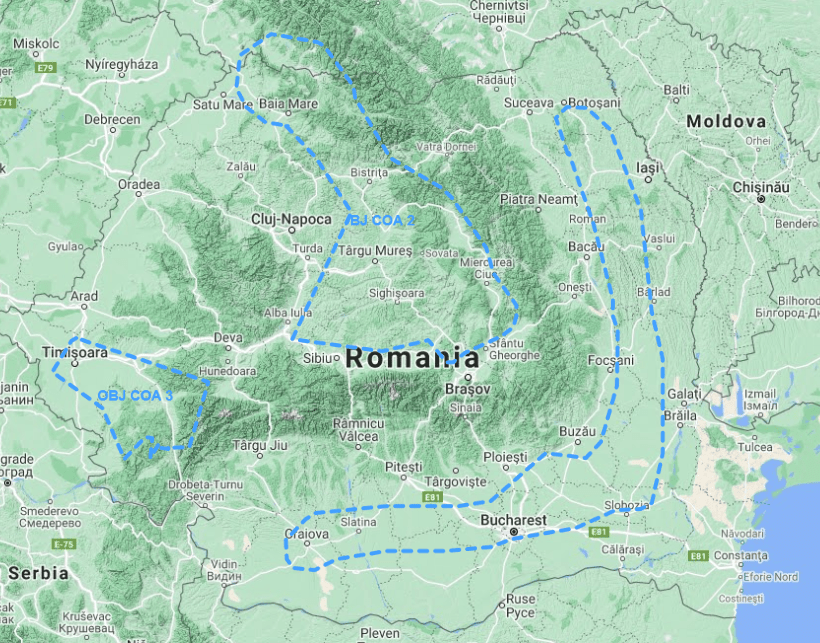
Course of Action 1 (not labeled but closest to the border) is the most tame, and features a variety of tactical close-to-support airdrops in the initial advance areas. Course of Action 2 is a deeper operational/strategic drop to secure the other side of the Carpathian Mountains. Finally, COA 3 is the deepest and most daring yet and involves having paratroopers land ultra-deep to quickly establish a presence in the Yugoslav/Serbian border to try and hold off any escape or resistance aid from there.
As for the rest of the plan, it’s pretty much Soviet boilerplate-blast through, charge deep. Bucharest is going to be encircled first and then left to second-line units (including Bulgarian ones) to actually reduce. Romania’s plan in this not-unexpected event was to just stage a prolonged unconventional resistance and use their inevitable-to-be-overrun regular units to buy a little setup time.
 Fuldapocalypse Fiction