Review: The Bodyguard Manual

The Bodyguard Manual

For those wondering why I seem to be reviewing so much about bodyguards/security contraptions, the answer is a combination of general curiosity and writing research. The first needs no explanation. The second is because I have a character in my WIPs who’s both extremely wealthy and extremely paranoid (beyond the totally justified concerns someone of wealth would have about security). I wanted to look at the excesses to see what they looked like. And Leroy Thompson’s The Bodyguard Manual is nothing if not excessive.

I can forgive some sensationalism. After all, a genuine manual on executive protection would have to be as long and detailed as a military field manual-and about as exciting to read. This does go into detail on the basics and the tactical templates. But there’s an impression that Thompson is just getting past the boring, realistic, “if it comes to force at all, you’ve already catastrophically failed” details before he goes to the good stuff. And boy is it good.

The general theme of much of the book is that if you are a bodyguard, you will have near-unlimited resources, and you will need them, because the principal [client] is being threatened by a Predator and an entire clan of techno-ninjas. Thompson talks about helicopters, tons of agents there, and exotic weapons that I’ll get to in a bit. If I was to give him the benefit of the doubt, I’d say that his stated experience in protecting military officers means that he’s used to dealing with military-grade threats where you do have lots of assets but also face much more capable threats. However, I have a hunch that the target audience for this book isn’t really aspiring protection officers.

There was an obsession with submachine guns. The biggest red flag I saw was a constant positive reference to drum magazines. Not only do they have a justified reputation for being clunky and jam-prone (see how the Thompson and PPSH both phased them out), but they go completely against the (accurate) stated info that bodyguards should be as low profile as possible. My favorite weird superweapon is his recommendation that, if you can’t get a Barrett .50 caliber rifle or equivalent for legal reasons, an elephant gun should be used to deter vehicles from attacking the principal’s estate.

After reading this, I can see where the “these guys aren’t like the people in action movies-they’re better” annoyance I’ve read in countless cheap thrillers comes from. One of the gun sections is basically “a badass bodyguard with a submachine gun scything down the villains-in controlled single-digit shot bursts”. It’s the definition of having ones cake and eating it too.

Is this a book I would recommend if I or anyone I knew sincerely wanted to be a bodyguard? No, definitely not. But is this a very fun book that can be very inspiring for cheap thriller authors? You bet it is. I had a lot of entertainment reading this book, and the review is the most fun I’ve had writing one in a while.
A Thousand Words: Wario Land 4

Wario Land 4

When I was a kid, I got a Game Boy Advance, and one of the available games that early in the product’s life cycle was Wario Land 4. It’s still one of my favorite platformers ever, and learning about it and the character’s history has made it even better.

Wario’s origin apparently came from the Game Boy team loathing having to make a Mario game, viewing him as this ugly mustached intruder. So for Super Mario Land 2, they made an ugly mustached intruder. By a good coincidence, flipping the letter “M” in Mario led to a viable pun in both Japanese (Warui) and English (War) for a villain. Wario became popular enough to get his own games.

The excuse plot is Wario finding about an ancient pyramid and then heading off to plunder it. He travels through paintings into various dimensions (it just dawned on me now that this is a parody of Mario 64), and goes on weird escapades. This is a well-done game. The platforming is very good, and the colorful setup manages to work around the GBA’s infamous dark screen without being too obnoxious. It also ditches the outdated arcade holdover “life” system completely-if you die, you just get pushed back to the hub and have to restart the level.

What’s made me extra-fond of this game is that it’s the first that I mastered. I remember how fun it was to be able to effortlessly beat bosses that used to give me trouble, and recall being able to constantly stunlock one boss as a moment of pride. (Also, it was actually hard to accidentally get the worst ending, but I remember being “bad” on purpose to do so as yet another challenge). The GBA had a lot of clunkers, but this was not one of them.

Review: Tupolev Tu-22

Tupolev Tu-22

The Tu-22 “Blinder” is one of those “overshadowed by more famous successor” aircraft, the Backfire, which was doing the “let’s keep the same nominal designation for a new aircraft to pretend its more similar than it actually is” long before the Super Hornet. Sergey Burdin and Alan Dawes’ history of the Blinder is one that does it justice.

Though this is a very dry and very technical book overall, it does have some humorous anecdotes, such as how the Libyans used their Tu-22s (spoiler alert: Not very well). It also defends the bomber, with evidence, from the charge that it was a deathtrap. The authors make the good, backed-up case that it was no more dangerous than any other 1950s design, a period known for its high attrition. I’m reminded of the tale of it being unusual when the flagpole at Nellis wasn’t at half staff.

As for why a 1950s design stayed in service so long, the combination of the Soviet packrat attitude and its ability to carry monster ASMs a decent distance meant it was still viable. This “redemption of the ugly duckling” makes me eager for a similar book on another Soviet aircraft with a poor reputation, the MiG-23.

Really, this is a great book for aviation enthusiasts. I didn’t mind the reams of charts, and it goes into detail on lots of things. And the “use oddball tactics” side of me loved the passage where they trained/experimented with using the tail gun against ground targets. This is a solid work and I recommend it.

A Thousand Words: Pokemon Silver

Pokemon Silver Version

It’s the 25th anniversary of Pokemon, the series of my childhood. And one generation stands out in particular for me-Generation II, more specifically the Silver Version. However, I also feel like this particular generation happened at exactly the right time, when I was young enough to be in total awe but old enough to appreciate it.

I’d say Gen II felt alive in ways that neither Gen I or III did. There’s a clock, and visible day-night progression. Certain events only happen on certain days of the week. There are two regions, both of which look and sound distinct. It feels impressive.

Of course, two regions also lead to something I did notice even at the time-its horrible difficulty progression. Most of the early game is an absolute cakewalk, to the point where I think Whitney’s infamous Miltank gets its memetic status purely because it’s the only even slight challenge in an otherwise effortless journey. Then the difficulty jumps big and stays there.

If I was to replay Gen II now, I’d say it almost certainly wouldn’t impress me nearly as much. But it will always have a place in my heart that none of the other (worthy and enjoyable) games did.

A Thousand Words: Two For The Money

Two For The Money

2005’s Two For The Money stars Al Pacino and Matthew McConaughey. It is one of the few movies about sports betting, and perhaps the only movie in recent history about sports betting “handicappers” who sell pick advice, or, as they’re known more derogatorily, “touts”. As someone writing my own fiction about touts, I knew I had to watch this film. What did I think about it?

First the plot. McConaughey is an injured college quarterback who goes from playing football games to predicting them. Pacino is a super-tout who values in his skill. The movie chronicles their rise and fall. It’s a classic, predictable narrative. Al Pacino does the stereotypical “Al Pacino Hamfisted Role”, but he does it well. His co-star is more erratic, and not in a good way.

Beyond that, the biggest issue I had was how it misrepresented touts. Now, I was fully expecting and prepared for sports-movie exaggeration (for instance, the way the main character’s picks zoom from great to poor so quickly and consistently). But this goes beyond that, treating the handicappers as sincerely trying to get the right pick and sincerely caring about the outcomes of the games. In reality, nearly all touts don’t.

They make referral deals with sportsbooks, meaning they have a vested interest in their customers losing. They will either cherry-pick or outright lie about their records to make them seem more impressive. And, most notably, they will pull the infamous “give half the callers one team and half the other” trick so that 50% will be ‘winners’. You get the idea. Honestly admitting to the inevitable losing periods doesn’t attract business. Neither does advertising the highest realistic win rate, which less knowledgeable people (ie, the people who’d fall for touts at all) would not consider impressive compared with “79% WIN RATE IN THIS CFB SEASON!”

The thing is, this movie could be equally dramatic, equally exaggerated, and equally able to pull off the “man’s descent into sleaze” plot if it treated its “handicapping” service in this way. There are a few times when it does get the image right, like its spot-on reenactment of over the top sports betting shows/infomercials. But far more often, Two For The Money misses when it didn’t have to. Which is a shame.

Review: Persuader

Persuader

Lee Child’s Persuader was the first Jack Reacher novel I read. It was also one of the first real “action novels” that I read. This wasn’t an adventure novel, or a science fiction novel. No, this was contemporary red blooded action! Because of this, the book has a special place in my heart.

The actual book is still kind of “51%” in the full context-it doesn’t really stand out with hindsight after reading countless other books (including those following a similar formula). But I still think the success of it and the whole series is deserved. It promises action, and it delivers. Who knows how many people got into cheap thrillers after reading a Jack Reacher?

Review: Storied Independent Automakers

Storied Independent Automakers

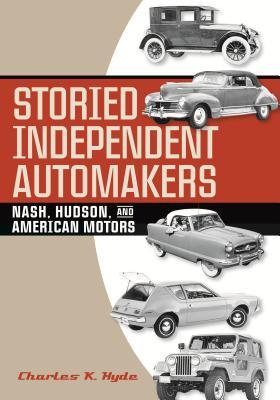
Charles K. Hyde’s Storied Independent Automakers tells the tale of the American-owned car companies that were not the Big Three. It’s a story worth telling, because they illustrated just how ruthless and consolidating the car industry is. These car companies went under or were bought out at the height of the domestic auto industry’s success (one ironic silver lining was that many of their left-hanging dealers turned to import brands and proceeded to make a fortune from them).

They had one brief moment of popularity due to a completely artificial boom when World War II resulted in years of pent-up demand. And now and then they managed to pull an innovation out that gave them a temporary edge (like compacts for AMC) until the big three caught up. But that was mostly it, and other than that it was all uphill. Hyde rightly points out it was impressive that they lasted as long as they did, and gives credit where it was due.

Though written in a history book tone (ie, it’s not exciting for anyone other than me), Hyde’s book is light enough to be readable while still containing lots of well-researched statistics on cars. It tells the story of an overlooked but important part of the auto industry’s history. Any enthusiast should enjoy it.

Review: Strong Enough To Die

Strong Enough To Die

The debut book in the Caitlin Strong series of thrillers, Strong Enough to Die is the first Jon Land book I’ve read in some time. How does she fare compared to Blaine McCracken? Well, it’s a tough question. It’s not bad by any means, but it’s still a little lacking compared to his earlier thrillers.

The plot has a lot of Land’s signature elements, and it’s not quite as jarringly mundane as Dead Simple was. By the standards of other thrillers, it’s a competent, somewhat out-there action novel. But by Land’s own high, past standards it’s not their equal. While the central MacGuffin fits, the action around it is more conventional than the craziness of the early McCrackens. The literary fundamentals being a little bit off compared to Land at his height doesn’t help either. The book just jumps around too much, and it’s too fragmented.

In isolation, I’d like this book. But its author has done better, and I’d recommend reading the Blaine McCrackens over this.

Review: The Clone Republic

The Clone Republic

A (comparably) long time ago, before the rise in self-publishing, I read a novel called The Clone Republic, the first in a series of military science fiction books by Steven L. Kent. And in hindsight, it seems kind of impressive in how it nailed a type of story that would later appear in much greater numbers. It’s a strange kind of impressiveness, but impressive nonetheless.

Even at the time, I never thought this story of a futuristic clone army was never more than a merely satisfactory cheap thriller. But it really fits the niche of what I’d call a “spacesuit commando” novel because of its “genericness”, limited technology, and weird touches. For instance, the clones don’t know they’re clones, believe themselves to be genuine orphans, and all but the main character biologically self-destruct (!) if told they’re a clone.

So this book and its series is in the “weird nostalgia segment” for me. Then it may have stood out a little by being so generic (!). Now it wouldn’t diverge from the considerably bigger pack. Still, I had fun with it.

Review: Fire Ice

Fire Ice

The novel Fire Ice holds a great deal of importance to me. It was, without a doubt, the first real “cheap thriller” a young me read. This makes it hard to truly judge its literary quality. After all, young me saw the name Clive Cussler on the cover and didn’t know at the time about how the “co-author” system worked, so I assumed it was all him (which had the thankful effect of leading me to earlier Cussler books that were indeed all his own).

With its big locales, action, and high-stakes plot with a Russian oligarch and a supervillain scheme, this has all the ingredients a Cussler thriller and a cheap thriller in general needs. Certainly, for one’s first cheap thriller, you could do a whole lot worse than that. While my reading habits are such that another cheap thriller probably would have taken its place, I still owe Fire Ice a lot for getting me into them.