The Differences

Just as how Hector Bywater’s The Great Pacific War got a lot of specifics from the later conflict off but the general feel of a Japanese-American war completely right, I figured I’d look at my Soviet/Romanian War (which I’ve outlined) and see the differences.

  • First, the absolute biggest. Instead of being against an elected government and earning massive condemnation, this is against the odious regime of Nicolae Ceausescu. The prevailing outside sentiment would be sympathy for Romania’s people, but very little for their government.
  • Second, the force structure of the invaders is different and both stronger and weaker. Belarus has been replaced with Bulgaria, which has mobilized a gargantuan army in and of itself-albeit an army that still uses T-34s (really, there were units with those, as in Romania, up until the very end). Whereas the Union of Soviet Sovereign Republics, for the most part (especially in its Mobile Force units), is a lot deeper than what I’ve seen from the Russians IRL in terms of substantive modernization (where a lot of old equipment, and, more importantly, stuff like few night vision devices and still using unsecure commercial radios beneath their shiny digi-flora uniforms)
  • Third, the invasion is a lot smoother out of the gate (note that I’m not speculating on the ultimate outcome in real life as of now). This is because, if nothing else, Romania is a lot smaller, less populous, and the invasion force is a lot bigger. Oh, and said horrendous Romanian government leading to apathy rather than near-unified disdain.

However, one thing that did appear in fiction and fact is the use of high-risk to the point of questionable VDV (Airborne Forces) operations. Of course, given their prominence, this is of little real surprise. Also, writing this post was tough, as is anything in a fluid, confusing situation.

Review: American Secret Projects: Bombers

American Secret Projects: Bombers, Attack, and Anti-Submarine Aircraft

One of the American Secret Projects series, this book looks at air-to-surface planes from the end of World War II to Vietnam. Covering everything from mammoth strategic bombers to light propeller planes, it’s an ideal aviation niche history book. With lots of illustrations, the obscure become visible.

With this book you can see all the bizarre and erratic 1950s designs. You can see how the AX project that became the A-10 started off as just a rich man’s Skyraider. This is an excellent book for any aviation enthusiast.

Review: Blood Brothers (Dallas Barnes)

Blood Brothers (Dallas Barnes)

Not to be confused with the Black Eagle Force book of the same name I reviewed previously, Dallas Barnes’ Blood Brothers is the tale of Native Americans, casinos, and underworld intrigue. It’s also the book that, because of its subject matter, has highlighted the inherent differences between me as a writer and me as a critic.

Now the book itself is a 51% potboiler in a genre I’m not the most interested in. Yes, it’s full of cliches and doesn’t make the best use of them, but it’s also competently written. That’s what a 51% book is, basically. What separates it is the element that makes up the bulk of the plot, beyond the opening “publicity stunt gone wrong” incident that drives it.

See, it’s about the struggle to build a casino. Now the reader in me was thinking “is this really the best plot for a thriller? Something as low-stakes [no pun intended] and not really that economically beneficial as a casino?” But the writer in me went “Well, uh, you made an entire book where one of the main plots was about the establishment of an online casino. Clearly you thought it would be a a suitable plot point.”

I’ve said before that I don’t think being a critic has made me a better writer, but do think that being a writer has made me a better critic. This book is an interesting specific example of that. The critic part of me doesn’t think that highly, while the writer part of me can understand.

Review: AlloAmericana

AlloAmericana: Myths and Legends From Other Americas

Alexander Wallace’s edited anthology of the folklore from different Americas is a treat. From Native American legends adopted by settlers to the West Coast from 17th century Japan to D. B. Cooper, this takes the reader through many a myth and legend. The collection of authors each brings something distinct and good to the table.

If I have any critiques, it’s that the short story collection format is only useful for a brief snapshot of a world. But that’s not the fault of the editors or authors, and some times this is all you need. I believe this is my favorite Sea Lion Press anthology to date.

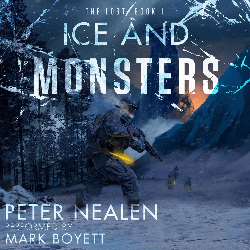
Review: Ice and Monsters

Ice and Monsters

When I saw that Peter Nealen was doing an entry in the same “Wargate” military isekai series as Forgotten Ruin, I knew I had to instantly get it. So I did instantly get Ice and Monsters. It has the same basic concept as Forgotten Ruin, only the deliberate expedition gives way to an inadvertent gate transport, as recon marines on an exercise near Norway find themselves in a Norse-themed horror fantasy world. It also has the same basic strengths-and weaknesses.

The strengths are that the action is good and the modern forces weaknesses and vulnerabilities are emphasized instead of their capabilities and advantages. The weaknesses involve not taking advantage of the potential for worldbuilding in favor of just an artificial swarm of trash mobs. What’s grated upon me after seeing it the second time is the nominal commander being a cross between a Gorman-style out-of-his-depth boss and a “we need to talk things out” nebbish. As the narrator even admits, you should have to see what local ties you can forge when severely outnumbered.

But nope, the captain is clearly duped by the Evil Magic Viking one-dimensional savages from the get-go, and all hints of moral ambiguity are tossed aside once the protagonists find a set of imprisoned “good guys”. How convenient! Yes, it’s a cheap thriller in what’s openly stated as an Adventure Friendly World. But a little more worldbuilding would go a long way.

Also there’s a personal stylistic nitpick, which is that Nealen clearly is comfortable writing in first person when I prefer his third person thrillers. But I kind of expected that. This is a decent cheap thriller but it still could have been better with just a bit more thought and finesse.

Review: Blue Masquerade

Blue Masquerade

T. K. Blackwood’s Blue Masquerade is a treat I knew I had to read. First, it’s one of those beasts that are as rare as left-handed baseball catchers or male calico cats-the conventional World War III novel that takes place as an alternate history after the Vietnam War. That its premise involves two of my personal tropes I wish got used more often made it even more appealing.

The first premise is that instead of the USSR backsliding after a successful August Coup or something like it, it reforms enough to avert such a thing. This happens here. Don’t expect to see MiG 1.42s or robot-turret supertanks here-it’s just the classic tanks and BTRs/BMPs. Still, it’s heartening to see this gimmick after wanting to for so long. The second is Yugoslavia, the tinderbox of Europe, being the catalyst for the war. This is a lot more plausible than some other World War III novels you may have heard about.

As for the substance of the book, I would call it a “51% World War III big war thriller”. It gets enough of the basics right and never comes across as truly “bad” in any way. That being said, I have seen everything it does being done better in other books. However, I’ll adjust for context, since this subgenre is extremely hard to do well. In that case, a 51% book is quite the accomplishment, like a baseball pitcher having a positive win-loss record while playing for an otherwise bad team.

If you like alternate history, conventional World War IIIs, or both, check this out. For another opinion, see Alexander Wallace at Sea Lion Press.

Review: Invasion Chronicles

Invasion: Chronicles

DC Alden’s “epic” ends with less than a bang in the last two installments, gathered with the previously reviewed two in the Chronicles omnibus. The politics do take an interesting turn, and that’s that the Evil Continental Caliphate is actually too feminist. It has women in its military in exactly the same places as its opponents (including such non-nurse/clerk roles as AWACS radar operator and explosives technician). And of course the evil collaborator ex-lawyer turned butcher governor (and not a figurehead one either) is a British woman. This all felt deliberate on the author’s part. It wasn’t a redeeming quality or the act of adapting something else. It made “sense” given how more of the vitriol was aimed at the “traitorious British” than the actual invaders, but adds to the creepiness of the books.

The last two entries, Frontline and Deliverance, have all the same issues of their predecessors. The camera is either jumping around various viewpoints or focusing on big arcs involving unsympathetic characters. Having to combine these together leads to plot contrivances clearly designed to make them tied when they shouldn’t have been. Sending a super-secret stealth aircraft to rescue several AWOL squaddies on an ill-conceived raid into Birmingham is the biggest example of this.

The conclusive battle involves a clumsy attempt at Fortress London that’s designed to try to fit a square peg into a round hole. Having to tie the high and low level parts together means it couldn’t just focus on individual danger, and having the previous war be so one-sided means a broad-scope view doesn’t work. There’s more contrived, artificial drama and a very strange series ending that’s at best a sappy dream sequence and at worst implying that the whole thing was just a nightmare (that would explain the military inaccuracies at least…)

So yes, having read this entire series, I can say that it deserves the infamy and scorn it’s gotten. Even accepting its premise as an invasion novel with all the inherent baggage, this could have been executed a lot better. As it stands, it was not.

Review: Invasion Uprising

Invasion: Uprising

DC Alden’s Invasion: Uprising follows the Anglo-American counterattack into occupied England, and manages to be (even?) worse than its predecessor in all that matters. The only real highlights are some middling amounts of mediocre cloak-and-dagger stuff and a few C-list infantry firefights, neither which can make up for the collapse elsewhere.

First, the big battles come across as something that could have been written by post-Sum of All Fears Tom Clancy. They involve Americans with supertech handily crushing their hapless opponents. Needless to say, they’re not very good. The weird and slapdash enemy arsenal is still there, as is the politics.

Criticizing an invasion novel for its politics is kind of like criticizing a professional wrestling match for its melodrama. But I feel obligated to note that the book seems to direct less of its anger towards the invaders themselves and more towards the British who enabled and allied with them, in a message that is not exactly subtle. From a series that started off iffily, this book has the “achievement” of sinking lower.

The Green Mess

In the 1905 World Series, Giants utilityman Sammy Strang had one plate appearance where he struck out. This entitled him to his complete share of the gate, the equivalent of around $33,000 today. Over a century later, another sportsman would only appear briefly yet cause a great amount of money to shift hands.

On January 9, 2022, in an otherwise undistinguished game between the Golden State Warriors and Cleveland Cavaliers, an injured Draymond Green made a ceremonial appearance at tipoff to be able to “start” with returning Klay Thompson before immediately fouling an opposing player and leaving. The result was that those who bet the under on his player props triumphed. However, this was not an issue of just him getting hurt quickly. His plan was announced shortly before the game, creating a window for people for hammer said unders.

It was an example of what Jason “Spreadapedia” Weingarten rightfully summed up as “One word: Greed”. And it demonstrates what I consider the odiousness at both sides of the sports betting industry. A big reason for the outsized losses is the presence of the “Single-game parlay”, where you can make parlay/accumulator bets (ie, you get a bigger payout, but they all have to win), on different elements of one game. Parlays are notoriously more profitable for the books overall, which is why they push them. However, the nightmare scenario is that all those blockbuster parlays (usually strings of giant favorites) actually hit. So yes, the books were playing with fire, and got burned.

However, I also have surprisingly little sympathy for the people who tried to take advantage of the error and got restricted for it. One of the secrets that a lot of casual observers don’t know are that many, if not most pro bettors (Protip: DO NOT BE A PRO SPORTS BETTOR) are people who pounce on slow/off/etc… lines instead of being super-handicappers. It’s why their complaints about being constantly restricted have fallen on deaf ears to me. And for something so obvious, I’m extra-uncaring about their “plight”.

Review: The Thousand Dollar Touchdown

The Thousand Dollar Touchdown

Time to review another thriller with a main character that has a perfect thriller name: Colt Ryder. When I saw that the premise of The Thousand Dollar Touchdown involved sports and gambling, I knew I had to read it. Ryder, the wandering “thousand dollar man”, helps people for that amount. He also kills people in the process. This time his client is the wife of an NFL quarterback. Her brother-in law has died suspiciously, and she thinks he’s been throwing games.

This is very much a 51% book. None of the elements are really that bad, and it’s short and breezy. But it falls short of being genuinely good. A bit of this is the premise: Someone who’s studied the actual way that the sports leagues have been two-faced behind sports betting, the actual composition of their management, and the actual composition of the gambling underworld will notice the oversimplifications and inaccuracies. But since cheap thrillers do not have to be accurate per se, I can wave that off.

A bigger problem is the style. It’s written in this first-person classic hardboiled type that I don’t care the most for, and that style is not the best suited for an action-packed climax where the main character performs ridiculous feats. There’s also a bit of tonal clash. The main character’s approach involves Jack Bauer-ing his way to information by beating people up until they talk, but he’s kept alive in a Dr. Evil Deathtrap after being captured because of plot.

This is a 51% book, but it’s a more interesting to review “mean 51%” than a flat “median 51%”.