Review: Blind Strategist

Blind Strategist

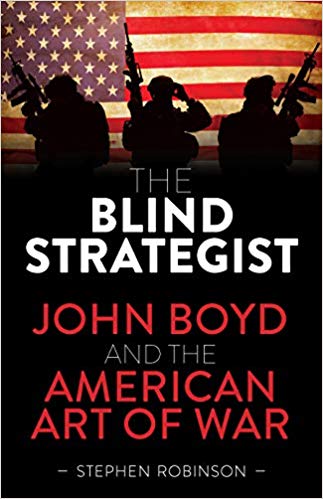
I’ve wanted a book that dove deep into the excesses of supporters of so-called “maneuver warfare”. In Stephen Robinson’s Blind Strategist, I finally have it. How is it? Mixed. Thankfully, it’s the kind of mixed that makes for a good review.

The book is nominally aimed at John “OODA Loop” Boyd. However Boyd, due to his aversion to writing anything down, his own constantly shifting imagination, and his uh, “difficult personality”, is hard to pin anything on. I do not think it’s a coincidence that Boyd’s teachings are excellent in general terms but almost never work for anything specific.

Blind Strategist spends most of its pages slamming Basil Liddell-Hart and William Lind, who did not have an aversion to writing anything down. It also talks of the Wehrmacht Legend that drove maneuver warfare activism, and defends the oft-criticized William DePuy and his “Active Defense”. (I agree with almost all of the substantial criticisms of Active Defense, but think that in the mid-1970s, the post-Vietnam US Army needed to walk before it could run). Finally, it tries to hold maneuver warfare responsible for the Iraq War’s struggles. Even I think this is going too far, and it doesn’t exactly sound convincing.

Even in its main thesis, this comes across as being overly nitpicky and a little straw-mannish. I do not believe that even almost all of the most devoted maneuver practitioners would deny that there comes a point where you have to close and destroy. Note that I said “almost all”…

…Because Lind is one of those obsessives. And here, weirdly, Robinson arguably doesn’t go far enough. Blind Strategist neglects Victoria, a fantasy where indeed, just doing the right principles and following the right footwork causes the Mary Sue’s enemy to collapse totally without the need for a slugfest. It rightly talks about him trying to shove “third-gen” maneuver war into “fourth-gen” unconventional war, but doesn’t elaborate (and should) on just how he jumps right back to his third-gen map exercises at the slightest opportunity.

I feared this book would go a little too far in the opposite direction, and it does. But I can understand, given the maneuverist min-maxing, why it would do so. I don’t blame Robinson, and if there is room for extreme pro-“maneuver” arguments, there’s also room for extreme reactions.

Fuldapocalypse Year In Review

While 2020 was a bad year for everyone, my 2021 was excellent. I made and released my first full-length novel, The Sure Bet King. It was the most fun I’ve had writing a book-ever. Really, it was a great experience. I got to write in a genre I knew nothing about when I started the blog, and know I could do a 100,000 word book.

Writing it was so smooth and fun that I actually thought I could just go right in to making the next book, which didn’t quite click (yet). But one full-length novel is better than none, and that it was a “pop epic” inspired by the likes of Sidney Sheldon (an author I didn’t know about when I started the blog) and about sports betting (A topic I didn’t know nearly as much about when I started the blog) made it all the sweeter. It really showed how the blog’s diversification paid off.

I actually found that in many ways, writing a big-scale book that took place over a long period of time was actually easier than a shorter, narrower-scope one. I could add varied scenes without having them feel like just padding. Of course, now I have the desire to make a more conventional action thriller…

Review: Small Unit Tactics

Small Unit Tactics

Because of a desire to write action scenes that are at least slightly more maybe, kinda-a-little more realistic than “hand cannons and elbow drops”, and because I’m a sucker for instruction books, I’ve been dipping into visual tactical guides. These are the kind of things the infamous Paladin Press would publish, and aim to translate from field-manualese to English (a more charitable interpretation is that they’re aimed at genuine military personnel and try to make legitimately important stuff clearer). One of them is Matthew Luke’s Small Unit Tactics. How is it?

This book focuses almost entirely on the ambush. Because I actually enjoy reading field manuals for fun, there wasn’t a lot I didn’t already know. But this is a clear example, and it talked about ambushes in a way different from how I’d previously read about them. Maybe because I had read so much about irregular forces, the type most firmly in my mind was “fire, do as much damage as you can, and then immediately try to escape”. The book talks about a further close assault, and labels that kind a mere “harassing ambush”, used mainly for deterring patrols/reaction forces.

This is a good resource for fiction writers and/or armchair generals. The pictures and photos (mostly of military exercises practicing the type of actions written in the book) are well-done, the text is well done, and it can be applied to almost any type of formation. Yes, the classic OPFOR has the simplest foot infantry tactics (unitary squads deploying in lines), but those unitary squads are still capable of launching an ambush. It’s not the be-all-end-all of research, but it’s still a very good component.

Review: Blood Debt

Blood Debt

Peter Nealen’s Brannigan’s Blackhearts return with a bang in Blood Debt. When I saw the teaser and saw that the book took place in Kyrgyzstan, I was excited. Central Asia is an excellent and underused setting. Reading the actual book, and seeing the series return to its high-powered enemy heights made me even more excited. A lot of the time fiction works best when it’s audacious, and this is definitely that.

If anything, the action is somehow improved. I got a greater sense of a (very plausible and realistic) fog of war in the action scenes without it taking away from the cheap thriller spectacle. There’s this and there’s well, the main villainess (yes, villainess) having an Esperanto-derived name. What’s not to like?

Review: Danger Close

Danger Close

Cameron Curtis’ Danger Close is kind of like seeing a local band play an original love song in a club with iffy acoustics. It’s not exactly ambitious, and you know the quality isn’t the best, but you don’t care. You enjoy the music anyway. Likewise, this ridiculously cliche “shoot the terrorist” story is still enjoyable.

It has a very predictable arc (I basically knew the fate of a certain supporting character because she reminded me of a similar one in Rambo II). It has the big burly macho ex-operator man-bro main character. It has research that somehow gets some basic details wrong. It has the Clancy/Baen-ist politics of a cliche cheap thriller and then some.

I didn’t care. Not everything can be an epic masterpiece, and not everything should be. This is disposable entertainment and should be treated as such.

Review: The Clinch

The Clinch

Nicole Disney’s The Clinch is a yuri (female/female) MMA romance. Boy, I never thought I’d be having one of those highlighted on Fuldapocalypse. Anyway, it works very well as both a romance (the main character Eden Bauer is very well developed) and as a mixed martial arts book (Disney is experienced in martial arts herself, and it shows.)

There are a few quibbles, all of which are still highly forgivable. In the book the UFC women’s featherweight division is big and prestigious. In real life it’s a tiny skeleton consisting of just Amanda Nunes and her next tomato can victim. There’s also characters having too much situational awareness in the middle of a fight, which is understandable for literary reasons but still comes across as a little forced and unrealistic.

Still, this is the best mixed martial arts novel I’ve read, romance or not.

A Thousand Words: BUSTAFELLOWS

BUSTAFELLOWS

So, it should be obvious that I’m not the target romance fiction aimed at women. But romance fiction that doubles as a crime thriller? Call me intrigued. So when I saw the Blerdy Otome Review of BUSTAFELLOWS (the official title is in ALL CAPS), I felt like I should check what’s still a crime thriller out. Hey, if an otome game took place in a conventional World War III, I’d look at it (I’d be seriously interested in how someone who came from the opposite background as most technothriller authors would handle it.)

Anyway, BUSTAFELLOWS takes place in the fictional NYC stand-in of New Sieg, where a reporter who can send her mind back in time and bodyjack someone in the past to change the present (the implications are addressed, and it’s portrayed as more limited and less powerful than it could theoretically be) gets involved with five possible love interests/vigilantes. While a visual novel doesn’t have much in the way of gameplay per se save for selecting choices, I have to say that this is one of those “PC version as a total afterthought” ports with a bizarre control scheme. Oh well. I got used to it, and the actual game ran fine.

The good news is that this is the rare “Romantic Suspense” that actually succeeds in balancing “Romance” and “Suspense”. The bad news is A: I think there’s a bit of culture clash that’s iffy but still bears little ill will (I’d expect the same from an American production that tried to tackle East Asian socio-political issues), and worse, B: The tone zigzags too much from “too serious” to “too goofy”. But these aren’t deal-breakers and I found it worth my money.

Review: Super-Squad

Super-Squad: The Now Missing Component

It’s time to look at one of the most prolific military theorists: Vietnam veteran H. John Poole. Poole’s recent Super-Squad is a detailed call for improved light infantry tactics and a different squad organization, along with a historical study of various opponents from World War I to the present.

I may have never, ever encountered a “mean 51%” nonfiction book like this one. Poole is an infantry veteran who’s walked the walk. His desires are sincere and heartfelt, and many of his goals are valid or at least understandable. Yet there’s just so much else wrong in presentation and even theory here.

The book could probably be around half of its length and work with a concise message of “This is my proposed squad organization. This is how various limited-resource opponents across history used maneuver and skill to counter their lack of direct resources. You cannot always assume superior resources, so this is vital.”

Instead, it’s a long rambling bunch of anecdotes and illustrations, often from old field manuals. Anything that shows the “eastern army” succeeding is trumpeted. Anything that shows them failing is quickly glossed over. The writing lacks humility, to put it mildly. There are statements like “no combined infantry/tank attack has succeeded except on open terrain”, which is simply untrue. The ridiculous lumping of every possible Asian opponent into generalized “eastern armies”, combined with an obsession with ninjas (really!) doesn’t exactly help much. Neither does (especially if you want change) the constant bashing of the existing American military, something that will put most people on the defensive.

This has to be understood as being like Curtis Lemay calling for a giant fleet of super-bombers dropping souped-up nuclear weapons. If your experience involves a hammer, everything looks like a nail. Everything. It gets kind of repetitive and even a little annoying at places.

I don’t regret getting this book. As an “OPFOR light infantry tactics and case studies as written by your kooky old granddad who’s convinced he can save the economy through multi-level marketing” book, it (and many of Poole’s other books, given their similarities) works for what it is. Just don’t really expect it to be anything more.

Review: Project 19

Project 19

James Ronsone and Matt Jackson’s Project 19 is an alternate history story about a far more severe Gulf War. In it, the Soviets, eager to disrupt the world’s oil supply (and thus raise the value of their own products) have more or less openly supported the Iraqis with piles of modern equipment and trained pilots. Thus they charge full-force down the Arabian Peninsula, and the squash of the historical war turns into a frantic struggle instead.

The very designation of this book (and its series) is a matter of question. It’s an alternate history “big war thriller” for certain, but even though not designated as such, I feel it deserves the term “World War III”. Yes, the location is different and so are some of the participants. But I see a giant conventional Soviet-American conflict and know only one thing to call it.

As for literary quality, it’s a little awkward. On one hand, the characters are Steel Panthers cutouts who exist to stand around in conference rooms or operate military equipment with cameras strapped to their heads so that the reader can see them. And the prose, well, sometimes it comes across as even clunkier than what I’ve read in the Kirov series. That is no small feat. Finally, while the technical inaccuracies are never more than mild, something this infodumpy has no right to get details like “Chinese T-62 copies” (which never existed) wrong.

But on the other hand, this is an extremely hard genre to write well. I’d even go so far as to say that “big war thrillers” are arguably the hardest type of fiction to write well. They’re certainly tougher and require far more balancing than normal action hero or small unit stories. What Ronsone and Jackson want to do is make a broad scope telling of a very different war. And here they succeed. It comes at the expense of a lot of other things, but this book succeeds in its main goal.

Apart from that dichotomy, I could have a few more nitpicks about the plausibility. The Soviets couldn’t supply an external country with high-end tanks without either stripping their most essential forward forces or diverting a year or two’s worth of factory production. Even there, advanced tanks didn’t grow on trees. The speed at which the Iraqis advance is more than the ideal distance of a successful operation, much less the imperfect, generally slow military that they were. But all these can be handwaved aside in the name of wanting to provide a challenging opponent, which is where this succeeds. I particularly like the US military being placed in a position where it doesn’t have total air control right away.

So in conclusion, this book has many virtues and flaws. Though not the best example of its subgenre, it’s nonetheless readable for fans of Larry Bond and the like.

Review: Russian and Soviet Ground Attack Aircraft

Russian And Soviet Ground Attack Aircraft

Alberto Trevisan and Anatoly Borovik’s Russian and Soviet Ground Attack Aircraft is the latest addition to my collection of technical, diagram-filled books on aviation history. It’s meant to be a comprehensive, picture-heavy catalogue of all the “Samolety Polya Boya”, a term that can be very awkwardly translated to [their definition] “Battlefield Aircraft”. The “Russian” in the title is accurate, as this book also includes World War I and post-1991 designs.

The “Samolety Polya Boyas” in this book range from the famous Il-2 and Su-25 Sturmoviks to low-end propeller planes to high performance edge cases like the MiG-23BN/27s (the proposed but never adopted final upgrade package that included the ability to mount radar pods and refuel in midair warms my Flogger fan heart). It also looks at never-were designs in the same range, most notably the postwar Illyushins, which were victims of technology, doctrinal changes, and being extremely ugly.

Some of the types it does and doesn’t focus on can feel a little arbitrary. While I suppose that’s the perils of dedicating a book to as vague a term as “ground attack aircraft”, I feel obligated to point it. Thankfully their choices never feel too weird or too bad, and I can understand the desire to avoid mission creep.

If I had one quibble (besides a somewhat iffy layout), it’s that there isn’t enough “how” in the book for my tastes. I would have liked to see an Air Battle Central Europe-esque section on the doctrinal “division of labor” between them, helicopters, and higher-performance bombers/strike aircraft, and how it evolved and changed. While I can get information on that from other sources (and/or intuit it based on capability-your slow short-legged ground attackers are not going to be used for deep, well-defended targets if they can help it), it’s still a lacking feature.

But the rest of the book is still great. The artwork is excellent, the list of aircraft covered is very big despite its self-imposed limitations, and the technical detail (especially for paper aircraft with fewer sources available) is surprisingly high. Even without the parts I would have liked, this is still a great resource for a centerpiece of the VVS.