Review: Praxis Tacticum

Praxis Tacticum

Canadian retired colonel Chuck Oliviero has released the new Praxis Tacticum. It’s one of those “mean 51%” books, being incredibly erratic. Much of the actual content is not objectionable-ie, “learn to face someone who isn’t a low intensity, technically inferior opponent”. Some of it is stuff even unqualified armchair general me picked up-me being the OPFOR addict I am, I’ve seen journal articles complaining about the rigidity of the OPFOR in practice compared to its flexibility in theory that he states. And some of it, however much I’d disagree with, is at least defensible and understandable. Oliviero is much, much more of a “manueverist” than I would be.

Plus, anyone who wants to simplify documents and instructions into something that isn’t in field-manualese has their heart in the right place.

However, the execution does not come across as ideal. For something aimed at lower-level commanders, it feels far too pretentious and buries the important stuff (stuff like how to do rapid drills and move a unit very quickly without outrunning your supply lines), in a mess of pompous mush. His decision to have a flexible, winning OPFOR (good) turns into an embrace of exercise munchkinism. This also has its heart in the right place (again, an opponent with the ability will seek to disrupt your setup and can often succeed) but I had the uncomfortable feeling that it was just him wanting to show off his supposed genius, crossing the line too often from “spar in an unconventional way” to “spar in traditional boxing and then instantly launch a Masvidal-Askren flying knee to crush your partner before patting yourself on the back.”

And this is the biggest problem. There is a very, very, very obvious barely disguised subtext of resentment that he didn’t get to be in charge throughout the book. High technology is treated with skepticism, unless it’s on tracks. Like everyone, Oliviero comes across as unavoidably biased-but he takes it to extremes.

I would recommend this for enthusiasts or intellectuals who have a full grasp of the context surrounding this book. Yet from my limited viewpoint, I actually would not recommend it to his target audience. It comes across as too slanted and inefficiently written.

Review: Sporting Blood

Sporting Blood

Carlos Acevedo’s Sporting Blood is a nonfiction chronicle of boxers at their worst. Not at their worst in the ring, but at their worst out of it. His writing is excellent and well-handled (legendary boxing historian Thomas Hauser praises him in the foreword, no easy feat). It’s just the book can get a little repetitive.

There’s some interesting entries, like a 1920s prizefighter prolonging his career through quack medical surgery. But so much of the book is just one entry after another detailing how a boxer got beat up, lost his brain, lost his temporary money, lost his prestige, and sank back into the terrible life he came from. And then there are the stories of how many of them had terrible upbringings-the tale of boxing trainer Tony Ayala Sr. and how he treated his sons was especially disturbing. (Sadly but unsurprisingly, one of them became an absolute monster).

This isn’t the author’s fault, but it does make for melancholy reading. And it also details why the talent pool of American boxers shrank so dramatically after World War II. Because given a choice between that and another career, athletic or note, who would want to subject oneself to the vicious free-for-all of boxing?

Review: Deception

Deception

Zach James’ Deception is a debut thriller by a debut author. While it has some roughness around the edges and is a little clunky plot-wise in terms of jumping around between times and places, it does enough right to make me forgive it. I’ll even forgive the description of “Hudson Bay” as being close to New York and not close to northern Canada.

Hopefully the announced and obviously set up sequel will improve the writing fundamentals. But this is still a good action read and a good enough cheap thriller. Welcome to the community of thriller writers, Zach James!

Review: WagerEasy

WagerEasy

It took me a long time to actually read the sports betting-centric thriller/murder mystery WagerEasy by Tom Farrell. This is simply because I was writing my own book centered around that industry, and didn’t want any, however accidental, cross-contamination or subconscious comparisons. So I only took it up after I finished The Sure Bet King.

That being said, I needn’t have worried (at least in hindsight). WagerEasy is a first-person thriller where the same general subject matter is the only thing it has in common with my own novel. It’s very much an apple to an orange.

So how is it as a book? The answer is-very good, even with me not being the biggest fan of first-person narration or the “hardboiled” style it tries to go for.While I feared it would be just dreary and grubby at first, WagerEasy turns out to have high stakes in a clever way and effective action set pieces. In fact, one of the action scenes in the middle of the novel had me going “Really?” And I meant it in a good way. Like, this could have been written by Jon Land. And Farrell definitely knows his stuff concerning sports betting itself (although I was a little surprised there wasn’t more discussion of the reputation European sportsbooks have for banning/ultra-restricting winning bettors). So I enjoyed this a lot.

Review: ATP 7-100.3 Chinese Tactics

ATP 7-100.3 Chinese Tactics

After seeing the excellent work on North Korea, I eagerly awaited the next installment in the ATP 7-100 series on the most potential opponents. When ATP 7-100.3, Chinese Tactics dropped, I was not disappointed. Well detailed and well laid out, this is the first comprehensive unclassified analysis of the PLA in decades.

In some ways, being a far more advanced opponent that’s far closer to the fictional maximum-challenge “composite OPFOR” than North Korea is means that the tactics shown feel a lot more mundane and slightly less interesting. But showing the (deliberately overcomplicated and confounding) organization is where this shines. The modern PLA is organized a lot like the old “GENFORCE-Mobile” OPFOR with a bunch of brigades and combined arms battalions jumping straight to corps-equivalents with six line brigades each.

This is a great resource and I highly recommend reading it. Besides its topicality, seeing a force structure diverge from the classic Russo-American style is interesting to see and valuable for wargamers.

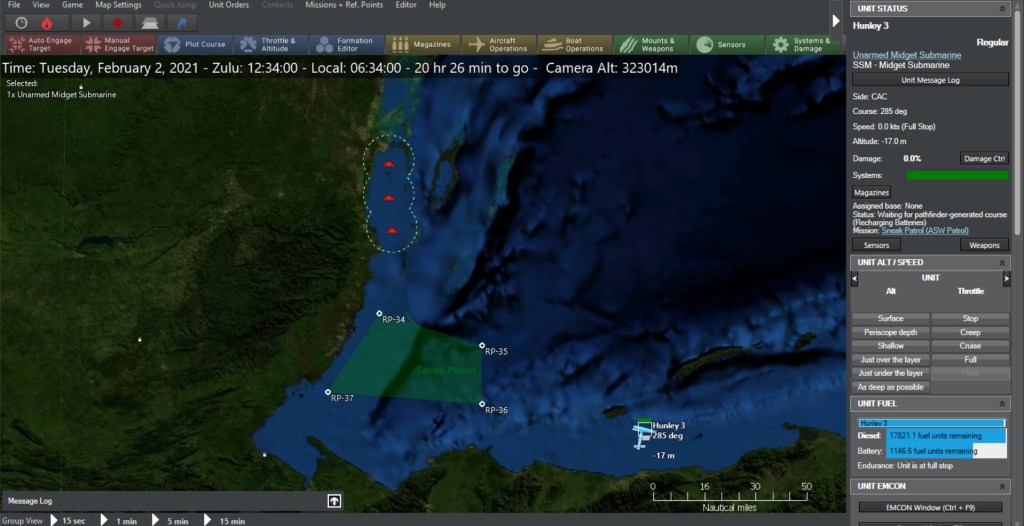
New Command scen for testing: Sneaky Sneaky

I got back into making Command: Modern Operations content with another draft scenario that I’ve called Sneaky Sneaky. It’s in an alternate historical setting where a “Walkerist” rogue state survived in Central America. Now they have to try and slip a few improvised mini-subs past the Royal Navy to Belize. Much inspirational thanks goes to the Covert Shores website for its great work on analyzing such submarines.

The scenario can be tried out here.

Review: Our Man On The Hill

Our Man On The Hill

Matthew Kresal’s debut on Sea Lion Press (full disclosure, I’m published there too) is Our Man On The Hill, a story which takes a bit of historical commentary and plays with it. It’s been said that Joe McCarthy was such a blustering bumbler that he actually did damage to legitimate anti-communism. Thus Kresal turns into him being a Soviet agent intended to sabotage the opposition.

Though not exact, this has parallels with Agent Lavender, the book that started SLP in the first place. Both make alternate histories where a conspiracy theory about a huge political figure (Wilson, McCarthy) is treated as true. Both are well researched. And both are excellent reads.

Even though I’m not generally the biggest fan of this kind of political/spy story, Our Man On The Hill is well done enough that I had a blast reading it. I highly recommend this book.

Review: North Korean Tactics

North Korean Tactics

One of the best OPFOR manuals I’ve seen, and one of the most recent, is ATP 7-100.2, North Korean Tactics. The manual itself is a good read, and the “Breaking Doctrine” podcast that comes along with does a great job explaining how both it and other OPFOR documents (a long weird guilty pleasure of mine) have come into being.

Thus the manual isn’t a direct “They will do this” the way that some of the more overly rigid Soviet-inspired ones were. But it does show the characteristics of the secretive country (light infantry, high willingness to take casualties, artillery over tanks, etc…) and has to focus on its specific qualities instead of just lumping them in with a generic OPFOR designed for challenge above adherence to any specific country.

It’s not perfect, but it’s intriguing and well-done, showing the seeming contradiction of mass asymmetric warfare in action. Ones for China and Iran are planned, and I’m awaiting them. (There’s one for Russia announced, but it’s kind of in limbo. My hunch is that the need for something so specific is less for a country that’s already studied and already fairly close to the generic OPFOR).

Review: Dodgebomb

Dodgebomb

Darrin Pepple’s Dodgebomb is a historical fiction novel about the Iraq War. I will freely admit that plain historical military fiction, as opposed to alternate/never was conflicts, just isn’t my favorite (sub)genre. Nonetheless, this is a very good book.

The work of a veteran, it shows. Everything rings true, and it’s overall a well-written piece. Occasionally there are overly clunky paragraphs and/or descents to Herman Melville levels of detail, but those are small nitpicks. This is an excellent novel and I highly recommend it. Often it’s hard to describe how I like something as opposed to how I didn’t like it, but trust me-I liked this book.

Review: Nonstate Warfare

Stephen Biddle’s Nonstate Warfare aims to debunk the myths around warfare featuring nonstate actors and point out that there really isn’t as clear a line as thought between “conventional” and “unconventional” warfare. As I’ve been annoyed by the use of the terms “Hybrid War” and especially “4th Generation War”, I was eagerly awaiting this book. However, I found the execution significantly flawed.

Now, the premise is sound and well supported, which makes the flaws in outcome all the more severe. Basically, even the most mass-mobilized total wars with the clearest defined front lines have an irregular and/or deep element (he uses the excellent example of partisans on the Eastern Front in World War II). Likewise, even non-state elements can and have fought battles with large forces, heavy weapons, and the aim to hold territory. Very few people would dispute this. Biddle also points out that the progress of industrial-age technology means that ill-equipped irregulars can have weapons that the most advanced world powers didn’t have a few decades prior.

None of this is really controversial, and simply stating that would make for a very short book. What would be useful would an example of middle-level armies that don’t fit categories very well. Biddle does do this, with his descriptions of the Sadrist militias in the Iraq War and Adid’s forces in Somalia fitting well. He also has an interesting analogy with a spectrum from “Fabian” operations (a reference to the Roman strategy of avoiding defeat) to “Napoleonic” ones (a reference to seeking decisive battlefield victory). To be snarky, Fabian operations to excess are Kalib Starnes spending the entire MMA fight running away from Nate Quarry, while Napoleonic ones are the bandit in a Bethesda game charging the player in super-armor.

Unfortunately, this is written in clunky academese. Biddle uses a rigid scale to rank various forces from “Fabian” to “Napoleonic”, one that I found to be too rigid for an inherently arbitrary judgement. His writing is full of hair-splitting and nitpicking of what honestly feels like a strawman that everything is either phalanxes on a field or nothing but backstabbing. There’s weird hangups like a fixation on force density for its own sake, obsession on individual technical examples (so Adid had TOWs? So what? Even in 1993 it wasn’t like they were stealth fighters), and not enough focus on non-state forces supplied by state ones.

I wanted to like this book. And I don’t disagree with the overall point. But it could have been made just so much better. This feels like an academic squabble in academic language, when a plain-text history of case studies with “conventional irregular armies” would have been far more suitable in promoting the argument.