Review: Weapons and Tactics of the Soviet Army

Weapons and Tactics of the Soviet Army

David Isby’s 1988 edition of Weapons and Tactics of the Soviet Army is perhaps the missing link in the OPFOR puzzle. I have to give the obligatory “this is a Cold War western source” to get it out of the way. That being said, once basic prudence is applied, this is an amazing compendium.

It covers every single major weapons system in the 198X Soviet army detailing not just the paper specs but also the intended doctrinal use and actual combat experience in Afghanistan or with foreign armies. This comprehensive look at the whole and not just the sum of the parts is sadly too rare and is very welcome here.

This is a rare, expensive, and massive book. But it is well worth it to any scholar of the Fuldapocalypse.

Review: Midnight Ops

Midnight Ops

Midnight Ops is the latest Duncan Hunter book by Mark Hewitt . It is also not just the worst in the series but the worst “thriller” novel that I’ve read. Ever. At least as of this post. And I do not mean this lightly. Having read literally hundreds of these books, I’ve reached the point.

So the Amazon blurb mentions a defecting F-22 that flew to North Korea as the MacGuffin. Well you will be “glad” to hear that it takes two thirds of the book to even reach that point at all. And then it goes back to what it was previously doing. What was it doing?

Political rants. I’d say it’s like reading the Facebook page of your boomer uncle from rural Oklahoma, but that would be an insult to boomer uncles from rural Oklahoma. If you trained an AI model on nothing but conspiracy talk radio transcripts and then let it rip for five hundred pages, you’d have this book. But I’m still pretty sure the AI could do better.

The worst part is that I used to like this series! It had the same ridiculously right-wing politics and unstoppable Mary Sue, but could be fun in a Mack Maloney manner. This isn’t. The actual ‘action’ is the same repetitive easy victories that feels like an afterthought. It’s easy to tell the real emotion is in the rants.

So yes, I’ve found the new worst (thriller) novel ever. Welp.

UAV Classes

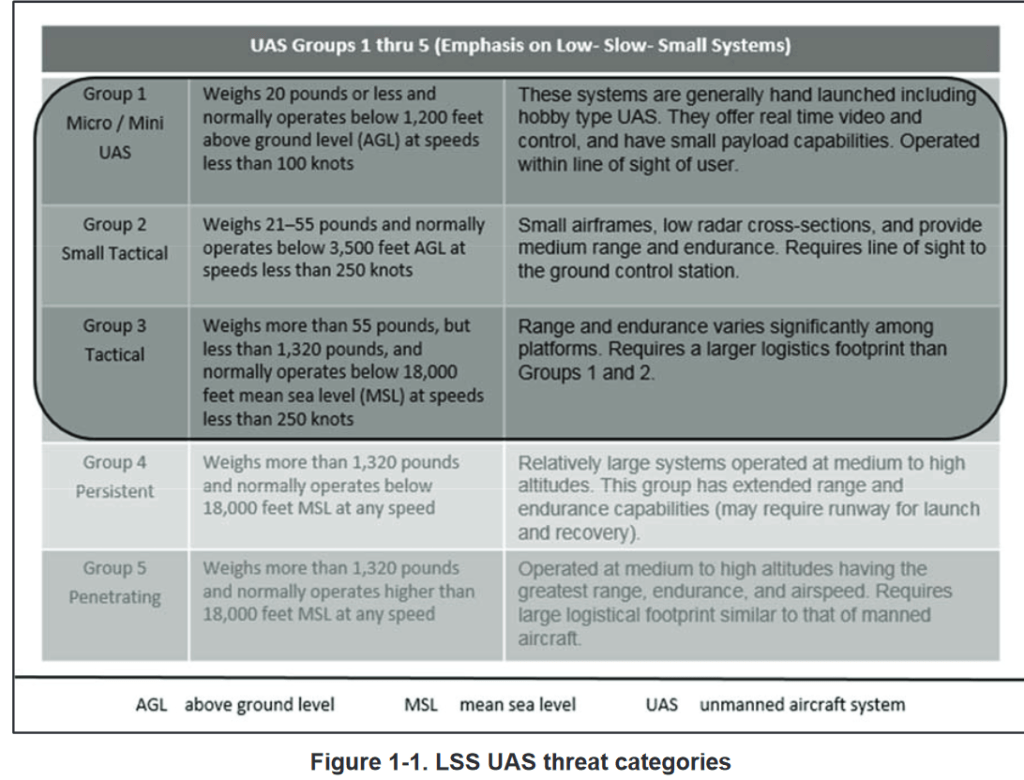
The US Military has five official group of UAVs/drones.

(from ATP 3-01-81)

The standard hobby drone is a Group 1. Smaller military drones are groups 2 and 3. The ScanEagle is the best American example of a Group 2. The classic Iowa spotter Pioneer is a Group 3, so is the RQ-7 Shadow. Heavy attack drones like the Predator and Bayraktar TB2 are 4, while monsters like the Reaper and Global Hawk are 5.

Review: Super Mirage 4000

Super Mirage 4000

Finally translated into English, this is a look at what was to France what the Avro Arrow was to Canada, the TSR-2 was to Britain, the Lavi was to Israel, and the Osorio tank was to Brazil. (Or what the AMX-32 and AMX-40 tanks were to… France).

It’s what you’d expect from a small coffee table book whose sources came from inside the program: A combination of knowledge and bias, mixed with tidbits without being the deepest. This isn’t a bad thing if you know what you’re getting into, and the plane is certainly worthy of such a book.

On Star Wars

Now I want to say that I’ve liked a lot of Star Wars stuff. I don’t mind the setting, I’ve seen 2/3s of the official movies. Like any big setting it has its ups and downs. But I definitely don’t hate this.

However, I feel obligated to say one thing about Star Wars that I believe. It is the most overrated work of modern fiction, and this overrating has made it impossible to judge. What you have is first a trio of fun sci-fi pulp movies that get treated as if they were more than fun sci-fi pulp movies, because they were a breath of fresh air in the pretentious dark tone of 1970s science fiction. Then you have a giant franchise.

Next you have the prequels, which are basically what happens when a Dunning-Krugered director gets free reign to run amuck. People nowadays are swinging towards defending the prequels in a dose of inevitable “defend midsize sedan cars the minute they stop being popular” hipsterism. Although I don’t blame them, because…

Then George Lucas cashed out and the Mouse Machine made the sequel trilogy. Now I had little desire to see them in full personally, and everything I saw and heard reinforced that desire. When I finally, recently looked at them in more depth, I was even gladder. At least the first six were works of genuine artistic imagination. These are just rehashed play it too safe mush piles that don’t understand the feel of their setting.

(Not so small side note: Devereaux’s excellent blog has the point in a review of fellow cash grab Rings of Power that authors are obsessed with winning battles via an unrealistic One Neat Trick. That plus “why didn’t they fly in on the eagles” ”’rationalism”’ leads to the infamous hyperspace ram.)

Soviet-Romanian Air War

With All Union now on a little cooldown, I figured I’d share my exposition/notes about the Soviet-Romanian air war:

Overall course of the war: Starting on September 8, 1998, the Sovereign Union invaded Romania with two fronts (army groups). The northern Dniester Front was arguably the most advanced and powerful fighting force in history at that time. That combined with good terrain made it sweep south in close to nine days. The southern Danube Front had a more difficult task in the form of more fortifications,more cohesive defense, the daunting task of crossing a massive river opposed, and the bulk of it consisting of forcibly mobilized Bulgarians. Still, after the same nine days they had encircled Bucharest and linked up with the Dniester Front. For the rest of the month they prepared to storm the city, continued bombardment, and tried to push for a surrender that eventually came.

In the end, the USSR lost around 3,500 soldiers and the Bulgarians and other minor allies around 7,000. Romanian casualties are almost literally uncountable with at least 70,000 being essentially confirmed and with estimates as high as 120,000 KIA.

Now for the air:

The USSR’s air force was a curious mixture of everything from the hyper-advanced Su-37 Fermion fighter to dozens of ancient Il-28s. In general, METT-TC was used to allocate things, with older planes doing area strikes with smother/splash damage weapons in the daytime and newer ones using PGMs at night whenever possible. While not perfect, it was extremely devastating.

Romania:

The initial fire strike took out around five hundred Romanian aircraft on the ground, over 80% of its total. This caused a lot of panic in the USAF after the war. A few planes made it through, most notably in the defeat of a Danube Front forward detachment at Alexandria very early on. Otherwise Romanian aircraft were limited to tiny nuisance strikes and suffered very heavy losses while doing so, though surprisingly few to the vaunted SAMs. (Total air superiority+tons of friendly Soviet aircraft = a very short ROE leash and lots of fighter opportunities).

What’s In A Space Warship Name

(That I’m interested in this topic just as I’ve gotten into Starmada is just a coincidence, I swear.)

Atomic Rockets is a great site for semi-realistic spacecraft design. However, one of their contributors was adamant about not transplanting ship names wholesale from maritime ones, as has happened many times before. Is this a sensible avoidance of tropes or just hipsterism for the sake of being different?

I feel it depends on the setting and tone. IE Warhammer 40k and its broadside space cathedrals and obvious Age of Sail symbolism can adopt naval terminology just fine. But there are understandable reasons to avoid the ‘superdreadnought’.

Names I think could make the cut:

  • Battleship. Pretty self-explanatory.
  • Carrier for anything carrying smaller craft. Also pretty self-explanatory.
  • Gunship/gunboat. I think this has already passed one test in that plenty of real aircraft are called gunships, and an added bonus of being a good literal description for many designs. (IE, big weapon on a spinal mount the rest of the ship is built around).

Cruiser, Destroyer, and Frigate are already a mess and have been for decades if not longer. These smaller ships are probably the best to make up your own terminology for (ie “Dragonship”).

Review: Starmada

Starmada 30th Anniversary Edition

I was looking for something to scratch my spaceship wargaming itch. A set of generalist rules that you could apply to basically any setting and have a semi-reasonable approximation of things. Enter Starmada. Now its newest 30th anniversary edition, it lets you build and battle on the tabletop whatever ships you can imagine.

Naturally as a generalist set it lacks specific gimmicks, with anything offensive having to be translated into weapon qualities (ie a big area blast would be “proximity”, and a powerful kinetic cannon shell would be “crushing”) and anything defensive being translated to either “screens” (roll above X or the attack fails) or “shields” (takes a hit before anything else). You get the idea.

It requires some imagination. But if you have imagination and a willingness to abstract, well let me just say that even my initial crude playtesting sessions had me beaming bright. Want to play as a cumbersome pure brute force fleet going against an agile but brittle rapier? This lets you do all that and then some.

Review: Eastern Front 1945

Eastern Front 1945

An Osprey book on the air war in WWII’s final year, Eastern Front 1945 is about the often-overlooked in the west clash in the eastern skies. It basically does every Osprey book thing right. While it’s not the most detailed, it provides an excellent overview of the somewhat different air war (ie, where the P-39 shined even as it flopped in other theaters).

One thing I particularly liked was how the book accurately showed the air campaign’s influence on postwar Soviet/Russian doctrine. Instead of a “big blue blanket” smothering every enemy in its tracks, it was focused on targeted air superiority and supporting maneuver formations. Which led to February 1945 when the Luftwaffe actually regained air superiority for a time. ( In short, they pulled more or less every propeller fighter away from the fruitless bomber interceptions and were were able to operate from intact developed airbases while the Soviets were worn and had their field strips wrecked by bad weather)

It’s a good look at both Soviet air doctrine being successful and at the eastern air war.

The Imperium Vs. The Death Star

So the question has to be asked: What about this?

Original source

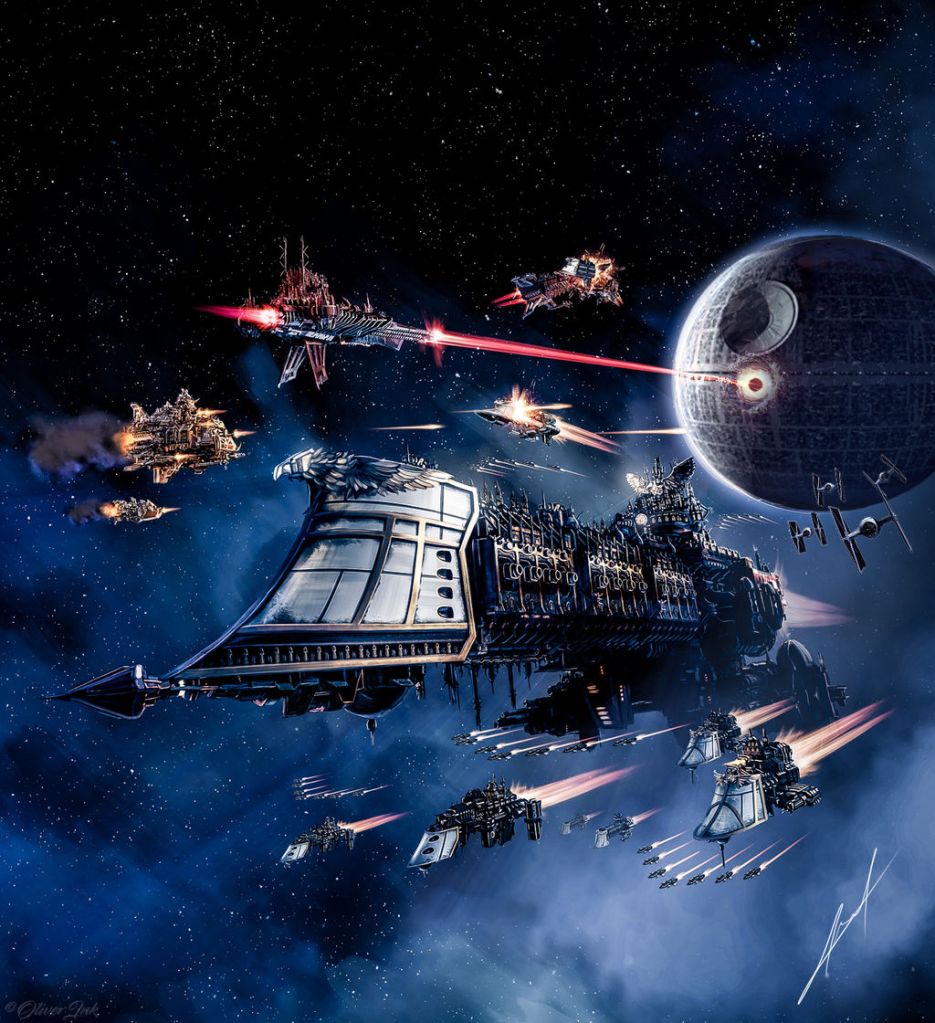
A Star Wars/Warhammer 40k crossover has to include the battles of evil vs. slightly more justified evil and feature a large Imperial Navy cathedral armada going up against the Death Star (presumably with its own array of Star Destroyers). Now I have put some actual thought into this.

  • The Imperium is not likely to be terribly fazed by the Death Star, thanks to confrontations with giant horrific superweapons being known as “Wednesday” over there.
  • If they cannot overpower it via masses of lances, nova cannons, and whatever other exotic tricks they’d undoubtedly pull out (ie psychic lashes, vortex torpedoes to just shunt it into the warp, etc…), for the main Imperial Navy it would be difficult to duplicate what the Rebel Alliance did. The reason simply is because Warhammer 40k space fighters are substantially larger than their Star Wars counterparts, and their ordnance is the same.
  • However, moving in for a pinpoint strike on a difficult but decisive target is the exact thing that Astartes were made for. So trench runs of Thunderhawks, vacuum chainsword fights, and tossing a melta bomb down the port would make for a fitting story.