Review: The Thran

The Thran

J. Robert King’s The Thran is meant as a backstory novel in the setting of Magic: The Gathering. It tells the story of the ancient civilization that only existed in ruins by the time of The Brothers War, and the rise to power of Yawgmoth and Phyrexia. This setting, with its fusion of magic and technology (of course there are airships), and especially the twisted technomagical nightmare of Phyrexia itself, is my favorite part of Magic.

The setting and premise is good, as is its antagonist’s/evil main character’s portrayal, but this book desperately needed a better author. Lynn Abbey did Phyrexia’s nightmare justice in Planeswalker. King does not. Not only is the depiction of the human Yawgmoth merging with the plane done in a very “straightforward” manner, but he even “unplugs” and returns to being normal throughout the book afterward, as if the author didn’t feel like writing cosmic-level fantasy.

Which is a shame because not only is the setting good, but the alternate possibilities are there too. The Thran Empire was not exactly a paradise, and Glacian, the withering master technologist, comes across as someone who’d make for a great blue mana-themed villain in his own right, obsessed with building the better mousetrap at any cost. It’s potential that King simply couldn’t realize. So this feels like something only lore completionists would really like, which I feel was probably always the case.

Review: Enemy Of My Enemy

Enemy Of My Enemy

It’s been a long wait, but Peter Nealen’s Brannigan’s Blackhearts have finally returned in Enemy Of My Enemy, the latest installment in the series. The crew heads down into the Caucasus on a mission that’s dubious and ultra-risky even by their standards, and the result is a typically solid thriller. By now I know the structure used in the series, but that doesn’t make it a bad thing.

What’s interesting is that I’ve read this series so long that my tastes have shifted against its trends multiple times. When it was doing a giant multi-book arc, I’d gotten a little annoyed that it had abandoned light, easy standalone pieces. Now that it’s back to standalone books, I’ve gotten a little annoyed that it’s moved past big, ambitious arcs. But these are only small annoyances. They’re understandable and the works underneath are still excellent.

Review: The Betsy

The Betsy

Harold Robbins was an author with a…. “reputation”. As successful as he was sleazy, Robbins turned to the car industry in The Betsy. The number of fictional novels centered specifically around the automobile industry is tiny-it makes conventional World War IIIs look like Harlequins in comparison.

It’s a story of sleaze, the struggles of Ford-esque Bethlehem Motors, and more sleaze. Oh, and bureaucracy as well. There’s a lot of that too. Robbins’ writing “style” can be determined right from the very start, as the first-person narrator appraises his nurse.

However, the rest of the book is a bizarre jumble. There’s the ridiculous exaggerated sleaze that everyone knows him for along with countless meetings about cars and the titular car in particular. It has the personalities of Ford, but the market share of one of the struggling “independents” like AMC, the “auto side isn’t profitable while the non-auto side is, so we want to leave the auto business” situation that characterized Studebaker, and oh yeah, the actual car companies of the past still exist as well alongside this upstart.

The impression is one of knowing the basics but not the whole. The Betsy is supposed to be powered by a turbine, making it the car version of the T-80 tank. Compared to its rivals with conventional engines, it would probably, like that tracked vehicle, offer a little more (theoretical) performance, regardless of raw power, at a lot more expense. Chrysler’s turbine car program failed. A struggling, close-to-stopping car company likely wouldn’t/couldn’t have funded it. The impending gas crisis or any fuel price increase would probably stop it, and it’s unlikely even a initial success would…

…Yeah, I’m probably overthinking things. It’s just I’ve read so much about the actual history of the actual auto industry that it feels like I’m obligated to critique it that way. But I do think Robbins threw down the gauntlet by including so many meetings and so many details.

Anyway, there’s meetings, weird sex scenes, more meetings, car scenes, even more meetings, even more weird sex scenes, flashbacks, and did I mention meetings? This unfocused narrative isn’t helped by the perspective shifting from first to third person at various intervals. While the prose is decent when not having to describe anything either tasteless or dull, the plotting is horrendous.

The obvious comparison is to Sidney Sheldon, who relished in “gilded sleaze”. But Sheldon was far more coherent in his writing and, as weird as it sounds to say it, actually more tasteful as well. Go read Sheldon instead of Robbins if you want “sleaze in high places” done better.

Review: The Ninja

The Ninja

Eric Van Lustbader’s The Ninja is a very fascinating book. On one hand, it played a big role in the 1980s “Western Ninja” craze. On the other, the book itself is… bad. To put it very mildly.

The actual substance of the first Nicholas Linnear novel consists of little more than sleaze, padding, and ridiculously purple prose. I mean, it makes Kenneth Bulmer at his worst look like a field manual in comparison. That’s how bad it is. What’s interesting is how it was successful.

While literary tastes can be very different, this still feels strange that what got a subgenre going was something like this. It’s as if The Hunt For Red October was a thousand-page impenetrable mess where the protagonists effortlessly sink the Northern Fleet. Or if War Against The Mafia was full of exclamation points! in weird spots and couldn’t even keep its main character’s name consistent. It’s something, but it’s not exactly something I’d recommend.

Review: Dance of the Vampires

Dance of the Vampires

The ebook Dance of the Vampires is a behind-the-scenes look at the wargaming Larry Bond used for what would become Red Storm Rising. It’s fascinating to see how this battle was conducted. For someone who’s worked on Command, seeing this comparably ancient system is like looking at one of Naismith’s original basketball games.

Most of the book is composed of after action reports and figures detailing the games. Besides the ones that play out similarly to the actual book, there’s a short summary of the “Keflavik Turkey Shoot”, a scenario where the Soviets attempted to force the GIUK Gap with heavy bombers and got crushed (despite legitimately clever play on their side). This was what required them to take Iceland in Red Storm Rising proper. The smaller-than-I-thought presence of that country in World War III fiction started here.

This is in many ways a book about struggles, because they were on unfamiliar ground, and not just about rivet-counting specifics. When something like this hadn’t been done in this way before, there’s bound to be issues. And there were. But the results were still impressive, and so is this chronicle of the wargames. For those interested in this kind of history, I can recommend this book.

A Thousand Words: The Sumerian Game

The Sumerian Game

Putting this in the “A Thousand Words” category might be a little awkward because this is a text-based simulation, but The Sumerian Game and its successors like Hamurabi (spelled that way due to programming limitations) were among, if not the first, long-form strategy/management games. Using text-based inputs and randomization, you could either succeed massively or fail just as massively.

As my family enjoyed the classic Simcity games when I was younger, I thought it was very interesting to find what started it all, or at least what popularized it all. Like OXO (A tic tac toe simulator playable on one of the first computers), this stands as a piece of gaming history. Simulations had to start somewhere.

Review: Jericho

Jericho

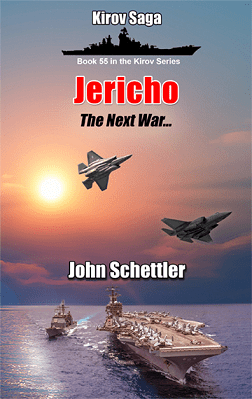
The 55th book in the Kirov series and most recent as of this post, Jericho is a victim of the series’ structure. In it, the third World War III in the series rages on, as wargame lets plays naval fighting rages off the coast of East Asia. There amphibious landings and tense reinforcement missions. There are also big naval battles where tons of offensive missiles are fired and tons of defensive missiles are fired.

The problem is there were six books in this arc before of big modern naval battles where tons of missiles are fired. And then there was an eight-book arc before this one with plenty of naval battles where tons of missiles were fired. You see the issue here?

Even with keeping the “huge set of wargame lets plays” structure, there’s a lot that could be trimmed. The novelty of a toy box with unique force structures is bound to wear off after several books of seeing that in action again and again. It happened in the previous arcs, and despite this (deliberately) being more out-there than the earlier World War III, by now I’m used to seeing the platforms, formations, and paper-thin Steel Panthers Characters crewing them. The actual simulations could still happen while not going into detail on the least important and/or dramatic of them. One can novelize a game without detailing every single encounter.

As for the central characters, well, they’re not very significant here. Part of this is just that the series is getting ready for the next big arc (insisted yet again to be the final one in the series), but there just aren’t that many words devoted to them in this novel. They’re just there to crew ships like the other to-be-erased cutouts.

This feels like a sports game late in the regular season where nothing is really at stake for either side and there’s no traditional rivalry to spice things up. Yes it’s sports/a Kirov book with wargame battles and jumping plotlines in it, but the feeling of being something greater just isn’t there. It’s understandable given the structure, but that doesn’t change the lackluster quality of the specific novel/game.

Review: Blood Vortex

Blood Vortex

The newest Mack Bolan, Blood Vortex is the 464th (!) Executioner novel. It’s also the last Executioner book planned, or at least the last Gold Eagle/Harlequin one. Thus this marks the end of an era lasting nearly forty years.

In it, every single terror group gathers in Venezuela for a meeting and Bolan has to stop them. So basically, this is like a serious version of The Naked Gun’s opening. The tonal dissonance here is an issue I’ve noticed in other Gold Eagles. Other cheap thrillers often successfully go for either a grounded or audacious tone, but these tend to have seemingly goofy premises that are countered by a self-serious tone and flat execution.

We get long descriptions of each component of the League of Evil arriving at Venezuela. There’s not just over-description of weapons, but over-description of weapons in a very clunky way. There’s also just as clumsy exposition that reads like Wikipedia excerpts about other things. Another big issue I’ve seen with some of these men’s adventure books (including Gold Eagle Bolans) is that despite their short length, they still contain lots of really obvious padding.

Then there’s the other thing I’ve noticed in these Gold Eagles, which is that the infodumps on anything bigger than a bazooka are frequently not just wrong, but blatantly wrong. For instance, the AIM-120 and Kh-59MK2 (yes, the book uses that exact designation) are considered “equivalents”, dubious when the latter is an air-to-surface missile. And the context in which they appear is a paragraph of pure filler.

But what about the action here? Well, it manages to be adequate-at best. There’s a lot more flow-breaking internal monologues here than in other cheap thrillers, and it never rises that high. And this has the problem of going against a mega-saturated genre.

This isn’t some kind of grand finale and there’s no attempt to make it one. Like a lot of “men’s adventure” novels that stopped, it’s just one installment among others. This is like the last nondescript econobox car rolling off the assembly line, long after the rest of the auto world passed it by. This isn’t a dinosaur, it’s a trilobite, with its genre’s business model being obsoleted twice. A series that became disposable and interchangeable (really, look at all the “mass production” and “assembly line” metaphors I’ve used in past reviews) was bound to conclude in such a way.

Review: Threat Warning

Threat Warning

The third Jonathan Grave “shoot the terrorist” thriller, Threat Warning remains mostly as good as its two predecessors. However, it backslides just a little, as I’m seeing plot elements decisively solidify. The first part of this isn’t too bad, simply featuring Gilstrap deciding on a certain style and it becoming less novel to me. Any long series would have this problem.

The second part is that it features my “this isn’t the movies-it’s worse!” pet peeve where the books go into a lot of semi-realistic detail, and then Grave turns into John Rourke and can fight off giant armies of goons on his own. It’s not a deal-breaker by any means, but it’s still a little annoying.

There’s also two issues specific to this book. The first is that it tips its hand about the main plot too soon, unlike the last two. Again, this doesn’t ruin the book and the action/execution is still as good as ever (with the previously mentioned caveat), but it is a downgrade. The second is that the climax has the villains failing as much due to their own incompetence as the heroes action. While plausible, it isn’t as satisfying. These issues lower Threat Warning from the heights of the previous two novels, but it’s still a fine thriller.

A Thousand Words: Final Justice

A Joe Don Baker story about a trip to Malta where mobsters are (supposedly) fought, Final Justice is a terrible movie. It is a movie so bad that not even the Mystery Science Theater 3000 team could make it bearable. It’s certainly down there on my list of worst movies ever, although it inevitably faces some tough competition.

Still, this is a very bad movie consisting almost entirely of the main character walking around Malta and repeatedly getting berated by the Maltese police chief. It’s like someone did a faithful adaptation of one of those horrendous “action novels without action” paperbacks. And the acting is as “good” as you’d expect. But really, this is a terrible film. A terrible, terrible, terrible, terrible, terrible film.