Review: Planeswalker

Planeswalker

The second novel in the Magic: The Gathering “Artifacts Cycle”, Lynn Abbey’s Planeswalker is a strange book that succeeds in one way but seemingly fails in its main goal. Where it succeeds, at least to me, is in one of its main characters.

Xantcha, a woman who was created by the technomagic horror plane of Phyrexia as an infiltrator, but who grew to have (mostly) free will of her own, steals the show. I’ll admit that the notion of an artificial almost-but-not-quite human is a fascinating one for me, and Abbey succeeds at portraying her well, certainly better than Urza himself.

Part of the problem is that the rest of the book consists of clunky pushes towards one middling set piece after another. As good as Xantcha’s story is, it gets in the way of the main plot. Furthermore, having the numbers routinely get big – ie “A THOUSAND YEAR journey” actually makes the experiences seem smaller and more mundane. Thus one big part of the book is better than the whole. But that part sure is good.

Snippet Reviews: June 2020

It’s time for more snippet reviews.

The Kingdom of the Seven

There are two things you need to know about The Kingdom of the Seven. 1: It is one of the tamer Blaine McCracken books. 2: It features an evil televangelist building an underground city in an old salt mine.

Sword of the Prophet

The final entry in the Cody’s Army series, Sword of the Prophet is a merely middling book. Though not the worst men’s adventure novel ever, it’s not hard to see why this was the last in the series.

If Tomorrow Comes

A Sidney Sheldon novel about a female con artist, If Tomorrow Comes stands out for its ridiculous character arc. The protagonist goes from being a naive fool to a super-genius very quickly.

Review: Kirov

Kirov

Having started later in John Schettler’s massive series, it’s taken me quite a while to actually pick up the original book. I had very low expectations and somehow managed to still be disappointed by Kirov. This might seem strange, but it makes sense.

The book stars a “Frankenstein-Kirov” assembled from the rest of the class on a live fire exercise during a period of heightened tension before it’s timeshifted back to World War II. I’d heard this book was a tinny Final Countdown/Axis of Time knockoff. I suspected this book would be a tinny Final Countdown/Axis of Time knockoff. I was right.

So why the extra disappointment? Well, the structural issues from later in the series I saw were there from the start. The descriptions are over-detailed, the action scenes are too precisely described, and the dialogue is still extremely clunky. Worse, it’s more concentrated, for lack of a better word, instead of being incredibly spread out. The plot has the main characters acting in ways intended to set up battles in a forced way.

Finally, though the timeshifting, feuding and cosmic changes are there from the start, the main scenario of “modern ship fights a 1940s fleet” just isn’t as interesting as the the places the later books go. So even knowing what I was getting into, I found the first Kirov book to be a letdown.

Review: The Brothers’ War

The Brothers’ War

One of the big games in my childhood was Magic: The Gathering, a fantasy card game with a surprisingly deep and varied backstory. Having encountered some parts of the backstory when I was younger, I turned my attention recently to The Brothers’ War, a novel by author Jeff Grubb.

The plot features brothers Urza and Mishra as they grow up and turn against each other, eventually leading opposite sides in a war of techno-supernatural contraptions. While passable, the prose isn’t the best, and the descriptions of large events take precedence over character development. The book is also about a third longer than it should have been. I kept seeing more repetition than I felt was necessary, and this comes at the expense of a rushed finale.

Still, you could do worse. The setting is a genuinely interesting one that takes fantasy tropes and builds on them, and while it could have been better, the writing could also have been done more poorly than it was.

Review: The Kamikaze Legacy

The Kamikaze Legacy

A sequel to The Yakusa Tattoo, The Kamikaze Legacy continues to follow hardboiled Ed Mulvaney as he moves to foil another international plot in a stereotypical Japan, this one concerning a deep-sea expedition with sinister motives. This is less the “crazy Jerry Ahern novel mixed with technothriller” of its predecessor and more “crazy Jerry Ahern novel mixed with Clive Cussler-esque technology/ secret history thriller.”

While it still has the strengths and weaknesses of The Yakusa Tattoo (strengths: good ridiculous action and an even more ridiculous plot-weaknesses: blocky prose and a million weapon descriptions), I found that this has a MacGuffin that by all means should belong in a boring “shoot the terrorist” novel, but ends up being just as crazy as the rest of the book. This emphasizes that, especially for cheap thrillers, execution is more important than concepts by far. As for what it is, it shouldn’t be too hard to guess.

This is a very stupid-fun Jerry Ahern book. It’s the kind of book where the mountains of technical inaccuracy and implausibility actually add to the appeal of it all. While it’s not quite as bizarre as its predecessor, it’s still a very fun cheap thriller.

Review: Black Friday

Black Friday

I decided to finally do it, reading a book by a super-famous author. James Patterson’s Black Friday (original title Black Market) is a thriller of financial and physical chaos. It’s also a book that’s (as far as I can tell) genuinely his and not simply a “James Patterson’s” book with his name on it.

The chapters tend to be very short, in a style I already knew about from secondhand talk of his writing. I generally don’t mind short chapters, and he was not the first author to use them, but somehow they didn’t fit here. I think it’s a combination of them and a ton of shifting viewpoint characters that make the whole thing just look disjointed and sloppy.

And then there’s the tone, which is this constant plodding of Deep, Dark Seriousness. The jarring differences between that and the inaccuracies, particularly surrounding firearms, is astounding. This isn’t (just) having guns work on action movie logic or making mistakes like calling an SKS “automatic” and not knowing which airborne division has an eagle as its symbol. It isn’t even having a character use an American-180 for no discernable reason except the “it’s an exotic gun I’ve heard of” factor.

This is references to “machine gun pistols” (Exact words). This is talking about how submachine guns weren’t used in city fighting due to their high rate of fire (er…), and a gun that combines ridiculously effective silencing (even by cheap thriller/action movie standards) with implied heat seeking bullets. Said gun is only used in a single scene. It’s bad, even by the standards of someone who’s read a lot of cheap thrillers.

The plot feels like an absurdist jumble of cheap thriller cliches. There’s a super-conspiracy, lots of cutaways, and everything from international terrorists to crazy veterans. But with the tone and janky pacing getting in the way, it’s not the kind of book where you can enjoy the excess. There are a lot better books, even mainstream thrillers, out there.

Review: Red Hammer 1994

Red Hammer 1994

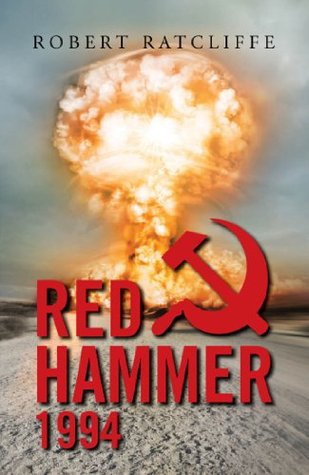
Robert Ratcliffe’s Red Hammer 1994 is a tale of an alternate nuclear World War III in the early 1990s. The feared regression to authoritarianism takes place in post-1991 Russia, and its leader proceeds to launch a nuclear strike on the west. Cue a big picture, wide-scope look at everything from bombers to silos to submarines to, yes, conference rooms.

The characters feel just like they’re just there to operate military equipment instead of being actual characters. The plot is basically “have a nuclear war that stays mainly counterforce and thus only mauls civilization instead of wrecking it totally, and show every part of it in set pieces”. The grounded and frequently realistic (at least technically) nature of the book is somewhat admirable, but works against it when questionable moments like a giant force of super-Spetsnaz in the continental US emerges-or for that matter, the basic plot happening at all. The ending is incredibly abrupt (and not in a plausible Dr. Strangelove way) and the most positive elements are some of the set pieces themselves.

This is what it is. If you like technical detail and want to see Herman Melville’s Story Of A Moderate Nuclear War, you’ll like this book. But if you want a solid narrative, this isn’t it.

Review: Primary Target

Primary Target

Jim Heskett and Nick Thacker’s Primary Target is not the deepest story, nor does it have the most plausible premise. Basically, circumstances lead to assassin Ember Clarke having to participate in a trial by combat, fighting off other assassins trying to kill her over the course of several weeks.

However, in spite of this setup, it’s well done. Yes, it has the “this isn’t a movie but I do super stuff anyway” gripe I’ve seen far too often, and its premise deserves action far more bizarre and over the top than what actually occurs. But the book remains a solid cloak and dagger thriller.

Granted, I’m not the biggest fan of such novels, but I still like variety. And this is cloak and dagger done very well.

Review: The Weekend Warriors

The Weekend Warriors

Reading James Burke’s The Weekend Warriors means I’ve now read all ten of the alternate history conventional World War III series I’d identified. So how is it?

Telling the story of National Guard soldiers and their families during a 198X Fuldapocalypse, Burke uses some plot devices I’ve thought would have worked, like using fictional unit designations. He also aims for characterization and doesn’t hesitate to show the duller parts of military life. The result is something that tries to be something fuller than just tanks exploding…

…With an emphasis on tries. A lot of the high-level military details are anachronistic and in some cases outright “off”. The most jarring example to me was how the Soviets would focus on NORTHAG (which would be true) and thus do nothing but special forces operations in the American sector at the beginning of the war (which would not be). The action suffers from the same rough prose as the rest of the work and sometimes devolves into listing armaments in full.

Because of this, it comes across as being like a somewhat worse Chieftains-a tale of a conventional World War III that’s ambitious, but erratic and unpolished in execution.

Review: The Man With The Iron Heart

The Man With The Iron Heart

One of my theories about Harry Turtledove is that, for all times he’s been labeled “the master of alternate history”, he never had the most enthusiasm for the genre. It goes like this: Turtledove wanted to write Byzantine/Eastern Roman-themed fantasy, but after Guns of The South, alternate history became the money-making niche that he was stuck in. Turtledove would be neither the first nor last writer to have their most successful fiction be considerably different from the type they actually wanted to write.

Or maybe he did have enthusiasm for the genre, but didn’t have the mindset needed to really take advantage of it. Or maybe the nature of alternate history and needing to appeal to a generalist audience who doesn’t have the most knowledge of history forced him into a corner. Whatever the reason, The Man With The Iron Heart symbolizes the weaknesses of his style vividly.

The plot is simple. Reinhard Heydrich survives, gets the Werwolf resistance movement up and running, and launches a horrifically hamfisted/anachronistic Iraq War analogy. In reality, the German populace at large had no stomach for continued resistance, and the Allies, who came close to turning Germany into a giant farm, were prepared to crack the whip. The Werwolf plan was doomed from the get-go by the scarce resources and infighting that was baked into the Nazi regime from day one.

The execution of the book is done just as clumsily and clunkily as the setup. Much of Turtledove’s writing has the problem of what I frequently call the “technothriller without technology or thrills”, and this is no exception. It uses the “alternate history as a genre format” where there’s a big-picture, broad-viewpoint look at the situation and changed world. However, if the changed world is nothing but an unrealistic and worse, uninteresting analogy, that format is the worst possible.

Alternate history is a very divided genre. There are a lot of reasons for this, from the vague nature of what it even is to the different desires of different fandoms to how it’s frequently not considered advantageous to label a work as such. But that the “mainstream” end often consists of books like this doesn’t help.

Maybe there’d be more overlap if someone really did extensive research, made it more character focused, and kept it feeling substantially different while providing still noticeable but far more subtle commentary. Instead, Turtledove wrote this book, which I do not recommend.